Interesting find on the Invite link
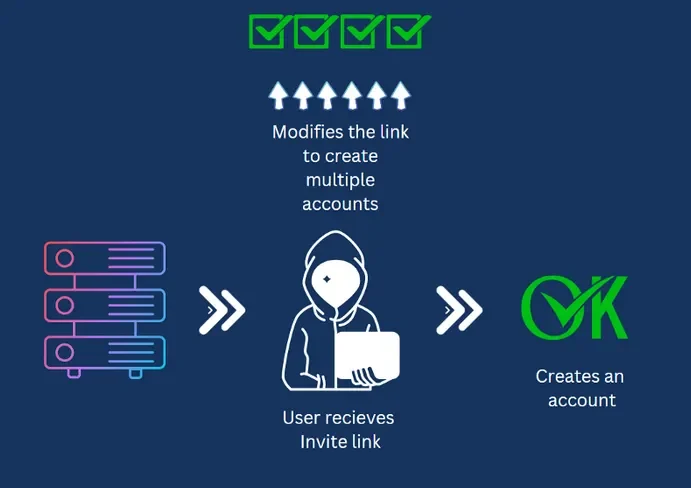
The invitation link contained a base64-encoded parameter holding the user's registration details, which could be decoded and modified to create additional accounts without a new invitation. An attacker could pay for one subscription and generate unlimited accounts by reusing the same link with altered details.

Today I would like to talk about how I found an interesting bug that could create numerate accounts without the need of any subscription. So lets find out more about it.
The full write-up lives on its author's site
It belongs to its author, so we link to it rather than copy it. The other two tabs are our own rewrites, checked against it.
Context
The target is a private program, so its name cannot be disclosed; the author refers to it as redacted.com. The product has a distinctive onboarding model: there is no self-service registration page. Instead, a prospective user requests an account by submitting their details, and the application emails them an invitation link. Opening that link and setting a password completes the account creation.
The feature under examination is therefore the invitation flow itself: the link that is generated after an account request, and the data it carries.
Setup
No special tooling is described beyond the ability to base64-decode and re-encode strings. The precondition is simply that the tester can request an invitation, which requires submitting a first name, a last name and an email ID.
Finding it
The invitation link that arrives by email looks like this:
https://redacted.com/invite=[redacted]=
The link carries a single parameter, invite, whose value is a long base64 string. That single opaque parameter is what drew the author's attention. Decoding the value with base64 revealed the registration data that had been submitted:
{"firstName":"Hackt3r","lastName":"M4ze","loginId":"[redacted]","inviteEmailTemplate":false}
The decoded object contains the first name, last name and login ID (the email address) plus an inviteEmailTemplate flag. On its own, the author notes, this does not look like a serious issue: the data is the requester's own. The interesting question was what happens if those details are changed, re-encoded and used again.
Exploitation
Step 1: Decode the invitation parameter
Take the invite value from the emailed link and base64-decode it. The result is the JSON object shown above, containing firstName, lastName, loginId and inviteEmailTemplate.
Step 2: Modify the decoded details
Change the identity fields in the decoded JSON to those of another person, keeping the same structure.
Step 3: Re-encode and reuse the link
Base64-encode the modified JSON and place it back into the invite parameter, producing a link of the same shape as the original. The author tried this and was able to create another account on behalf of some other person, without having to request a new signup link.
In other words, the invitation link is not bound to the request that produced it: the identity that ends up in the new account is whatever the client puts inside the parameter.
Root cause
The identity data for the invitation is carried in a base64-encoded parameter. Base64 is an encoding, not a signature or a MAC, so anyone holding a link can read and rewrite its contents. The tampered link was accepted, so the server did not reject the modified values. Because the link can be edited, one invitation link was used to create another account.
Impact
The application has no registration page and works on a one-time subscription. As a result, an attacker can pay for one account and then create any number of accounts using the same URL, each with details of their choosing, including another person's. The author reported the vulnerability and says it was a high issue.
Fix
The author suggests several mitigations:
- Use a specially crafted token instead of an
inviteparameter. - Hide the user's details in the invite link.
- Make sure the link expires once it has been used.
Variants to test
- Decode every opaque parameter. Base64-decode invitation, reset and verification parameters. A positive result is readable JSON or structured data containing identity fields.
- Tamper with identity fields. Change names or email addresses in the decoded data, re-encode and submit. A positive result is an account created with the modified identity.
- Replay a used link. Complete signup with one link, then try it again. A positive result is a second account from the same link.
- Reuse one link for many accounts. Request a single invitation and create multiple accounts from it. A positive result is more accounts than invitations issued.
- Check for signatures. If the parameter is signed, alter one byte and resubmit. A positive result is acceptance of a modified, unsigned value.
What happened, in plain words
Imagine a club that has no front desk where you can sign up. Instead, you fill in a form with your name and email, and the club emails you a personal invitation card. You show the card at the door, choose a password, and you are in.
That invitation card is the thing this report is about. The card is not a physical card but a web link, and the link contains your details written in a form of text that anyone can read and change. The author of the report noticed this, changed the details inside the link, and found they could use the same link to create more accounts, including accounts in someone else's name, without asking for a new invitation.
The report calls the target redacted.com because it is a private program and the name cannot be disclosed. The weakness is a logic flaw: the application follows its own rules correctly, but the rules themselves allow something they should not.
Before going further, a few words on the ideas involved.
- A web link (URL) is the address you type or click in a browser. Everything after the
?in an address is called the query string, and it is made of parameters, which are name and value pairs. Inhttps://example.com/page?colour=blue, the parameter iscolourand its value isblue. - Base64 is a way of writing data using only letters, digits and a couple of symbols. It is not encryption and it is not a secret code. It is more like writing a sentence in a different alphabet: anyone who knows the alphabet can read it back. Its purpose is to let computers carry data safely through places that only accept plain text characters.
- JSON is a simple text format for structured data, made of names and values in curly braces, such as
{"name":"Alex"}. It is how many applications pass information around. - A token is a short piece of data that stands in for something else, like a cloakroom ticket that stands for your coat. In security, a token is often a value the server creates and can later check, so that a client cannot simply make up a new one.
- A subscription is a paid plan that gives access for a period of time. Here the application works on a one-time subscription, meaning you pay once for an account.
The product and the feature
The application has an unusual way of letting people in. There is no registration page at all. You cannot simply go to a sign-up form and create an account yourself. Instead you request an account by giving your details: first name, last name and email ID. The application then sends you an invitation link by email. You open that link, set a password, and your account is ready.
So the feature under examination is the invitation flow: the link that is generated after an account request, and the information that link carries.
How the author found it
The author requested an invitation and received a link by email. It looked like this:
https://redacted.com/invite=[redacted]=
Line by line, in plain words:
https://is the usual prefix for a secure web address.redacted.comis the placeholder name for the application's domain./invite=is the path plus a single parameter calledinvite. Notice there is no?and no second name: the whole thing hangs on one parameter.- The long string after the equals sign is the value of that parameter. It is made of letters, digits and ends with
=, which is typical of base64.
That single, unreadable-looking parameter is what caught the author's attention. A link that carries a long blob of text is worth a closer look, because the blob may contain information the application trusts.
Decoding the link
The author decoded the value using base64. The result was this:
{"firstName":"Hackt3r","lastName":"M4ze","loginId":"[redacted]","inviteEmailTemplate":false}
Line by line:
- The outer curly braces
{and}mark the start and end of a JSON object, a bundle of named values. "firstName":"Hackt3r"is the first name that was submitted when requesting the account."lastName":"M4ze"is the last name."loginId":"[redacted]"is the email address used as the login identifier."inviteEmailTemplate":falseis a flag, a simple true or false setting, related to the invitation email template.
In other words, the details the author had typed into the account request were sitting inside the link, readable by anyone who knows base64. The author's first reaction was that this alone did not seem like a big issue, because the data was the author's own. The real question was different: what happens if those details are changed, encoded again, and used for another account?
Trying the change
The author changed the identity details in the decoded JSON, encoded the result back into base64, and put it back into the invite parameter, producing a link of the same shape as the original. The author then tried it, and was able to create another account on behalf of some other person, without having to request a new signup link.
Why does this matter? Because the invitation link is not tied to the request that produced it. The identity that ends up in the new account is simply whatever the person holding the link puts inside the parameter. The tampered link was accepted, so the modified values were not rejected.
This is the heart of the flaw. The identity data for the invitation is carried in the link itself. Base64 is an encoding, not a signature or a MAC. A signature or MAC (message authentication code) is a value computed with a secret key that lets the server verify that data has not been altered. Without one, anyone holding a link can read its contents and rewrite them.
Why it was rated high
On a normal application this might not be a huge vulnerability. But this application has no registration page and works on a one-time subscription. That combination changes the impact: an attacker can pay for one account and then create any number of accounts with the same URL, each with details of their choosing, including another person's. The author reported the vulnerability and says it was a high issue.
How to prevent it
The author suggests several mitigations:
- Use a specially crafted token instead of an
inviteparameter. A token made and checked by the server cannot be edited by the person holding the link. - Hide the user's details in the invite link, so the link does not carry readable identity information.
- Make sure the link expires once it has been used, so a single invitation cannot be replayed.
What to look for in other applications
The author's approach can be repeated elsewhere. These are the checks worth trying:
- Decode every opaque parameter. Take invitation, password reset and email verification parameters and base64-decode them. A positive result is readable JSON or structured data containing identity fields.
- Tamper with identity fields. Change names or email addresses in the decoded data, re-encode and submit. A positive result is an account created with the modified identity.
- Replay a used link. Complete signup with one link, then try the same link again. A positive result is a second account from the same link.
- Reuse one link for many accounts. Request a single invitation and create multiple accounts from it. A positive result is more accounts than invitations issued.
- Check for signatures. If the parameter is signed, alter one byte and resubmit. A positive result is acceptance of a modified, unsigned value.
Glossary
- Base64: a way of writing data using letters, digits and a few symbols so it can travel safely as plain text. It is not encryption; anyone can decode it.
- Client side: happening in the browser or on the user's machine, as opposed to the server.
- Encoding: converting data into another representation, without hiding it.
- Flag: a simple true or false setting in data.
- Invitation flow: the sequence of steps from requesting an account to receiving a link and setting a password.
- JSON: a text format for structured data made of names and values in curly braces.
- Logic flaw: a weakness where the application follows its own rules but those rules allow something harmful.
- MAC (message authentication code): a value computed with a secret key that lets the server check data has not been altered.
- Parameter: a name and value pair in a web address, usually after the
?. - Query string: the part of a web address after the
?, made of parameters. - Replay: sending the same request or link again to see whether it is accepted a second time.
- Signature: a value that lets the server verify data has not been changed, usually computed with a secret key.
- Subscription: a paid plan that gives access for a period of time; here a one-time payment for an account.
- Tamper: to change data on purpose before sending it.
- Token: a piece of data that stands in for something else and is normally created and checked by the server.
- URL: the address of a page or resource on the web.




