Is It Possible to Get an $850 Subscription Plan With Only $0?
The billing endpoint accepted any subscriptionId supplied by the client, including hidden plans not shown in the UI, and activated the subscription even when the payment was not funded. An authenticated user could obtain an expensive premium plan for free.

Bug Bounty
The full write-up lives on its author's site
It belongs to its author, so we link to it rather than copy it. The other two tabs are our own rewrites, checked against it.
Context
The target is a web application that sells subscription plans. Users pick a plan in the UI and are sent into a Stripe checkout flow to pay for it. The billing feature is the part that matters here: the front end lists the plans, and the back end creates a Stripe payment session for the plan the user selected.
The write-up is by 0xMo7areb and describes a payment bypass in that billing flow. The UI exposed around 8 subscription plans. The back end, however, accepted subscription identifiers that were never shown to the user, and at least one of those hidden plans was worth approximately $850. By choosing a hidden identifier and then letting the payment fail, the researcher ended up with an active premium subscription.

Setup
The report describes a normal, authenticated user account. No special role or privilege is mentioned. The tools used were Burp Suite, specifically Burp Intruder for enumerating identifiers, and a Bybit account with a zero balance to take the checkout through to a payment that could not be funded.
No software versions, endpoint hostnames or account details beyond that are given.
Finding it
While testing the billing flow, the researcher noticed that the request which starts a payment session carries a subscriptionId parameter. The UI showed around 8 plans, which raised the obvious question of whether those were really the only plans the back end knew about.
The request that creates the payment session looked like this:
POST /en/user/billing/payment/stripe/init HTTP/2Content-Type: application/x-www-form-urlencoded
subscriptionId=25
The body is a single form field, subscriptionId, and the value is a plain number. The body is a single form field, subscriptionId, and the value is a plain number, which made it worth manipulating.
Exploitation
Step 1: enumerate the identifier
The researcher sent the request to Burp Intruder and tested numeric values in the range:
1234...2000
Many of the identifiers returned valid checkout sessions. The report notes that a lot of the discovered IDs returned full premium plans for $0, and uses subscriptionId=1041 purely as an example to demonstrate the issue.
Step 2: confirm a hidden plan is accepted
Sending:
subscriptionId=1041
returned:
{ "status": "ok", "message": { "redirectUrl": null, "publicKey": "pk_live_...", "sessionId": "cs_live_..." }}
The response is a successful status with a Stripe publishable key and a checkout session identifier, for an identifier the UI never offered. The UI showed around 8 plans; the back end was issuing sessions for other identifiers without complaint.
During testing the researcher found around 60 valid IDs. Many of them returned full subscription plans for $0, while others gave access to plans with large discounts. Among them was a high-tier plan worth approximately $850.
Step 3: take the $850 plan through checkout without funds
The researcher continued the payment flow for the hidden $850 plan using a Bybit account with a zero balance. The payment could not be funded, so it should have failed and no subscription should have been created.
Instead, the premium subscription became active. At that point the issue was no longer just hidden identifiers being reachable: it was a payment bypass.
Step 4: reproduce from scratch
The report gives the proof of concept as a numbered sequence:
- Create a normal account.
- Open the subscription page and notice that only around 8 plans are displayed.
- Intercept:
POST /en/user/billing/payment/stripe/init HTTP/2.....subscriptionId=25
- Send the request to Burp Intruder.
- Test different
subscriptionIdvalues (from 1 to 2000). - Find valid IDs that are not exposed in the UI.
- Select the hidden subscription worth approximately $850.
- Continue the checkout using a Bybit account with insufficient funds.
- The payment is not legitimately funded.
- The subscription is still activated and premium features become available.
Root cause
The back end trusted a client-supplied subscriptionId when creating the payment session, and it accepted identifiers that were not part of the set offered in the UI. The report does not show the server-side code, so the exact mechanism is not stated. What the behaviour implies is that the identifier was used to look up a plan and start a session without checking that the plan was one the user was allowed to buy, and that the subscription was activated even though the payment was never funded.
The expected behaviour, as the report puts it, is:
Payment fails ↓No subscription
What happened instead was:
Hidden subscription ↓$850 plan ↓$0 balance ↓ Premium access
The UI only ever offered around 8 plans, yet the back end accepted other identifiers. The report does not show the server-side code, so whether any such checks existed is not stated.
Impact
The report frames the impact as direct financial loss for the company. An attacker could, in the researcher's words:
- Activate expensive subscriptions for free.
- Access premium functionality without payment.
- Abuse hidden subscription plans.
- Consume paid resources and limits.
- Repeatedly abuse the billing flow.
The hidden identifiers could also expose old, internal, discounted, or otherwise unavailable subscription configurations.
Fix
Based on the behaviour described, the back end should validate the submitted subscriptionId against the plans that are actually purchasable and authorised for that user, rather than trusting the value from the request, and it should only activate a subscription once the payment has been confirmed as settled. Which of these was implemented is not stated.
Report status
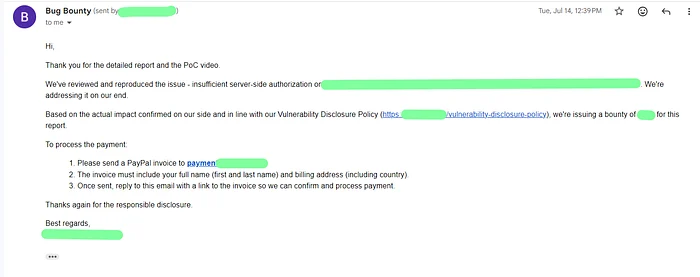
The vulnerability was accepted and the researcher received a bounty for it.
Variants to test
- Identifier enumeration on other billing endpoints. Send the payment-initialisation request with identifiers outside the range the UI offers, for example a small set of low and high numbers. A positive result is a successful response containing a checkout session for a plan that is not listed in the interface.
- Price or plan fields in the request body. Look for other client-supplied fields that select what is being bought, such as a plan name, tier or amount, and change them. A positive result is a session created for a different plan or price than the one selected.
- Activation before settlement. Complete checkout with a payment method that cannot be funded, or abandon the payment page after the session is created, then check the account. A positive result is premium access without a completed payment.
- Hidden or legacy plan identifiers. Try identifiers that look like old, internal or discounted configurations. A positive result is a valid session for a plan that is no longer sold or was never meant to be public.

What happened, in plain words
A website sold subscription plans: you pick a plan in the page, you pay, and your account gets premium features. The page showed about 8 plans. But the part of the website that actually creates the payment (the back end) accepted plan numbers that the page never showed. One of those hidden plans was worth about $850. The researcher picked a hidden plan number, went to pay with an account that had no money in it, the payment could not go through, and the premium subscription still switched on. That is a payment bypass: getting the paid product without paying.
The write-up is by 0xMo7areb. The report does not give software versions, hostnames or account details.
The words you need first
Before the steps, a few ideas that come up constantly.
- Front end and back end. The front end is what your browser shows you: buttons, pages, the list of plans. The back end is the computer at the company that does the real work: it checks who you are, creates payment sessions, and switches subscriptions on. A useful comparison is a restaurant: the menu is the front end, the kitchen is the back end. You can cross out a price on your menu at home, but the kitchen still charges what its own system says.
- Request. Every time you click something, your browser sends a message to the back end asking it to do something, and the back end sends a reply. That message is a request. Tools like Burp Suite let you pause a request, look at it, change it, and send it again.
- Parameter. A request often carries small named values, like
subscriptionId=25. The name is the parameter, the value is what you send. If the back end trusts that value without checking it, you can change it. - API. The back end's set of doors that requests go through. Each door has an address (a URL) and expects certain values. Here the door is the one that starts a Stripe payment.
- Stripe. A payment company that websites use so they do not have to handle card details themselves. The website asks Stripe to create a checkout session, and Stripe handles the actual payment page.
- Session identifier. A short code that names one specific checkout attempt, so the website and Stripe can talk about the same thing later.
- Publishable key. A public identifier for a Stripe account. It is meant to be visible in pages, so seeing one in a response is not itself a secret leak.
- Enumeration. Trying a series of values one after another (1, 2, 3, ...) to see which ones the back end accepts. Like trying every key on a keyring to see which doors open.
- Burp Intruder. A part of Burp Suite that sends the same request many times, each time with a different value in one spot. It automates the keyring test.
- Payment bypass. Making the system give you the paid result without a successful payment.
- Authenticated user. Someone logged in with a normal account. No special admin rights are involved here.
Setup
The researcher used a normal logged-in account. The tools were Burp Suite, with its Intruder feature for trying many plan numbers, and a Bybit account with a zero balance. Bybit is a cryptocurrency exchange, so the checkout could be taken all the way to a payment that could not possibly be funded. That last part matters: the point was to prove the subscription activates even when no money arrives.
Finding it
While going through the billing flow, the researcher noticed that the request which starts a payment carries a parameter called subscriptionId. The page showed around 8 plans. That raised the obvious question: are those really the only plans the back end knows about?
The request that creates the payment session looked like this:
POST /en/user/billing/payment/stripe/init HTTP/2Content-Type: application/x-www-form-urlencoded
subscriptionId=25
Line by line:
POSTis the kind of request used to send data to the back end and ask it to create something. Here, create a payment session./en/user/billing/payment/stripe/initis the address of that door.initsuggests it initialises, that is, starts, a Stripe payment.HTTP/2is the version of the web protocol used for the conversation.Content-Type: application/x-www-form-urlencodedsays the body is formatted like a simple web form, the same format a login form uses.subscriptionId=25is the body: one field, namedsubscriptionId, with the value25. It is a plain number.
The body carries only a plain number, which a tool can change to any value. The browser sends whatever number it was given, and a tool can send any number at all. That is what made it worth changing.
Exploitation
Step 1: try many plan numbers
The request went into Burp Intruder, with the number as the part to vary. The values tested were in the range:
1234...2000
This means numbers from 1234 up to 2000. Intruder sends the request once per number and collects the replies, so you can see which numbers produce a real answer instead of an error. Many of them did. The report notes that a lot of the discovered IDs returned full premium plans for $0, and uses subscriptionId=1041 only as an example to show the issue.
Step 2: confirm a hidden plan is accepted
Sending:
subscriptionId=1041
returned:
{ "status": "ok", "message": { "redirectUrl": null, "publicKey": "pk_live_...", "sessionId": "cs_live_..." }}
Line by line:
"status": "ok"means the back end treated the request as valid. It did not reject the number."redirectUrl": nullis where the browser would be sent next. Here it is empty."publicKey": "pk_live_..."is the Stripe publishable key. Thepk_live_prefix indicates a live Stripe account rather than a test one. The rest is shortened in the report."sessionId": "cs_live_..."is the identifier of a real checkout session that Stripe created. Again shortened in the report.
So the back end returned a successful response with a checkout session for a number the page never offered. The page showed around 8 plans; the back end was handing out sessions for other numbers without complaint. The page showed around 8 plans, but the back end accepted other numbers.
During testing the researcher found around 60 valid IDs. Many returned full subscription plans for $0, while others gave access to plans with large discounts. Among them was a high-tier plan worth approximately $850.
Step 3: take the $850 plan through checkout with no money
The researcher continued the payment flow for the hidden $850 plan, using a Bybit account with a zero balance. The payment could not be funded, so it should have failed, and no subscription should have been created.
Instead, the premium subscription became active. At that point the issue was no longer just hidden plan numbers being reachable. It was a payment bypass.
Step 4: reproduce it from scratch
The report gives the proof of concept as a numbered sequence:
- Create a normal account.
- Open the subscription page and notice that only around 8 plans are displayed.
- Intercept:
POST /en/user/billing/payment/stripe/init HTTP/2.....subscriptionId=25
- Send the request to Burp Intruder.
- Test different
subscriptionIdvalues (from 1 to 2000). - Find valid IDs that are not exposed in the UI.
- Select the hidden subscription worth approximately $850.
- Continue the checkout using a Bybit account with insufficient funds.
- The payment is not legitimately funded.
- The subscription is still activated and premium features become available.
Step 3 is the same request as before, written on one line with the body attached. "Intercept" means Burp catches the request on its way out of the browser so you can read and edit it before it reaches the back end.
Result
The expected behaviour, as the report puts it, is:
Payment fails ↓No subscription
What happened instead was:
Hidden subscription ↓$850 plan ↓$0 balance ↓ Premium access
In plain words: a logged-in user could obtain an expensive premium subscription without successfully paying for it.
Why it worked
The back end trusted a plan number supplied by the browser when creating the payment session, and it accepted numbers that were not part of the set offered in the page. The report does not show the server-side code, so the exact mechanism is not stated. What the behaviour implies is that the number was used to look up a plan and start a session without checking that the plan was one the user was allowed to buy, and that the subscription was switched on even though the payment was never funded.
The page only ever offered around 8 plans, yet the back end accepted other numbers.
Impact
The report frames the impact as direct financial loss for the company. An attacker could, in the researcher's words:
- Activate expensive subscriptions for free.
- Access premium functionality without payment.
- Abuse hidden subscription plans.
- Consume paid resources and limits.
- Repeatedly abuse the billing flow.
The hidden numbers could also expose old, internal, discounted, or otherwise unavailable subscription configurations. The conditions are a logged-in account and the ability to send the billing request directly.
Fix
Based on the behaviour described, the back end should check the submitted subscriptionId against the plans that are actually purchasable and authorised for that user, rather than trusting the value from the request, and it should only activate a subscription once the payment has been confirmed as settled. Which of these was implemented is not stated.
Report status
The vulnerability was accepted and the researcher received a bounty for it.
Variants to test
- Plan-number enumeration on other billing endpoints. Send the payment-initialisation request with numbers outside the range the page offers, for example a small set of low and high numbers. A positive result is a successful response containing a checkout session for a plan that is not listed in the interface.
- Price or plan fields in the request body. Look for other fields supplied by the browser that select what is being bought, such as a plan name, tier or amount, and change them. A positive result is a session created for a different plan or price than the one selected.
- Activation before settlement. Complete checkout with a payment method that cannot be funded, or abandon the payment page after the session is created, then check the account. A positive result is premium access without a completed payment.
- Hidden or legacy plan numbers. Try numbers that look like old, internal or discounted configurations. A positive result is a valid session for a plan that is no longer sold or was never meant to be public.
Glossary
- API: the set of addresses and rules a back end exposes so that browsers and other programs can ask it to do things.
- Authenticated user: someone who has logged in with an account.
- Back end: the company's servers that do the real work, such as checking accounts and creating payments.
- Burp Intruder: a Burp Suite tool that repeats one request many times, each time with a different value in a chosen spot.
- Burp Suite: a tool that sits between your browser and a website so you can read, pause and edit requests.
- Bybit: a cryptocurrency exchange, used here as a payment account with a zero balance.
- Checkout session: a single payment attempt created at Stripe, identified by a session identifier.
- Content-Type: a header that says what format the body of a request is in.
- Enumeration: trying a series of values to discover which ones the back end accepts.
- Front end: the part of a website your browser displays and you interact with.
- HTTP/2: a version of the protocol browsers and servers use to exchange requests and responses.
- Intercept: to catch a request on its way out of the browser so it can be inspected or changed before it is sent.
- Parameter: a named value carried in a request, such as
subscriptionId=25. - Payment bypass: obtaining the paid result of a system without a successful payment.
- POST: a request type used to send data to the back end and ask it to create or change something.
- Premium features: the extra functionality a paid subscription unlocks.
- Proof of concept (POC): a numbered set of steps that lets someone else reproduce the issue.
- Publishable key: a public Stripe identifier meant to be visible in pages; the
pk_live_prefix indicates a live account. - Request: a message your browser sends to a back end asking it to do something.
- Response: the back end's reply to a request.
- Root cause: the underlying reason a vulnerability exists, as opposed to its visible symptom.
- Session identifier: a short code naming one specific checkout attempt.
- Stripe: a payment company websites use to handle checkout and card or crypto payments.
- Subscription: a recurring paid plan that unlocks features on an account.
subscriptionId: the parameter naming which plan the payment session is for.- UI (user interface): what the user sees and clicks, here the page listing the plans.
- Vulnerability: a weakness in a system that lets someone make it behave in a way its owners did not intend.




