Multiple vulnerabilities in Eclipse ThreadX
 Published on security.humanativaspa.it
Azure RTOS was Microsoft’s real-time operating system for IoT devices. At the beginning of 2024, Microsoft contributed the Azure RTOS technology to the Eclipse Foundation.
The full write-up lives on its author's site
It belongs to its author, so we link to it rather than copy it. The other two tabs are our own rewrites, checked against it.
Context
Azure RTOS was Microsoft's real-time operating system for IoT devices. At the beginning of 2024, Microsoft contributed the Azure RTOS technology to the Eclipse Foundation, where it was rebranded as Eclipse ThreadX. Eclipse ThreadX is an advanced embedded development suite including a small but powerful operating system that provides reliable, ultra-fast performance for resource-constrained devices. It offers a vendor-neutral, open source, safety certified OS for real-time applications, all under a permissive licence.
The source code is hosted on GitHub under the eclipse-threadx organisation. This review covered that codebase and identified multiple security vulnerabilities that may cause memory corruption, with impacts ranging from denial of service to potential arbitrary code execution. The detailed advisory is published at https://github.com/hnsecurity/vulns/blob/main/HNS-2024-06-threadx.txt.
Setup
This was a source code review, not a live-target engagement, so there were no accounts, roles or deployed instances involved. The work continued a series of vulnerability research efforts in the IoT space, aimed at assisting open-source projects in finding and fixing security vulnerabilities by reviewing their source code. In December 2023, Azure RTOS, which one month later was rebranded as Eclipse ThreadX, was selected as a target of interest.
Two tools were used to identify hotspots in the code on which to focus attention:
- A Semgrep C/C++ ruleset.
- A weggli pattern collection.
The author also shared a general SAST workflow in the article:
How to SAST:
- Use @semgrep
- Get extra rules from @0xdea and @trailofbits
- Output SARIF and use @trailofbits sarif explorer VSCode extension
- Tune out noise and don't send your devs 100k untriaged findings
Finding it
The review produced 8 bugs across 4 repositories. The resulting vulnerabilities are:
- CVE-2024-2214: ineffective array size check and static buffer overflow in Eclipse ThreadX (GHSA-vmp6-qhp9-r66x).
- CVE-2024-2212: integer wraparounds, under-allocations, and heap buffer overflows in Eclipse ThreadX (GHSA-v9jj-7qjg-h6g6).
- CVE-2024-2452: integer wraparound, under-allocation, and heap buffer overflow in Eclipse ThreadX NetX Duo (GHSA-h963-7vhw-8rpx).
- Other bugs with potential security implications in Eclipse ThreadX NetX Duo and USBX.
For additional information about these vulnerabilities and their fixes, the detailed advisory is the reference. The code review itself took about 24 hours, with an additional 24 hours spent in the disclosure process, which got complicated due to the ongoing project ownership transfer.
Exploitation
The article does not walk through exploitation steps, requests or payloads. It reports the vulnerabilities at the level of their class and impact, and points to the advisory for the technical detail. What can be said from the article itself is the shape of each confirmed issue:
Step 1: array size check and static buffer overflow (CVE-2024-2214)
An ineffective array size check leads to a static buffer overflow in Eclipse ThreadX.
Step 2: integer wraparounds and heap overflows (CVE-2024-2212)
Integer wraparounds lead to under-allocations, which in turn produce heap buffer overflows in Eclipse ThreadX.
Step 3: integer wraparound and heap overflow in NetX Duo (CVE-2024-2452)
The same pattern appears in Eclipse ThreadX NetX Duo: an integer wraparound causes an under-allocation and a heap buffer overflow.
Step 4: further bugs in NetX Duo and USBX
Additional bugs with potential security implications were found in Eclipse ThreadX NetX Duo and USBX.
Root cause
The common thread across the confirmed CVEs is arithmetic and bounds checking that does not hold under adversarial input: an array size check that is ineffective, and integer wraparounds that make an allocation smaller than the subsequent write.
Impact
The impacts range from denial of service to potential arbitrary code execution. The article does not assign severity scores or CVSS ratings to the individual issues.
Fix
Eclipse ThreadX maintainers have fixed all vulnerabilities discussed in the article. MSRC confirmed that three vulnerabilities were fixed in version 6.4 (on 2024-01-05, 2024-01-10 and 2024-02-27). The remaining reports were agreed to be declassified to standard issues on 2024-04-26. Readers should check the official Eclipse ThreadX channels for further information about fixes.
The disclosure timeline, in the author's simplified form:
- 2023-12-01: Reported two vulnerabilities to MSRC.
- 2023-12-13: MSRC confirmed the first vulnerability.
- 2023-12-14: MSRC confirmed the second vulnerability.
- 2023-12-21: Reported two more vulnerabilities to MSRC.
- 2023-12-31: Reported another vulnerability to MSRC.
- 2024-01-02: Reported three more vulnerabilities to MSRC.
- 2024-01-05: MSRC confirmed a vulnerability was fixed in version 6.4.
- 2024-01-06: MSRC informed the author of making the 2023 Q4 leaderboard.
- 2024-01-10: MSRC confirmed another vulnerability was fixed in version 6.4.
- 2024-02-10: Asked MSRC for updates on all open reports.
- 2024-02-16: Asked the Eclipse Foundation for advice on how to proceed.
- 2024-02-20: Eclipse replied they were coordinating with MSRC.
- 2024-02-21: MSRC informed the author of the ownership transfer to Eclipse.
- 2024-02-27: MSRC confirmed a third vulnerability was fixed in version 6.4.
- 2024-02-28: Upon MSRC's request, the reports were submitted to Eclipse.
- 2024-03-05: Eclipse started creating GitHub advisories for all reports.
- 2024-03-13: Provided Eclipse with clarifications on some of the reports.
- 2024-03-15: MSRC provided additional feedback on the transition.
- 2024-03-18: Eclipse finished creating GitHub advisories for all reports.
- 2024-03-22: MSRC closed the remaining cases after the transition.
- 2024-03-25: Eclipse published CVE-2024-2212, CVE-2024-2214 and CVE-2024-2452.
- 2024-03-29: Provided Eclipse with clarifications on remaining reports.
- 2024-04-24: Asked for a status update on the remaining reports.
- 2024-04-26: Agreed to declass the remaining reports to standard issues.
- 2024-05-02: Sent draft advisory and writeup to MSRC and Eclipse.
- 2024-05-28: Published advisory and writeup.
For the reporting effort, the author was awarded 7th place in the Top MSRC 2023 Q4 Azure Security Researchers Leaderboard.
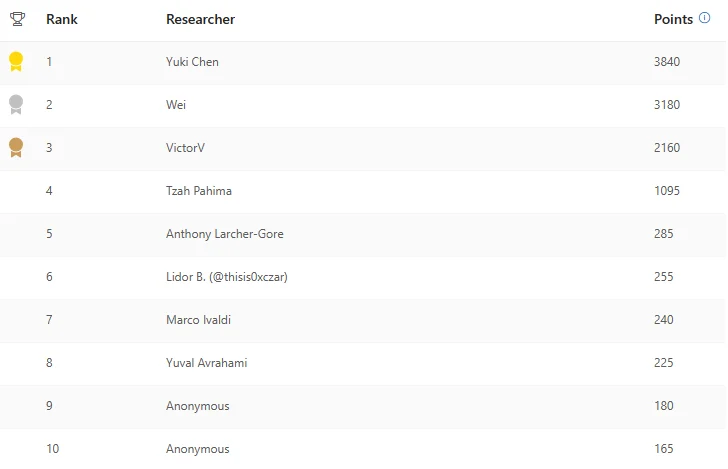
The image shows the Researcher Portal Azure Leaderboard rankings, captioned by the author as a thank-you to the Academy.
Variants to test
- Array size checks that compare against the wrong bound. Look for length checks that use a signed or truncated value, or that check one field while the copy uses another. A positive result is a write past the end of a static buffer with attacker-influenced length or content.
- Integer wraparound before allocation. Trace every size computation that multiplies or adds a length before an allocation, then compare it with the length used by the subsequent copy. A positive result is an allocation smaller than the data written into it, giving a heap overflow.
- Under-allocation in packet parsing paths. In network stacks such as NetX Duo, feed lengths near the integer boundary and watch for allocations that do not match the parsed length. A positive result is memory corruption reachable from network input.
- USB and device-class parsing. In components such as USBX, exercise descriptor and control-transfer parsing with inconsistent length fields. A positive result is an out-of-bounds read or write driven by device-supplied data.
- Run the same Semgrep and weggli rulesets over sibling repositories in the same organisation, since the same idioms tend to recur across components.
Acknowledgments
The author thanks MSRC and the Eclipse Foundation, with a special mention to Marta Rybczynska, who took care of coordinated disclosure after the project ownership change, for triaging and fixing the reported vulnerabilities.
What happened, in plain words
A security researcher spent about a day reading the source code of a small operating system called Eclipse ThreadX, which runs on tiny internet-connected devices. Reading code, rather than attacking a live website, is a common way to find bugs in software that is given away for free. He found eight bugs spread across four code repositories. Three of them received a CVE, and the remaining reports were later declassified to standard issues. The bugs can make a device crash, and in the worst case could let an attacker run their own code on it. The maintainers fixed all the vulnerabilities discussed, and the researcher published the details on 2024-05-28.
This article walks through the same story for someone who has never done security work: what the product is, how the review was done, what each bug class means, and how the reports were handled while the project changed owner.
Background: what Eclipse ThreadX is
Azure RTOS was Microsoft's real-time operating system for IoT devices. A few terms need unpacking first.
- An operating system (OS) is the software that sits between the hardware and the programs you run. On your laptop it manages windows and files; on a tiny device it mostly manages memory and timing.
- Real-time means the system must respond within a guaranteed, very short time. Think of a car's airbag controller: a late answer is as bad as no answer.
- IoT stands for Internet of Things: everyday devices with a small computer inside and a network connection, such as sensors, meters, cameras or industrial controllers.
- Embedded means the computer is built into a product rather than being a general-purpose PC.
- Resource-constrained means very little memory and processing power, often kilobytes rather than gigabytes.
- Open source means the source code, the human-readable instructions that make up the program, is published for anyone to read and reuse.
At the beginning of 2024, Microsoft contributed the Azure RTOS technology to the Eclipse Foundation, a non-profit that hosts open-source projects. With the move, the product was rebranded as Eclipse ThreadX. Eclipse ThreadX is an advanced embedded development suite including a small but powerful operating system that provides reliable, ultra-fast performance for resource-constrained devices. It offers a vendor-neutral, open source, safety certified OS for real-time applications, all under a permissive licence.
A permissive licence means you may use the code in your own products with few conditions. Vendor-neutral means it is not tied to one hardware maker. Safety certified means it has been assessed against formal safety standards, which matters for products such as medical or automotive equipment.
The source code is hosted on GitHub under the eclipse-threadx organisation. GitHub is a website where code projects live publicly, with a history of every change. An organisation there is simply a grouping of related repositories. A repository (repo) is one project's folder of code plus its history.
Setup: how the review was done
This was a source code review, not a live-target engagement. In other words, nobody pointed the researcher at a running server and said "break in". There were no accounts, roles or deployed instances involved. He reviewed the source code hosted on GitHub.
The work continued a series of vulnerability research efforts in the IoT space, aimed at assisting open-source projects in finding and fixing security vulnerabilities by reviewing their source code. In December 2023, Azure RTOS, which one month later was rebranded as Eclipse ThreadX, was selected as a target of interest.
Why read code instead of probing a running device? If you can read the instructions, you can spot the places where they go wrong without ever touching real hardware.
Two tools were used to identify hotspots in the code on which to focus attention:
- A Semgrep C/C++ ruleset.
- A weggli pattern collection.
C and C++ are programming languages commonly used for operating systems because they are fast and give fine control over memory. That control is also why mistakes in them can be dangerous.
Semgrep is a tool that searches source code for patterns. You describe a suspicious shape, such as "a length check followed by a copy", and it lists every place that matches. A ruleset is a collection of such patterns. weggli does a similar job with a different style of pattern language. Both are SAST tools: Static Application Security Testing, meaning analysis of code without running it. The everyday comparison is a proofreader who scans a manuscript for repeated grammar mistakes rather than reading it for the story.
The author also shared a general SAST workflow in the article:
How to SAST:
- Use @semgrep
- Get extra rules from @0xdea and @trailofbits
- Output SARIF and use @trailofbits sarif explorer VSCode extension
- Tune out noise and don't send your devs 100k untriaged findings
Line by line:
- Run Semgrep over the code.
- Add rules written by other researchers, because a shared library of patterns catches more than your own.
- SARIF is a standard file format for tool findings. VSCode is a popular code editor, and an extension adds features to it. The extension lets you click through findings inside the editor.
- Tune out noise: most matches are harmless, and a report of 100,000 unchecked results is useless. Untriaged means nobody has yet decided whether each one is real. The point is to hand developers a short, verified list.
Finding it: the bugs
The review produced 8 bugs across 4 repositories. The resulting vulnerabilities are:
- CVE-2024-2214: ineffective array size check and static buffer overflow in Eclipse ThreadX (GHSA-vmp6-qhp9-r66x).
- CVE-2024-2212: integer wraparounds, under-allocations, and heap buffer overflows in Eclipse ThreadX (GHSA-v9jj-7qjg-h6g6).
- CVE-2024-2452: integer wraparound, under-allocation, and heap buffer overflow in Eclipse ThreadX NetX Duo (GHSA-h963-7vhw-8rpx).
- Other bugs with potential security implications in Eclipse ThreadX NetX Duo and USBX.
Some of those terms need explaining.
- A CVE (Common Vulnerabilities and Exposures) is a public catalogue number for a known security flaw, so everyone can refer to the same bug unambiguously.
- A GHSA is GitHub's own advisory identifier, used on the project's GitHub page.
- NetX Duo is the networking component of the suite: the part that handles internet traffic.
- USBX is the component that handles USB devices.
- A buffer is a reserved block of memory used to hold data, like a labelled box.
- A buffer overflow means writing more data into that box than it can hold, so the extra spills into neighbouring memory. That is memory corruption: data that other parts of the program rely on gets overwritten.
- Static memory is reserved for the whole life of the program; heap memory is handed out on request while the program runs.
- An integer wraparound happens when a number gets too big for its fixed-size container and rolls over, much like a car odometer going from 99999 back to 00000. A size that was meant to be large becomes small.
- Under-allocation means reserving a box smaller than the data that will later be put in it.
For additional information about these vulnerabilities and their fixes, the detailed advisory is the reference. The code review itself took about 24 hours, with an additional 24 hours spent in the disclosure process, which got complicated due to the ongoing project ownership transfer.
Disclosure is the process of telling the people who maintain software about a bug privately, giving them time to fix it, and only then telling the public.
Exploitation: what each bug looks like
The article does not walk through exploitation steps, requests or payloads. It reports the vulnerabilities at the level of their class and impact, and points to the advisory for the technical detail. What can be said from the article itself is the shape of each confirmed issue:
Step 1: array size check and static buffer overflow (CVE-2024-2214)
An ineffective array size check leads to a static buffer overflow in Eclipse ThreadX.
An array is a numbered row of slots in memory. A size check is code that asks "is this input short enough for my row?" before copying it in. If the check is written wrongly, it answers yes when it should say no, and the copy spills over. The everyday comparison is a bouncer who checks the wrong list and lets in more people than the room holds.
Step 2: integer wraparounds and heap overflows (CVE-2024-2212)
Integer wraparounds lead to under-allocations, which in turn produce heap buffer overflows in Eclipse ThreadX.
In plain terms: the program calculates how much memory to reserve using arithmetic that can roll over. It reserves a small box, then copies a large amount of data into it, and the excess lands in neighbouring heap memory.
Step 3: integer wraparound and heap overflow in NetX Duo (CVE-2024-2452)
The same pattern appears in Eclipse ThreadX NetX Duo: an integer wraparound causes an under-allocation and a heap buffer overflow.
Step 4: further bugs in NetX Duo and USBX
Additional bugs with potential security implications were found in Eclipse ThreadX NetX Duo and USBX. Declassified here means the maintainers decided to track them as ordinary bug reports, without a security advisory of their own.
Root cause: why these bugs happen
The common thread across the confirmed CVEs is arithmetic and bounds checking that does not hold under adversarial input: an array size check that is ineffective, and integer wraparounds that make an allocation smaller than the subsequent write. Bounds checking is verifying that data stays inside its allowed range. Adversarial input means data deliberately crafted by an attacker to be awkward, such as a length field set to a huge value.
A hosted application is one running on a full computer with an operating system underneath that can add protections. On a tiny device there is often no such layer, so a memory mistake goes straight to the hardware.
Impact: what an attacker could do
The impacts range from denial of service to potential arbitrary code execution. Denial of service means making the device crash or stop responding, like jamming a machine so it cannot do its job. Arbitrary code execution is the worst case: the attacker gets the device to run instructions of their choosing.
A device that never uses the networking component is not exposed through that component. The article does not assign severity scores or CVSS ratings to the individual issues. CVSS is a standard scoring system for how severe a vulnerability is.
Fix: what the maintainers did
Eclipse ThreadX maintainers have fixed all vulnerabilities discussed in the article. MSRC confirmed that three vulnerabilities were fixed in version 6.4 (on 2024-01-05, 2024-01-10 and 2024-02-27). MSRC is the Microsoft Security Response Center, the team that receives security reports about Microsoft products. The remaining reports were agreed to be declassified to standard issues on 2024-04-26. Readers should check the official Eclipse ThreadX channels for further information about fixes.
The disclosure timeline, in the author's simplified form:
- 2023-12-01: Reported two vulnerabilities to MSRC.
- 2023-12-13: MSRC confirmed the first vulnerability.
- 2023-12-14: MSRC confirmed the second vulnerability.
- 2023-12-21: Reported two more vulnerabilities to MSRC.
- 2023-12-31: Reported another vulnerability to MSRC.
- 2024-01-02: Reported three more vulnerabilities to MSRC.
- 2024-01-05: MSRC confirmed a vulnerability was fixed in version 6.4.
- 2024-01-06: MSRC informed the author of making the 2023 Q4 leaderboard.
- 2024-01-10: MSRC confirmed another vulnerability was fixed in version 6.4.
- 2024-02-10: Asked MSRC for updates on all open reports.
- 2024-02-16: Asked the Eclipse Foundation for advice on how to proceed.
- 2024-02-20: Eclipse replied they were coordinating with MSRC.
- 2024-02-21: MSRC informed the author of the ownership transfer to Eclipse.
- 2024-02-27: MSRC confirmed a third vulnerability was fixed in version 6.4.
- 2024-02-28: Upon MSRC's request, the reports were submitted to Eclipse.
- 2024-03-05: Eclipse started creating GitHub advisories for all reports.
- 2024-03-13: Provided Eclipse with clarifications on some of the reports.
- 2024-03-15: MSRC provided additional feedback on the transition.
- 2024-03-18: Eclipse finished creating GitHub advisories for all reports.
- 2024-03-22: MSRC closed the remaining cases after the transition.
- 2024-03-25: Eclipse published CVE-2024-2212, CVE-2024-2214 and CVE-2024-2452.
- 2024-03-29: Provided Eclipse with clarifications on remaining reports.
- 2024-04-24: Asked for a status update on the remaining reports.
- 2024-04-26: Agreed to declass the remaining reports to standard issues.
- 2024-05-02: Sent draft advisory and writeup to MSRC and Eclipse.
- 2024-05-28: Published advisory and writeup.
Read as a story, the timeline shows the awkward middle of a handover: reports filed with one organisation while the project moved to another, with the researcher chasing status updates and both sides coordinating. A GitHub advisory is a public notice attached to a repository that describes a security flaw and its fix.
For the reporting effort, the author was awarded 7th place in the Top MSRC 2023 Q4 Azure Security Researchers Leaderboard. A leaderboard is a public ranking, here of researchers by their contributions in a quarter of the year.
The image shows the Researcher Portal Azure Leaderboard rankings, captioned by the author as a thank-you to the Academy.
Variants to test: where else to look
In other words, these are hunting hints for similar code elsewhere, not recipes against ThreadX itself.
- Array size checks that compare against the wrong bound. Look for length checks that use a signed or truncated value, or that check one field while the copy uses another. A positive result is a write past the end of a static buffer with attacker-influenced length or content. A signed value can be negative, and a negative length can slip past a check that only expects positive numbers; truncated means cut down to a smaller type, losing information.
- Integer wraparound before allocation. Trace every size computation that multiplies or adds a length before an allocation, then compare it with the length used by the subsequent copy. A positive result is an allocation smaller than the data written into it, giving a heap overflow.
- Under-allocation in packet parsing paths. In network stacks such as NetX Duo, feed lengths near the integer boundary and watch for allocations that do not match the parsed length. A positive result is memory corruption reachable from network input. A packet is one unit of network data; parsing is reading its fields to decide what to do.
- USB and device-class parsing. In components such as USBX, exercise descriptor and control-transfer parsing with inconsistent length fields. A positive result is an out-of-bounds read or write driven by device-supplied data. A descriptor is a small structured description a USB device sends about itself; an out-of-bounds read is reading memory outside the intended area, which can leak data.
- Run the same Semgrep and weggli rulesets over sibling repositories in the same organisation, since the same idioms tend to recur across components. An idiom here is a recurring coding habit, and habits tend to be copied from one component to the next.
Acknowledgments
The author thanks MSRC and the Eclipse Foundation, with a special mention to Marta Rybczynska, who took care of coordinated disclosure after the project ownership change, for triaging and fixing the reported vulnerabilities. Triaging means sorting reports, confirming which are real, and deciding what to do with each.
Glossary
- Adversarial input: data deliberately crafted by an attacker to be awkward or extreme.
- Arbitrary code execution: the worst-case impact where an attacker gets a device to run instructions of their choosing.
- Array: a numbered row of slots in memory holding values of the same kind.
- Bounds checking: verifying that data stays inside its allowed range.
- Buffer: a reserved block of memory used to hold data.
- Buffer overflow: writing more data into a buffer than it can hold, so the excess spills into neighbouring memory.
- C / C++: programming languages widely used for operating systems, offering fine control over memory.
- Coordinated disclosure: telling maintainers about a bug privately, letting them fix it, then publishing.
- CVE: a public catalogue number for a known security vulnerability.
- CVSS: a standard scoring system for the severity of a vulnerability.
- Declassified (to a standard issue): a security report tracked as an ordinary bug report instead of a security advisory.
- Denial of service: making a device crash or stop responding.
- Descriptor (USB): a small structured description a USB device sends about itself.
- Disclosure: the process of reporting a bug privately and later making it public.
- Embedded: a computer built into a product rather than being a general-purpose PC.
- Extension (VSCode): an add-on that gives a code editor extra features.
- GHSA: GitHub's identifier for a security advisory on a repository.
- GitHub: a website hosting public code projects with their full history.
- Heap: memory handed out on request while a program runs.
- Hosted application: software running on a full computer with an operating system underneath that can add protections.
- Idiom (coding): a recurring coding habit that tends to be copied between components.
- Integer wraparound: a number rolling over to a small value because it exceeded its fixed-size container.
- IoT: Internet of Things; everyday devices with a small computer and a network connection.
- Leaderboard: a public ranking, here of security researchers by contribution.
- Memory corruption: data in memory being overwritten so that other parts of the program misbehave.
- MSRC: the Microsoft Security Response Center, which receives security reports about Microsoft products.
- NetX Duo: the networking component of Eclipse ThreadX.
- Open source: source code published for anyone to read and reuse.
- Operating system (OS): software between the hardware and the programs, managing memory and timing.
- Organisation (GitHub): a grouping of related repositories on GitHub.
- Out-of-bounds read: reading memory outside the intended area, which can leak data.
- Packet: one unit of network data.
- Parsing: reading the fields of data to decide what to do with it.
- Permissive licence: a licence allowing use in your own products with few conditions.
- Real-time: a system that must respond within a guaranteed, very short time.
- Repository: one project's folder of code plus its change history.
- Resource-constrained: having very little memory and processing power.
- Ruleset: a collection of search patterns for a code analysis tool.
- Safety certified: assessed against formal safety standards for products such as medical or automotive equipment.
- SARIF: a standard file format for code analysis tool findings.
- SAST: Static Application Security Testing; analysing code without running it.
- Semgrep: a tool that searches source code for described patterns.
- Signed value: a number that can be negative as well as positive.
- Static memory: memory reserved for the whole life of a program.
- Triaging: sorting reports, confirming which are real, and deciding what to do with each.
- Truncated: cut down to a smaller type, losing information.
- Under-allocation: reserving a buffer smaller than the data later written into it.
- Untriaged: not yet checked to decide whether a finding is real.
- USBX: the USB component of Eclipse ThreadX.
- Vendor-neutral: not tied to one hardware maker.
- VSCode: a popular code editor.
- weggli: a code search tool using a different pattern style from Semgrep.