My First Bug on VDP & BBP - Bug Bounty
The author found that removing the authentication token from a request caused the application to return private IP addresses, and separately that a new Smartsheet feature let users with the same email alias join organisations, exposing other users' stored XSS payloads. An attacker could disclose internal IP addresses and, in the second case, have stored scripts execute in another user's session.
 Published on cyberick.com
Hello, Today I am going to share how and what I found my first bug on VDP and BBP.
The full write-up lives on its author's site
It belongs to its author, so we link to it rather than copy it. The other two tabs are our own rewrites, checked against it.
Context
This is a short account of two firsts: the author's first accepted bug on a Vulnerability Disclosure Program (VDP) and their first bug on a Bug Bounty Program (BBP). The author opens by defining both terms for readers who are new to them. A VDP does not pay money; it offers public acknowledgements, reputation or points, or swag such as T-shirts, hoodies and stickers. A BBP pays a monetary reward for a reported vulnerability.

The two targets are the Trint VDP on HackerOne and the Smartsheet BBP. The first finding is an information disclosure on Trint. The second is an XSS on Smartsheet, in a feature that lets users with the same email alias join organisations.
Setup
The author describes themselves as a newbie on HackerOne at the time of the Trint work, knowing only a few vulnerability classes: HTML injection, XSS (not properly, in their words) and information disclosure. The only tool named in the report is Burp Suite, used to inspect and replay requests. No versions are given.
For the Smartsheet work the author registered accounts using the @wearehackerone.com email alias. The alias is why the author was redirected to the new feature, which groups users by email alias.
Finding it
Trint: information disclosure
The author spent a few weeks on the Trint VDP. They found HTML injection and an email verification bypass, the latter by changing a parameter value to "null" in Burp Suite. Both reports were closed as duplicates.
While reviewing the requests Burp Suite had captured on the site, the author removed the authentication token from a request. The application returned errors.
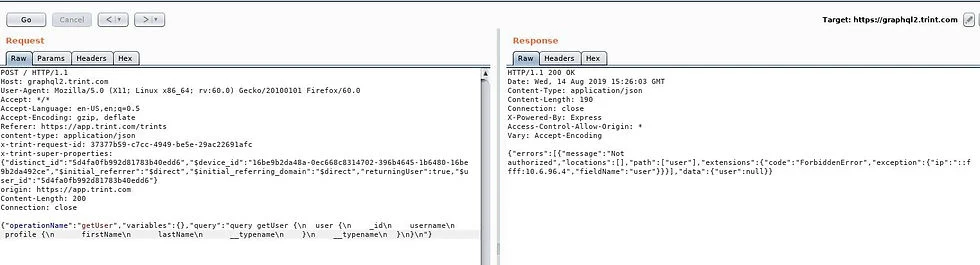
In those error responses the author saw private IP addresses. Sending the request again returned a different private IP address. The report does not name the endpoint, the parameter or the exact response body. The author reported the behaviour and it was triaged.
Smartsheet: stored XSS
The Smartsheet program was new at the time and, in the author's view, had a good scope. They spent time understanding the web application, which has many features, and then hunted. They found a few bugs such as HTML injection, but these were closed as duplicate or informative. After almost two months on the program the author was close to giving up.
Exploitation
Step 1: start again with a fresh alias account
The author decided to restart from the beginning on the Smartsheet application, registering accounts again with the @wearehackerone.com email alias.
Step 2: follow the post-verification redirect
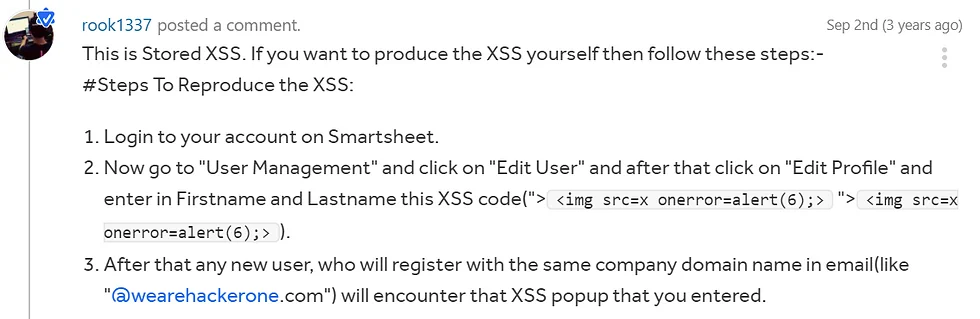
After email verification, the application redirected the author to a different page. On that page the author saw many XSS popups.
Step 3: understand why the page was reachable
The redirect happened because the account used the @wearehackerone.com alias, and a new Smartsheet feature had been released. That feature allows users of the same email alias to join their organisations. The page the author landed on showed the organisations of other users, where XSS payloads had been used.
Step 4: report
The author reported it quickly, expecting it to be closed as a duplicate. After a few hours it was triaged, and the author was the first person to notice the new feature. The payloads executing were not the author's own: they belonged to other hackers who had stored them on the same page.
Root cause
The report does not describe the server-side or client-side code, so the exact mistake is not stated. What it does show is that a newly released feature let the author see other users' organisations on a page reached through a shared email alias, and that XSS payloads from other users executed there. The report gives no detail on which existing defences, if any, were present or why they failed.
Impact
On Trint, removing the authentication token produced error responses that leaked private IP addresses, and repeated requests returned different ones.
On Smartsheet, XSS popups appeared on the page showing other users' organisations. Because the page was reached through the shared-alias feature, the author saw other users' XSS payloads. The author's own payload was not the one executing; other hackers' payloads were.
Fix
For the XSS, the fix would be to encode user-controlled output on the organisation page so stored payloads render as text rather than execute, and to review the new shared-alias feature for what it exposes between accounts. For the Trint issue, the fix would be to stop returning internal addresses in error responses. The report does not confirm that either was done.
Variants to test
- Strip the authentication token from authenticated requests and inspect error bodies for internal addresses, hostnames or stack traces. A positive result is a response that still returns internal detail, and a second request that returns a different internal address.
- Register accounts with a shared email alias on any platform that groups users by alias or domain, then look at pages that list other users or their organisations. A positive result is content from another account appearing on your page.
- Store a benign marker payload in profile or organisation fields and view the page from a second account in the same alias group. A positive result is your marker executing in the second account's session.
- Watch newly released features for a short period after launch, since they may not yet have been tested by other hunters. A positive result is any reflected or stored rendering of user input without encoding.
What happened, in plain words
This is the story of two firsts. The first is the first bug the author got accepted on a Vulnerability Disclosure Program, or VDP. The second is the first bug they found on a Bug Bounty Program, or BBP. Both are programmes that companies run so that people outside the company can report security problems to them.
A VDP does not pay money. Instead it gives public acknowledgements, reputation or points, or swag such as T-shirts, hoodies and stickers. Think of it like a school noticeboard that thanks you by name for returning a lost wallet: you get recognition, not cash.
A BBP pays a monetary reward for a reported vulnerability. Same idea, but the company hands over money when you find something real.
The two targets in this story are the Trint VDP on HackerOne and the Smartsheet BBP. HackerOne is a website where many companies list their programmes in one place, so researchers can browse them and submit reports. The first finding is an information disclosure on Trint. The second is an XSS on Smartsheet, in a feature that lets users with the same email alias join organisations.
Setup
The author describes themselves as a newbie on HackerOne at the time of the Trint work. They knew only a few kinds of vulnerability: HTML injection, XSS (not properly, in their words) and information disclosure. The only tool named in the report is Burp Suite, which is used to inspect and replay requests. No versions are given.
A quick word on those three ideas, since they come up again. HTML injection means putting your own markup into a page so the page shows content the site did not intend. XSS, short for cross-site scripting, is the more dangerous cousin: instead of just showing text or markup, you get the site to run JavaScript, the programming language browsers use to make pages interactive, in someone else's browser. Information disclosure means the site reveals something it should have kept private, such as internal addresses or error details.
Burp Suite deserves its own explanation. When you use a website, your browser sends a request to the server for every page, image and action, and the server sends a response back. Burp Suite sits between your browser and the server like a recording machine on a phone line: it captures every request and response, lets you read them, and lets you change a request and send it again. That ability to replay a modified request is the core of most web testing.
For the Smartsheet work the author registered accounts using the @wearehackerone.com email alias. An email alias is a second address that delivers to the same inbox. HackerOne gives researchers aliases on that domain so they can sign up for services without using a personal address. The alias is why the author was redirected to the new feature, which groups users by email alias.
Finding it
Trint: information disclosure
The author spent a few weeks on the Trint VDP. They found HTML injection and an email verification bypass, the latter by changing a parameter value to "null" in Burp Suite. A parameter is one of the named values sent with a request, like the fields on a form. Both reports were closed as duplicates, meaning someone else had already reported the same thing.
While reviewing the requests Burp Suite had captured on the site, the author removed the authentication token from a request. An authentication token is a short piece of text, often stored in a cookie, that your browser sends with each request to prove who you are. It works like the wristband you get at an event: show it and staff know you are allowed in. Removing it is like taking the wristband off and walking back to the door, to see what the door does when it cannot tell who you are. The application returned errors.
In those error responses the author saw private IP addresses. An IP address is the number that identifies a device on a network, and a private one is an address used only inside an internal network, not routable on the public internet. Seeing one in an error page is a hint that the server is describing its own insides to an outsider. Sending the request again returned a different private IP address. The report does not name the endpoint, the parameter or the exact response body. The author reported the behaviour and it was triaged, meaning the programme accepted it as a real issue and started working on it.
Smartsheet: stored XSS
The Smartsheet program was new at the time and, in the author's view, had a good scope. Scope means the list of what you are allowed to test and what counts as a valid finding. They spent time understanding the web application, which has many features, and then hunted. They found a few bugs such as HTML injection, but these were closed as duplicate or informative. Informative means the report was noted but did not qualify for a reward. After almost two months on the program the author was close to giving up.
Stored XSS is worth explaining before the next part. In a reflected XSS the malicious script is bounced straight back to whoever sent it. In a stored XSS the script is saved by the application, for example in a profile field or a comment, and then served to anyone who later views that page. It is the difference between shouting an insult at one person and writing it on a wall everyone walks past.
Exploitation
Step 1: start again with a fresh alias account
The author decided to restart from the beginning on the Smartsheet application, registering accounts again with the @wearehackerone.com email alias. Starting fresh is a common tactic: old accounts carry old state, and a clean account shows you the first-run experience a new user gets, including any new features.
Step 2: follow the post-verification redirect
After email verification, the application redirected the author to a different page. On that page the author saw many XSS popups. A popup here means the script ran and produced a visible alert box, the classic sign that JavaScript executed.
Step 3: understand why the page was reachable
The redirect happened because the account used the @wearehackerone.com alias, and a new Smartsheet feature had been released. That feature allows users of the same email alias to join their organisations. The page the author landed on showed the organisations of other users, where XSS payloads had been used. A payload is simply the piece of input an attacker submits, in this case the script that gets stored.
Step 4: report
The author reported it quickly, expecting it to be closed as a duplicate. After a few hours it was triaged, and the author was the first person to notice the new feature. The payloads executing were not the author's own: they belonged to other hackers who had stored them on the same page.
Root cause
The report does not describe the server-side or client-side code, so the exact mistake is not stated. What it does show is that a newly released feature let the author see other users' organisations on a page reached through a shared email alias, and that XSS payloads from other users executed there. Output encoding means converting characters like < and > into harmless equivalents so the browser shows them as text instead of treating them as code. The report gives no detail on which existing defences, if any, were present or why they failed.
Impact
On Trint, removing the authentication token produced error responses that leaked private IP addresses, and repeated requests returned different ones.
On Smartsheet, XSS popups appeared on the page showing other users' organisations. Because the page was reached through the shared-alias feature, the author saw other users' XSS payloads. The author's own payload was not the one executing; other hackers' payloads were.
Fix
For the XSS, the fix would be to encode user-controlled output on the organisation page so stored payloads render as text rather than execute, and to review the new shared-alias feature for what it exposes between accounts. For the Trint issue, the fix would be to stop returning internal addresses in error responses. The report does not confirm that either was done.
Variants to test
- Strip the authentication token from authenticated requests and inspect error bodies for internal addresses, hostnames or stack traces. A positive result is a response that still returns internal detail, and a second request that returns a different internal address.
- Register accounts with a shared email alias on any platform that groups users by alias or domain, then look at pages that list other users or their organisations. A positive result is content from another account appearing on your page.
- Store a benign marker payload in profile or organisation fields and view the page from a second account in the same alias group. A positive result is your marker executing in the second account's session.
- Watch newly released features for a short period after launch, since they may not yet have been tested by other hunters. A positive result is any reflected or stored rendering of user input without encoding.
Glossary
- VDP (Vulnerability Disclosure Program): a programme that accepts security reports but pays no money, offering acknowledgement, reputation, points or swag instead.
- BBP (Bug Bounty Program): a programme that pays a monetary reward for a valid vulnerability report.
- HackerOne: a platform where companies list their VDPs and BBPs and researchers submit reports.
- Burp Suite: a tool that sits between your browser and a server, capturing requests and responses and letting you edit and resend them.
- Request: the message your browser sends to a server asking for a page or an action.
- Response: the message the server sends back.
- Parameter: a named value sent with a request, like a form field.
- Authentication token: a piece of text sent with requests to prove who you are, often held in a cookie.
- Cookie: a small piece of data a site stores in your browser and your browser sends back with later requests.
- HTML injection: getting your own markup into a page so it displays content the site did not intend.
- XSS (cross-site scripting): getting a site to run your JavaScript in another user's browser.
- Stored XSS: XSS where the malicious script is saved by the application and served to anyone who later views the affected page.
- Payload: the input an attacker submits, such as the script that gets stored.
- Information disclosure: a site revealing data it should have kept private, such as internal addresses or error details.
- IP address: the number identifying a device on a network.
- Private IP address: an address used only inside an internal network, not reachable from the public internet.
- Email alias: a second email address that delivers to the same inbox.
- Scope: the list of what a programme allows you to test and what counts as a valid finding.
- Duplicate: a report of something someone else already reported.
- Informative: a report that was noted but did not qualify for a reward.
- Triaged: the programme has reviewed a report and accepted it as a real issue to work on.
- Output encoding: converting characters like
<and>into harmless equivalents so the browser shows them as text instead of running them as code. - JavaScript: the programming language browsers use to make pages interactive.
- Popup: a visible alert box produced by a script, the classic sign that JavaScript executed.