PHP’s New Unpatched RCE Risk: What CVE-2026–115560 Means for Developers
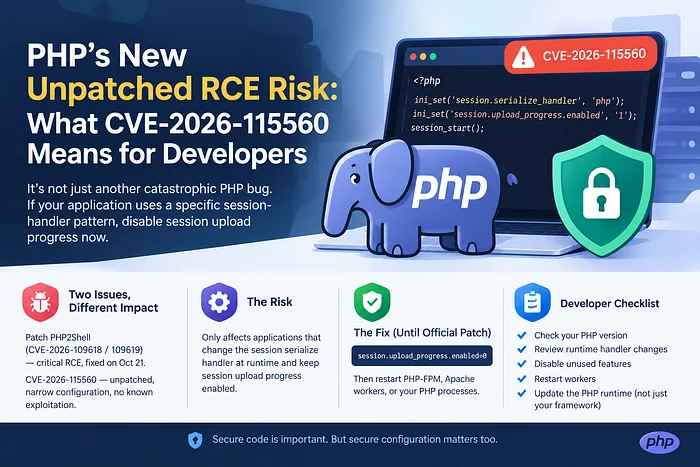
A PHP vulnerability arises when an application changes the session serialisation handler at runtime before starting a session while upload progress is enabled. An attacker could potentially achieve remote code execution, but only under this uncommon configuration.
 Published on tharindums.medium.com
PHP
The full write-up lives on its author's site
It belongs to its author, so we link to it rather than copy it. The other two tabs are our own rewrites, checked against it.
Context
PHP's session handling includes a feature called session upload progress. When it is enabled, PHP tracks the progress of file uploads during a request and exposes that state through the session, so an application can poll it while a large upload is in flight. The feature is controlled by the session.upload_progress settings, and the report's mitigation turns it off with session.upload_progress.enabled=0.
A second, related setting is session.serialize_handler, which decides how PHP serialises and deserialises the session data it stores. The report names php_binary and php_serialize as the two handlers involved in the issue, alongside the plain php handler.
CVE-2026-115560 is a potential remote code execution issue in PHP that the project published an informational advisory for on October 23, 2026. It is not fixed by the emergency updates released two days earlier, and PHP plans to address it in a routine release. The report stresses that it is not being treated as an emergency: it affects an uncommon application configuration and has not been reported as exploited.
Setup
The issue is a configuration interaction rather than something an attacker reaches through a single request, so the relevant preconditions are the application's session settings. All of the following must hold for CVE-2026-115560 to become relevant:
session.serialize_handleris initially set tophp_binaryorphp_serialize.- The application later changes it to
phpusingini_set(). - That change happens before
session_start()is called. session.upload_progressremains enabled.
If an application never switches the serialise handler at runtime, PHP considers it unaffected through this path. PHP itself describes the configuration as unlikely in real-world applications.
The report gives no target application, no accounts or roles, and no tooling: the advisory is about the PHP runtime and how an application configures it.
Finding it
The report frames the issue as a follow-on disclosure rather than a hunt. On October 21, PHP released emergency patches for two critical unauthenticated RCE flaws, CVE-2026-109618 and CVE-2026-109619, collectively called PHP2Shell. Those were fixed in PHP 8.5.12, 8.4.27, 8.3.36 and 8.2.35.
On October 23, PHP published an informational advisory for a separate issue, CVE-2026-115560. That vulnerability is not fixed by the October 21 emergency updates. The report's point is that the two should not be conflated: PHP2Shell was a runtime-level problem that could affect PHP applications broadly, while CVE-2026-115560 depends on a specific and uncommon application-level configuration.
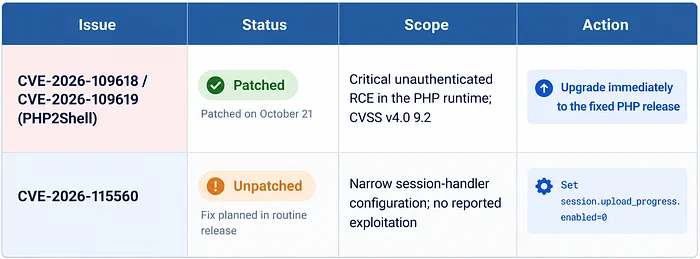
PHP Security Update: Patched vs. Unpatched Vulnerabilities
Exploitation
The report does not include a request, payload or proof-of-concept for CVE-2026-115560. What it describes is the configuration path that makes the issue reachable, and the mitigation that closes it.
Step 1: Start from a handler that is not php
The application's session.serialize_handler is initially set to php_binary or php_serialize. This is the starting state the advisory cares about.
Step 2: Switch the handler at runtime
The application later changes the handler to php using ini_set(). The report gives the call to search for as:
ini_set(‘session.serialize_handler’, …)
What matters is whether that call runs before session_start(). If it does, and upload progress is still enabled, the combination the advisory describes is present.
Step 3: Keep upload progress enabled
The fourth condition is that session.upload_progress remains enabled. The report does not describe the resulting exploitation mechanics beyond calling the issue a potential remote code execution risk; it does not show what an attacker sends or what comes back.
Step 4: Apply the mitigation
Until the official fix arrives, PHP recommends disabling session upload progress:
session.upload_progress.enabled=0
After changing this setting, restart PHP-FPM, Apache workers, or any other long-running PHP processes so the configuration takes effect. If you already applied this mitigation for CVE-2026-109619, you do not need to take additional action for CVE-2026-115560.
Root cause
The report attributes the exposure to a configuration interaction rather than an obvious code defect. A feature such as session upload progress may be harmless by itself, but combined with a runtime change to the serialisation handler it can create an exploitation path. The report does not go further into the underlying PHP internals, so the precise mechanism is not stated.
Existing defences did not stop it in the sense that the October 21 emergency updates for PHP2Shell do not fix this issue; PHP plans to address it in a routine release. The narrow precondition set is also why the project treats the risk as limited: applications that never switch the serialise handler at runtime are considered unaffected through this path.
Impact
The report characterises CVE-2026-115560 as a potential remote code execution issue, and notes that it has not been reported as exploited. Exposure depends on the four session conditions above all holding, and PHP describes that configuration as unlikely in real-world applications. The report does not state a severity score, a CVSS vector or a weakness classification.
The practical impact for most teams is therefore about knowing whether their code meets those conditions, not about a broadly reachable flaw. The report contrasts this with PHP2Shell, which it describes as a runtime-level problem that could affect PHP applications broadly.
Fix
No official fix exists yet: the vulnerability is not fixed by the October 21 emergency updates, and PHP plans to address it in a routine release. The interim mitigation PHP recommends is to disable session upload progress with session.upload_progress.enabled=0, followed by a restart of PHP-FPM, Apache workers or any other long-running PHP processes so the configuration takes effect. Teams that already applied this mitigation for CVE-2026-109619 need take no additional action for CVE-2026-115560.
For PHP2Shell, the report's guidance is to update to at least PHP 8.5.12, 8.4.27, 8.3.36 or 8.2.35, depending on your branch.
The report's checklist for backend developers:
- Check your PHP version. For PHP2Shell, update to at least PHP 8.5.12, 8.4.27, 8.3.36 or 8.2.35, depending on your branch.
- Search for runtime handler changes. Look for
ini_set(‘session.serialize_handler’, …)and determine whether it runs beforesession_start(). - Disable upload progress if not required. Add
session.upload_progress.enabled=0to your PHP configuration unless your application genuinely relies on upload-progress tracking. - Restart workers. Configuration changes do not protect existing PHP-FPM or Apache worker processes until they restart.
- Remember the runtime is separate from your framework. Updating Laravel, WordPress, Symfony or your application code does not update the underlying PHP runtime; that comes from the server package, container image or hosting platform.
Variants to test
The report gives no exploitation detail, so the concrete things to try follow from its preconditions. Each is a check on your own codebase or configuration.
- Grep for runtime handler changes. Search the codebase for
ini_set(‘session.serialize_handler’, …)calls and confirm the exact setting name used. A positive result is any call that setssession.serialize_handlertophpat runtime; then check whether it executes beforesession_start(). - Trace the order of calls. For each match, follow the request path to see whether
session_start()is reached after theini_set()call. A positive result is a code path where the handler is switched tophpand the session is started afterwards in the same request. - Check the initial handler. Confirm whether
session.serialize_handleris configured asphp_binaryorphp_serializeinphp.ini, the pool configuration or a framework bootstrap. A positive result is one of those two values as the starting state, combined with a runtime switch tophp. - Check upload progress. Confirm whether
session.upload_progress.enabledis on. A positive result is that it is enabled while the handler switch above is present. - Verify the mitigation took effect. After setting
session.upload_progress.enabled=0, confirm the running workers were restarted and that the setting is off in the effective configuration, not just in the file on disk. A positive result is a restarted worker pool reporting upload progress disabled. - Check the runtime separately from the framework. Compare the PHP version reported by the server package, container image or hosting platform against the PHP2Shell fixed versions. A positive result is a runtime older than 8.5.12, 8.4.27, 8.3.36 or 8.2.35 on the relevant branch, regardless of what the framework reports.
What happened, in plain words
PHP is a programming language that runs on web servers. Most of the websites you visit are built with something like it, and the code runs on the server, not in your browser. When a website needs to remember who you are between page loads, it uses a session: a small store of data the server keeps on your behalf, tied to a short identifier your browser carries around.
On 21 October 2026, the people who maintain PHP released emergency fixes for two serious security holes, CVE-2026-109618 and CVE-2026-109619, which together are called PHP2Shell. Those fixes shipped in PHP 8.5.12, 8.4.27, 8.3.36 and 8.2.35. Two days later, on 23 October 2026, the PHP project published an informational advisory about a separate issue, CVE-2026-115560. This one is a potential remote code execution risk, meaning an attacker might be able to make the server run code of their choosing. It is not fixed by the 21 October updates, and PHP plans to address it in a routine release.
The report is careful about the tone: this is not another catastrophe. The issue only matters if an application is set up in a particular, uncommon way, and it has not been reported as exploited. The practical message is short: if your application uses a specific session-handler pattern, turn off session upload progress now.
The two PHP features involved
Before the conditions make sense, you need to know what the two settings do. Both are configuration settings: named switches that control how PHP behaves, usually written in a file called php.ini or set from code.
Session upload progress is a feature that tracks how far a file upload has got while it is still happening. Imagine sending a very large parcel and being able to watch a progress bar: the sender (the browser) uploads the file, and the website can ask the server "how much has arrived so far?" and show that to the user. PHP exposes that progress through the session, so the application can poll it while a large upload is in flight. The feature is controlled by the session.upload_progress settings. The mitigation in the report turns it off with session.upload_progress.enabled=0.
The serialise handler is the part of PHP that decides how session data is written down and read back. Session data has to be stored somewhere between requests, and it has to be turned into a string of bytes to be saved and turned back into usable data when it is loaded. That conversion is called serialisation (data to bytes) and deserialisation (bytes back to data). Different handlers do this in different formats. The report names php_binary and php_serialize as the two handlers involved in the issue, alongside the plain php handler.
A useful comparison: serialisation is like packing a set of items into a box for shipping, and deserialisation is unpacking the box at the other end. The handler is the packing method. If the packing method changes halfway through, the person unpacking may misread what is inside.
Why the risk is limited
The issue is not something an attacker reaches with a single request to a website. It is a configuration interaction: several settings have to line up in a particular way. All of the following must hold for CVE-2026-115560 to become relevant:
session.serialize_handleris initially set tophp_binaryorphp_serialize.- The application later changes it to
phpusingini_set(). - That change happens before
session_start()is called. session.upload_progressremains enabled.
If an application never switches the serialise handler at runtime, PHP considers it unaffected through this path. PHP itself describes the configuration as unlikely in real-world applications.
The report gives no target application, no accounts or roles, and no tooling: the advisory is about the PHP runtime and how an application configures it. In other words, there is no website to attack here and no set of steps to follow against a victim. The work is on your own code and your own settings.
Finding it
The report frames the issue as a follow-on disclosure rather than a hunt. Nobody went looking for a bug in a particular website; the PHP project told the world about a problem in PHP itself.
The timeline matters because the two disclosures are easy to mix up:
- 21 October 2026: emergency patches for PHP2Shell, the two critical unauthenticated RCE flaws, CVE-2026-109618 and CVE-2026-109619. Fixed in PHP 8.5.12, 8.4.27, 8.3.36 and 8.2.35.
- 23 October 2026: an informational advisory for a separate issue, CVE-2026-115560, which is not fixed by those emergency updates.
The report's point is that the two should not be conflated. PHP2Shell was a runtime-level problem that could affect PHP applications broadly. CVE-2026-115560 depends on a specific and uncommon application-level configuration. "Runtime-level" means the problem lives in PHP itself, so any application running that PHP could be exposed. "Application-level" means the problem only appears because of choices the application's own code makes.
PHP Security Update: Patched vs. Unpatched Vulnerabilities
Exploitation
The report does not include a request, payload or proof-of-concept for CVE-2026-115560. What it describes is the configuration path that makes the issue reachable, and the mitigation that closes it. So the steps below are not an attack recipe; they are the conditions to check in your own application.
Step 1: Start from a handler that is not php
The application's session.serialize_handler is initially set to php_binary or php_serialize. This is the starting state the advisory cares about. Think of it as the packing method the application begins with: one of two less common formats rather than the plain php one.
Step 2: Switch the handler at runtime
The application later changes the handler to php using ini_set(). ini_set() is a PHP function that changes a configuration setting while the program is running, rather than in the configuration file before it starts. The report gives the call to search for as:
ini_set(‘session.serialize_handler’, …)
Line by line, in plain words:
ini_set(is the name of the PHP function being called. It means "change a setting".‘session.serialize_handler’is the name of the setting being changed, written as text. It is the serialise handler described earlier., …stands for the value being passed in. In the case the advisory cares about, that value isphp.)closes the call.
What matters is whether that call runs before session_start(). session_start() is the PHP function that opens the session and loads its stored data. If the handler is switched before the session is opened, and upload progress is still enabled, the combination the advisory describes is present. The order of these two calls is the whole point: switching the packing method after the box has already been unpacked is not the same as switching it before.
Step 3: Keep upload progress enabled
The fourth condition is that session.upload_progress remains enabled. The report does not describe the resulting exploitation mechanics beyond calling the issue a potential remote code execution risk; it does not show what an attacker sends or what comes back. So there is no payload to study here, only the setting to check.
Step 4: Apply the mitigation
Until the official fix arrives, PHP recommends disabling session upload progress:
session.upload_progress.enabled=0
Line by line:
session.upload_progress.enabledis the name of the setting. It is the on/off switch for the upload progress feature.=assigns a value to it.0means off. In configuration files,1usually means on and0means off.
After changing this setting, restart PHP-FPM, Apache workers, or any other long-running PHP processes so the configuration takes effect. PHP-FPM and Apache workers are the processes that actually run PHP code on the server. They are long-running: they start once and keep serving requests, holding their configuration in memory. Changing a file on disk does not reach them until they are restarted. A comparison: editing a shop's price list on paper does not change the prices the staff have already memorised; they need to be told again.
If you already applied this mitigation for CVE-2026-109619, you do not need to take additional action for CVE-2026-115560.
Root cause
The report attributes the exposure to a configuration interaction rather than an obvious code defect. A feature such as session upload progress may be harmless by itself, but combined with a runtime change to the serialisation handler it can create an exploitation path. The report does not go further into the underlying PHP internals, so the precise mechanism is not stated.
Existing defences did not stop it in the sense that the 21 October emergency updates for PHP2Shell do not fix this issue; PHP plans to address it in a routine release. The narrow precondition set is also why the project treats the risk as limited: applications that never switch the serialise handler at runtime are considered unaffected through this path.
Impact
The report characterises CVE-2026-115560 as a potential remote code execution issue, and notes that it has not been reported as exploited. "Remote code execution" means an attacker could, in principle, get the server to run code they supply, from a distance, without physical access. That is one of the most serious kinds of web vulnerability, which is why the word appears in the title, but the conditions here are narrow.
Exposure depends on the four session conditions above all holding, and PHP describes that configuration as unlikely in real-world applications. The report does not state a severity score, a CVSS vector or a weakness classification. A severity score is a number used to rank how bad a vulnerability is; a CVSS vector is the standard notation behind that number; a weakness classification is the category the flaw belongs to. None of those are given here.
The practical impact for most teams is therefore about knowing whether their code meets those conditions, not about a broadly reachable flaw. The report contrasts this with PHP2Shell, which it describes as a runtime-level problem that could affect PHP applications broadly.
Fix
No official fix exists yet: the vulnerability is not fixed by the 21 October emergency updates, and PHP plans to address it in a routine release. The interim mitigation PHP recommends is to disable session upload progress with session.upload_progress.enabled=0, followed by a restart of PHP-FPM, Apache workers or any other long-running PHP processes so the configuration takes effect. Teams that already applied this mitigation for CVE-2026-109619 need take no additional action for CVE-2026-115560.
For PHP2Shell, the report's guidance is to update to at least PHP 8.5.12, 8.4.27, 8.3.36 or 8.2.35, depending on your branch. A "branch" here means the line of PHP releases you are on, such as 8.4 or 8.3; each line gets its own fixed version number.
The report's checklist for backend developers:
- Check your PHP version. For PHP2Shell, update to at least PHP 8.5.12, 8.4.27, 8.3.36 or 8.2.35, depending on your branch.
- Search for runtime handler changes. Look for
ini_set(‘session.serialize_handler’, …)and determine whether it runs beforesession_start(). - Disable upload progress if not required. Add
session.upload_progress.enabled=0to your PHP configuration unless your application genuinely relies on upload-progress tracking. - Restart workers. Configuration changes do not protect existing PHP-FPM or Apache worker processes until they restart.
- Remember the runtime is separate from your framework. Updating Laravel, WordPress, Symfony or your application code does not update the underlying PHP runtime; that comes from the server package, container image or hosting platform. A framework is a toolkit built on top of PHP that provides ready-made structure for an application; it is not PHP itself.
Variants to test
The report gives no exploitation detail, so the concrete things to try follow from its preconditions. Each is a check on your own codebase or configuration. "Grep" means searching through files for a piece of text, the way you would use your browser's find function on a page, but across a whole project.
- Grep for runtime handler changes. Search the codebase for
ini_set(‘session.serialize_handler’, …)calls and confirm the exact setting name used. A positive result is any call that setssession.serialize_handlertophpat runtime; then check whether it executes beforesession_start(). - Trace the order of calls. For each match, follow the request path to see whether
session_start()is reached after theini_set()call. A positive result is a code path where the handler is switched tophpand the session is started afterwards in the same request. - Check the initial handler. Confirm whether
session.serialize_handleris configured asphp_binaryorphp_serializeinphp.ini, the pool configuration or a framework bootstrap. A positive result is one of those two values as the starting state, combined with a runtime switch tophp. - Check upload progress. Confirm whether
session.upload_progress.enabledis on. A positive result is that it is enabled while the handler switch above is present. - Verify the mitigation took effect. After setting
session.upload_progress.enabled=0, confirm the running workers were restarted and that the setting is off in the effective configuration, not just in the file on disk. A positive result is a restarted worker pool reporting upload progress disabled. - Check the runtime separately from the framework. Compare the PHP version reported by the server package, container image or hosting platform against the PHP2Shell fixed versions. A positive result is a runtime older than 8.5.12, 8.4.27, 8.3.36 or 8.2.35 on the relevant branch, regardless of what the framework reports.
Security lesson
This incident is a useful reminder that security exposure often lives in configuration interactions, not only in obvious code defects.
For production systems, the safest posture is simple: keep the PHP runtime patched, minimise exotic session configuration, disable features you do not use, and treat configuration changes as part of your security review, not just application logic.
Glossary
- PHP: a programming language that runs on web servers to build websites and web applications.
- Session: a small store of data a server keeps about you between page loads, tied to an identifier your browser carries.
- Session upload progress: a PHP feature that tracks how far a file upload has got during a request and exposes that state through the session.
- Serialisation: turning data into a string of bytes so it can be stored or sent.
- Deserialisation: turning stored bytes back into usable data.
- Serialise handler: the part of PHP that decides how session data is serialised and deserialised; the report names
php_binary,php_serializeandphp. - Configuration setting: a named switch that controls how a program behaves, usually in a file such as
php.inior set from code. ini_set(): a PHP function that changes a configuration setting while the program is running.session_start(): a PHP function that opens a session and loads its stored data.php.ini: the main configuration file for PHP.- PHP-FPM: the process manager that runs PHP for web servers; it keeps worker processes alive to serve requests.
- Apache worker: a process of the Apache web server that handles requests, including running PHP code.
- Runtime: the environment in which code actually runs, here the installed PHP itself, as opposed to the framework or application code.
- Framework: a toolkit built on top of a language that provides ready-made structure for an application, such as Laravel, WordPress or Symfony.
- Remote code execution (RCE): a vulnerability where an attacker can make a remote server run code of their choosing.
- Unauthenticated: reachable without logging in or proving an identity.
- CVE: a public identifier for a known security vulnerability, such as CVE-2026-115560.
- Advisory: an official notice published about a vulnerability, its impact and any fix or mitigation.
- Mitigation: a temporary measure that reduces risk when no official fix is available yet.
- Patch: an update that fixes a vulnerability.
- Exploit: code or steps that take advantage of a vulnerability.
- Proof-of-concept (PoC): a demonstration showing that a vulnerability can be exploited.
- Payload: the data an attacker sends to trigger a vulnerability.
- Severity score: a number used to rank how serious a vulnerability is.
- CVSS vector: the standard notation that describes the factors behind a severity score.
- Weakness classification: the category a vulnerability belongs to.
- Grep: searching through files for a piece of text.
- Container image: a packaged, ready-to-run copy of an application and its runtime, used to deploy software consistently.
- Production system: the live environment where real users use the application.


