Reversing a GTA VI “leak site” infostealer - Vidar behind a custom obfuscator [IN DEPTH ANALYSIS]
A fake GTA VI leak site served a Vidar infostealer disguised as an installer, using a custom obfuscator with API resolution by hash and a bytecode VM for string decryption. An attacker could steal browser cookies, credentials, cryptocurrency wallets, and messaging tokens from infected machines.
 Published on medium.com
Every big gaming leak grows a second economy around it. The GTA VI gameplay that cyberleek pushed in mid August 2026 was no different.
The full write-up lives on its author's site
It belongs to its author, so we link to it rather than copy it. The other two tabs are our own rewrites, checked against it.
Context
Every large gaming leak attracts a second economy. The GTA VI gameplay footage that the persona "cyberleek" published in mid August 2026 was no exception: within days there were "GTA 6 leak" and "download the build" sites, and a share of them were not fan pages but malware delivery campaigns. This is a static teardown of one of them.
Three groups have to be kept apart, because coverage around the leak keeps merging them:
- "cyberleek", the group or persona that published the footage. No malware is attributed to them here.
- Whoever registered the lure domains and served the stealers.
Nothing found links group 1 to group 2. The analysis covers only group 2, and only what the bytes show.
Two domains were in scope, kept defanged throughout:
- Target A,
hxxps[://]gta-six-leaks[.]com/, is a ClickFix loader. The victim is walked through a fake "verification" that quietly puts a command on the clipboard, then a hidden PowerShell runs it with ExecutionPolicy set to Bypass, drops a setup.exe, and wires up persistence. The scheduled tasks are the tell: two of them, named iTunesUpdate and SlackUpdate, both set to fire every single minute out of C:\WINDOWS\Temp. That is not how iTunes or Slack update. - Target B,
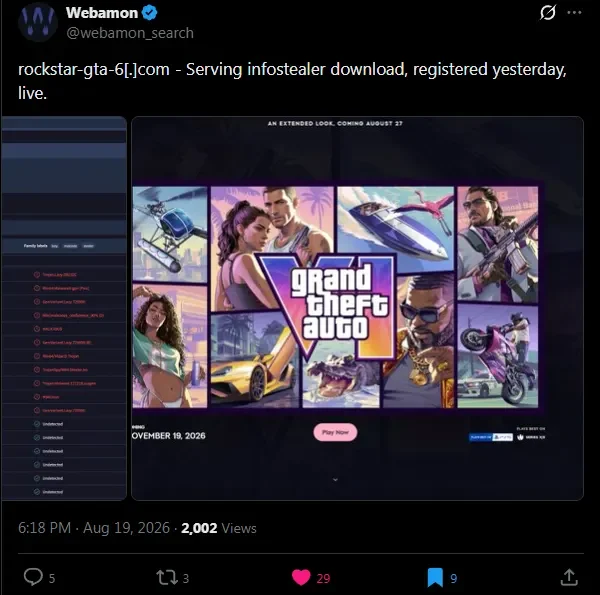
hxxps[://]rockstar-gta-6[.]com/, is the one that was reversed. It serves gta6_installer.exe, and the family is Vidar, the credential and wallet stealer that has been around since 2018.
Setup
The work is static analysis of a Windows x64 binary, done in IDA. The case folder holds api_hash_solver.py, string_vm.py, extract_strings_ida.py and decrypted-strings.txt. The recovered strings and the extractor live in a local case folder as decrypted-strings.txt.
One precondition shapes everything below: the sample analysed here is not the sample in the public sandbox report. The ANY.RUN report for Target B is built around one file hash. The file pulled from the site has a different sha256. They are not the same bytes. The most likely explanation, and a publishable finding on its own, is server side repacking: the site rebuilds the payload per download so the file hash keeps changing and hash blocklists never catch up. Until that is confirmed by pulling it a few more times, nothing observed in this binary is attributed to the ANY.RUN run, and the other way around. Two samples, one campaign.
file we analyzed   [redacted]
size               1157120 bytes
compiled           2026-08-05 12:50:41 UTC
imagebase          0x360000000 (non standard)
Finding it
First look: obfuscated, not packed.
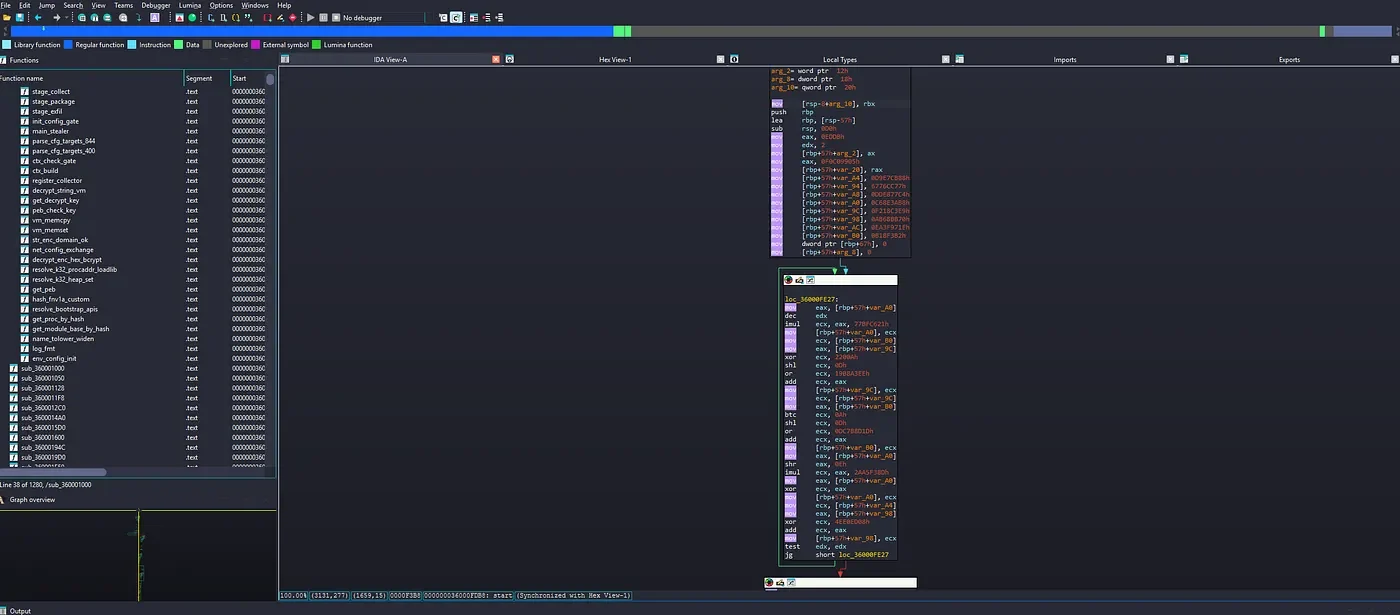
The entry point start() sits under Mixed Boolean Arithmetic. The wall of mov, xor and imul into var_XX slots feeds nothing; it is there to bury the four calls that actually matter.
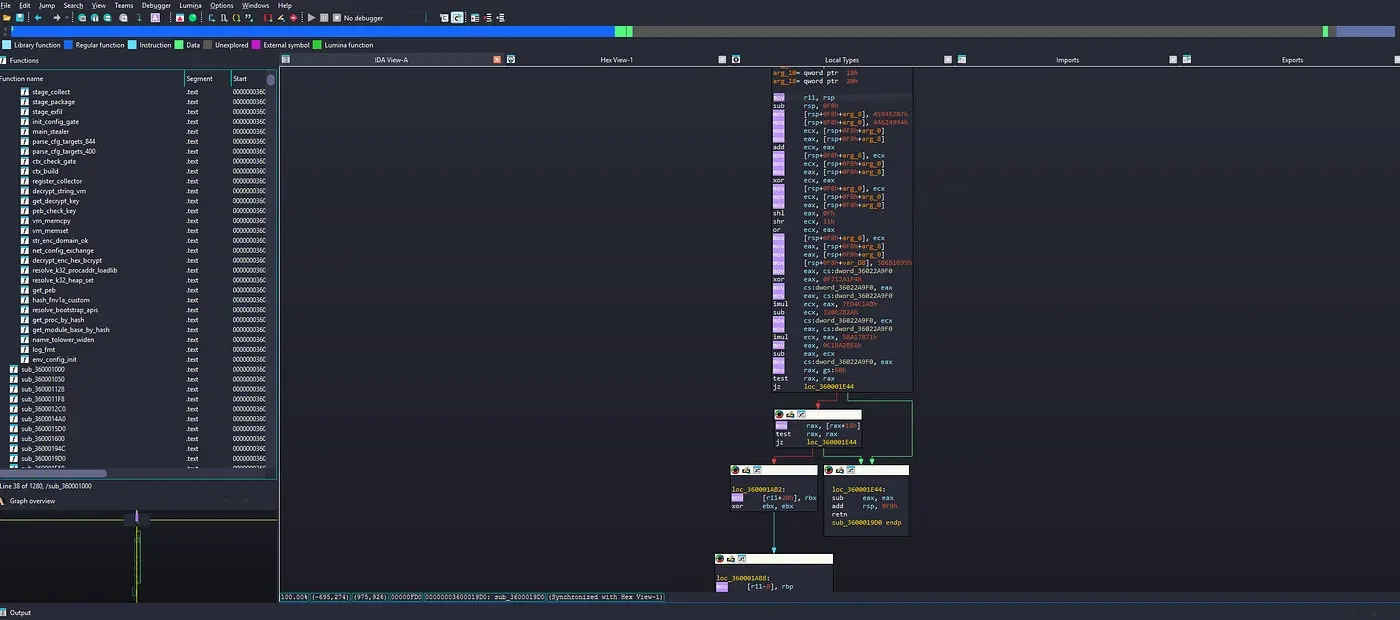
The loaded-module anti-analysis walk reads each PEB module's BaseDllName, hash-matches it against a monitored set, then sleeps and self-terminates on a hit.
Entropy across .text sits around 5.73. If this were packed or encrypted it would be near 8.0. So the code is plain x64, made unreadable on purpose by four techniques stacked together:
- No import table at all, the imphash is empty. Every Windows API is resolved at runtime. Five places read
gs:[0x60], the x64 way to reach the PEB and walk the loaded module list without an import directory. - Mixed Boolean Arithmetic: a global labelled the junk PRNG is churned with dozens of pointless arithmetic lines in almost every function. It feeds nothing, and once you learn to ignore it, functions shrink by 80 percent.
- Control flow flattening: the real order of operations is hidden behind switch dispatchers keyed on obfuscated values.
- Timing anti-analysis: over twenty
rdtscreads, used as opaque predicates and as single step detection.
IDA recovers only eight strings from a 1.1 MB stealer. Everything that matters is encrypted, so the whole job comes down to two questions: how does it resolve APIs, and how does it decrypt strings. Break those two and the binary opens up.
Exploitation
Step 1: the API resolver, a custom FNV-1a by hash
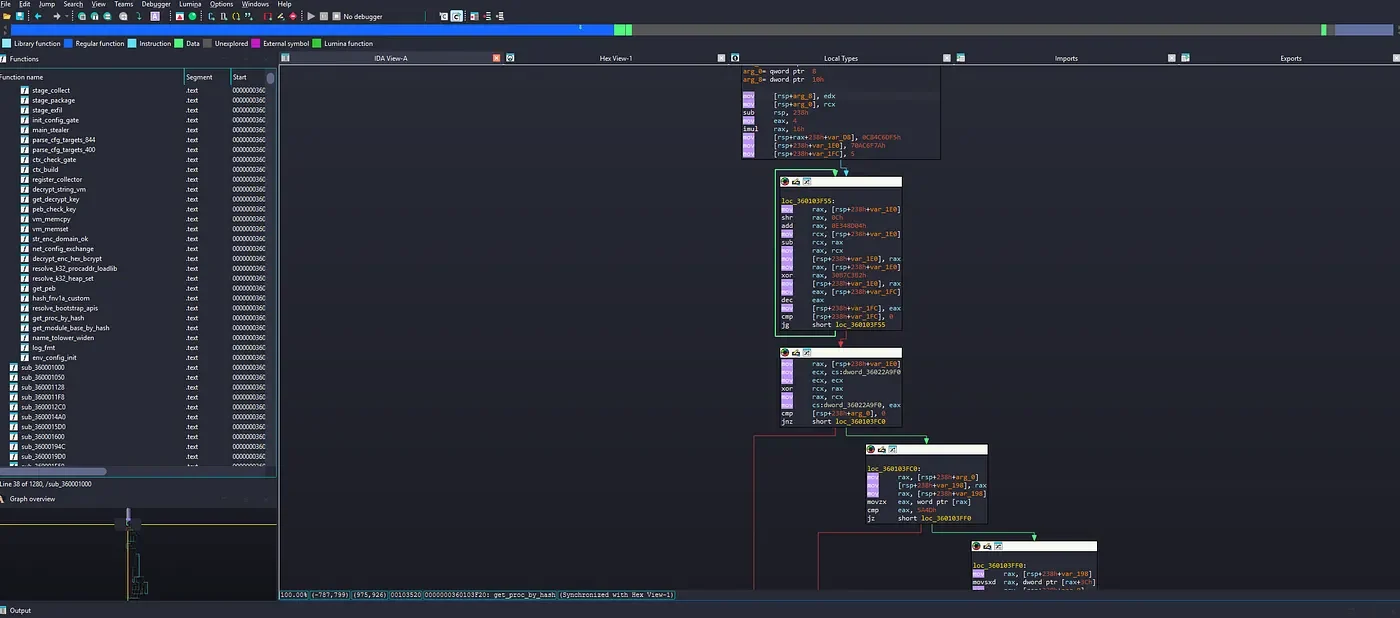
The export-directory parser: the cmp eax, 5A4Dh check (MZ) and the [rax+3Ch] read (e_lfanew) are the start of walking a module's export table.
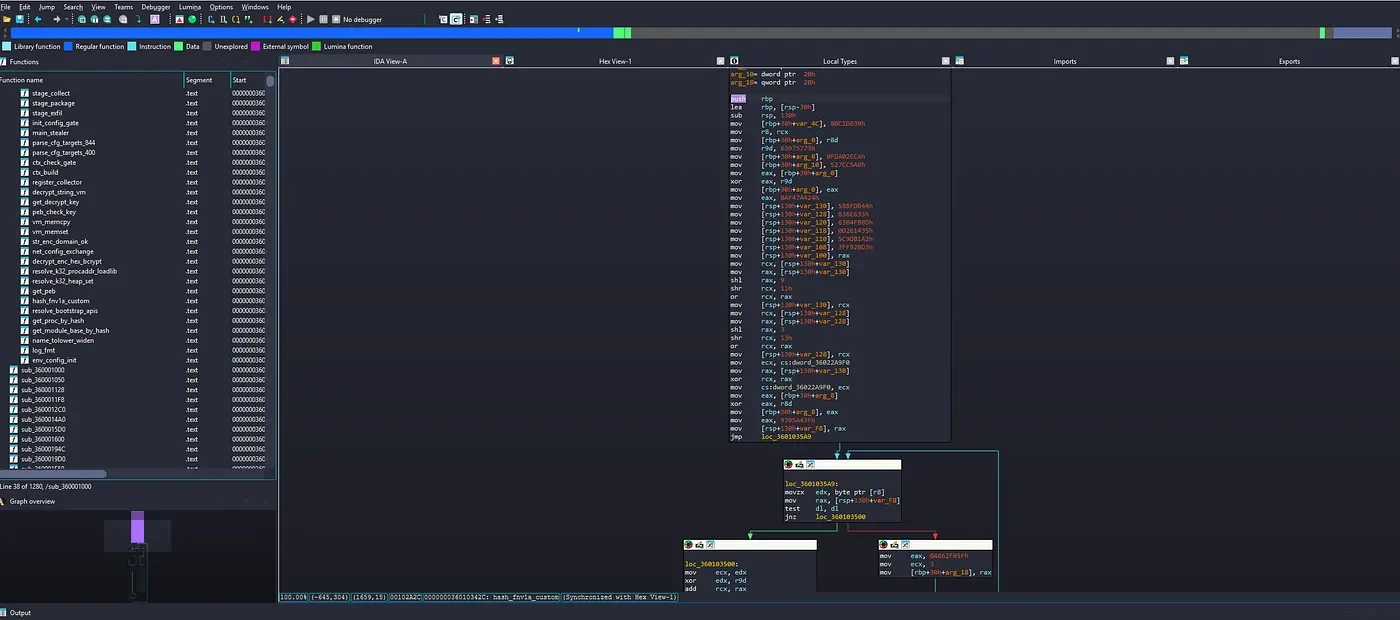
The custom hash: mov r9d, 63975773h is the offset basis, and the loop multiplies by 0x010003F1.
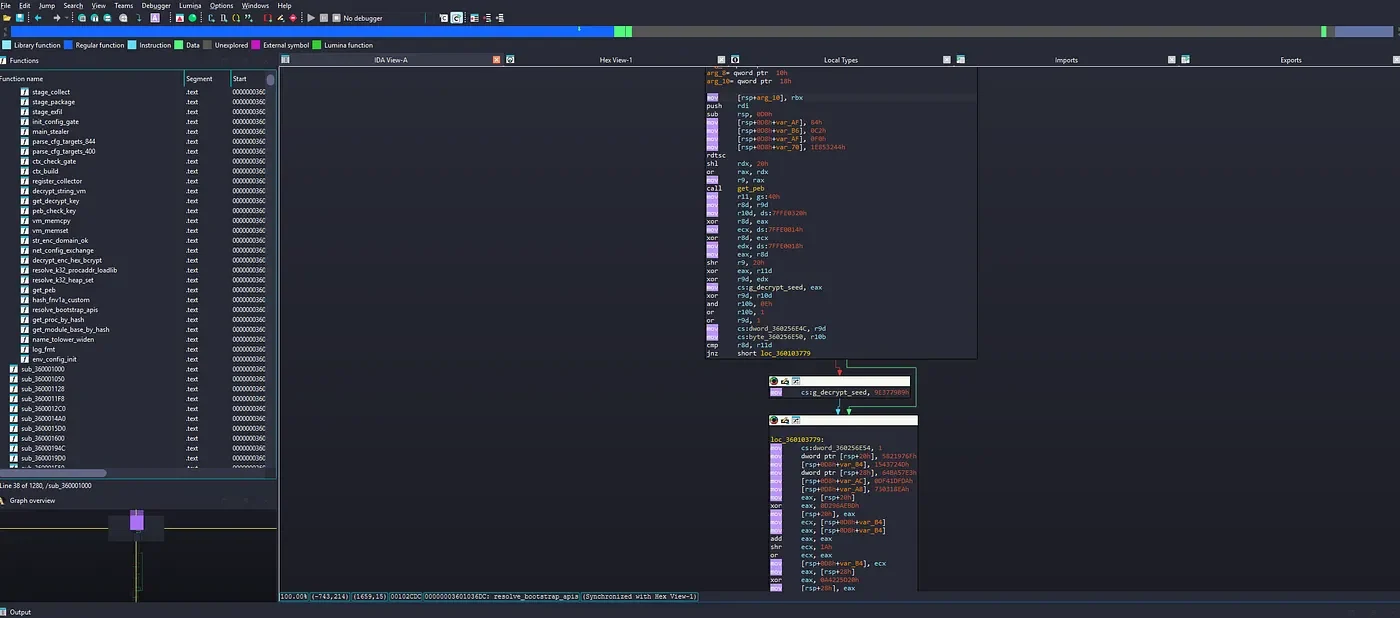
The bootstrap resolves and caches GetProcAddress, LoadLibraryA, and the heap set from ntdll and kernel32.
Two routines do the work. The first walks PEB->Ldr->InMemoryOrderModuleList, and for each module lowercases the base name, hashes it, and returns the module base when the hash matches a requested value. The second takes a module base, parses the export directory the normal way (MZ and PE checks, export table at e_lfanew + 0x88, walk AddressOfNames, map through AddressOfNameOrdinals into AddressOfFunctions), hashes each export name, and returns the function it wants. Forwarded exports are handled too.
The hash is a 32 bit FNV-1a variant with non standard constants:
h = 0x63975773
for each byte b:  h = ((h XOR b) * 0x010003F1) mod 2^32
Module names are lowercased before hashing, export names are hashed as is. That is enough to brute force any hash against a wordlist. The bootstrap resolves and caches the classic Vidar starter set, then resolves everything else on demand:
ntdll.dll        0x7A6E9517
kernel32.dll     0x76AADBD3
GetProcAddress   0x1CBF76CD
LoadLibraryA     0x549BA99B
GetModuleHandleA 0x537CC144
ExitProcess      0xBCA384B8
GetProcessHeap   0xB90B6962
HeapAlloc        0xE7364482
HeapReAlloc      0x69534635
HeapFree         0xD74F873B
Step 2: the string decryptor is a tiny bytecode VM
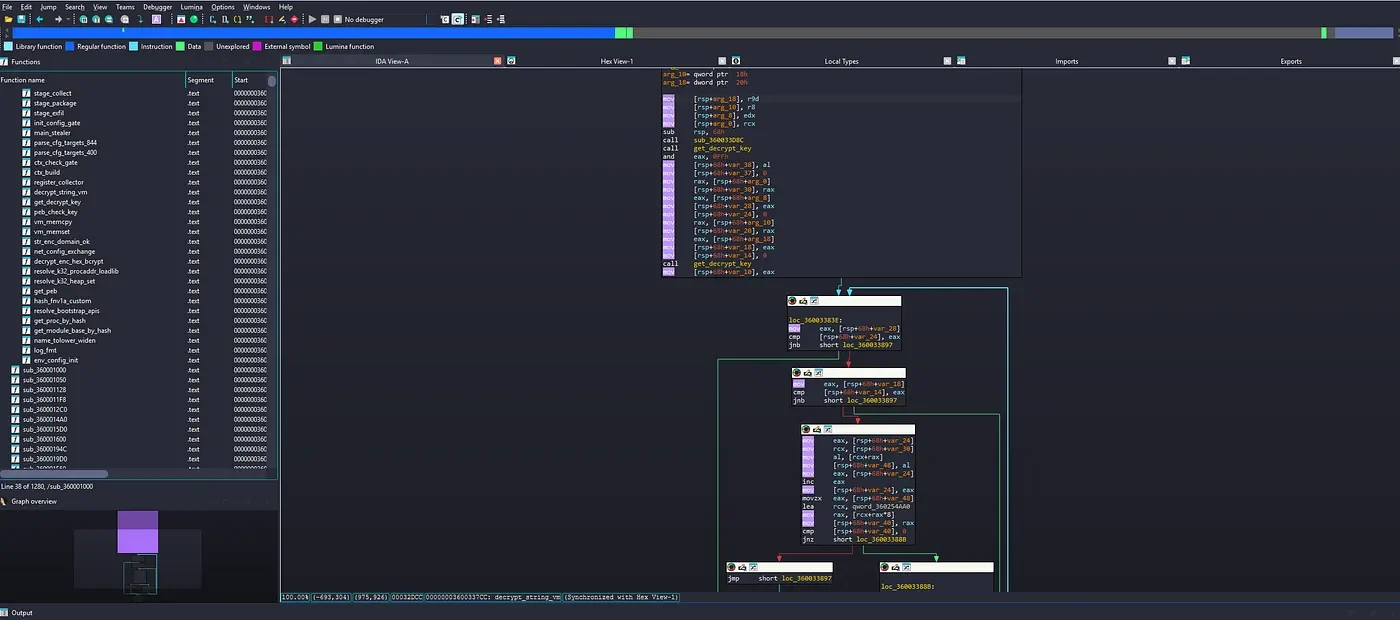
The VM dispatch loop: call get_decrypt_key seeds the state, lea rcx, qword_360254AA0 loads the handler table, and the [rcx+rax*8] read jumps to the handler for each opcode byte.
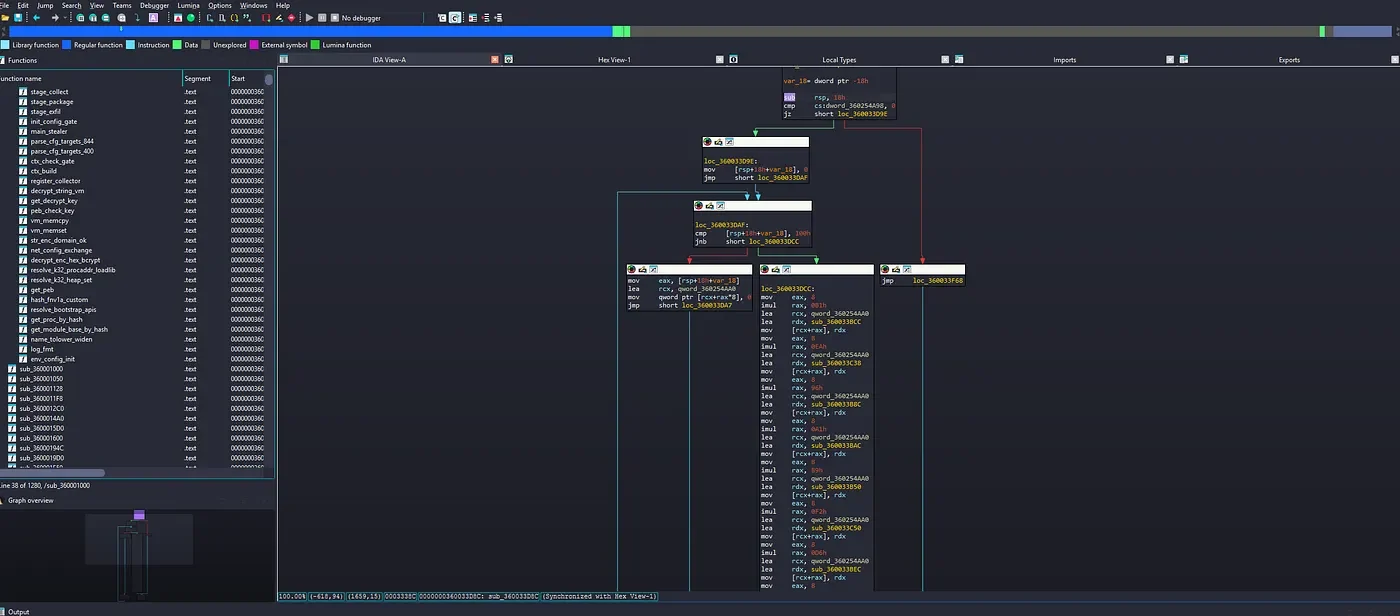
The table build: each qword_360254AA0[opcode] = handler line wires up one of the 14 operations.
This is the interesting part. Strings are not XOR blobs. Each string lives inside its own small function as a ciphertext buffer, and a shared routine decrypts it into a heap allocation and caches the pointer. That shared routine is a byte virtual machine: each ciphertext byte is an opcode into a 256 entry handler table, and a one byte running state is transformed until an emit opcode outputs a plaintext byte. There are 14 opcodes:
0x06 state = state * 0xCB          0x17 state ^= keybyte[out_idx & 3]
0x28 state -= next cipher byte     0x30 state ^= 0xD9
0x39 state ^= next cipher byte     0x49 rotate right 3
0x89 rotate left 1                 0x94 state = NOT state
0x96 state ^= (out_idx & 0xFF)     0xA1 state ^= previous output byte
0xB1 state = SBOX[state]           0xD6 state += next cipher byte
0xEA state += 13                   0xF2 EMIT: out = next ^ state, then state ^= out
The key comes from a routine that validates two PEB fields and returns 0x6B519DF3 on any real machine (and 0xDEADBEEF on failure, which doubles as an anti-tamper check). Because that key is constant on a normal host, the whole scheme is reproducible offline.
Reimplementing the VM and the S-box and decoding a buffer confirmed it, producing "%s=== Sandbox Check ===%s", one of the malware's own log format strings. Judging by output, it is most likely a vibecoded AI slop infostealer. This build ships a full verbose logger left in, which is a gift for analysis.
With the VM working, an IDA script finds every one of the 266 calls to the decryptor, rebuilds each inline ciphertext, and runs it. That turns eight readable strings into the whole behaviour of the sample. Here is the full list of decrypted strings:
0x360039444  'C2: block received'
0x36003EA24  'ENC domain decrypted OK'
0x36004194C  '------%s\r\nContent-Disposition: form-data; name="hwid"\r\n\r\n%s\r\n------%s\r\nContent-Disposition: form-data; name="build_id"\r\n\r\n%s\r\n------%s\r\nContent-Disposition: form-data; name="format"\r\n\r\njson\r\n------%s--\r\n'
0x36004B77C  'RmRegisterResources'
0x36004DAE0  'grabber_size_max'
0x36004F700  'ALLUSERSPROFILE'
0x360050700  'Software\\Microsoft\\Windows\\CurrentVersion\\Explorer'
0x3600532CC  'Mozilla/5.0 (Windows NT 10.0; Win64; x64) AppleWebKit/537.36 Safari/537.36 Edg/[redacted]'
0x3600592CC  '%s=== Sandbox Check ===%s'
0x360059A94  '  ntdll: unhooked'
0x36005B2B4  'sb: peb_flags    OK'
0x36005C078  'sb: cpus         %lu FAIL'
0x36005CCEC  'sb: modules      OK'
0x36005D534  'sb: ram          %lu GB OK'
0x36005F610  'sb: user         %s FAIL'
0x360060010  'G9S1W[5t,I\x05ñ'
0x3600605B0  'sb: pc           %s OK'
0x360063708  'sb: sandbox detected - blocking'
0x3600658E8  'parse_response: invalid token'
0x360069680  'Config %s: empty response'
0x36006D150  'éÀ=&o6S}6é\x97"'
0x36006EF38  'Ä\x04\x906&üm\n\\/F:'
0x3600742E0  'AV: Malwarebytes'
0x360074CD4  'û<3Ál|g2w"\x12X'
0x3600753EC  'Mutex acquired on attempt %d/%d'
0x3600783E4  'SKIP %s [read failed]'
0x360078BEC  '%s%s %s %s[%s]%s'
0x36007C2BC  'Soft\\Azure\\msal_token_cache.json'
0x36007CC80  'TokenCache.dat'
0x36007E890  '²éFnU\x98cf^\x149 '
0x36008014C  'cookies.sqlite'
0x360080E94  'formhistory.db'
0x360085B54  '  [files_copy] queued: %d files'
0x360089D0C  '  [keys] NtQueueApcThreadEx2 not found'
0x36008F764  '  v20: APC decrypt pid %lu...'
0x36009005C  '  v20: APC failed pid %lu'
0x360097054  'rJ\xa0}:iEÐØøiN'
0x360099934  '  [keys] CryptUnprotectMemory not found (crypt32+dpapi)'
0x36009C170  '  [v10] not found'
0x36009CB08  '  %s[v20]%s %s'
0x36009CF98  '  [v20] FAIL (pid=%lu, procs=%d, launched=%s)'
0x36009FF1C  'C:\\Program Files\\Google\\Chrome\\Application\\'
0x3600A2D34  '  v20: scan %lu regions, %lu threads'
0x3600A385C  '  v20: early stop (score >= 3, poll %d)'
0x3600A4E60  'C2 unavailable'
0x3600A7084  '  version: %s, build: %s'
0x3600AAFD0  'úlÙdA˾/)<3p'
0x3600AE5E8  '"%s" --no-first-run --disable-gpu about:blank'
0x3600B0900  'Firefox Plugins'
0x3600B0DD4  '  apc: no threads for pid %lu'
0x3600B2334  '  v20_com: launching %s hidden...'
0x3600B3A0C  '  v20_com: browser pid %lu'
0x3600B4838  '  v20_com: scanning (no fork)...'
0x3600B60A4  '  v20_com: key OK'
0x3600B74A4  'FileZilla\\recentservers.xml'
0x3600B9820  '  FTP/SSH: WinSCP %d, FileZilla %d'
0x3600BA8B0  '  pool: %d threads'
0x3600BC434  'Soft: WinSCP\nHost: '
0x3600BF02C  '%LOCALAPPDATA%'
0x3600BFC34  '%PROGRAMFILES%'
0x3600C1080  'Microsoft\\Windows\\Recent'
0x3600C33DC  '  Grabber: queued %d files (%d handle steal)'
0x3600C9D70  'Loader: %d/%d tasks done'
0x3600CC028  '  [social] discord...'
0x3600CC694  '  [keys] starting...'
0x3600CCCB8  '  [social] telegram tdata...'
0x3600CD548  '  [social] telegram web...'
0x3600CE5AC  'Discord: v10 key [%d] %s'
0x3600D00C4  '  Discord: BCrypt unavailable'
0x3600D1188  'Local Storage\\leveldb'
0x3600D1ACC  'Soft\\Discord\\tokens.txt'
0x3600D4988  'NtQueryVirtualMemory'
0x3600D9DC4  'loginusers.vdf'
0x3600DB688  '[redacted]+/'
0x3600DEC18  'number_of_accounts'
0x3600E4A70  'SOFTWARE\\Microsoft\\Windows NT\\CurrentVersion'
0x3600E63B0  'CurrentBuildNumber'
0x3600E7204  '%s %s (Build %s)'
0x3600E9D88  'ProcessorNameString'
0x3600ED23C  'MachineID: %s\n'
0x3600ED678  '(\x9d¬-a{Ëm¤7:y'
0x3600EE8D8  'cryptocurrency'
0x3600F1280  '  resolution: %s'
0x3600F34E0  'Processor: %s\n'
0x3600F7804  '  Crypto: copied %d files (%d handle steal)'
0x3600FA324  '\r\nContent-Disposition: form-data; name="l"\r\n\r\n'
0x3600FB420  'Content-Type: multipart/form-data; boundary=----%s\r\nCache-Control: no-cache\r\n'
Step 3: the architecture, and what the strings gave up
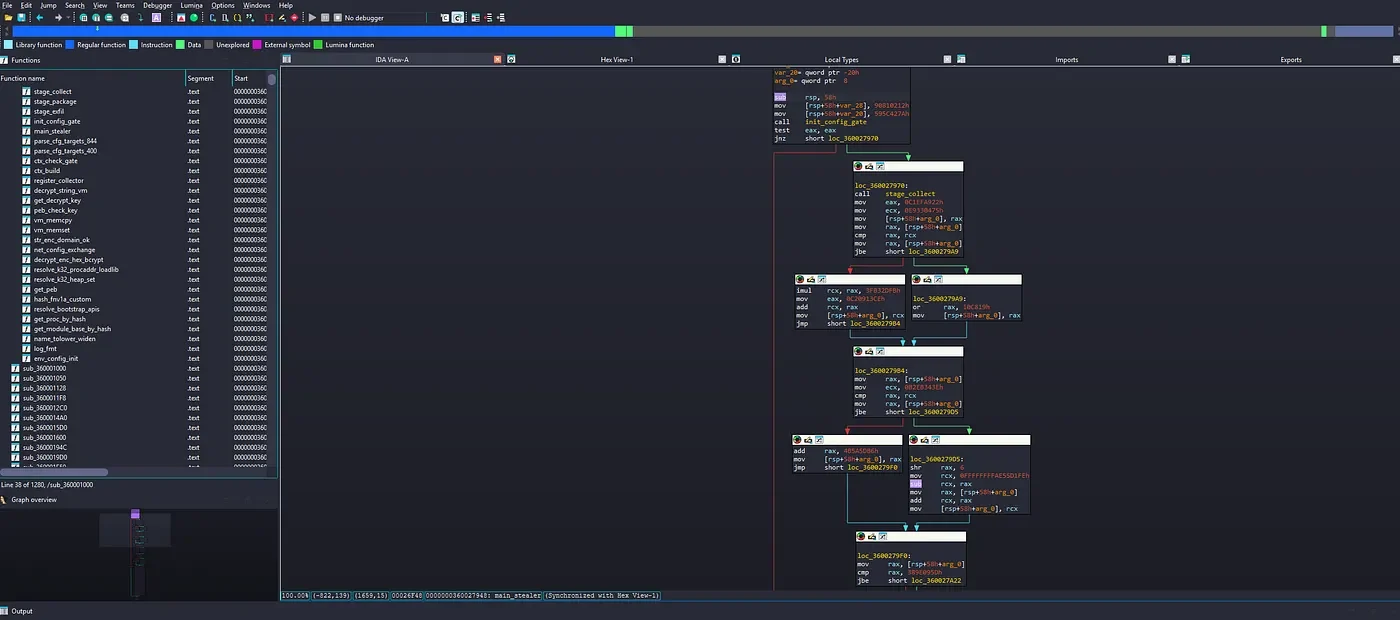
The main routine once the flattening junk is ignored: a gate and then collect, package, exfil.
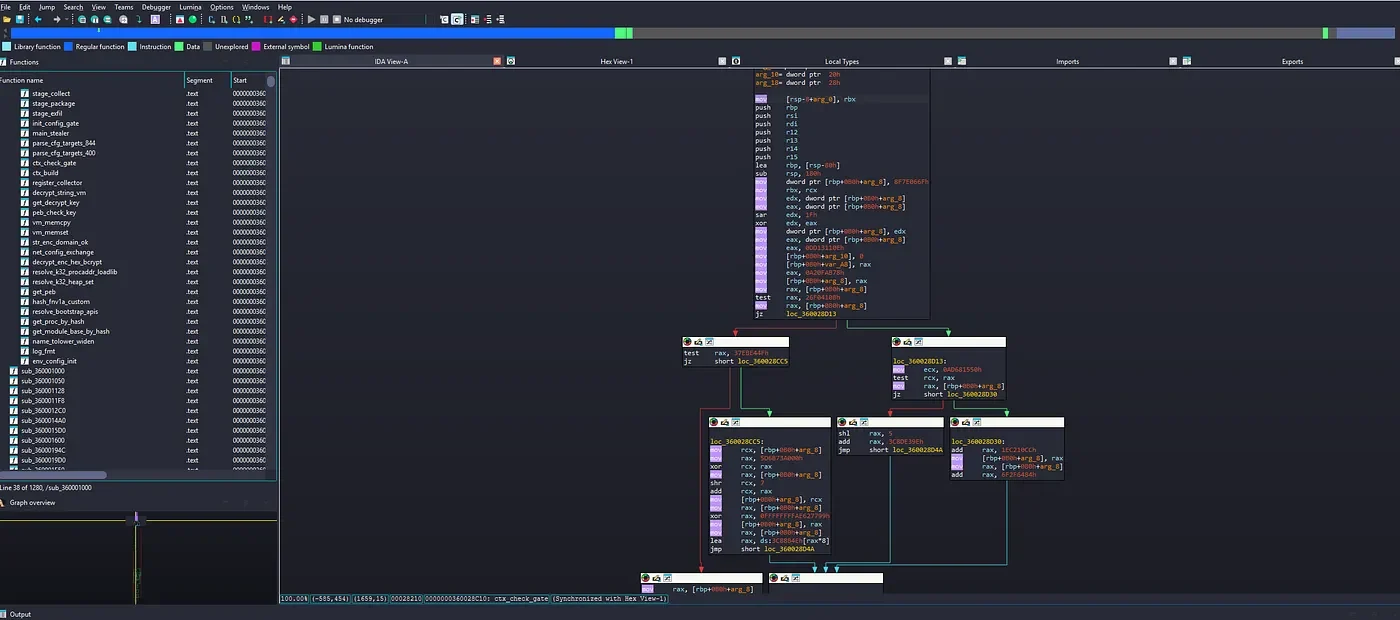
The config gate: it gathers host identifiers and registers the four collector tables before the network step.
The main routine is a gate followed by three stages over one large context struct: collect, package, exfil.
The gate gathers host identifiers (a hardware id, the user, locale), runs the environment and timing anti analysis, and then performs a network config exchange that must succeed or the sample logs an error and quits. A config, parsed in a JSON like format into four typed target tables (browser and credential targets, wallet and app targets, file grabber rules, and a simple list), tunes what runs.
The anti sandbox stage keeps a scorecard, and it logs every line of it:
sb: peb_flags    OK
sb: cpus         %lu FAIL
sb: modules      OK
sb: ram          %lu GB OK
sb: user         %s FAIL
sb: pc           %s OK
sb: sandbox detected - blocking
It checks for named analysis tooling too, Malwarebytes among them, and it will unhook ntdll ("ntdll: unhooked") to defeat userland EDR before it does anything.
The theft targets are hardcoded and now readable:
- Browsers:
cookies.sqlite,formhistory.db,Local Storage\leveldb, the Chrome install path,Recentand Explorer registry paths. - Chrome App-Bound Encryption: the strings expose a full v20 cookie decryption path, launching the browser hidden with
"%s" --no-first-run --disable-gpu about:blank, injecting viaNtQueueApcThreadEx2, and callingCryptUnprotectMemory(with a crypt32 plus dpapi fallback). This is the current technique for beating Chrome's bound cookies, and it is built in. - Messengers: Discord token and v10 key theft, Telegram tdata and Telegram web.
- FTP clients: FileZilla
recentservers.xmland WinSCP. - Cloud tokens: Azure
msal_token_cache.json,TokenCache.dat.
The exfil format is a multipart POST, also recovered, with form fields hwid, build_id, and format set to json, over the hardcoded User-Agent string "Mozilla/5.0 (Windows NT 10.0; Win64; x64) AppleWebKit/537.36 Safari/537.36 Edg/[redacted]". That User-Agent and the "sb:" log lines are strong, low false positive hunting strings.
Step 4: the C2, and the dead drop that hides it
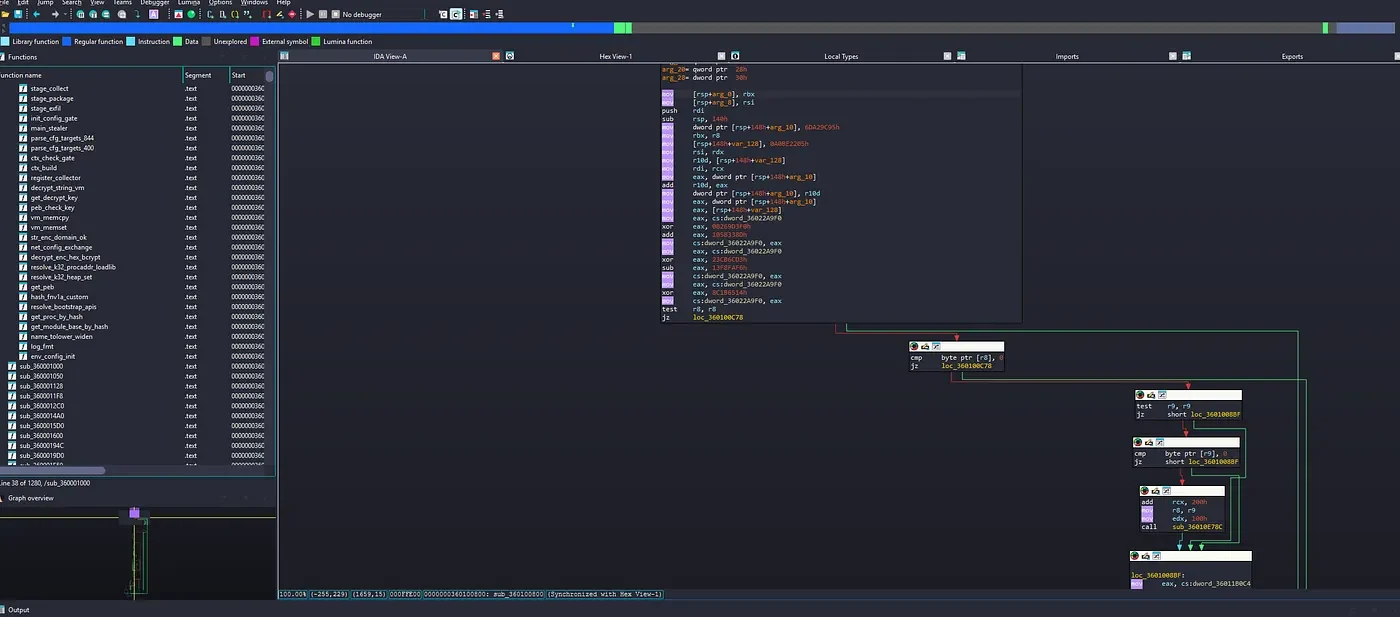
The response parser: it pulls a KEY=VALUE field out of a fetched page, and when the value starts with ENC: it hands the hex blob to the crypto routine.
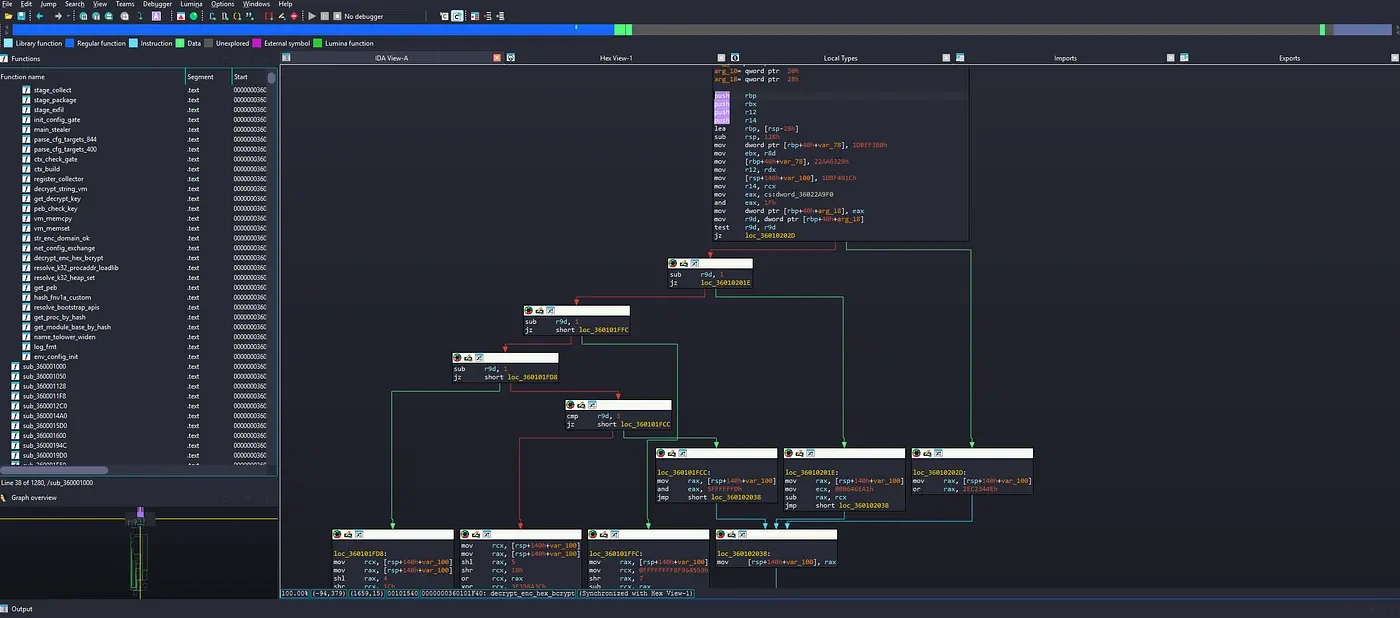
The ENC decrypt: it resolves BCrypt by hash, derives a 32-byte key at runtime, and XORs it against the hex-decoded bytes.
The C2 is not a hardcoded domain, which is why the string VM never produces one. The config loader builds a single endpoint record out of three decrypted values: a resolver URL, a build id, and the User-Agent.
The resolver URL is two layers deep. The string VM produces a 12-byte blob, an 8-byte key and a 4-byte IV, and a second routine uses that as an FNV-seeded keystream to XOR a 32-byte hardcoded blob. Reimplementing both offline gives the lot with no execution at all:
resolver   hxxps[://]www[.]pinterest[.]com/m1duus   (field x4tte)
build_id   [redacted]
version    2.8
This is the classic Vidar dead drop. The stealer fetches that public Pinterest page, pulls a field out of the response, and when the field is "ENC:<hex>" it runs it through the BCrypt routine above to get the real, rotating C2 domain.
Three independent hardcoded blobs, the resolver, the build id, and the version, all decrypting to well-formed values through the same deterministic routine, is its own proof the recovery is right.
The only piece left is the live rotating domain, whatever that Pinterest page serves at request time. By the time of analysis the m1duus account was already gone, which is exactly what a dead drop is for, so the current domain is not observable.
Step 5: the operator's own staging notes
A file named data.txt sits in the web root of the distribution site, and it is still served today:
request    GET hxxps[://]rockstar-gta-6[.]com/data.txt
response   the operator's own staging notes, in plaintext
It was confirmed live with a host-safe, server-side fetch, so the analysis machine never connected to the site. The contents, defanged:
45[.]237[.]85[.]49:9104   login MNMWQV   password 4sdQLN
hxxps[://]www[.]rockstargames[.]com/VI
cd A:\ebanina\gt
python -m http.server 8765
hxxp[://]127[.]0[.]0[.]1[:]8765
This is the operator's workflow, deployed to the web root by mistake.
- 45[.]237[.]85[.]49:9104 with a six-character login and password is a purchased proxy or backconnect node, their anonymization layer. It resolves to AS266820 (HAMMERHEAD DIVE S.A.), an obscure shell ASN, and it is dark now: Shodan indexes no open ports on it. It was never a website, which is why a browser just hangs.
- rockstargames.com/VI is the real Rockstar page they cloned for the fake landing.
- cd A:\ebanina\gt then python -m http.server 8765 on [redacted] is their local payload staging, a throwaway HTTP server off an A: drive. The folder name ebanina is Russian slang, a small language and likely origin tell baked into a path they never meant anyone to see.
The Vidar dead-drop resolver is a Telegram channel in the sandbox-run sample (telegram.me in the ANY.RUN traffic) and a Pinterest account in the one reversed here (pinterest.com/m1duus). Both drops are dead, and no live rotating C2 was observable from any source.
Root cause
The delivery side fails in two distinct ways. On Target A, the ClickFix pattern relies on the victim pasting a clipboard command, and the persistence is disguised as ordinary updater tasks. On Target B, the installer is a heavily obfuscated Vidar build with no import table, API resolution by custom hash, and per-string bytecode VM decryption, which defeats signature and string based detection of the outer file. The server side repacking, if confirmed, means the outer file hash rotates per download, so hash blocklists never catch up; the durable traits are the engine bytes, not the file hash.
The dead drop design means there is no hardcoded C2 domain: the resolver is a public page on a third party platform, and the real domain is fetched at runtime and decrypted with a key derived in memory. The operator's own mistake, leaving data.txt in the web root, is unrelated to the malware's design and is a plain operational hygiene failure.
Impact
The hardcoded theft targets are browser cookies and form history, Chrome App-Bound encrypted cookies via the v20 path, Discord tokens and keys, Telegram tdata and web sessions, FileZilla and WinSCP credentials, Azure token caches, and cryptocurrency wallet files, then exfiltrates them as a multipart POST carrying hwid, build_id and format=json. It unhooks ntdll to defeat userland EDR and blocks execution when its sandbox scorecard trips. The live rotating C2 domain could not be observed because the dead-drop account was gone by the time of analysis; the build id is the durable pivot that outlives it. Nothing here attributes the malware to the cyberleek group or to accounts impersonating them; it concerns whoever ran rockstar-gta-6[.]com, and only what the bytes prove.
Fix
The report provides detection content that survives the repack:
- A YARA rule anchored on two engine traits that live in the Vidar core and survive server side repacking: the full 256 byte S-box of the string VM, and the custom FNV-1a constants
0x010003F1and0x63975773. There is also an exact hash rule for fleet scoping.
import "hash"

/*
  Case GTA6-Lures - Target B payload (Vidar infostealer)
  Detections target the UNPACKED Vidar core: the runtime API resolver and the
  string-decryption VM. These byte-level engine traits survive server-side
  repacking of the outer installer, which only rotates the file hash.
  Sample:
    md5    [redacted]
    sha256 [redacted]
    size   1157120
  All indicators defanged elsewhere, this file is engine bytes only.
*/

rule Vidar_GTA6_installer_exact
{
    meta:
        author      = "devmihaylov"
        description = "Exact file match for the carved gta6_installer Vidar sample"
        case        = "GTA6-Lures"
        reference   = "anyrun [redacted]"
    condition:
        hash.sha256(0, filesize) == "[redacted]"
}

rule Vidar_custom_fnv1a_resolver
{
    meta:
        author      = "devmihaylov"
        description = "Custom FNV-1a used by the API-resolve-by-hash routine (prime 0x010003F1, basis 0x63975773)"
        case        = "GTA6-Lures"
        note        = "PROVISIONAL - generic to this build family, validate before fleet deploy"
    strings:
        $fnv_prime = { F1 03 00 01 }
        $fnv_basis = { 73 57 97 63 }
    condition:
        uint16(0) == 0x5A4D and all of them
}

rule Vidar_string_decrypt_vm_sbox
{
    meta:
        author      = "devmihaylov"
        description = "256-byte substitution table of the Vidar string-decryption byte-VM (opcode 0xB1)"
        case        = "GTA6-Lures"
        note        = "Strong anchor - the full S-box is unique to this string engine"
    strings:
        $sbox = {
            81 6A AF 91 C8 E3 B6 A1 0D 7D 94 67 2C 0C 62 16 DF 66 17 06 4E 00 98 32
            64 D2 99 CB 12 F4 BD 24 B1 DB 0A 78 79 A8 3E 75 F3 19 B5 FA 74 EB 58 9D
            25 CF B4 A6 FF 93 8C 04 6F 28 08 1B 05 F6 C7 2B B7 39 36 9F 3F E4 42 38
            5E 48 01 80 1E 53 02 7E 2E FE CD 8A C5 56 9B 7F AA D0 C0 BE FD 8D FB 1A
            A4 71 89 27 43 90 96 B0 8F C3 F7 EC 31 E9 2D 1D EF E0 EE 92 E7 86 D1 68
            AC 3A 76 0F A3 18 55 DC 87 9A 30 0E 69 A7 E5 33 72 7C E2 4D 83 F1 77 5D
            D4 E6 A0 F2 EA 3C FC CC 6B D9 44 ED A2 D6 4F F5 97 8B 9E 03 C6 2F 41 82
            20 E1 7A 47 CA B8 6C 35 21 60 F8 85 73 C2 F0 A5 5B 5F 46 D5 B2 BB 07 5A
            15 AD 40 49 52 29 11 61 1C AB B3 C1 7B 14 F9 13 63 CE 3B DA 65 34 50 C4
            DD 88 4A 4B 6D 2A 5C DE 10 BC BF 3D D3 22 09 84 8E 23 9C B9 D7 C9 26 0B
            6E A9 E8 BA AE 4C 1F 51 95 45 D8 54 37 59 70 57
        }
    condition:
        $sbox
}

rule Vidar_GTA6_core
{
    meta:
        author      = "devmihaylov"
        description = "Vidar core for Case GTA6-Lures: custom FNV-1a resolver plus string-VM S-box together"
        case        = "GTA6-Lures"
    condition:
        Vidar_custom_fnv1a_resolver and Vidar_string_decrypt_vm_sbox
}
- Sigma rules covering both lures. For Target B, a browser downloading
gta6_installer.exeinto Downloads and it spawning a second copy pluscmd.exe. For Target A,schtaskscreating one minuteiTunesUpdateorSlackUpdatetasks out ofWindows\Temp, and hidden bypass PowerShell spawned from a browser.
title: GTA6 lure - Vidar installer executed from Downloads
id: 6a3d9d2e-7c11-4f0e-9a1b-2f0b6b5c9a01
status: experimental
description: >
  Detects the Target B chain from Case GTA6-Lures: a browser downloads
  gta6_installer.exe from a rockstar/gta6 themed lure domain and it runs from
  the user Downloads folder, spawning a second copy plus cmd.exe. Vidar stealer.
references:
  - anyrun [redacted]
author: devmihaylov
date: 2026/08/20
logsource:
  category: process_creation
  product: windows
detection:
  selection_installer:
    Image|endswith: '\gta6_installer.exe'
    Image|contains: '\Downloads\'
  selection_parent_browser:
    ParentImage|endswith:
      - '\msedge.exe'
      - '\chrome.exe'
      - '\firefox.exe'
  selection_child_cmd:
    ParentImage|endswith: '\gta6_installer.exe'
    Image|endswith: '\cmd.exe'
  condition: selection_installer or selection_parent_browser or selection_child_cmd
falsepositives:
  - None expected; the filename is attacker chosen
level: high
---
title: GTA6 lure - ClickFix scheduled task persistence (Target A)
id: 2b8f1c40-5e6a-49d2-b7c3-9a1e0d4f7c22
status: experimental
description: >
  Detects the Target A ClickFix loader persistence from Case GTA6-Lures:
  schtasks creating one-minute recurring tasks named iTunesUpdate / SlackUpdate
  that launch a payload from C:\Windows\Temp, and hidden ExecutionPolicy-Bypass
  PowerShell spawned from a browser via a pasted clipboard command.
references:
  - anyrun [redacted]
author: devmihaylov
date: 2026/08/20
logsource:
  category: process_creation
  product: windows
detection:
  selection_schtasks:
    Image|endswith: '\schtasks.exe'
    CommandLine|contains|all:
      - '/create'
      - '/sc minute'
      - '/mo 1'
    CommandLine|contains:
      - 'iTunesUpdate'
      - 'SlackUpdate'
      - '\Windows\Temp\'
  selection_clickfix_ps:
    ParentImage|endswith:
      - '\chrome.exe'
      - '\msedge.exe'
    Image|endswith: '\powershell.exe'
    CommandLine|contains|all:
      - '-w'
      - 'hidden'
    CommandLine|contains:
      - 'Bypass'
  condition: selection_schtasks or selection_clickfix_ps
falsepositives:
  - Legitimate admin scheduled tasks are rarely named iTunesUpdate/SlackUpdate at one-minute cadence
level: high
Variants to test
- Pull the same lure URL several times and compare sha256 values. A positive result is a different hash each time with the same size class, which would support the server side repacking theory.
- Run the FNV-1a variant against a wordlist of module and export names. A positive result is a hash match that resolves to a plausible Windows API, which means the resolver can be reversed without execution.
- Reimplement the bytecode VM and S-box offline and decode a known buffer. A positive result is a readable format string, which confirms the key is constant on a normal host.
- Fetch the dead-drop page and look for a
KEY=VALUEfield whose value starts withENC:. A positive result is a hex blob that decrypts to a well-formed domain through the BCrypt routine. - Request
data.txtfrom the web root of a distribution site. A positive result is plaintext staging notes, which exposes the operator's proxy, cloned page and local staging path. - Scan the engine bytes rather than the file hash with the S-box and FNV constants. A positive result is a match on a repacked sample that the exact hash rule misses.
Closing
This site is Vidar wearing a heavy but ordinary custom obfuscator: no imports, API by hash, a string VM, MBA and flattening, and a dead-drop C2 resolver. Static analysis mapped the engine, the full target set, the exfil format, and the hardcoded resolver, build id, and version. The only piece it cannot reach is the live rotating domain, which died with the operator's Pinterest account, and the build id is the durable pivot that outlives it.
Once more for the record, since the leak coverage keeps blurring it: nothing here attributes this malware to the cyberleek group or to the accounts impersonating them. This is about whoever ran rockstar-gta-6[.]com, and only what the bytes prove.
Credits
Huge shoutout to webamon_search on X who made a post regarding the website finding and it tricking people into downloading the infostealer.

What happened, in plain words
In mid August 2026, someone using the name "cyberleek" published gameplay footage from the unreleased game GTA VI. Big leaks like this always attract a second, less friendly crowd. Within days, websites appeared offering "GTA 6 leaks" and "download the build". Some of those sites were not made by fans at all. They were built to hand you a piece of malicious software.
This article is a teardown of one of those sites. A teardown means taking a program apart without running it, reading its instructions the way you would read a very long recipe, to work out exactly what it does. That approach is called static analysis: you look at the file's contents on disk, not at what happens when it runs.
Before going further, three groups need to be kept apart, because news coverage about the leak keeps mixing them up:
- "cyberleek", the group or persona that published the footage. No malware is attributed to them here.
- Whoever registered the fake websites and served the stealers.
Nothing found in this analysis links group 1 to group 2. The article is only about group 2, and only about what the bytes in the file actually show.
Two websites were examined. Both are written in a deliberately broken form, called defanged, so that nobody clicks them by accident. In a defanged address, hxxps stands in for https and [.] stands in for a dot, which stops the text from becoming a working link.
- Target A,
hxxps[://]gta-six-leaks[.]com/, uses a trick called ClickFix. The visitor is walked through a fake "verification" step that quietly copies a command to the clipboard, the invisible holding area your computer uses when you press Ctrl+C. The command is then run with a hidden PowerShell. A hidden PowerShell, Windows' built-in scripting tool, runs the command with a setting called ExecutionPolicy set to Bypass, which means "ignore the safety rules about running scripts". It drops a file called setup.exe and sets itself to start again automatically. The giveaway is two scheduled tasks, named iTunesUpdate and SlackUpdate, both set to fire every single minute out of C:\WINDOWS\Temp. A scheduled task is Windows' built-in alarm clock: it runs a program at a set time or interval. Real iTunes and Slack do not update themselves every minute from a temporary folder. - Target B,
hxxps[://]rockstar-gta-6[.]com/, is the one that was taken apart. It serves a file called gta6_installer.exe. The malware family inside is Vidar, a credential and wallet stealer that has existed since 2018. A stealer is a program whose whole job is to copy your saved passwords, session cookies and cryptocurrency wallet files and send them to someone else.
Setup
The work was static analysis of a Windows 64-bit program, done in a tool called IDA. IDA is a disassembler: it takes a compiled program, which is just numbers to a human, and turns it back into readable assembly, the low-level instruction language the processor actually executes. Two custom scripts were written to automate the tedious parts the obfuscation creates: api_hash_solver.py and string_vm.py. A third, extract_strings_ida.py, walks the binary and rebuilds every hidden piece of text. The recovered strings and the extractor live in a local case folder as decrypted-strings.txt.
One precondition shapes everything below. The file analysed here is not the file in the public sandbox report. A sandbox is an isolated, instrumented computer used to run suspicious files safely and record what they do; ANY.RUN is a well-known online sandbox service. The ANY.RUN report for Target B is built around one file hash. A hash is a short fingerprint computed from a file's contents: change one byte and the fingerprint changes completely. The file pulled from the site has a different sha256, which is one particular kind of fingerprint. They are not the same bytes.
The most likely explanation, and a finding worth publishing on its own, is server side repacking: the website rebuilds the payload fresh for every download, so the file fingerprint keeps changing and blocklists built on fingerprints never catch up. Until that is confirmed by pulling the file a few more times, nothing observed in this binary is attributed to the ANY.RUN run, and the other way around. Two samples, one campaign.
file we analyzed   [redacted]
size               1157120 bytes
compiled           2026-08-05 12:50:41 UTC
imagebase          0x360000000 (non standard)
Line by line:
file we analyzedis the sha256 fingerprint of the exact file examined here. Anyone with the same file can check this value and know they have identical bytes.sizeis how big the file is: 1,157,120 bytes, a little over one megabyte.compiledis the date and time the program was built, 5 August 2026 at 12:50:41 UTC. UTC is the world's reference clock, so this is comparable across time zones.imagebaseis the address in memory where the program expects to be loaded.0x360000000is unusual; most Windows programs load at a much lower, standard address. The note "non standard" flags that. This matters later: every address in the recovered string table starts with0x3600, which is a direct consequence of this unusual base.
Finding it
First look: obfuscated, not packed.
The entry point start() sits under Mixed Boolean Arithmetic. The entry point is the first function that runs when the program launches. Mixed Boolean Arithmetic, usually shortened to MBA, is a trick where simple maths is rewritten as a long chain of equivalent but confusing operations, so the result is the same but the code is unreadable. The wall of mov, xor and imul instructions writing into var_XX slots feeds nothing; it is there to bury the four calls that actually matter. mov copies a value, xor combines two values bit by bit, imul multiplies, and a "call" jumps into another function. Four real calls are hidden among dozens of pointless ones.
The loaded-module anti-analysis walk reads each PEB module's BaseDllName, hash-matches it against a monitored set, then sleeps and self-terminates on a hit. The PEB, or Process Environment Block, is a data structure Windows keeps for every running program; it lists the program's settings and every library loaded into it. A module here means a loaded library file, usually ending in .dll. BaseDllName is the field holding that library's file name. The malware reads each name, computes a fingerprint of it, compares it against a list of names it dislikes, and if it finds a match it waits a while and then kills itself. That is anti-analysis: it is checking whether it is being watched by a tool.
Entropy across .text sits around 5.73. Entropy is a measure of randomness: low means predictable, high means scrambled. .text is the section of a program that holds its executable code. If this file were packed or encrypted, entropy would be near 8.0, the maximum. Packing means compressing or encrypting a program so its real code is hidden until it runs. So the code here is plain 64-bit Windows code, made unreadable on purpose by four techniques stacked together:
- No import table at all, the imphash is empty. The import table is the list of outside functions a program says it needs, like a shopping list attached to the file. The imphash is a fingerprint of that list, used by defenders to group similar malware. An empty one means the program declares nothing. Every Windows API is resolved at runtime instead. An API, or Application Programming Interface, is a set of functions the operating system offers to programs: "create a file", "read the clipboard", "open a network connection". Normally a program lists the ones it wants up front; this one looks them up secretly while running. Five places read
gs:[0x60], the 64-bit Windows way to reach the PEB and walk the loaded module list without an import directory. - Mixed Boolean Arithmetic: a global variable labelled the junk PRNG is churned with dozens of pointless arithmetic lines in almost every function. A PRNG is a pseudo-random number generator, a function that produces numbers that look random. It feeds nothing, and once you learn to ignore it, functions shrink by 80 percent.
- Control flow flattening: the real order of operations is hidden behind switch dispatchers keyed on obfuscated values. A switch dispatcher is a construct that picks one of many branches based on a value. Normally code runs top to bottom; here every step is routed through a central chooser, so reading it in order tells you nothing.
- Timing anti-analysis: over twenty
rdtscreads, used as opaque predicates and as single step detection.rdtscis a processor instruction that reads a hardware cycle counter, effectively a very precise clock. An opaque predicate is a condition whose answer is always the same but which the reader cannot easily work out, used to hide which branch really runs. Single step detection means noticing that a debugger, a tool that runs code one instruction at a time, is slowing execution down.
IDA recovers only eight readable strings from a 1.1 MB stealer. A string is a piece of text inside a program, such as a file name or an error message. Everything that matters is encrypted, so the whole job comes down to two questions: how does it resolve APIs, and how does it decrypt strings. Break those two and the binary opens up.
Exploitation
Step 1: the API resolver, a custom FNV-1a by hash
The export-directory parser: the cmp eax, 5A4Dh check (MZ) and the [rax+3Ch] read (e_lfanew) are the start of walking a module's export table. An export table is the list of functions a library offers to other programs, like a menu. MZ is the two-letter marker at the start of every Windows executable file. e_lfanew is a field that says where the real header of the file begins. So this code is checking "is this a Windows program?" and then jumping to its internal directory of functions.
The custom hash: mov r9d, 63975773h is the offset basis, and the loop multiplies by 0x010003F1. A hash here is a short number computed from a name, used as a stand-in for the name itself. The offset basis is the starting value of that calculation, and the multiplier is the number each step is multiplied by.
The bootstrap resolves and caches GetProcAddress, LoadLibraryA, and the heap set from ntdll and kernel32. A bootstrap is the first small piece of code that gets everything else going. GetProcAddress is the Windows function that finds a function inside a library; LoadLibraryA loads a library into memory. ntdll and kernel32 are core Windows libraries. The heap is the area of memory a program uses for temporary data, and the heap set are the functions that allocate and free it.
Two routines do the work. The first walks PEB->Ldr->InMemoryOrderModuleList, a chain of records listing every library loaded into the process, and for each module lowercases the base name, hashes it, and returns the module base when the hash matches a requested value. The second takes a module base, parses the export directory the normal way (MZ and PE checks, export table at e_lfanew + 0x88, walk AddressOfNames, map through AddressOfNameOrdinals into AddressOfFunctions), hashes each export name, and returns the function it wants. Forwarded exports are handled too. A forwarded export is an entry that says "the real function lives in another library", and handling it means following that pointer.
The hash is a 32-bit FNV-1a variant with non standard constants. FNV-1a is a well-known, simple hashing recipe; a variant means the recipe was altered, here by swapping the usual numbers for its own.
h = 0x63975773
for each byte b:  h = ((h XOR b) * 0x010003F1) mod 2^32
Line by line:
h = 0x63975773sets the starting value of the running numberh. The0xprefix means the number is written in hexadecimal, base 16.for each byte bmeans the calculation repeats once for every byte of the name being hashed.h XOR bmixes the current byte intohusing XOR, a bit-by-bit operation that is reversible and cheap.* 0x010003F1multiplies the result by a fixed number, which spreads the bits around so small changes in the name produce very different results.mod 2^32keeps the result inside 32 bits, that is, wraps it around at 4,294,967,296, so the number never grows beyond what a 32-bit register holds.
Module names are lowercased before hashing, export names are hashed as is. That is enough to brute force any hash against a wordlist. Brute forcing means trying every candidate until one matches; a wordlist is just a long list of likely names. So a defender can take a list of Windows function names, hash each one with this recipe, and see which hash in the malware corresponds to which function. The bootstrap resolves and caches the classic Vidar starter set, then resolves everything else on demand:
ntdll.dll        0x7A6E9517
kernel32.dll     0x76AADBD3
GetProcAddress   0x1CBF76CD
LoadLibraryA     0x549BA99B
GetModuleHandleA 0x537CC144
ExitProcess      0xBCA384B8
GetProcessHeap   0xB90B6962
HeapAlloc        0xE7364482
HeapReAlloc      0x69534635
HeapFree         0xD74F873B
Line by line:
ntdll.dllandkernel32.dllare the two core Windows libraries whose hashes the malware looks for first, so it can find them without an import table.GetProcAddressfinds a function inside a library;LoadLibraryAloads a library;GetModuleHandleAreturns the memory address of an already loaded library.ExitProcessends the program, used when the anti-analysis checks decide to quit.GetProcessHeap,HeapAlloc,HeapReAllocandHeapFreeare the memory management set: get the program's heap, reserve a block, resize a block, release a block.- The hex number on each line is the fingerprint the malware compares against. If a name hashes to that value, it is the function the malware wants.
Step 2: the string decryptor is a tiny bytecode VM
The VM dispatch loop: call get_decrypt_key seeds the state, lea rcx, qword_360254AA0 loads the handler table, and the [rcx+rax*8] read jumps to the handler for each opcode byte. A VM, or virtual machine, here means a small interpreter built into the malware: instead of machine instructions, it reads its own private instruction set. An opcode is one such private instruction number. The handler table is a list of code addresses, one per opcode, and the [rcx+rax*8] read picks the right entry by multiplying the opcode by 8, the size of an address, and adding it to the table's start.
The table build: each qword_360254AA0[opcode] = handler line wires up one of the 14 operations. In plain words, the program fills in its own menu of 14 actions before it starts using them.
This is the interesting part. Strings are not XOR blobs. XOR is a simple reversible mixing operation often used to hide text; a blob is just a lump of bytes. Each string lives inside its own small function as a ciphertext buffer, meaning the encrypted bytes sit right there in the code. A shared routine decrypts it into a heap allocation and caches the pointer, so the same string is only decrypted once. That shared routine is a byte virtual machine: each ciphertext byte is an opcode into a 256-entry handler table, and a one-byte running state is transformed until an emit opcode outputs a plaintext byte. Plaintext means the readable result. There are 14 opcodes:
0x06 state = state * 0xCB          0x17 state ^= keybyte[out_idx & 3]
0x28 state -= next cipher byte     0x30 state ^= 0xD9
0x39 state ^= next cipher byte     0x49 rotate right 3
0x89 rotate left 1                 0x94 state = NOT state
0x96 state ^= (out_idx & 0xFF)     0xA1 state ^= previous output byte
0xB1 state = SBOX[state]           0xD6 state += next cipher byte
0xEA state += 13                   0xF2 EMIT: out = next ^ state, then state ^= out
Line by line, each line is one opcode and what it does to the running state:
0x06multiplies the state by0xCB, scrambling it.0x17mixes in one byte of the key, cycling through the key's four bytes usingout_idx & 3.0x28subtracts the next ciphertext byte from the state.0x30mixes in the fixed value0xD9.0x39mixes in the next ciphertext byte.0x49rotates the bits of the state right by 3 positions, moving bits off one end back to the other.0x89rotates the bits left by 1.0x94flips every bit of the state, the NOT operation.0x96mixes in the position of the output byte, masked to 8 bits with& 0xFF.0xA1mixes in the byte that was output just before.0xB1looks the state up in a substitution box, or SBOX: a fixed 256-entry table that swaps each byte value for another. This is the strongest fingerprint of the whole engine.0xD6adds the next ciphertext byte to the state.0xEAadds 13 to the state.0xF2is EMIT: it produces one plaintext byte by XORing the next ciphertext byte with the state, then mixes that output byte back into the state so the next byte comes out differently.
The key comes from a routine that validates two PEB fields and returns 0x6B519DF3 on any real machine (and 0xDEADBEEF on failure, which doubles as an anti-tamper check). Anti-tamper means noticing if someone has modified the program or is running it somewhere fake. Because that key is constant on a normal host, the whole scheme is reproducible offline: a defender can rebuild the same machine on their own computer and decrypt everything without ever running the malware.
Reimplementing the VM and the S-box and decoding a buffer confirmed it, producing "%s=== Sandbox Check ===%s", one of the malware's own log format strings. A format string is text with placeholders like %s that get filled in later. Judging by output, it is most likely a vibecoded AI slop infostealer: "vibecoded" means written largely by asking an AI assistant for code and accepting the result. This build ships a full verbose logger left in, meaning it writes detailed progress messages as it works, which is a gift for analysis.
With the VM working, an IDA script finds every one of the 266 calls to the decryptor, rebuilds each inline ciphertext, and runs it. That turns eight readable strings into the whole behaviour of the sample. Here is the full list of decrypted strings:
0x360039444  'C2: block received'
0x36003EA24  'ENC domain decrypted OK'
0x36004194C  '------%s\r\nContent-Disposition: form-data; name="hwid"\r\n\r\n%s\r\n------%s\r\nContent-Disposition: form-data; name="build_id"\r\n\r\n%s\r\n------%s\r\nContent-Disposition: form-data; name="format"\r\n\r\njson\r\n------%s--\r\n'
0x36004B77C  'RmRegisterResources'
0x36004DAE0  'grabber_size_max'
0x36004F700  'ALLUSERSPROFILE'
0x360050700  'Software\\Microsoft\\Windows\\CurrentVersion\\Explorer'
0x3600532CC  'Mozilla/5.0 (Windows NT 10.0; Win64; x64) AppleWebKit/537.36 Safari/537.36 Edg/[redacted]'
0x3600592CC  '%s=== Sandbox Check ===%s'
0x360059A94  '  ntdll: unhooked'
0x36005B2B4  'sb: peb_flags    OK'
0x36005C078  'sb: cpus         %lu FAIL'
0x36005CCEC  'sb: modules      OK'
0x36005D534  'sb: ram          %lu GB OK'
0x36005F610  'sb: user         %s FAIL'
0x360060010  'G9S1W[5t,I\x05ñ'
0x3600605B0  'sb: pc           %s OK'
0x360063708  'sb: sandbox detected - blocking'
0x3600658E8  'parse_response: invalid token'
0x360069680  'Config %s: empty response'
0x36006D150  'éÀ=&o6S}6é\x97"'
0x36006EF38  'Ä\x04\x906&üm\n\\/F:'
0x3600742E0  'AV: Malwarebytes'
0x360074CD4  'û<3Ál|g2w"\x12X'
0x3600753EC  'Mutex acquired on attempt %d/%d'
0x3600783E4  'SKIP %s [read failed]'
0x360078BEC  '%s%s %s %s[%s]%s'
0x36007C2BC  'Soft\\Azure\\msal_token_cache.json'
0x36007CC80  'TokenCache.dat'
0x36007E890  '²éFnU\x98cf^\x149 '
0x36008014C  'cookies.sqlite'
0x360080E94  'formhistory.db'
0x360085B54  '  [files_copy] queued: %d files'
0x360089D0C  '  [keys] NtQueueApcThreadEx2 not found'
0x36008F764  '  v20: APC decrypt pid %lu...'
0x36009005C  '  v20: APC failed pid %lu'
0x360097054  'rJ\xa0}:iEÐØøiN'
0x360099934  '  [keys] CryptUnprotectMemory not found (crypt32+dpapi)'
0x36009C170  '  [v10] not found'
0x36009CB08  '  %s[v20]%s %s'
0x36009CF98  '  [v20] FAIL (pid=%lu, procs=%d, launched=%s)'
0x36009FF1C  'C:\\Program Files\\Google\\Chrome\\Application\\'
0x3600A2D34  '  v20: scan %lu regions, %lu threads'
0x3600A385C  '  v20: early stop (score >= 3, poll %d)'
0x3600A4E60  'C2 unavailable'
0x3600A7084  '  version: %s, build: %s'
0x3600AAFD0  'úlÙdA˾/)<3p'
0x3600AE5E8  '"%s" --no-first-run --disable-gpu about:blank'
0x3600B0900  'Firefox Plugins'
0x3600B0DD4  '  apc: no threads for pid %lu'
0x3600B2334  '  v20_com: launching %s hidden...'
0x3600B3A0C  '  v20_com: browser pid %lu'
0x3600B4838  '  v20_com: scanning (no fork)...'
0x3600B60A4  '  v20_com: key OK'
0x3600B74A4  'FileZilla\\recentservers.xml'
0x3600B9820  '  FTP/SSH: WinSCP %d, FileZilla %d'
0x3600BA8B0  '  pool: %d threads'
0x3600BC434  'Soft: WinSCP\nHost: '
0x3600BF02C  '%LOCALAPPDATA%'
0x3600BFC34  '%PROGRAMFILES%'
0x3600C1080  'Microsoft\\Windows\\Recent'
0x3600C33DC  '  Grabber: queued %d files (%d handle steal)'
0x3600C9D70  'Loader: %d/%d tasks done'
0x3600CC028  '  [social] discord...'
0x3600CC694  '  [keys] starting...'
0x3600CCCB8  '  [social] telegram tdata...'
0x3600CD548  '  [social] telegram web...'
0x3600CE5AC  'Discord: v10 key [%d] %s'
0x3600D00C4  '  Discord: BCrypt unavailable'
0x3600D1188  'Local Storage\\leveldb'
0x3600D1ACC  'Soft\\Discord\\tokens.txt'
0x3600D4988  'NtQueryVirtualMemory'
0x3600D9DC4  'loginusers.vdf'
0x3600DB688  '[redacted]+/'
0x3600DEC18  'number_of_accounts'
0x3600E4A70  'SOFTWARE\\Microsoft\\Windows NT\\CurrentVersion'
0x3600E63B0  'CurrentBuildNumber'
0x3600E7204  '%s %s (Build %s)'
0x3600E9D88  'ProcessorNameString'
0x3600ED23C  'MachineID: %s\n'
0x3600ED678  '(\x9d¬-a{Ëm¤7:y'
0x3600EE8D8  'cryptocurrency'
0x3600F1280  '  resolution: %s'
0x3600F34E0  'Processor: %s\n'
0x3600F7804  '  Crypto: copied %d files (%d handle steal)'
0x3600FA324  '\r\nContent-Disposition: form-data; name="l"\r\n\r\n'
0x3600FB420  'Content-Type: multipart/form-data; boundary=----%s\r\nCache-Control: no-cache\r\n'
What this list tells you, in plain words:
- The first column is the memory address where the string was found. Every one begins
0x3600, which follows from the unusual image base noted in the setup. C2: block receivedandENC domain decrypted OKshow the program talks to a C2, short for command and control, the server the attacker uses to give instructions or receive stolen data.- The long line with
Content-Disposition: form-datais the template for a web form upload. It names three fields:hwid, a hardware identifier for the victim's machine;build_id, which version of the malware is running; andformat, set tojson. JSON is a common text format for structured data. This is how stolen data is packaged for sending. RmRegisterResourcesis a Windows function name the malware references.grabber_size_maxis a setting name, a limit on how much file data the grabber will take. A grabber is the part that copies files.ALLUSERSPROFILE,%LOCALAPPDATA%,%PROGRAMFILES%are Windows environment variables, named shortcuts to standard folders.- The
Software\\Microsoft\\Windows\\CurrentVersion\\ExplorerandMicrosoft\\Windows\\Recentlines are registry paths. The registry is Windows' central settings database, and these particular keys record recently used files. - The
Mozilla/5.0 ... Edg/[redacted]line is a User-Agent, the text a browser sends to identify itself. The malware pretends to be Microsoft Edge so its traffic looks ordinary. - The
sb:lines are the sandbox scorecard, covered in the next step. ntdll: unhookedrefers to unhooking, explained below.Mutex acquired on attempt %d/%drefers to a mutex, a Windows lock that ensures only one copy of a program runs at a time. The%dplaceholders are numbers filled in at runtime.cookies.sqliteandformhistory.dbare browser database files: one holds cookies, the other what you have typed into web forms.Local Storage\\leveldbis where browsers keep website data for modern web apps.C:\\Program Files\\Google\\Chrome\\Application\\is Chrome's install folder.- The
v20,NtQueueApcThreadEx2,CryptUnprotectMemoryandcrypt32+dpapilines belong to the Chrome cookie decryption path, explained in the next step. Soft\\Azure\\msal_token_cache.jsonandTokenCache.datare files where Microsoft cloud login tokens are cached. A token here is a temporary credential, like a wristband that proves you already logged in.FileZilla\\recentservers.xmlholds saved FTP server logins. FTP is an old file transfer protocol, and WinSCP is a similar program for copying files to servers.Soft\\Discord\\tokens.txt,[social] discord...,[social] telegram tdata...and[social] telegram web...are the messenger targets: Discord login tokens, and Telegram's local data and web session.loginusers.vdfis a file the malware targets.[redacted]+/is the Base64 alphabet, the character set used to encode binary data as text.cryptocurrency,Crypto: copied %d files,number_of_accountsandresolutionare wallet and system profiling strings.SOFTWARE\\Microsoft\\Windows NT\\CurrentVersion,CurrentBuildNumber,ProcessorNameStringandMachineIDare used to fingerprint the machine: Windows version, processor name, machine identifier.- The lines that look like random symbols, such as
G9S1W[5t,I\x05ñ, are buffers that did not decode to readable text. They are listed as found.
Step 3: the architecture, and what the strings gave up
The main routine once the flattening junk is ignored: a gate and then collect, package, exfil. Exfil, short for exfiltration, means sending stolen data out.
The config gate: it gathers host identifiers and registers the four collector tables before the network step. A config is a settings file the malware fetches, telling it what to steal. A collector is a module that gathers one kind of data.
The main routine is a gate followed by three stages over one large context struct: collect, package, exfil. A struct is a bundle of related variables kept together in memory.
The gate gathers host identifiers (a hardware id, the user, locale), runs the environment and timing anti analysis, and then performs a network config exchange that must succeed or the sample logs an error and quits. A config, parsed in a JSON-like format into four typed target tables (browser and credential targets, wallet and app targets, file grabber rules, and a simple list), tunes what runs. In plain words: before stealing anything, the malware asks its server what to steal, and if the server does not answer, it gives up.
The anti sandbox stage keeps a scorecard, and it logs every line of it:
sb: peb_flags    OK
sb: cpus         %lu FAIL
sb: modules      OK
sb: ram          %lu GB OK
sb: user         %s FAIL
sb: pc           %s OK
sb: sandbox detected - blocking
Line by line:
sb: peb_flags OKis one of the scorecard lines the sample logs.sb: cpus %lu FAILis one of the scorecard lines the sample logs.sb: modules OKis one of the scorecard lines the sample logs.sb: ram %lu GB OKis one of the scorecard lines the sample logs.sb: user %s FAILis one of the scorecard lines the sample logs.sb: pc %s OKis one of the scorecard lines the sample logs.sb: sandbox detected - blockingis the verdict line: if enough checks fail, the program stops.
It checks for named analysis tooling too, Malwarebytes among them, and it will unhook ntdll ("ntdll: unhooked") to defeat userland EDR before it does anything. Unhooking means restoring a clean copy of a Windows library that security software had modified to watch function calls. EDR, endpoint detection and response, is the class of software that watches a computer for malicious behaviour. Userland means the ordinary, non-kernel part of the system where most programs run.
The theft targets are hardcoded and now readable:
- Browsers:
cookies.sqlite,formhistory.db,Local Storage\leveldb, the Chrome install path,Recentand Explorer registry paths. - Chrome App-Bound Encryption: the strings expose a full v20 cookie decryption path, launching the browser hidden with
"%s" --no-first-run --disable-gpu about:blank, injecting viaNtQueueApcThreadEx2, and callingCryptUnprotectMemory(with a crypt32 plus dpapi fallback). This is the current technique for beating Chrome's bound cookies, and it is built in. App-Bound Encryption is a Chrome feature that ties cookie encryption to the Chrome program itself, so a thief cannot simply copy the cookie file and decrypt it elsewhere. The malware gets around it by starting Chrome hidden, injecting code into it withNtQueueApcThreadEx2(a Windows function that makes a running program execute code you supply), and asking Chrome's own decryption function,CryptUnprotectMemory, to unlock the data. A fallback is a second method tried if the first fails; crypt32 and dpapi are the Windows libraries that hold those decryption functions. - Messengers: Discord token and v10 key theft, Telegram tdata and Telegram web.
- FTP clients: FileZilla
recentservers.xmland WinSCP. - Cloud tokens: Azure
msal_token_cache.json,TokenCache.dat.
The exfil format is a multipart POST, also recovered, with form fields hwid, build_id, and format set to json, over the hardcoded User-Agent string "Mozilla/5.0 (Windows NT 10.0; Win64; x64) AppleWebKit/537.36 Safari/537.36 Edg/[redacted]". A POST is the web request a browser makes when it submits a form; multipart means the request is split into labelled parts, like a parcel with several compartments. That User-Agent and the "sb:" log lines are strong, low false positive hunting strings: text so distinctive that finding it almost certainly means this malware, with few innocent explanations.
Step 4: the C2, and the dead drop that hides it
The response parser: it pulls a KEY=VALUE field out of a fetched page, and when the value starts with ENC: it hands the hex blob to the crypto routine. A parser is code that reads text and extracts the parts it wants. Hex means hexadecimal text, a way of writing raw bytes as characters.
The ENC decrypt: it resolves BCrypt by hash, derives a 32-byte key at runtime, and XORs it against the hex-decoded bytes. BCrypt is the Windows cryptography library. Deriving a key means computing it from other data rather than storing it.
The C2 is not a hardcoded domain, which is why the string VM never produces one. A domain is the readable part of a web address, like example.com. The config loader builds a single endpoint record out of three decrypted values: a resolver URL, a build id, and the User-Agent. A resolver here is a page the malware reads to learn where its real server is.
The resolver URL is two layers deep. The string VM produces a 12-byte blob, an 8-byte key and a 4-byte IV, and a second routine uses that as an FNV-seeded keystream to XOR a 32-byte hardcoded blob. An IV, initialisation vector, is a starting value that makes encryption output different each time. A keystream is a long sequence of bytes generated from a key and used to scramble data by XOR. Reimplementing both offline gives the lot with no execution at all:
resolver   hxxps[://]www[.]pinterest[.]com/m1duus   (field x4tte)
build_id   [redacted]
version    2.8
Line by line:
resolveris the web page the malware will read to find its real server. Here it is a Pinterest profile page, defanged.field x4tteis the name of the field on that page the malware looks for.build_idis a long identifier for this particular build of the malware. It is the value the malware sends home in its upload form.versionis the malware's own version number, 2.8.
This is the classic Vidar dead drop. A dead drop is a hiding place where two parties leave messages without meeting; here, the malware reads a public page on a normal website instead of contacting a suspicious server directly. The stealer fetches that public Pinterest page, pulls a field out of the response, and when the field is "ENC:<hex>" it runs it through the BCrypt routine above to get the real, rotating C2 domain. Rotating means the domain changes over time, so blocking one does not help for long.
Three independent hardcoded blobs, the resolver, the build id, and the version, all decrypting to well-formed values through the same deterministic routine, is its own proof the recovery is right. Deterministic means the same input always gives the same output.
The only piece left is the live rotating domain, whatever that Pinterest page serves at request time. By the time of analysis the m1duus account was already gone, which is exactly what a dead drop is for, so the current domain is not observable.
Step 5: the operator's own staging notes
A file named data.txt sits in the web root of the distribution site, and it is still served today. The web root is the folder a web server publishes to the internet; anything placed there can be downloaded by anyone who knows the address.
request    GET hxxps[://]rockstar-gta-6[.]com/data.txt
response   the operator's own staging notes, in plaintext
Line by line:
request GETis a simple web request asking for a file, the same kind your browser makes when you open a page.- The address is the distribution site plus
/data.txt, the file name. responseis what came back: the operator's own notes about how they set things up, in plaintext, meaning unencrypted and readable.
It was confirmed live with a host-safe, server-side fetch, so the analysis machine never connected to the site. A server-side fetch means a separate machine fetched the file on the researcher's behalf, so the researcher's own computer never touched the malicious site. The contents, defanged:
45[.]237[.]85[.]49:9104   login MNMWQV   password 4sdQLN
hxxps[://]www[.]rockstargames[.]com/VI
cd A:\ebanina\gt
python -m http.server 8765
hxxp[://]127[.]0[.]0[.]1[:]8765
Line by line:
45[.]237[.]85[.]49:9104is an IP address and port, with a login and password. An IP address is a computer's numeric address on the internet; a port is the numbered door on that computer a service listens at.hxxps[://]www[.]rockstargames[.]com/VIis a real Rockstar Games web address, the page they copied to make their fake landing page look genuine.cd A:\ebanina\gtchanges directory, the command-line way of moving into a folder, here a folder on an A: drive.python -m http.server 8765starts a tiny web server using Python, a programming language, serving whatever is in the current folder on port 8765.hxxp[://]127[.]0[.]0[.]1[:]8765is the address of that little server.[redacted]always means "this computer", so it is only reachable from the machine itself.
This is the operator's workflow, deployed to the web root by mistake.
- 45[.]237[.]85[.]49:9104 with a six-character login and password is a purchased proxy or backconnect node, their anonymisation layer. A proxy is a middleman computer that forwards traffic so the real sender is hidden. It resolves to AS266820 (HAMMERHEAD DIVE S.A.), an obscure shell ASN, and it is dark now: Shodan indexes no open ports on it. An ASN, autonomous system number, identifies which network a block of addresses belongs to; a shell company is a registered company with little real activity behind it. Shodan is a search engine for internet-connected devices. It was never a website, which is why a browser just hangs.
- rockstargames.com/VI is the real Rockstar page they cloned for the fake landing.
- cd A:\ebanina\gt then python -m http.server 8765 on [redacted] is their local payload staging, a throwaway HTTP server off an A: drive. The folder name ebanina is Russian slang, a small language and likely origin tell baked into a path they never meant anyone to see.
The Vidar dead-drop resolver is a Telegram channel in the sandbox-run sample (telegram.me in the ANY.RUN traffic) and a Pinterest account in the one reversed here (pinterest.com/m1duus). Both drops are dead, and no live rotating C2 was observable from any source.
Root cause
The delivery side fails in two distinct ways. On Target A, the ClickFix pattern relies on the victim pasting a clipboard command, and the persistence is disguised as ordinary updater tasks. On Target B, the installer is a heavily obfuscated Vidar build with no import table, API resolution by custom hash, and per-string bytecode VM decryption, which defeats signature and string based detection of the outer file. A signature is a known pattern defenders search for. The server side repacking, if confirmed, means the outer file hash rotates per download, so hash blocklists never catch up; the durable traits are the engine bytes, not the file hash.
The dead drop design means there is no hardcoded C2 domain: the resolver is a public page on a third party platform, and the real domain is fetched at runtime and decrypted with a key derived in memory. The operator's own mistake, leaving data.txt in the web root, is unrelated to the malware's design and is a plain operational hygiene failure.
Impact
The hardcoded theft targets are browser cookies and form history, Chrome App-Bound encrypted cookies via the v20 path, Discord tokens and keys, Telegram tdata and web sessions, FileZilla and WinSCP credentials, Azure token caches, and cryptocurrency wallet files, then exfiltrates them as a multipart POST carrying hwid, build_id and format=json. A cookie is a small file a website stores in your browser to remember who you are, which is why stealing cookies can let an attacker log in as you without your password. It unhooks ntdll to defeat userland EDR and blocks execution when its sandbox scorecard trips. The live rotating C2 domain could not be observed because the dead-drop account was gone by the time of analysis; the build id is the durable pivot that outlives it. A pivot is a fact you can search for to find related activity. Nothing here attributes the malware to the cyberleek group or to accounts impersonating them; it concerns whoever ran rockstar-gta-6[.]com, and only what the bytes prove.
Fix
The report provides detection content that survives the repack:
- A YARA rule anchored on two engine traits that live in the Vidar core and survive server side repacking: the full 256-byte S-box of the string VM, and the custom FNV-1a constants
0x010003F1and0x63975773. There is also an exact hash rule for fleet scoping. YARA is a free tool for writing rules that describe what a malicious file looks like, so scanners can find matches. Fleet scoping means limiting a rule to the machines you actually care about.
import "hash"

/*
  Case GTA6-Lures - Target B payload (Vidar infostealer)
  Detections target the UNPACKED Vidar core: the runtime API resolver and the
  string-decryption VM. These byte-level engine traits survive server-side
  repacking of the outer installer, which only rotates the file hash.
  Sample:
    md5    [redacted]
    sha256 [redacted]
    size   1157120
  All indicators defanged elsewhere, this file is engine bytes only.
*/

rule Vidar_GTA6_installer_exact
{
    meta:
        author      = "devmihaylov"
        description = "Exact file match for the carved gta6_installer Vidar sample"
        case        = "GTA6-Lures"
        reference   = "anyrun [redacted]"
    condition:
        hash.sha256(0, filesize) == "[redacted]"
}

rule Vidar_custom_fnv1a_resolver
{
    meta:
        author      = "devmihaylov"
        description = "Custom FNV-1a used by the API-resolve-by-hash routine (prime 0x010003F1, basis 0x63975773)"
        case        = "GTA6-Lures"
        note        = "PROVISIONAL - generic to this build family, validate before fleet deploy"
    strings:
        $fnv_prime = { F1 03 00 01 }
        $fnv_basis = { 73 57 97 63 }
    condition:
        uint16(0) == 0x5A4D and all of them
}

rule Vidar_string_decrypt_vm_sbox
{
    meta:
        author      = "devmihaylov"
        description = "256-byte substitution table of the Vidar string-decryption byte-VM (opcode 0xB1)"
        case        = "GTA6-Lures"
        note        = "Strong anchor - the full S-box is unique to this string engine"
    strings:
        $sbox = {
            81 6A AF 91 C8 E3 B6 A1 0D 7D 94 67 2C 0C 62 16 DF 66 17 06 4E 00 98 32
            64 D2 99 CB 12 F4 BD 24 B1 DB 0A 78 79 A8 3E 75 F3 19 B5 FA 74 EB 58 9D
            25 CF B4 A6 FF 93 8C 04 6F 28 08 1B 05 F6 C7 2B B7 39 36 9F 3F E4 42 38
            5E 48 01 80 1E 53 02 7E 2E FE CD 8A C5 56 9B 7F AA D0 C0 BE FD 8D FB 1A
            A4 71 89 27 43 90 96 B0 8F C3 F7 EC 31 E9 2D 1D EF E0 EE 92 E7 86 D1 68
            AC 3A 76 0F A3 18 55 DC 87 9A 30 0E 69 A7 E5 33 72 7C E2 4D 83 F1 77 5D
            D4 E6 A0 F2 EA 3C FC CC 6B D9 44 ED A2 D6 4F F5 97 8B 9E 03 C6 2F 41 82
            20 E1 7A 47 CA B8 6C 35 21 60 F8 85 73 C2 F0 A5 5B 5F 46 D5 B2 BB 07 5A
            15 AD 40 49 52 29 11 61 1C AB B3 C1 7B 14 F9 13 63 CE 3B DA 65 34 50 C4
            DD 88 4A 4B 6D 2A 5C DE 10 BC BF 3D D3 22 09 84 8E 23 9C B9 D7 C9 26 0B
            6E A9 E8 BA AE 4C 1F 51 95 45 D8 54 37 59 70 57
        }
    condition:
        $sbox
}

rule Vidar_GTA6_core
{
    meta:
        author      = "devmihaylov"
        description = "Vidar core for Case GTA6-Lures: custom FNV-1a resolver plus string-VM S-box together"
        case        = "GTA6-Lures"
    condition:
        Vidar_custom_fnv1a_resolver and Vidar_string_decrypt_vm_sbox
}
Line by line:
-
import "hash"loads YARA's built-in hashing module, so a rule can compute a file's fingerprint. -
The comment block records the case name, what the rules target, and the sample's md5 and sha256 fingerprints and size. md5 and sha256 are two different fingerprint algorithms; sha256 is the stronger one.
-
rule Vidar_GTA6_installer_exactis the first rule, matching one exact file. -
Its
meta:block is bookkeeping: author, description, case name, and a reference to the ANY.RUN report. -
condition: hash.sha256(0, filesize) == "a8f19..."says: compute the sha256 of the whole file, from byte 0 to the end, and match only if it equals this value. This catches exactly the analysed sample and nothing else. -
rule Vidar_custom_fnv1a_resolvermatches the custom hashing recipe, which survives repacking because it is part of the engine. -
$fnv_prime = { F1 03 00 01 }and$fnv_basis = { 73 57 97 63 }are the two constants from the hash, written as raw bytes in the order they appear in the file. The note marks the rule as provisional: generic to this build family, to be validated before deploying widely. -
condition: uint16(0) == 0x5A4D and all of themmeans: the file must start with the two bytesMZ, the Windows executable marker, and both constants must be present. -
rule Vidar_string_decrypt_vm_sboxmatches the 256-byte substitution table used by the string VM. The note calls it a strong anchor because the full table is unique to this string engine. -
$sbox = { ... }is that table, written as 256 hex bytes. -
condition: $sboxmeans: match if the table is found anywhere in the file. -
rule Vidar_GTA6_corecombines the two engine rules:Vidar_custom_fnv1a_resolver and Vidar_string_decrypt_vm_sbox. It fires only when both engine traits are present, which is a much stronger signal than either alone. -
Sigma rules covering both lures. Sigma is a shared format for describing suspicious behaviour in logs, so the same rule can be translated to many security products. For Target B, a browser downloading
gta6_installer.exeinto Downloads and it spawning a second copy pluscmd.exe. For Target A,schtaskscreating one-minuteiTunesUpdateorSlackUpdatetasks out ofWindows\Temp, and hidden bypass PowerShell spawned from a browser.schtasksis the Windows command-line tool for managing scheduled tasks.
title: GTA6 lure - Vidar installer executed from Downloads
id: 6a3d9d2e-7c11-4f0e-9a1b-2f0b6b5c9a01
status: experimental
description: >
  Detects the Target B chain from Case GTA6-Lures: a browser downloads
  gta6_installer.exe from a rockstar/gta6 themed lure domain and it runs from
  the user Downloads folder, spawning a second copy plus cmd.exe. Vidar stealer.
references:
  - anyrun [redacted]
author: devmihaylov
date: 2026/08/20
logsource:
  category: process_creation
  product: windows
detection:
  selection_installer:
    Image|endswith: '\gta6_installer.exe'
    Image|contains: '\Downloads\'
  selection_parent_browser:
    ParentImage|endswith:
      - '\msedge.exe'
      - '\chrome.exe'
      - '\firefox.exe'
  selection_child_cmd:
    ParentImage|endswith: '\gta6_installer.exe'
    Image|endswith: '\cmd.exe'
  condition: selection_installer or selection_parent_browser or selection_child_cmd
falsepositives:
  - None expected; the filename is attacker chosen
level: high
---
title: GTA6 lure - ClickFix scheduled task persistence (Target A)
id: 2b8f1c40-5e6a-49d2-b7c3-9a1e0d4f7c22
status: experimental
description: >
  Detects the Target A ClickFix loader persistence from Case GTA6-Lures:
  schtasks creating one-minute recurring tasks named iTunesUpdate / SlackUpdate
  that launch a payload from C:\Windows\Temp, and hidden ExecutionPolicy-Bypass
  PowerShell spawned from a browser via a pasted clipboard command.
references:
  - anyrun [redacted]
author: devmihaylov
date: 2026/08/20
logsource:
  category: process_creation
  product: windows
detection:
  selection_schtasks:
    Image|endswith: '\schtasks.exe'
    CommandLine|contains|all:
      - '/create'
      - '/sc minute'
      - '/mo 1'
    CommandLine|contains:
      - 'iTunesUpdate'
      - 'SlackUpdate'
      - '\Windows\Temp\'
  selection_clickfix_ps:
    ParentImage|endswith:
      - '\chrome.exe'
      - '\msedge.exe'
    Image|endswith: '\powershell.exe'
    CommandLine|contains|all:
      - '-w'
      - 'hidden'
    CommandLine|contains:
      - 'Bypass'
  condition: selection_schtasks or selection_clickfix_ps
falsepositives:
  - Legitimate admin scheduled tasks are rarely named iTunesUpdate/SlackUpdate at one-minute cadence
level: high
Line by line:
title,id,status,description,references,author,dateare the rule's identity and notes.status: experimentalmeans it is new and not yet proven in production.logsource: category: process_creation, product: windowssays the rule reads Windows logs of new programs starting. Every time a program starts, Windows can record its name, its parent (the program that started it) and its command line.selection_installermatches a program whose file name ends in\gta6_installer.exeand whose path contains\Downloads\.selection_parent_browsermatches any program started by Edge, Chrome or Firefox.selection_child_cmdmatchescmd.exe, the Windows command prompt, started bygta6_installer.exe.condition: selection_installer or selection_parent_browser or selection_child_cmdfires if any of the three is true.falsepositives: None expected; the filename is attacker chosenmeans the author expects no innocent matches, because no legitimate software is called that.level: highis the severity.---separates the first rule from the second in the same file.- The second rule,
GTA6 lure - ClickFix scheduled task persistence (Target A), targets the other site. selection_schtasksmatchesschtasks.exewhose command line contains/create,/sc minuteand/mo 1(create a task, schedule it by minutes, every 1 minute) plus one ofiTunesUpdate,SlackUpdateor\Windows\Temp\.selection_clickfix_psmatchespowershell.exestarted by Chrome or Edge, with-wandhiddenin its command line (run without a window) andBypassin it (ignore script policy).condition: selection_schtasks or selection_clickfix_psfires on either pattern.- The false positive note explains why: legitimate admin tasks are rarely named iTunesUpdate or SlackUpdate and run every minute.
Variants to test
- Pull the same lure URL several times and compare sha256 values. A positive result is a different hash each time with the same size class, which would support the server side repacking theory.
- Run the FNV-1a variant against a wordlist of module and export names. A positive result is a hash match that resolves to a plausible Windows API, which means the resolver can be reversed without execution.
- Reimplement the bytecode VM and S-box offline and decode a known buffer. A positive result is a readable format string, which confirms the key is constant on a normal host.
- Fetch the dead-drop page and look for a
KEY=VALUEfield whose value starts withENC:. A positive result is a hex blob that decrypts to a well-formed domain through the BCrypt routine. - Request
data.txtfrom the web root of a distribution site. A positive result is plaintext staging notes, which exposes the operator's proxy, cloned page and local staging path. - Scan the engine bytes rather than the file hash with the S-box and FNV constants. A positive result is a match on a repacked sample that the exact hash rule misses.
Closing
This site is Vidar wearing a heavy but ordinary custom obfuscator: no imports, API by hash, a string VM, MBA and flattening, and a dead-drop C2 resolver. Static analysis mapped the engine, the full target set, the exfil format, and the hardcoded resolver, build id, and version. The only piece it cannot reach is the live rotating domain, which died with the operator's Pinterest account, and the build id is the durable pivot that outlives it.
Once more for the record, since the leak coverage keeps blurring it: nothing here attributes this malware to the cyberleek group or to the accounts impersonating them. This is about whoever ran rockstar-gta-6[.]com, and only what the bytes prove.
Credits
Huge shoutout to webamon_search on X who made a post regarding the website finding and it tricking people into downloading the infostealer.
Glossary
- API (Application Programming Interface): a set of functions the operating system or another program offers, such as "create a file" or "open a connection".
- App-Bound Encryption: a Chrome feature that ties cookie encryption to the Chrome program itself, so copied cookie files cannot be decrypted elsewhere.
- ASN (autonomous system number): an identifier for the network a block of internet addresses belongs to.
- Assembly: the low-level instruction language a processor executes, readable by humans only with training.
- Base64: a way of writing binary data using only text characters.
- BCrypt: the Windows cryptography library.
- Bootstrap: the first small piece of code that gets the rest of a program going.
- Brute force: trying every candidate until one matches.
- Build id: an identifier for one particular build of a piece of malware.
- C2 (command and control): the server an attacker uses to send instructions or receive stolen data.
- ClickFix: a trick where a fake verification step copies a command to the clipboard and nudges the victim into running it.
- Collector: a module that gathers one kind of data.
- Config: a settings file the malware fetches, telling it what to steal.
- Control flow flattening: an obfuscation that hides the real order of operations behind a central dispatcher.
- Cookie: a small file a website stores in your browser to remember who you are.
- Dead drop: a public place where messages are left so two parties never meet; here, a public web page the malware reads to find its server.
- Defanged: written so a malicious address or file name cannot be clicked or run, for example
hxxpsand[.]. - Deterministic: the same input always produces the same output.
- Disassembler: a tool that turns a compiled program back into readable assembly.
- Domain: the readable part of a web address, such as example.com.
- EDR (endpoint detection and response): software that watches a computer for malicious behaviour.
- Entropy: a measure of randomness in data; high means scrambled.
- Exfil / exfiltration: sending stolen data out to an attacker.
- Export table: the list of functions a library offers to other programs.
- FNV-1a: a simple, well-known hashing recipe; a variant means its constants were changed.
- Format string: text with placeholders like
%sthat get filled in later. - FTP: an old protocol for transferring files between computers.
- Grabber: the part of a stealer that copies files.
- Hash: a short fingerprint computed from data; change one byte and it changes completely.
- Heap: the area of memory a program uses for temporary data.
- Hex / hexadecimal: a way of writing numbers and bytes using base 16, with the
0xprefix. - Image base: the memory address where a program expects to be loaded.
- Imphash: a fingerprint of a program's import table, used to group similar malware.
- Import table: the list of outside functions a program declares it needs.
- IV (initialisation vector): a starting value that makes encryption output different each time.
- JSON: a common text format for structured data.
- Keystream: a long sequence of bytes generated from a key and used to scramble data.
- MBA (Mixed Boolean Arithmetic): rewriting simple maths as long chains of equivalent but confusing operations.
- Module: a library file loaded into a running program, usually ending in .dll.
- Mutex: a Windows lock that ensures only one copy of a program runs at a time.
- Obfuscation: making code hard to read on purpose without changing what it does.
- Opaque predicate: a condition whose answer is fixed but hard for a reader to work out.
- Opcode: one instruction number in a private instruction set.
- Packing: compressing or encrypting a program so its real code is hidden until it runs.
- Parser: code that reads text and extracts the parts it wants.
- PEB (Process Environment Block): a Windows data structure listing a program's settings and loaded libraries.
- Plaintext: readable, unencrypted data.
- Port: the numbered door on a computer that a service listens at.
- POST: the web request a browser makes when it submits a form.
- PRNG (pseudo-random number generator): a function that produces numbers that look random.
- Proxy: a middleman computer that forwards traffic so the real sender is hidden.
- Registry: Windows' central settings database.
- Repacking: rebuilding a payload fresh for each download so its fingerprint keeps changing.
- Resolver: a page the malware reads to learn where its real server is.
- Rotating domain: a server address that changes over time.
- S-box (substitution box): a fixed table that swaps each byte value for another.
- Scheduled task: Windows' built-in alarm clock that runs a program at a set time or interval.
- Server-side fetch: fetching a file from a separate machine so the researcher's own computer never connects.
- Sha256 / md5: two fingerprint algorithms; sha256 is the stronger one.
- Shodan: a search engine for internet-connected devices.
- Sigma: a shared format for describing suspicious behaviour in logs.
- Static analysis: examining a file's contents without running it.
- Stealer: malware that copies saved passwords, cookies and wallet files and sends them out.
- String: a piece of text inside a program, such as a file name or error message.
- Struct: a bundle of related variables kept together in memory.
- Token: a temporary credential that proves you already logged in.
- Unhooking: restoring a clean copy of a Windows library that security software had modified to watch calls.
- User-Agent: the text a browser sends to identify itself.
- UTC: the world's reference clock, comparable across time zones.
- VM (virtual machine): here, a small interpreter built into the malware that reads its own private instruction set.
- Web root: the folder a web server publishes to the internet.
- Wordlist: a long list of likely names used when brute forcing.
- XOR: a reversible bit-by-bit mixing operation often used to hide data.
- YARA: a free tool for writing rules that describe what a malicious file looks like.



