**The Premium Paradox: A YouTube Music Bug That Worked ONLY in India — Unreproducible in Other Countries!**🌍💀🔥
Certain songs in YouTube Music could be downloaded and played offline without a Premium subscription, but only when the user appeared to be in India. An attacker could share a public playlist of such songs so that any non-Premium user, including those outside India using an India-region VPN, could obtain Premium-only downloads for free.

Cybersecurity
The full write-up lives on its author's site
It belongs to its author, so we link to it rather than copy it. The other two tabs are our own rewrites, checked against it.
Context
YouTube Music lets a listener download tracks for offline playback, but that download button is meant to work only for accounts with a Premium subscription. For a free account, pressing download should produce an upgrade prompt. This write-up is about a case where, for certain songs and only from India, the download went through for a non-Premium account, and the offline playback that followed also worked.
The author is Vasanth, a part-time bug bounty hunter from Madurai, Tamil Nadu, who says he has been acknowledged by Google, Apple, Microsoft, GitHub, Pornhub and more than ten other organisations. The bug was reported to the Google VRP.
Setup
The setup was ordinary: an account without Premium, YouTube Music, and later a company laptop running Windows Virtual Desktop (WVD) whose OS and apparent location were in the USA, plus a personal laptop with VPN access. No special tooling, intercepting proxy or modified client is described. The precondition for the finding was a free account, the download button and, as it turned out, the right song.
Finding it
On the evening of 7 February 2026 the author had been on a call with a friend, Usman, discussing an earlier YouTube finding about members-only video views leaking in the page source. They moved to Google Meet at 9 PM, the call ended around 12 AM, and he opened YouTube Music to listen to something before sleeping.
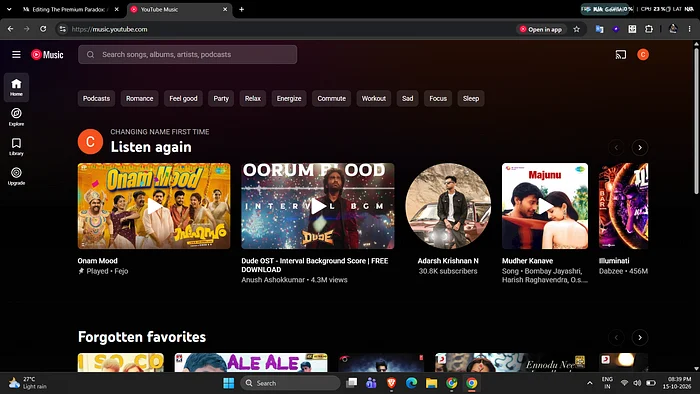
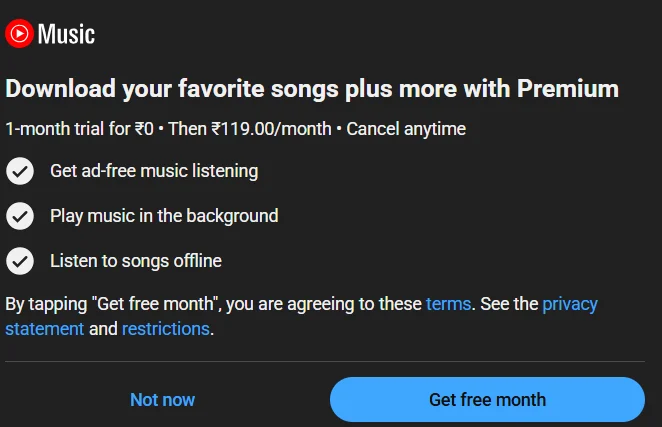
He searched for a song and pressed the download button. As expected for a free account, the premium upgrade message appeared.
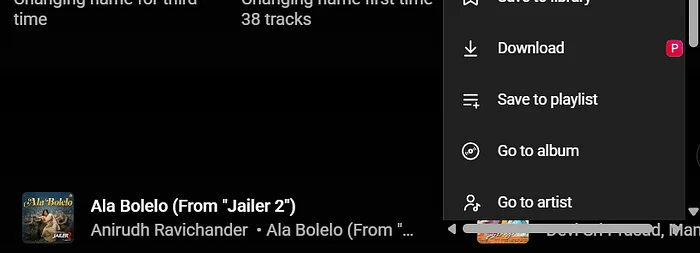
He then tried a famous Prashanth song that had recently become popular again through Instagram wedding reels. The exact song name is deliberately withheld because, in the author's words, the issue had not yet been fully addressed.
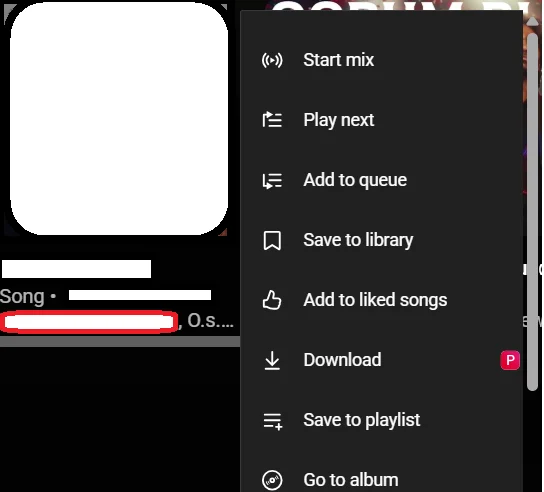
On this second song the upgrade message did not appear. The download control sits in the left corner of the interface, so he did not notice at first that anything had happened; a pop-up afterwards told him the track had been downloaded.
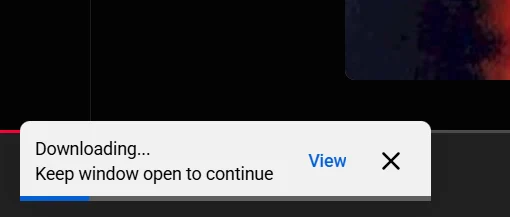
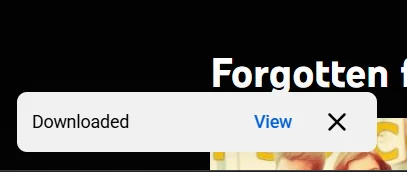
That is the anomaly: the same account, the same button, two songs, two different outcomes.
Exploitation
Step 1: reproduce deliberately
He refreshed the page, the message disappeared, and he could not initially remember which track had downloaded. Clicking another song brought the premium prompt back. After about thirty minutes he remembered which song it was, deleted it from downloads, and tried the same song again. It downloaded successfully without Premium.
He then verified offline playback, a feature restricted to Premium users, and it worked without any payment. Other songs from the same movie also downloaded without restriction and without an upgrade prompt.
Step 2: turn it into an impact scenario
A report needs an attack scenario, and at that point he had none. Looking through the other YouTube options he noticed that playlists can be created.
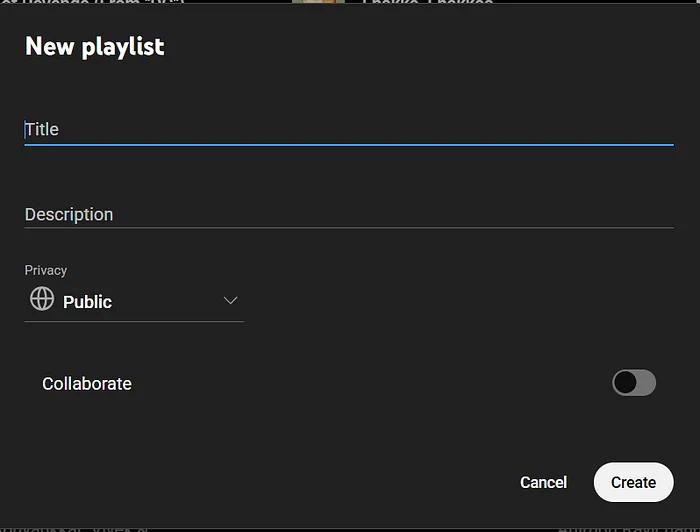
He collected songs from different movies that downloaded without Premium, added them to a new playlist, and set the playlist to PUBLIC.
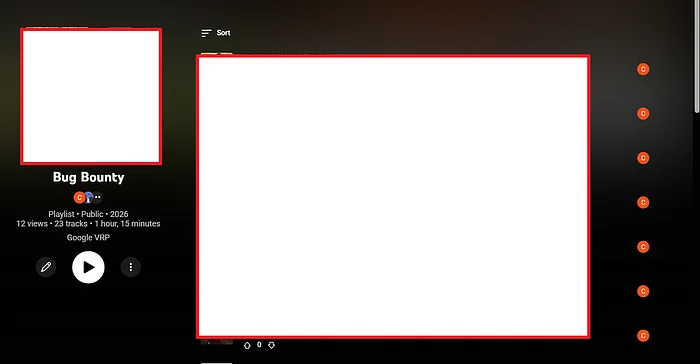
Over a full day he found more than 30 such songs and put all of them in the playlist. The scenario he described: send the public playlist link to users whose accounts have no Premium, and they can download every song in it and use offline features without a subscription.
Step 3: the region twist
While the report was in Google's hands he kept checking whether the bug still reproduced, and it did. The change came when he tried it from inside the WVD on his company laptop, whose OS and apparent network location are in the USA. The same song asked him to upgrade to Premium. He thought they had fixed the bug, then tried again outside the WVD from an Indian region and IP, and it downloaded.
On his personal laptop he connected to a USA VPN and the bug did not reproduce: the song was blocked with the upgrade prompt. Disconnecting the VPN and downloading the same song worked.
He then tried VPNs from Canada, Singapore, Nigeria and a few more countries, and none reproduced it; the same song was blocked each time. Only then did he conclude the bug was reproducible only in India.

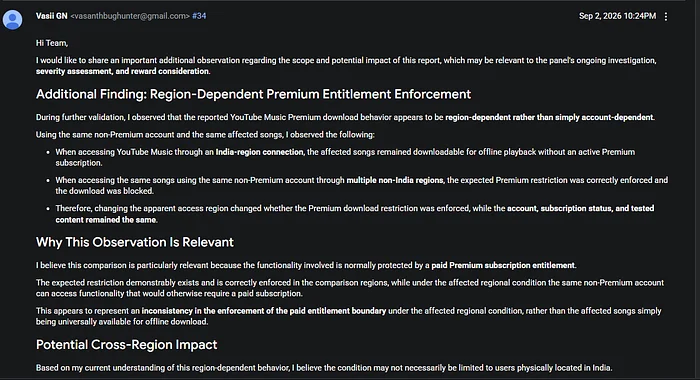
He sent this new detail to the panel.

Step 4: the generalisation
In a closing section he argues the affected population is wider than India. If the Premium check depends on the apparent region rather than the account, a non-Premium user anywhere could connect through an India-region VPN and get the same free downloads. He says he shared exactly this with the panel and believes it played a big role in the reward decision.
Root cause
The author is explicit that he cannot confirm the root cause and that only Google's team knows it; what follows is his guess. An important detail is that not all songs were affected: most correctly asked for an upgrade, and only certain tracks were downloadable for free.
YouTube Music uses region-specific licensing. His theory is that for those specific songs the licensing or metadata details were not updated properly in the India catalogue, so the download permission got tied to that stale regional flag instead of the account's actual Premium status, and the Premium check simply never ran. Outside India there was no such flag, so the normal check applied and the download was blocked. Same account, same song, two different answers: a logic flaw rather than a feature.
Impact
The impact section of the submitted report lists four points:
- Free users could download Premium-only songs and play them offline, ad-free, without a Premium subscription.
- A single public playlist link had the potential to expose the behaviour to unlimited users.
- Potential revenue impact for YouTube Music and the respective music rights holders.
- Demonstrated inconsistent enforcement of a paid subscription boundary.
All of this is conditional on the affected tracks and, as later established, on the India region. The author's own generalisation extends the exposure to anyone willing to use an India-region VPN, which is his inference rather than a demonstrated result.
Fix
The write-up does not describe what Google changed. The author notes only that the issue had not yet been fully addressed at the time of writing, which is why the song name is withheld. The implied fix, from his root cause reasoning, is to base the download permission on the account's Premium status rather than on a stale regional licensing flag, so that the check runs regardless of catalogue metadata.
Disclosure timeline
The author gives the following dates:
| Event | Date |
|---|---|
| Reported | Feb 8, 2026 |
| Triaged and accepted | Feb 10, 2026 |
| Panel decision, no reward | Mar 26, 2026 |
| Appeal #1 submitted | Mar 26, 2026 |
| Appeal #1 rejected | Mar 31, 2026 |
| Credit only (Hall of Fame) | Apr 8, 2026 |
| Report reopened by Google | Jun 24, 2026 |
| India-only region finding shared | Sep 2, 2026 |
| Panel response, bounty awarded | Oct 1, 2026 |
| Coordinated disclosure approved | Nov 9, 2026 |
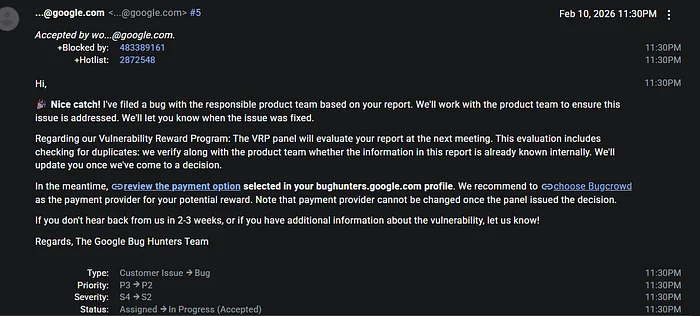
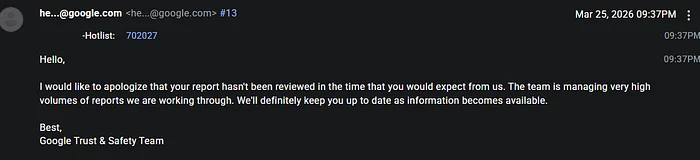
He submitted a PoC on a Sunday afternoon. The first response came quickly, and the next within an hour; he was confident because the bug involved financial loss and a premium feature restriction bypass. He notes that initial acceptance is not final and that the panel decision is. While waiting he asked for updates every 10 to 15 days and was told there were high volumes of reports because of AI slop.
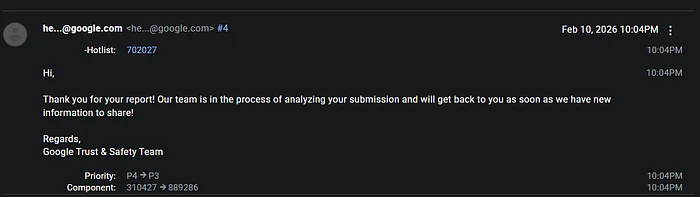
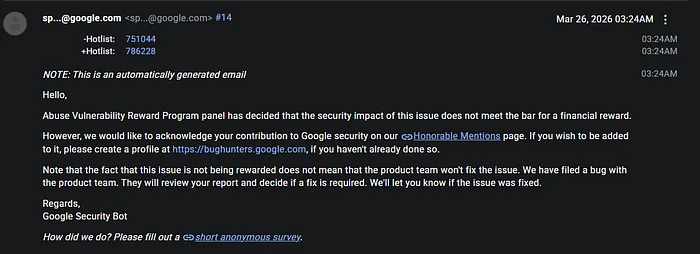
On 26 March the panel said the impact of the issue did not meet the bar for reward.
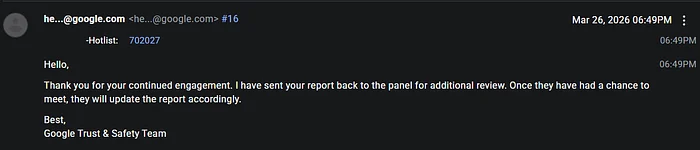
He appealed with additional details, and the report went back to the panel.
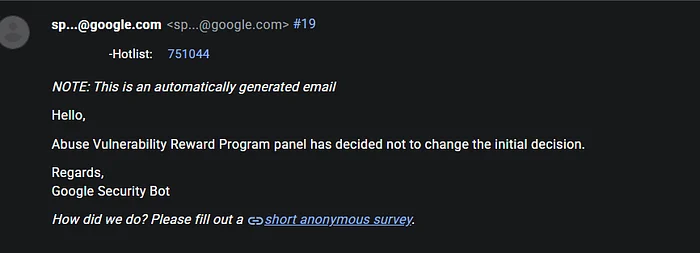
The appeal was rejected, and a further appeal with more details led to the final answer.
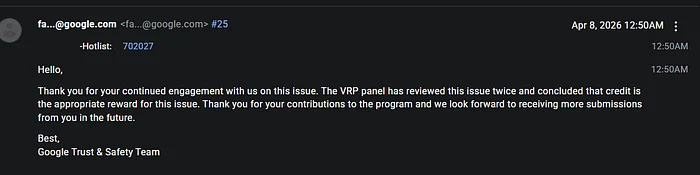
He says Google stated that only Hall of Fame credit was eligible for this bug, and he had already received that credit back in 2021, so he stopped appealing and the ticket was closed.
On 18 June a response arrived that he first took for a fix notification, but it was a hotlist update, removed and added.

Six days later the report was reopened by Google itself.

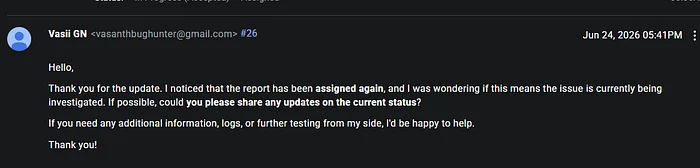
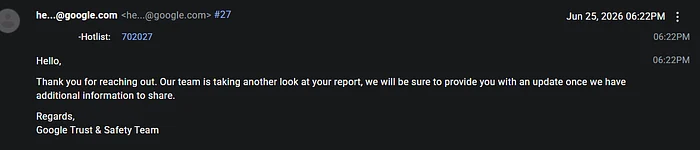
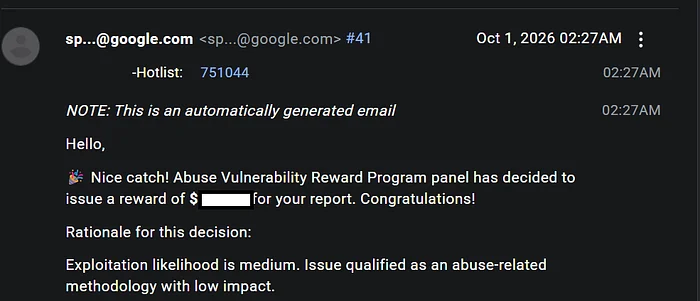
While waiting he kept checking whether the bug was fixed and could still reproduce it. After the India-only finding was shared and acknowledged, the panel eventually replied with "Nice catch!", which in Google VRP he reads as the signal that a reward is coming.
Variants to test
- Per-item entitlement checks on media catalogues. Take a free account and attempt the paid action (download, offline playback, high-bitrate stream) across many items rather than one. A positive result is a subset of items succeeding while the rest are correctly blocked, which points at per-item metadata rather than the account check.
- Region-dependent entitlement. Repeat the same action from a different country via VPN and from the local network. A positive result is the action succeeding in one region and being blocked in another for the same account and item, which suggests the check is tied to a regional flag.
- Playlist and sharing surfaces. Put items that bypass the check into a public playlist and open it from a second free account. A positive result is the second account downloading or playing offline from the shared link, which turns a per-item flaw into a distribution channel.
- Stale catalogue metadata. Compare items that recently changed licensing or were re-added to the catalogue against long-standing items. A positive result is newer or re-licensed entries bypassing the check while older ones do not.
- Client-side versus server-side enforcement. Watch whether the download request is refused by the server or merely hidden by the UI. A positive result is a server response that serves the media despite the account lacking entitlement, which confirms the check is missing rather than cosmetic.
Closing note
The author stresses how accidental the find was: the second song he touched that night happened to be the vulnerable one, out of a catalogue he describes as 100M+ songs. He also notes that not all songs were affected, and that the VPN and region behaviour was unexpected.
What happened, in plain words
YouTube Music is Google's music streaming service. Like most streaming services, it has a free tier and a paid tier called Premium. One of the things you get for paying is the ability to download songs onto your device so you can listen to them later without an internet connection, which is called offline playback.
On the website, every song has a download button. If you are on the free tier and you press it, the site is supposed to stop you and show a message inviting you to upgrade to Premium. That is the normal, expected behaviour.
This write-up is about a night when that did not happen. For one particular song, and later for more than 30 other songs, the download simply went through on a free account. The song then played offline, which is another Premium-only feature. The author paid nothing.
Later, while the report was sitting with Google, he discovered something even stranger: the same song, on the same account, downloaded fine from India and was blocked everywhere else. That regional detail turned out to matter a great deal.
The author is Vasanth, a part-time bug bounty hunter from Madurai, Tamil Nadu. He says he has been acknowledged by Google, Apple, Microsoft, GitHub, Pornhub and more than ten other organisations for responsibly reported security issues. He sent this bug to the Google VRP, which is Google's bug bounty programme: a scheme where outside researchers report security problems to Google and can receive money, called a bounty, if the report is judged valuable.
A quick word on what a bug bounty is, since everything that follows depends on it. Companies run these programmes because people outside the company sometimes notice problems the company's own testers miss. In exchange for a careful, private report, the company pays a reward and agrees not to take legal action against the researcher. The researcher, in turn, agrees not to tell the world until the company has had time to fix the problem. That agreement is called responsible disclosure, and you will see it shape several decisions in this story, including the author's choice not to name the song.
Setup
The setup here was completely ordinary, and that is part of the point. There was:
- a personal Google account without a Premium subscription;
- the normal YouTube Music website, opened in a browser;
- later, a company laptop running Windows Virtual Desktop (WVD), whose operating system and apparent location were in the USA;
- and a personal laptop with access to commercial VPN services.
A VPN, or virtual private network, is a service that routes your internet traffic through a computer in another country. To websites, you then appear to be browsing from that country rather than your own. People use VPNs for privacy, for security on public Wi-Fi, or to reach content that is restricted to certain regions.
No special tooling is described: no intercepting proxy (a tool that sits between your browser and the website and lets you read and change the traffic), no modified client, no scripts. The only precondition for finding the bug was a free account and the download button. This is worth pausing on, because it means the finding was available to anyone in India who happened to press the right button on the right song.
Finding it
On the evening of 7 February 2026 the author had been on a call with a friend, Usman, discussing an earlier YouTube finding of his about members-only video views leaking in the page source. The page source is the underlying text a browser receives and turns into the page you see; sometimes it contains information that is not displayed on screen. That earlier bug is a separate story and is not covered here.
They moved to Google Meet at 9 PM, the call ended around 12 AM, and he opened YouTube Music to listen to something before sleeping.
He searched for a song and pressed the download button. As expected for a free account, the premium upgrade message appeared.
He then tried a famous Prashanth song that had recently become popular again through Instagram wedding reels. The exact song name is deliberately withheld because, in the author's words, the issue had not yet been fully addressed. That is responsible disclosure in practice: while a problem may still be open, you do not publish details that would let other people exploit it.
On this second song the upgrade message did not appear. The download control sits in the left corner of the interface, so he did not notice at first that anything had happened; a pop-up afterwards told him the track had been downloaded.
That is the anomaly: the same account, the same button, two songs, two different outcomes. In security terms, this is a broken access control problem, or more precisely a logic flaw. Access control is the part of a system that decides who is allowed to do what: it is the difference between a paying customer and a free user. A logic flaw is not a crash or a broken password; it is a case where the system follows its rules incorrectly, so a rule that should apply to everyone quietly fails for one particular case.
Exploitation
Exploitation means taking a bug you have stumbled on and turning it into a repeatable, demonstrable result. Stumbling on something once is luck; being able to do it again on demand is a finding you can report.
Step 1: reproduce deliberately
He refreshed the page, the message disappeared, and he could not initially remember which track had downloaded. Clicking another song brought the premium prompt back. After about thirty minutes he remembered which song it was, deleted it from downloads, and tried the same song again. It downloaded successfully without Premium.
This step matters more than it looks. A report that says "something odd happened once" is not useful to anyone. A report that says "do exactly this and it happens every time" is. Deleting the download and repeating the action is how he proved the result was not a caching quirk or a misremembered click.
He then verified offline playback, a feature restricted to Premium users, and it worked without any payment. Other songs from the same movie also downloaded without restriction and without an upgrade prompt.
Step 2: turn it into an impact scenario
A report needs an attack scenario, and at that point he had none. Impact is the answer to the question "so what?": who is harmed, and how much. A single song downloading for free is odd, but a reviewer at Google could reasonably reply that it is a minor glitch. An attack scenario is a concrete story of how the flaw could be used at scale.
Looking through the other YouTube options he noticed that playlists can be created.
A playlist is simply a named list of songs that can be shared as a single link. He collected songs from different movies that downloaded without Premium, added them to a new playlist, and set the playlist to PUBLIC. A public playlist can be opened by anyone with the link, without logging in as the owner.
Over a full day he found more than 30 such songs and put all of them in the playlist. The scenario he described: send the public playlist link to users whose accounts have no Premium, and they can download every song in it and use offline features without a subscription.
That is the leap from bug to impact. One song is a curiosity; a shareable link containing thirty songs is a distribution channel. The playlist turns a per-song mistake into something that can be handed to unlimited people.
Step 3: the region twist
While the report was in Google's hands he kept checking whether the bug still reproduced, and it did. Re-checking is standard practice: a bug that has quietly been fixed is no longer worth reporting, and a bug that still works tells you the problem is live.
The change came when he tried it from inside the WVD on his company laptop, whose operating system and apparent network location are in the USA. The same song asked him to upgrade to Premium. He thought they had fixed the bug, then tried again outside the WVD from an Indian region and IP, and it downloaded.
An IP address is the numeric label a network uses to identify where traffic comes from; websites routinely use it to guess which country you are in. So the same account, the same song and the same button produced two different answers depending on where the request appeared to come from.
On his personal laptop he connected to a USA VPN and the bug did not reproduce: the song was blocked with the upgrade prompt. Disconnecting the VPN and downloading the same song worked.
He then tried VPNs from Canada, Singapore, Nigeria and a few more countries, and none reproduced it; the same song was blocked each time. Only then did he conclude the bug was reproducible only in India.
This is a good example of controlling one variable at a time. The account stayed the same, the song stayed the same, the browser stayed the same; only the apparent country changed. When the result flips with that one change, the country is the thing that matters.
He sent this new detail to the panel.
A panel, in this context, is the group inside Google that makes the final call on whether a report earns a reward. Getting new information in front of them, rather than arguing about the old information, is what moved this case forward.
Step 4: the generalisation
In a closing section he argues the affected population is wider than India. If the Premium check depends on the apparent region rather than the account, a non-Premium user anywhere could connect through an India-region VPN and get the same free downloads. He says he shared exactly this with the panel and believes it played a big role in the reward decision.
This is an important habit in security writing: distinguish what you demonstrated from what you infer. He demonstrated that the bug works from India and not from several other countries. He inferred that anyone using an India-region VPN would therefore be affected. The inference is reasonable, but it is an inference, and he presents it as one.
Root cause
The author is explicit that he cannot confirm the root cause and that only Google's team knows it; what follows is his guess. A root cause is the underlying reason a bug exists, as opposed to the symptom you observe. Fixing the symptom means blocking one song; fixing the root cause means correcting whatever rule let that song through.
An important detail is that not all songs were affected: most correctly asked for an upgrade, and only certain tracks were downloadable for free.
YouTube Music uses region-specific licensing. Music rights are sold country by country, so the same song may be available in one country and unavailable in another, and the service has to track that per region. His theory is that for those specific songs the licensing or metadata details were not updated properly in the India catalogue, so the download permission got tied to that stale regional flag instead of the account's actual Premium status, and the Premium check simply never ran. Outside India there was no such flag, so the normal check applied and the download was blocked. Same account, same song, two different answers: a logic flaw rather than a feature.
In plain terms: the system was supposed to ask "does this account pay for Premium?" before allowing a download. For a few songs, it apparently asked a different question instead, something like "is this song flagged as downloadable here?", and that flag was wrong. The right question was never asked, so the answer was never no.
Impact
The impact section of the submitted report lists four points:
- Free users could download Premium-only songs and play them offline, ad-free, without a Premium subscription.
- A single public playlist link had the potential to expose the behaviour to unlimited users.
- Potential revenue impact for YouTube Music and the respective music rights holders.
- Demonstrated inconsistent enforcement of a paid subscription boundary.
All of this is conditional on the affected tracks and, as later established, on the India region. The author's own generalisation extends the exposure to anyone willing to use an India-region VPN, which is his inference rather than a demonstrated result.
Fix
The write-up does not describe what Google changed. The author notes only that the issue had not yet been fully addressed at the time of writing, which is why the song name is withheld. The implied fix, from his root cause reasoning, is to base the download permission on the account's Premium status rather than on a stale regional licensing flag, so that the check runs regardless of catalogue metadata.
Disclosure timeline
The author gives the following dates:
| Event | Date |
|---|---|
| Reported | Feb 8, 2026 |
| Triaged and accepted | Feb 10, 2026 |
| Panel decision, no reward | Mar 26, 2026 |
| Appeal #1 submitted | Mar 26, 2026 |
| Appeal #1 rejected | Mar 31, 2026 |
| Credit only (Hall of Fame) | Apr 8, 2026 |
| Report reopened by Google | Jun 24, 2026 |
| India-only region finding shared | Sep 2, 2026 |
| Panel response, bounty awarded | Oct 1, 2026 |
| Coordinated disclosure approved | Nov 9, 2026 |
Triaged means the report has been looked at and confirmed as a real issue rather than spam or a misunderstanding. A Hall of Fame is a public list of researchers a company thanks for their reports; it is credit rather than money. Coordinated disclosure is the agreed moment when the researcher is allowed to publish the details.
He submitted a proof of concept on a Sunday afternoon. A proof of concept, or PoC, is the smallest set of steps that reliably demonstrates the bug, so a reviewer can reproduce it without guessing. The first response came quickly, and the next within an hour; he was confident because the bug involved financial loss and a premium feature restriction bypass. He notes that initial acceptance is not final and that the panel decision is. While waiting he asked for updates every 10 to 15 days and was told there were high volumes of reports because of AI slop, meaning large numbers of low-quality, machine-generated submissions that reviewers have to work through.
On 26 March the panel said the impact of the issue did not meet the bar for reward.
He appealed with additional details, and the report went back to the panel.
The appeal was rejected, and a further appeal with more details led to the final answer.
He says Google stated that only Hall of Fame credit was eligible for this bug, and he had already received that credit back in 2021, so he stopped appealing and the ticket was closed.
On 18 June a response arrived that he first took for a fix notification, but it was a hotlist update, removed and added. A hotlist, in this setting, is an internal list of reports that a team is tracking; an entry being removed and re-added is administrative housekeeping, not a decision about the bug.
Six days later the report was reopened by Google itself.
While waiting he kept checking whether the bug was fixed and could still reproduce it. After the India-only finding was shared and acknowledged, the panel eventually replied with "Nice catch!", which in Google VRP he reads as the signal that a reward is coming.
Variants to test
These are the general lessons, written as things you could try on other products. Each one is a way of asking the same question: is the paid check really being enforced, or is it only being displayed?
- Per-item entitlement checks on media catalogues. Take a free account and attempt the paid action (download, offline playback, high-bitrate stream) across many items rather than one. A positive result is a subset of items succeeding while the rest are correctly blocked, which points at per-item metadata rather than the account check.
- Region-dependent entitlement. Repeat the same action from a different country via VPN and from the local network. A positive result is the action succeeding in one region and being blocked in another for the same account and item, which suggests the check is tied to a regional flag.
- Playlist and sharing surfaces. Put items that bypass the check into a public playlist and open it from a second free account. A positive result is the second account downloading or playing offline from the shared link, which turns a per-item flaw into a distribution channel.
- Stale catalogue metadata. Compare items that recently changed licensing or were re-added to the catalogue against long-standing items. A positive result is newer or re-licensed entries bypassing the check while older ones do not.
- Client-side versus server-side enforcement. Watch whether the download request is refused by the server or merely hidden by the UI. A positive result is a server response that serves the media despite the account lacking entitlement, which confirms the check is missing rather than cosmetic.
That last point deserves a plain explanation, because it is the single most useful idea for a beginner. Client-side means the check happens in your browser, in code you control; server-side means the check happens on the company's computer before it sends you anything. A client-side check is like a shop putting up a sign saying "do not enter" with the door unlocked: anyone who ignores the sign walks in. A server-side check is a locked door. If the server sends the song file to an account that should not have it, the check is missing, not merely hidden.
Closing note
The author stresses how accidental the find was: the second song he touched that night happened to be the vulnerable one, out of a catalogue he describes as 100M+ songs. He also notes that not all songs were affected, and that the VPN and region behaviour was unexpected.
Glossary
- Access control: the part of a system that decides who is allowed to do what.
- AI slop: large volumes of low-quality, machine-generated content, here bug reports, that reviewers must sift through.
- Appeal: a request to have a rejected report looked at again.
- Attack scenario: a concrete story of how a flaw could be used and who would be harmed.
- Bounty: a cash reward paid for a valid security report.
- Broken access control: a flaw where the system lets someone do something they should not be allowed to do.
- Bug bounty programme: a scheme where a company pays outside researchers for reporting security problems privately.
- Client-side: code that runs in your browser, on your machine.
- Coordinated disclosure: the agreed moment when a researcher may publish details of a fixed bug.
- Entitlement: the right to use a paid feature, based on your subscription.
- Exploitation: turning a bug you found into a repeatable, demonstrable result.
- Hall of Fame: a public list of researchers a company thanks for their reports; credit, not money.
- Hotlist: an internal list of reports a team is tracking.
- Impact: who is harmed by a bug and how much.
- Intercepting proxy: a tool that sits between your browser and a website so you can read and change the traffic.
- IP address: the numeric label a network uses to identify where traffic comes from.
- Logic flaw: a bug where the system follows its rules incorrectly rather than crashing.
- Metadata: data about a piece of content, such as its licensing details, rather than the content itself.
- Offline playback: playing downloaded media without an internet connection.
- Page source: the underlying text a browser receives and turns into the page you see.
- Panel: the group inside a company that makes the final call on a reward.
- Playlist: a named list of songs that can be shared as a single link.
- PoC (proof of concept): the smallest set of steps that reliably demonstrates a bug.
- Premium: YouTube Music's paid subscription tier.
- Public playlist: a playlist anyone with the link can open.
- Region-specific licensing: music rights sold country by country, so availability differs by region.
- Responsible disclosure: reporting a problem privately and not publishing details until it has been addressed.
- Root cause: the underlying reason a bug exists, as opposed to the symptom you observe.
- Server-side: code that runs on the company's computer before anything is sent to you.
- Triaged: looked at and confirmed as a real issue rather than spam or a misunderstanding.
- VPN (virtual private network): a service that routes your traffic through another country so websites see you as being there.
- WVD (Windows Virtual Desktop): a Windows desktop hosted in the cloud that you connect to remotely.
- YouTube VRP: Google's Vulnerability Reward Program, its bug bounty scheme.




