Unauthenticated Sensitive Information Disclosure at [REDACTED]
The Gutenberg Template Library & Redux Framework plugin for WordPress exposed AJAX actions to unauthenticated users with predictable names derived from the site URL. An attacker could use these actions to retrieve the list of active plugins and their versions, the PHP version, and an unsalted MD5 hash of the AUTH_KEY concatenated with the SECURE_AUTH_KEY.
 Published on wahaz.medium.com
Hello InfoSec Community, I want to share my submission about this vulnerability, sorry for bad writing, still learning ✌
The full write-up lives on its author's site
It belongs to its author, so we link to it rather than copy it. The other two tabs are our own rewrites, checked against it.
Context
The target was the subdomain blog.redacted.com, a WordPress installation. The researcher identified it as running WordPress and tried CVE-2021-38314, which affects the Gutenberg Template Library & Redux Framework plugin in versions up to and including 4.2.11.
The feature at the centre of the bug is the plugin's AJAX action registration. In redux-core/class-redux-core.php, inside the includes function, the plugin registered several AJAX actions that were available to unauthenticated users. Those action names were unique to a given site but deterministic and predictable: they were derived from an md5 hash of the site URL with a known salt value of -redux, and then an md5 hash of the previous hash with a known salt value of -support. Because the inputs are the site URL and fixed salts, anyone who knows the URL can compute the action names without any credentials.
Setup
No accounts, roles or special tooling are described. The only precondition is that the target runs WordPress with the vulnerable Redux Framework plugin and that the site URL is known, which it is for any public site. The researcher worked from a script that computes the action names and then requests them.
Finding it
The researcher first confirmed that blog.redacted.com was using WordPress, then tried CVE-2021-38314 against it. The reasoning is that the AJAX action names are not secret: they are a deterministic function of the site URL and two published salt strings, so an unauthenticated attacker can derive them and call the corresponding admin-ajax.php actions directly.
Exploitation
Step 1: Compute the first action name
The first action name is the md5 of the site URL with -redux appended:
$target = "https://blog.redacted.com";
$key1 = md5("$target/-redux");
$key2 = file_get_contents("$target/wp-admin/admin-ajax.php?action=$key1");
Requesting that action returns a value. In this case it was:
[redacted]
According to the researcher, this is a hash of the AUTH_KEY concatenated with the SECURE_AUTH_KEY, with -redux appended.
Step 2: Compute the second action name
The second action name is the md5 of the value returned in step 1 with -support appended:
$key3 = md5($key2.'-support');
This produced:
[redacted]
Step 3: Obtain the verification code
The second action compares the code parameter against the output of the Redux verification service for that hash and site:
https://verify.redux.io/?hash=[redacted]&site=http://blog.redacted.com/
The code value used was:
Step 4: Call the final URL
The final request combines the second action name and the code:
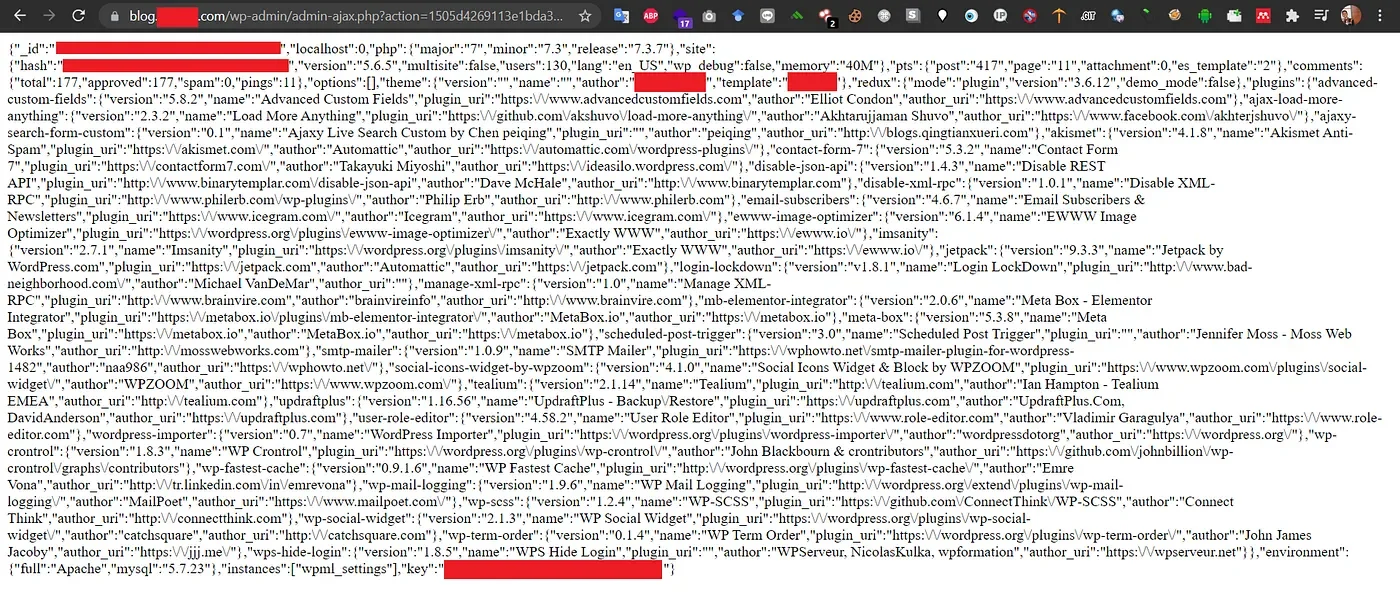
The screenshot shows the final request URL with the computed action and code parameters.
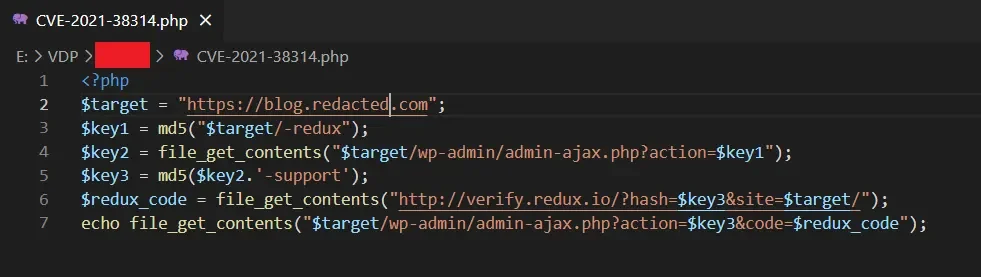
The second image shows the full PHP script.
Root cause
The plugin registered AJAX actions for unauthenticated users whose names were derived only from the site URL and two fixed salt strings (-redux and -support). Because the site URL is public and the salts are known, the action names are predictable and provide no access control. The actions then return sensitive values: the list of active plugins and their versions, the site's PHP version, and an unsalted md5 hash of the site's AUTH_KEY concatenated with the SECURE_AUTH_KEY. The second action additionally relies on a code value checked against an external verification service, but the researcher was able to obtain that value and complete the request. Existing defences did not stop this because the actions were deliberately exposed to unauthenticated users and the naming scheme was deterministic rather than secret.
Impact
An attacker can retrieve a list of active plugins and their versions, the site's PHP version, and an unsalted md5 hash of the site's AUTH_KEY concatenated with the SECURE_AUTH_KEY. The researcher notes that this is most useful where a separate plugin with an additional vulnerability is installed, since the information saves time and helps plan an intrusion. The disclosure itself does not grant access; its value depends on what else is present on the site.
Fix
The report states that the issue was fixed on 11 November 2021, three days after the report was submitted on 8 November 2021. The specific change is not described. No reward is recorded.
Variants to test
- On other WordPress sites, compute the two action names from the site URL and the
-reduxand-supportsalts, then request the first action onwp-admin/admin-ajax.php. A positive result is a hash-like value returned without authentication. - Follow up with the second action and the verification code from the Redux service. A positive result is a response containing plugin names and versions, the PHP version, or the key hash.
- Check whether the same predictable naming pattern appears in other plugins that register unauthenticated AJAX actions, by looking for action names derived from the site URL or other public values. A positive result is an action that can be computed and called without credentials and returns configuration or version data.
- Compare the disclosed plugin versions against known vulnerabilities for those plugins. A positive result is a plugin version that matches a published advisory, which is the scenario the researcher describes as the main use of the disclosure.
What happened, in plain words
A security researcher found that a public blog subdomain, blog.redacted.com, was running WordPress with a plugin called Gutenberg Template Library & Redux Framework. That plugin had a bug tracked as CVE-2021-38314. The bug let anyone on the internet, without logging in, ask the site a few questions and get back answers that should have been private: which plugins are installed and at what versions, which version of PHP the site runs, and a scrambled fingerprint of two secret keys the site uses internally.
To understand why that is possible, you need a little background on how WordPress sites work and what a plugin is. WordPress is a system for building websites. A plugin is an add-on that adds features to a WordPress site, like a gallery, a contact form or a page builder. Plugins often need to talk to the browser without reloading the page, and they do that through a mechanism called AJAX. You can think of AJAX as a waiter: the browser sends a small order to the kitchen (the server), and the kitchen sends back just that dish, without bringing the whole menu again.
On WordPress, many of those small orders go to a single file called admin-ajax.php. Each order carries a name, called an action, so the site knows which piece of code should handle it. Normally, actions that return sensitive data are protected: the site checks that the person asking is logged in and allowed to do so. The Redux plugin, however, registered several actions that anyone could call, even a visitor who has never logged in. That is what "unauthenticated" means: no login required.
What made it worse is how those action names were built. They were not random secrets. They were calculated from the site's own web address plus two fixed words, -redux and -support. Since the address of a public site is public, and the two words were written into the plugin's code, anyone could do the same calculation and arrive at the same action names. A useful comparison: imagine a building where the door code is made from the street address plus the word "welcome". It looks like a code, but anyone who knows the address and the word can work it out.
The technical name for this kind of bug is "sensitive information disclosure": the site reveals information it should keep to itself. The information does not by itself let an attacker walk in, but it helps them plan. If one of the listed plugins has its own known bug, the attacker now knows exactly which version is there and can look up the matching attack.
Background: the plugin and the bug
The researcher identified the target as a WordPress installation and tried CVE-2021-38314, which affects the Gutenberg Template Library & Redux Framework plugin in versions up to and including 4.2.11. That version range is affected by CVE-2021-38314. A CVE is a public catalogue number for a known security flaw, so people can refer to the same bug unambiguously.
The feature at the centre of the bug is how the plugin registers its AJAX actions. In the file redux-core/class-redux-core.php, inside a function called includes, the plugin registered several actions that were available to users who were not logged in. The names of those actions were unique to each site, but predictable: they were built by taking an md5 hash of the site URL with a known salt value of -redux, and then an md5 hash of the previous hash with a known salt value of -support.
Two terms need unpacking here. A hash is a one-way scrambling function: you put text in and get a fixed-length string of letters and numbers out. The same input always gives the same output, but you cannot easily turn the output back into the input. It is like a fingerprint: it identifies the person, but you cannot rebuild the person from the fingerprint. A salt, in this context, is a fixed piece of text added to the input before hashing, so that the result is different from what it would be without it. Here the salts were the literal strings -redux and -support, and they were not secret: they were part of the plugin's published code.
Because the only inputs are the site URL and those fixed salts, anyone who knows the URL can compute the action names without any credentials. That is the whole weakness: the names look like random strings, but they are really a recipe that anyone can follow.
Setup
The report describes no accounts, roles or special tools. The only precondition is that the target runs WordPress with the vulnerable Redux Framework plugin, and that its site URL is known, which is true for any public site. The researcher worked from a script that computes the action names and then requests them.
Finding it
The researcher first confirmed that blog.redacted.com was using WordPress, then tried CVE-2021-38314 against it. The reasoning is that the AJAX action names are not secret: they are a deterministic function of the site URL and two published salt strings. "Deterministic" means the same inputs always produce the same output, with no randomness involved. So an unauthenticated attacker can derive the names and call the corresponding admin-ajax.php actions directly.
Exploitation
The exploitation happens in four steps. Each step produces something the next step needs, which is why they are done in this order.
Step 1: Compute the first action name
The first action name is the md5 of the site URL with -redux appended:
$target = "https://blog.redacted.com";
$key1 = md5("$target/-redux");
$key2 = file_get_contents("$target/wp-admin/admin-ajax.php?action=$key1");
Line by line:
$target = "https://blog.redacted.com";stores the site's address in a variable called$target, so the rest of the script can reuse it. A variable is just a labelled box that holds a value.$key1 = md5("$target/-redux");takes the address, sticks/-reduxon the end, and runs the md5 hash on the result. The output, stored in$key1, is the name of the first action. This is the "recipe" part: the address is public and-reduxis a fixed word, so anyone can repeat this calculation.$key2 = file_get_contents("$target/wp-admin/admin-ajax.php?action=$key1");builds a web address that points at the site'sadmin-ajax.phpfile, passes the computed action name in theactionparameter, fetches the response and stores it in$key2.file_get_contentsis a PHP function that downloads whatever is at a URL, like a browser fetching a page, but without showing it on screen.
Requesting that action returns a value. In this case it was:
[redacted]
According to the researcher, this is a hash of the AUTH_KEY concatenated with the SECURE_AUTH_KEY, with -redux appended. AUTH_KEY and SECURE_AUTH_KEY are secret values WordPress generates for each site and uses to sign login cookies. A cookie is a small piece of data a site stores in your browser so it can recognise you on the next request; if someone can forge a valid cookie, they may be able to act as a logged-in user. The response here is not the keys themselves, but a hash derived from them.
Step 2: Compute the second action name
The second action name is the md5 of the value returned in step 1 with -support appended:
$key3 = md5($key2.'-support');
This line takes the value from step 1, adds -support to the end, hashes the result and stores it in $key3. The reason for chaining the two hashes is that the plugin itself built its second action name this way, so the researcher is simply reproducing the plugin's own calculation. This produced:
[redacted]
Step 3: Obtain the verification code
The second action does not only check the action name. It also compares a code parameter against the output of the Redux verification service for that hash and site:
https://verify.redux.io/?hash=[redacted]&site=http://blog.redacted.com/
This is a request to an external service run by the plugin's authors. It takes two pieces of information: the hash from step 2 and the site address. The service answers with a code that the plugin expects to see. The researcher obtained that code and used it as the code value:
The %2B and %2F sequences are URL encoding: some characters cannot appear literally in a web address, so they are written in a coded form. %2B stands for + and %2F stands for /. The value is stored in a variable called $redux_code so it can be used in the final request.
Step 4: Call the final URL
The final request combines the second action name and the code:
This is an ordinary web address. Everything after the ? is a list of parameters: action tells WordPress which piece of code should handle the request, and code is the value the plugin checks against the verification service. Because the action name was computed rather than guessed, and the code was obtained from the service, the request is accepted and the sensitive information is returned.
The screenshot shows the final request URL with the computed action and code parameters.
The second image shows the full PHP script.
Root cause
The plugin registered AJAX actions for unauthenticated users whose names were derived only from the site URL and two fixed salt strings (-redux and -support). Because the site URL is public and the salts are known, the action names are predictable and provide no access control. Access control is the part of a system that decides who is allowed to do what; here there was effectively none, because knowing the name was enough.
The actions then return sensitive values: the list of active plugins and their versions, the site's PHP version, and an unsalted md5 hash of the site's AUTH_KEY concatenated with the SECURE_AUTH_KEY. "Unsalted" here means no extra random text was added before hashing, which makes the hash easier to attack with precomputed tables than a salted one would be.
The second action additionally relies on a code value checked against an external verification service, but the researcher was able to obtain that value and complete the request. Existing defences did not stop this because the actions were deliberately exposed to unauthenticated users and the naming scheme was deterministic rather than secret.
Impact
An attacker can retrieve a list of active plugins and their versions, the site's PHP version, and an unsalted md5 hash of the site's AUTH_KEY concatenated with the SECURE_AUTH_KEY. The researcher notes that this is most useful where a separate plugin with an additional vulnerability is installed, since the information saves time and helps plan an intrusion. The disclosure itself does not grant access; its value depends on what else is present on the site.
Fix
The report states that the issue was fixed on 11 November 2021, three days after the report was submitted on 8 November 2021. The specific change is not described. No reward is recorded.
Variants to test
- On other WordPress sites, compute the two action names from the site URL and the
-reduxand-supportsalts, then request the first action onwp-admin/admin-ajax.php. A positive result is a hash-like value returned without authentication. - Follow up with the second action and the verification code from the Redux service. A positive result is a response containing plugin names and versions, the PHP version, or the key hash.
- Check whether the same predictable naming pattern appears in other plugins that register unauthenticated AJAX actions, by looking for action names derived from the site URL or other public values. A positive result is an action that can be computed and called without credentials and returns configuration or version data.
- Compare the disclosed plugin versions against known vulnerabilities for those plugins. A positive result is a plugin version that matches a published advisory, which is the scenario the researcher describes as the main use of the disclosure.
Glossary
- AJAX: a way for a web page to exchange small amounts of data with the server in the background, without reloading the whole page.
- Action (WordPress): a name sent with an AJAX request so WordPress knows which piece of code should handle it.
admin-ajax.php: the WordPress file that receives most AJAX requests.- Authentication: proving who you are, usually by logging in. "Unauthenticated" means no login is required.
- Access control: the part of a system that decides who is allowed to do what.
- CVE: a public catalogue number for a known security flaw, so people can refer to the same bug unambiguously.
- Hash (md5): a one-way scrambling function that turns text into a fixed-length string. The same input always gives the same output, but the output cannot easily be turned back into the input.
- Salt: a fixed piece of text added to the input before hashing, so the result differs from what it would be without it. Here the salts were
-reduxand-support. - Deterministic: producing the same output every time for the same input, with no randomness.
- Sensitive information disclosure: a bug where a site reveals information it should keep private.
- Plugin: an add-on that adds features to a WordPress site.
- PHP: the programming language WordPress is written in, and the language of the script in this report.
- Variable: a labelled box in a program that holds a value.
file_get_contents: a PHP function that downloads whatever is at a URL.- Parameter: a named value in a web address, after the
?, such asactionorcode. - URL encoding: writing characters that cannot appear literally in a web address in a coded form, such as
%2Bfor+and%2Ffor/. - Cookie: a small piece of data a site stores in your browser so it can recognise you on the next request.
AUTH_KEYandSECURE_AUTH_KEY: secret values WordPress generates for each site and uses to sign login cookies.- Unsalted hash: a hash computed without adding extra random text first, which makes it easier to attack with precomputed tables.
- Verification service: an external service run by the plugin's authors that returns a code for a given hash and site.
- Subdomain: a part of a larger domain name, such as
blog.redacted.comunderredacted.com. - WordPress: a system for building websites.
- Gutenberg Template Library & Redux Framework: the WordPress plugin affected by this bug, in versions up to and including 4.2.11.




