What Does Diwali Look Like for a Bug Hunter?
A public PHP login page for an internal admin portal showed timing differences that the hunter interpreted as boolean-based blind SQL injection, allowing extraction of database details. The program closed the report as Informative because the portal was out of scope, but awarded a goodwill bonus.
 Published on medium.com
Cybersecurity
The full write-up lives on its author's site
It belongs to its author, so we link to it rather than copy it. The other two tabs are our own rewrites, checked against it.
Context
This is a story about a login page for an internal administration portal, written up after the fact. The portal was a PHP application, and the sign-in page was reachable from the public internet. The researcher found it while looking through public DNS records for a HackerOne program, and the program's scope was a wildcard.
The feature under test is the ordinary username and password login. The researcher's interest was not in the credentials themselves but in how long the page took to answer, and whether that timing changed depending on what was submitted.
Setup
The work was done against a HackerOne program whose name and asset are anonymised in the write-up. The only tool named is Burp Suite, used to send requests and watch them sit until they timed out. No versions, accounts or roles are given.
The precondition that mattered most was scope. The researcher read the program's wildcard scope and assumed the subdomain was covered. The program's policy, as described later in the closure message, excluded internal and administrative infrastructure unless the asset was expressly listed.
Finding it
It started with two requests to the same login page. The first came back almost immediately. The second sat in Burp Suite until it timed out. That difference was the thing worth chasing: what was the page doing differently between the two?
Exploitation
Step 1: compare three checks on the username field
The username field was where the unusual behaviour appeared. The researcher used the same incorrect password each time and compared the results of three checks.
- When the condition was expected to be true, the server returned
200 OKin about two seconds, and the page showed "Invalid username or password." - When the condition was expected to be false, the connection timed out after about 30 seconds.
- With a username expected to be absent, the connection also timed out.
An isolated timeout can happen for plenty of reasons. What made this worth reporting was that, across the comparisons, the response pattern tracked the condition being checked. On that basis the researcher reported it as boolean-based blind SQL injection: the timing of the login response appeared to give a yes-or-no answer about data behind the page.
Step 2: record what the timing revealed
The first results pointed to an administrator account and gave the length and first three characters of its stored password hash. As the session went on, the researcher recorded the database name, the MySQL version, the session user and one table name.
The write-up is explicit that the program and asset are anonymised and that the values below are fictional examples of what was recorded:
- The account name was
demo_admin. - The password hash was 60 characters long and began with
Q7m. - The database name was
ops_demo. - The MySQL version was
8.0.42. - The MySQL session user was
[redacted]. - The table name was
job_queue.
So the page was leaking hints about stored data before anyone signed in. How far that exposure could go would depend on the database permissions granted to the application.
Step 3: watch the pattern move
During the session the response pattern changed. At one point both checks came back quickly with 200 OK. Later, the timeout showed up on the opposite side of the comparison. In some runs both requests timed out, so those comparisons were inconclusive.
The researcher's original notes attributed the shifts to hotfixes. From the outside of the login page, what could be documented was when the behaviour changed; the reason for the changes remained unconfirmed.
Step 4: the review
After the preliminary review, a HackerOne analyst asked for more information. They had run their own checks and sent a screenshot showing identical responses. The researcher offered timestamped Burp Suite logs and asked the program's engineers to compare the recorded values with their database. The report moved to Pending program review.
The lesson the researcher draws: next time a timing difference is reported, put the paired responses side by side with their timestamps and the client used, so the reviewer has a record of what was seen during the original test window.
Root cause
The report frames the issue as boolean-based blind SQL injection in the login flow: the timing of the response tracked a condition about data behind the page, which suggests the username reaches the database in a way that lets a condition influence execution time. The write-up does not show the payload or the query, so the exact mechanism is not stated. The recommended fix was parameterised queries so the database handles usernames as data.
Why existing defences did not stop it is not described. The page returned "Invalid username or password." when the condition was expected to be true; the leak was in timing.
Impact
The researcher demonstrated that data behind the login page could be inferred before authentication: an administrator account name, the length and first three characters of its password hash, the database name, the MySQL version, the session user and a table name. The extent of any wider exposure would depend on the database permissions granted to the application.
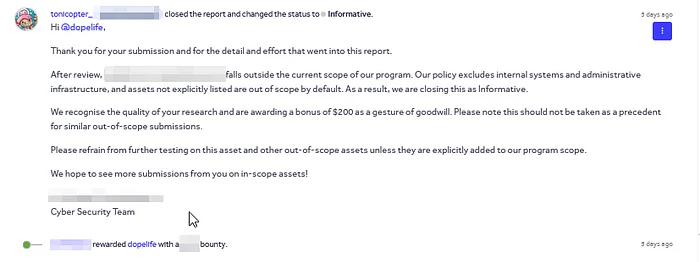
The report listed a severity of High (8.6). A few days after it was filed, the program closed it as Informative because the portal was out of scope: the policy excluded internal and administrative infrastructure unless the asset was expressly listed, and the team asked the researcher to stop testing it. The team also awarded $200 as a goodwill bonus.
Fix
No fix is described as having been applied. The report was closed as Informative on scope grounds, not on the basis of a code change.
The recommendations in the report were:
- Use parameterised queries for the login flow so the database handles usernames as data.
- Limit the application's database privileges.
- Restrict access to the admin portal.
Variants to test
- Timing on login forms generally. Submit the same wrong password with inputs designed to make a condition true and then false, and compare response times over several runs. A positive result is a stable, repeatable gap that follows the condition rather than the input length or random jitter.
- Absent versus present usernames. Compare a username you expect to exist with one you expect to be absent. A positive result is a consistent timing difference between the two, as seen here where both the false condition and the absent username timed out.
- Re-run after any change. Repeat the paired checks at intervals and keep timestamps. A positive result is a pattern that holds across runs; if the pattern flips sides or both requests time out, treat the comparison as inconclusive, as happened during this session.
- Scope before testing. For any subdomain found in public DNS, check the program's asset exclusions for internal and administrative infrastructure before sending a single request. A positive result here is confirmation that the asset is expressly listed, not merely covered by a wildcard.
- Record the evidence as you go. Keep paired responses with timestamps and the client used, so a reviewer repeating the test can compare against what you saw in the original window.
What happened, in plain words
A security researcher found a login page for an internal administration portal while browsing public DNS records for a HackerOne program. The page was reachable from the open internet. The researcher noticed that the page sometimes answered quickly and sometimes hung until it timed out, and that the timing seemed to depend on what was typed into the username field. That pattern pointed to a class of bug called boolean-based blind SQL injection, where the server's response time leaks a yes-or-no answer about data stored behind the page. The researcher recorded several pieces of information this way, filed a report rated High (8.6), and the program closed it as Informative because the portal was out of scope. The team still paid a $200 goodwill bonus.
This article walks through the same story for someone who has never done security testing. Every term is explained where it first appears, and there is a glossary at the end.
The image above is the header of the researcher's first Medium post, published on 17 November 2026.
Some background you need first
Before the steps make sense, a few ideas need to be clear. None of them require any prior security knowledge.
DNS. The Domain Name System is the internet's phone book. When you type a name like example.com into your browser, DNS translates it into the numeric address of a server. DNS records are public by design, and anyone can look them up. Companies often have many records, one for each subdomain such as mail.example.com or admin.example.com. Because these records are public, a subdomain that was meant to be internal can sometimes be discovered by simply reading them.
A login page. A login page is a form with a username field and a password field. When you press the button, your browser sends what you typed to a server, and the server checks it against stored records. If the details match, you get in; if not, you see an error.
A database. A database is an organised store of information, a bit like a very large spreadsheet with many sheets (called tables). Each table has rows and columns. A website's login page usually asks a database a question such as "is there a user with this name and this password?".
SQL. Structured Query Language is the language used to ask a database questions. A typical login check might be written as a query that looks for a matching row. If the username you type is pasted directly into that query as text, rather than being passed as a separate value, an attacker can sometimes change the meaning of the query. That is SQL injection.
SQL injection. Imagine a form that asks for your name and then builds a sentence like "Hello, [your name]". If you type Alice, it says "Hello, Alice". If you type something clever that includes extra instructions, the sentence changes meaning. SQL injection is the database equivalent: input that was meant to be data gets treated as part of the instruction.
Blind SQL injection. Sometimes the page does not show you the database's answer directly. It might just say "Invalid username or password" no matter what. In a blind injection, you cannot see the data, so you ask the database yes-or-no questions and infer the answers from some side effect. The side effect here is time: a true condition makes the page answer quickly, a false condition makes it hang.
Boolean. A boolean is simply a value that is either true or false. Boolean-based blind SQL injection means the attacker is asking the database true/false questions and reading the answers from behaviour rather than from visible output.
Burp Suite. Burp Suite is a tool that sits between your browser and a website. It lets you capture a request, look at exactly what was sent, change it, and send it again. It also shows how long each request takes. Security researchers use it because a browser hides most of this detail.
A request and a response. When your browser loads a page or submits a form, it sends a request to the server. The server sends back a response, which includes a status code (such as 200 OK for success) and the page content. A timeout means the server did not answer within the time the client was willing to wait.
Scope. A bug bounty program is a company's invitation to researchers to test certain systems in exchange for possible rewards. The scope is the list of systems that are allowed. It can be a wildcard, meaning every subdomain of a domain, or it can list specific assets. Anything outside the scope is off limits, even if it is technically reachable.
Severity and CVSS. Programs often rate reports by severity, from Low to Critical. A CVSS score is a number from 0 to 10 that expresses how serious a vulnerability is. High (8.6) is a serious rating.
Informative. When a program closes a report as Informative, it means the report was read and understood but did not qualify for a reward under the program's rules. It is not the same as saying the issue is not real.
A goodwill bonus. Some programs pay a small amount even when a report is closed, as a thank-you for the researcher's time. That is what happened here.
Finding the login page
The researcher was looking through public DNS records for a HackerOne program. DNS records are public, so this is not hacking in itself; it is reading information that the internet publishes on purpose. Among those records was a PHP login page for an internal administration portal. PHP is a programming language commonly used for websites. The sign-in page was reachable from the public internet, which is the important part: an internal tool that was supposed to be private could be reached by anyone who knew the address.
The program's scope was a wildcard. The researcher read that and assumed the subdomain was covered. That assumption would matter later, because the program's policy excluded internal and administrative infrastructure unless the asset was expressly listed.
The clue: two requests, two different behaviours
It started with two requests to the same login page. The first came back almost immediately. The second sat in Burp Suite until it timed out. The researcher wanted to know what the page was doing differently between the two.
This is the heart of the method. A single slow response proves nothing; servers are busy, networks are unreliable, and pages sometimes take a while. What matters is a pattern: if the same kind of request is fast every time and a slightly different one is slow every time, something in the page is reacting to the difference.
Step 1: compare three checks on the username field
The username field was where the unusual behaviour appeared. The researcher used the same incorrect password each time and compared the results of three checks.
- When the condition was expected to be true, the server returned
200 OKin about two seconds, and the page showed "Invalid username or password." - When the condition was expected to be false, the connection timed out after about 30 seconds.
- With a username expected to be absent, the connection also timed out.
Why keep the password wrong and the same every time? Because changing two things at once makes it impossible to know which one caused the difference. By holding the password constant, the only variable is the username.
Why three checks rather than one? Because a single timeout could be a coincidence. The first check establishes what a normal, fast answer looks like. The second shows that a false condition produces a slow answer. The third shows that a username that does not exist also produces a slow answer.
An isolated timeout can happen for plenty of reasons. What made this worth reporting was that, across the comparisons, the response pattern tracked the condition being checked. On that basis the researcher reported it as boolean-based blind SQL injection: the timing of the login response appeared to give a yes-or-no answer about data behind the page.
Notice that the page itself revealed nothing in its wording; the leak was in how long the page took to answer. The leak was not in the words on the screen; it was in how long the page took to say them. That is why this is called blind: you cannot see the data, you infer it.
Step 2: record what the timing revealed
The first results pointed to an administrator account and gave the length and first three characters of its stored password hash. A password hash is a scrambled form of a password, produced by a one-way function. Websites store hashes rather than plain passwords so that a database leak does not immediately hand over everyone's password. Knowing the length and the first few characters of a hash is a leak of stored data.
As the session went on, the researcher recorded the database name, the MySQL version, the session user and one table name. MySQL is a popular database system. The session user is the database account the website uses to connect. A table name tells you what kind of data is stored.
The write-up is explicit that the program and asset are anonymised and that the values below are fictional examples of what was recorded:
- The account name was
demo_admin. - The password hash was 60 characters long and began with
Q7m. - The database name was
ops_demo. - The MySQL version was
8.0.42. - The MySQL session user was
[redacted]. - The table name was
job_queue.
So the page was leaking hints about stored data before anyone signed in. How far that exposure could go would depend on the database permissions granted to the application. If the website's database account can only read a few tables, the leak is limited; if it can read everything, the leak is much more serious.
Step 3: watch the pattern move
During the session the response pattern changed. At one point both checks came back quickly with 200 OK. Later, the timeout showed up on the opposite side of the comparison. In some runs both requests timed out, so those comparisons were inconclusive.
This is important for anyone learning to test: a pattern that moves is not a reliable pattern. If the fast and slow results swap sides, or if both requests hang, you cannot conclude anything from that run. The researcher's original notes attributed the shifts to hotfixes, meaning small urgent changes made to the site. From the outside of the login page, what could be documented was when the behaviour changed; the reason for the changes remained unconfirmed.
Step 4: the review
After the preliminary review, a HackerOne analyst asked for more information. They had run their own checks and sent a screenshot showing identical responses. In other words, when the reviewer tried the same thing, the page returned identical responses for both conditions.
The researcher offered timestamped Burp Suite logs and asked the program's engineers to compare the recorded values with their database. Timestamped logs are a record of exactly when each request was sent and what came back. The report moved to Pending program review, a status meaning the program was still looking at it.
The lesson the researcher draws: next time a timing difference is reported, put the paired responses side by side with their timestamps and the client used, so the reviewer has a record of what was seen during the original test window. The client is the tool that sent the request, here Burp Suite. Without that record, a reviewer testing later may see different behaviour and have no way to compare.
Why it happened
The report frames the issue as boolean-based blind SQL injection in the login flow: the timing of the response tracked a condition about data behind the page, which suggests the username reaches the database in a way that lets a condition influence execution time. The write-up does not show the payload or the query, so the exact mechanism is not stated. The recommended fix was parameterised queries so the database handles usernames as data.
A parameterised query is a way of writing a database question where the input is passed separately from the instruction. Think of a form letter with a blank line: the letter is fixed, and whatever you write on the blank line is treated as a name, not as new instructions. That is the difference between data and code.
Why existing defences did not stop it is not described. The page returned "Invalid username or password." when the condition was expected to be true; the leak was in timing.
Impact
The researcher demonstrated that data behind the login page could be inferred before authentication: an administrator account name, the length and first three characters of its password hash, the database name, the MySQL version, the session user and a table name. The extent of any wider exposure would depend on the database permissions granted to the application.
The report listed a severity of High (8.6). A few days after it was filed, the program closed it as Informative because the portal was out of scope: the policy excluded internal and administrative infrastructure unless the asset was expressly listed, and the team asked the researcher to stop testing it. The team also awarded $200 as a goodwill bonus.
The image above is the closing part of the post, where the researcher describes the $200 goodwill bonus as a Diwali gift.
Fix
No fix is described as having been applied. The report was closed as Informative on scope grounds, not on the basis of a code change.
The recommendations in the report were:
- Use parameterised queries for the login flow so the database handles usernames as data.
- Limit the application's database privileges.
- Restrict access to the admin portal.
Each of these is worth understanding. Parameterised queries stop the input from changing the query's meaning. Limiting database privileges means the website's database account should only be able to do what it needs, so a leak cannot spread to unrelated tables. Restricting access to the admin portal means an internal tool should not be reachable from the public internet at all.
Variants to test
These are the same ideas the researcher would try next time, written for someone starting out.
- Timing on login forms generally. Submit the same wrong password with inputs designed to make a condition true and then false, and compare response times over several runs. A positive result is a stable, repeatable gap that follows the condition rather than the input length or random jitter. Jitter means small random variation in network speed.
- Absent versus present usernames. Compare a username you expect to exist with one you expect to be absent. A positive result is a consistent timing difference between the two, as seen here where both the false condition and the absent username timed out.
- Re-run after any change. Repeat the paired checks at intervals and keep timestamps. A positive result is a pattern that holds across runs; if the pattern flips sides or both requests time out, treat the comparison as inconclusive, as happened during this session.
- Scope before testing. For any subdomain found in public DNS, check the program's asset exclusions for internal and administrative infrastructure before sending a single request. A positive result here is confirmation that the asset is expressly listed, not merely covered by a wildcard.
- Record the evidence as you go. Keep paired responses with timestamps and the client used, so a reviewer repeating the test can compare against what you saw in the original window.
Glossary
- Boolean: a value that is either true or false.
- Boolean-based blind SQL injection: a technique where an attacker asks the database true/false questions and reads the answers from a side effect such as response timing, because the page does not show the data directly.
- Burp Suite: a tool that captures, inspects, modifies and resends web requests, and shows how long each one takes.
- Client: the program that sends a request, such as a browser or Burp Suite.
- CVSS: a scoring system from 0 to 10 that expresses the severity of a vulnerability.
- Database: an organised store of data, typically made of tables with rows and columns.
- DNS: the system that translates domain names into server addresses; its records are public.
- Goodwill bonus: a small payment a program may make even when a report is closed, as a thank-you.
- Hash: a scrambled, one-way form of a value such as a password, stored instead of the plain value.
- Informative: a report status meaning the report was read but did not qualify under the program's rules.
- Jitter: small random variation in network or server timing.
- MySQL: a popular database system.
- Parameterised query: a database query where input is passed separately from the instruction, so input is treated as data and cannot change the query's meaning.
- PHP: a programming language commonly used for websites.
- Request and response: a request is what a client sends to a server; a response is what the server sends back, including a status code such as
200 OK. - Scope: the list of systems a bug bounty program allows researchers to test.
- Severity: a rating of how serious a vulnerability is, from Low to Critical.
- SQL: the language used to ask a database questions.
- SQL injection: a bug where user input is treated as part of a database instruction instead of as data.
- Subdomain: a name under a main domain, such as
admin.example.comunderexample.com. - Timeout: the point at which a client stops waiting for a response.
- Wildcard scope: a scope that covers every subdomain of a domain, rather than listing each asset.



