What the Entra ID Deserialization Flaw (CVE-2026–69836) Teaches Us About Identity Risk
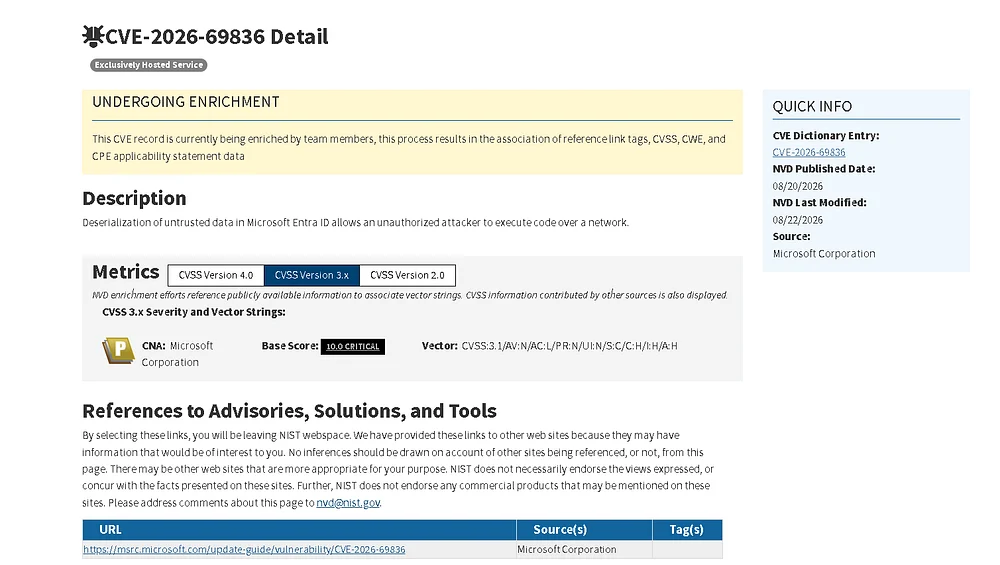
Entra ID deserialized untrusted data, allowing an unauthenticated attacker to execute code over the network. Microsoft says the flaw was fully mitigated centrally and was not exploited before the fix.
 Published on medium.com
Azure
The full write-up lives on its author's site
It belongs to its author, so we link to it rather than copy it. The other two tabs are our own rewrites, checked against it.
Context
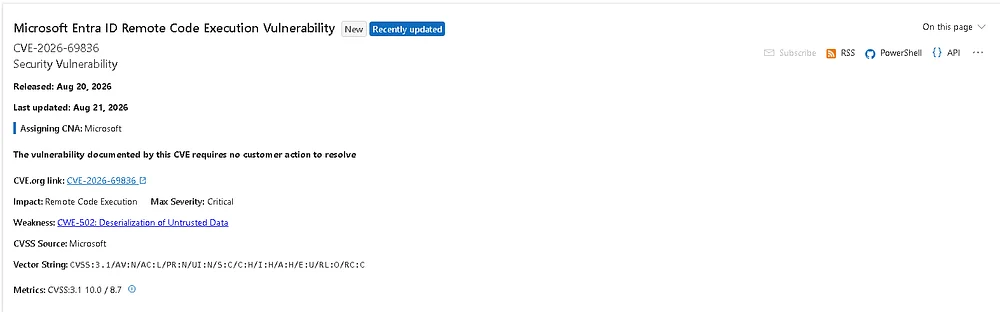
On 20 August 2026, Microsoft published an advisory for a vulnerability in Entra ID, the identity platform formerly known as Azure Active Directory. The flaw is tracked as CVE-2026-69836 and scored 10.0 on the CVSS scale. A score of that magnitude means an attacker needs no credentials and no user interaction, and can potentially achieve full compromise over the network.
Entra ID is the identity backbone that authenticates users and applications across an organisation's entire Microsoft cloud footprint. It issues tokens, evaluates conditional access policies, and decides whether a request to Exchange Online, SharePoint, Teams, Azure resources or any federated third-party app should be trusted. A remote-code-execution bug in the service that arbitrates trust for everything else is not just one more RCE: it is a bug in the referee.
Microsoft's advisory describes the issue as an unauthorised attacker being able to execute code over a network because Entra ID deserializes untrusted data. In plainer terms, somewhere in Entra ID's processing pipeline, data coming from outside the trust boundary was being unpacked back into live objects without properly checking that it was safe to do so.
Setup
There is no customer-side setup to describe. Entra ID is multi-tenant SaaS: Microsoft controls the code, the deployment and the rollout, and customers cannot patch it themselves. Microsoft states that the vulnerability has been fully mitigated on its end and that no action is required from customers. This is a cloud-service fix, not a patch you deploy.
Microsoft credited principal security engineer Robert Fitzpatrick with finding and reporting the issue. There is no public detail on how the flaw was discovered or how a working exploit might have been constructed, which is typical for cloud-service vulnerabilities: the vendor controls the entire attack surface and can close the door before publishing specifics.
There was also some confusion in early reporting about exploitation. Microsoft's initial advisory marked the "Exploited" field as "Yes", but the company corrected that to "No" after being contacted by journalists, clarifying that the vulnerability was not actually exploited before the fix went out.
Finding it
The public record does not describe the discovery process. The bug falls under CWE-502, deserialisation of untrusted data, a well-known category in the MITRE Common Weakness Enumeration.
Serialisation converts an in-memory object into a format that can be stored or transmitted, such as JSON, XML or a binary blob. Deserialisation reverses that process, turning the stored data back into a live object the application can use.

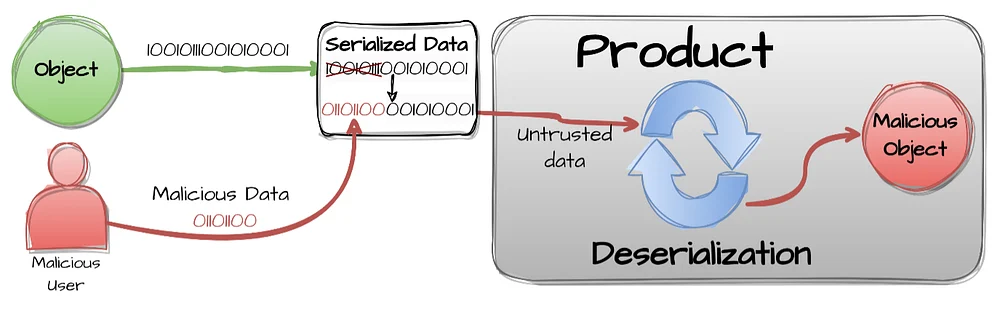
The danger appears when an application deserializes data it did not fully control or validate. Many serialisation formats allow the data itself to describe what type of object to reconstruct and how to reconstruct it. If an attacker can influence that data, they can potentially direct the deserializer to instantiate objects that were never meant to be created from untrusted input: objects whose constructors, setters or finalizers execute code as a side effect. Chained together, this is often called a gadget chain, a sequence of otherwise legitimate classes and methods that, invoked in just the right order, gives the attacker arbitrary code execution.
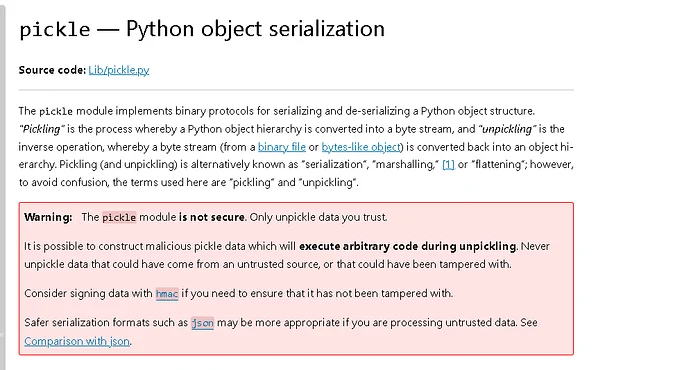
This is not a new or exotic bug class. Insecure deserialisation has powered major vulnerabilities for over a decade across Java, PHP, Python and .NET ecosystems alike. It keeps reappearing for a structural reason: deserialisation sits at a point in most applications where external input crosses directly into internal object state, and it is very easy to build a deserializer that is technically correct but security-blind, faithfully reconstructing whatever it is told to without asking whether it should.
Exploitation
No exploitation steps, requests, payloads or responses are public for this vulnerability. The advisory does not describe the vulnerable endpoint, the serialisation format involved, the object types that could be instantiated, or any gadget chain. Because the service is vendor-operated, the attack surface was closed before specifics were published, and the report gives no reproduction detail to work from.
What can be stated about the conditions is what the CVSS 10.0 implies: no credentials and no user interaction are required, and the attack is network-reachable. The report does not go beyond that.
Root cause
The root cause is the one the advisory describes: Entra ID deserialised untrusted data. Data crossing the trust boundary from outside was reconstructed into live objects without adequate validation of what was being reconstructed.
Why the existing defences did not stop it is not stated publicly. The report only implies the general failure mode of the class: a deserializer that reconstructs whatever it is told to, without asking whether it should. Any more specific account of the code path would be speculation.
Impact
Under the advisory's description, an unauthenticated, network-positioned attacker could potentially achieve code execution in Entra ID itself, and potentially full compromise of the service. Because Entra ID is the control plane for identity, it issues tokens, evaluates conditional access policies, and decides whether requests to Exchange Online, SharePoint, Teams, Azure resources and federated third-party apps should be trusted.
Two hedges matter. First, Microsoft states the vulnerability was not exploited before the fix, after correcting its own initial "Exploited: Yes" marking to "No". Second, there is no independent way for customers to verify exposure: no local log to check, no Patch Tuesday changelog entry, no visibility into the vulnerability window. Organisations have to take the vendor's word for both the severity and the remediation.
That is the trade-off of the cloud identity model. The upside is that the fix was pushed centrally before, according to Microsoft's corrected account, anyone exploited it. The downside is the absence of customer-side observability.
Fix
Microsoft states that it has fully mitigated the vulnerability on its end and that no customer action is required. The fix was applied centrally to the multi-tenant service; there is no patch for customers to deploy.
For the class in general, MITRE's guidance lists the standard defences:
- Sign or HMAC serialised data so tampering is detectable.
- Populate new objects through validated input paths rather than deserializing directly into live objects.
- Restrict which classes can be instantiated during deserialisation, using an allowlist rather than a blocklist, since new dangerous gadgets are discovered constantly.
- Treat any deserializer as a potential code-execution sink rather than a neutral parsing step.
Since there is no patch to deploy, the practical response for customers is identity hygiene prompted by the advisory:
- Review conditional access and privileged role assignments. Audit who holds Global Administrator and other high-privilege roles, and whether just-in-time access via Privileged Identity Management is actually used rather than standing admin rights.
- Check sign-in and audit logs for anomalies around the disclosure window. Even though Microsoft says this was not exploited, it is reasonable to review Entra ID sign-in logs and audit logs from early-to-mid August 2026 for unexpected service principal creation, unfamiliar admin consent grants, or authentication from unexpected locations.
- Reduce blast radius from federated trust. Minimise the number of apps with broad API permissions and tighten app consent policies, to limit downstream damage from a hypothetical identity-layer compromise.
- Watch the advisory for updates. Details on cloud-service CVEs sometimes get filled in later, as happened here with the exploitation status itself, and Microsoft's push toward greater transparency on cloud CVEs means entries occasionally get revised after initial publication.
The design habit to carry into your own systems is to treat every deserialisation boundary, every place where external data becomes an internal object, as a security control point rather than a formality.
Variants to test
These are generalisations of the class for your own targets, not details from this advisory:
- Type-directed deserializers. Send serialised data that names a class the application never expects from that input path. A positive result is the server instantiating the named type, visible through error messages, timing differences or side effects such as a DNS lookup or file write triggered by a constructor or setter.
- Gadget chains in common libraries. Where the stack is Java, .NET, PHP or Python, test known gadget chains against the deserialisation entry point. A positive result is out-of-band interaction from the target host, for example a callback to a listener you control.
- Unsigned or unverified serialised blobs. Take a serialised value the application issues (a cookie, a hidden form field, a token fragment), modify it, and resubmit. A positive result is the application accepting the modified object rather than rejecting it on signature or HMAC verification.
- Blocklist bypasses. If a class blocklist is in place, try equivalent classes or subclasses that reach the same dangerous behaviour. A positive result is a blocked payload's behaviour reproduced through an unlisted type.
- Nested and polymorphic fields. Target fields typed as generic or polymorphic containers, where the payload supplies the concrete type. A positive result is the deserializer honouring an attacker-chosen concrete type inside the container.
What happened, in plain words
On 20 August 2026, Microsoft published a security notice about a flaw in Entra ID. Entra ID is Microsoft's identity service, the thing that checks who you are when you sign in to Microsoft 365, Teams, Outlook on the web, Azure and many other apps. It used to be called Azure Active Directory, and many people still say "Azure AD".
Think of Entra ID as the doorman of a very large building. Every person and every app that wants to get into any room in that building first shows the doorman their pass. The doorman checks the pass, decides which rooms the holder may enter, and writes down the visit. If the doorman can be tricked, every room behind him is exposed at once.
The flaw in that doorman got the worst possible severity score: 10.0 on the CVSS scale. CVSS is a standard way of scoring how serious a security bug is, from 0 to 10. A 10.0 means an attacker needs no credentials and no user interaction, and could potentially take full control over the network. "No credentials" means they do not need a username or password. "No user interaction" means nobody has to click anything or open a file. "Over the network" means they can do it remotely, from wherever they are, as long as they can reach the service.
The good news, and it is genuinely good news, is that Microsoft says the problem is already fixed on its side and that customers do not have to do anything. This is not a piece of software you install on your own computers. Entra ID runs in Microsoft's cloud, on Microsoft's machines, and Microsoft fixed it there. You cannot patch it yourself, and in this case you did not need to.
This article walks through what the flaw was, why this particular kind of bug is so dangerous, and what you can usefully do even when there is no patch to install.
The basics
The flaw has an identifier: CVE-2026-69836. A CVE is a public catalogue number for a known security vulnerability. It works a bit like a case number at a police station: it lets everyone in the world refer to the same issue unambiguously. The "2026" part tells you the year it was catalogued.
Microsoft's notice describes the problem as an unauthorised attacker being able to run code over a network, because Entra ID deserializes untrusted data. That sentence is dense, so let us unpack it word by word.
- Running code means making a computer do something the attacker chose, rather than something the owner chose. In the worst case, the attacker's instructions run with the same rights as the service itself.
- Over a network means the attacker does not need to be sitting at the machine. They send data across the internet and the service acts on it.
- Deserializes is the technical heart of the bug, and the next section explains it from scratch.
- Untrusted data means data that came from outside, from someone the service does not control and has not verified.
In plain terms: somewhere inside Entra ID, information arriving from outside was being turned back into working internal objects without a proper check that it was safe to do so. The service took the stranger's word for what the data was and built it accordingly.
Microsoft credited principal security engineer Robert Fitzpatrick with finding and reporting the issue. "Principal security engineer" is a senior job title at Microsoft. Reporting a bug to the company that makes the product is the normal, responsible route: it gives the vendor a chance to fix it before anyone else learns the details.
Microsoft said it has fully mitigated the vulnerability on its end and that no action is required from customers. "Mitigated" means the dangerous behaviour has been removed or blocked. Because this is a cloud service, the fix is a change on Microsoft's servers, not a download for you.
There was some confusion in early reporting about whether the bug had been exploited in the wild. "Exploited in the wild" means real attackers actually used it against real victims, as opposed to it merely being possible in theory. Microsoft's first notice marked the "Exploited" field as "Yes", then corrected it to "No" after journalists asked, clarifying that the vulnerability was not actually exploited before the fix went out. That correction matters: it is the difference between a near miss and a known break-in.
As of this writing, there is no public detail on how the flaw was discovered or how a working exploit might have been built. That is normal for cloud-service bugs. The vendor owns the whole service, so it can close the door before publishing the blueprint. Publishing the details of a bug that is already fixed is useful for learning; publishing them while it is still open would be handing out a weapon.
Why "deserialisation of untrusted data" is such a dangerous category
This bug belongs to a known family called CWE-502. CWE stands for Common Weakness Enumeration, a public list maintained by MITRE, a non-profit organisation. Where a CVE names one specific bug, a CWE names a whole category of mistake, the way "leaving the front door unlocked" is a category of mistake rather than one particular burglary. CWE-502 is the category "deserialisation of untrusted data".
To understand it, start with serialisation. Serialisation is the process of converting an object that lives in a program's memory into a format that can be stored or sent somewhere: JSON, XML, or a binary blob. JSON is a text format for structured data, familiar to anyone who has seen curly braces and quoted field names. XML is an older text format built from tags. A binary blob is just a chunk of raw bytes with no text structure.
A useful comparison is packing a piece of furniture for shipping. In memory, the object is an assembled chair: it has parts, and the parts are connected in a particular way. Serialisation takes it apart and writes an instruction sheet: "four legs, one seat, this leg goes here". The instruction sheet can be stored in a warehouse or mailed to another city. Deserialisation is the person at the other end reading the sheet and rebuilding the chair.
The danger appears when an application deserializes data it did not fully control or validate. Many serialisation formats let the data itself describe what type of object to rebuild and how to rebuild it. That is like a shipping instruction sheet that not only says "four legs and a seat" but also says "and by the way, while you are assembling this, also switch on the office alarm and unlock the back door". If the person following the sheet does exactly what it says without questioning it, the extra instructions get carried out too.
In software, those extra instructions take the form of objects whose constructors, setters or finalizers run code as a side effect. A constructor is the code that runs when an object is created. A setter is the code that runs when a value is assigned to a field. A finalizer is code that runs when an object is cleaned up. Normally these are harmless housekeeping. But some classes in a codebase do surprising things when created or filled in, and an attacker who can choose which classes get created can pick the surprising ones on purpose.
Chained together, this is often called a gadget chain. A gadget, in this context, is a small piece of otherwise legitimate code that does something useful to an attacker when triggered in the right way. A chain is a sequence of such pieces, each one setting up the next, that together produce arbitrary code execution. The comparison is a Rube Goldberg machine: no single part is dangerous, but arrange them in the right order and a marble rolls down a ramp, tips a domino, and opens a door.
This is not a new or exotic bug class. Insecure deserialisation has powered major vulnerabilities for over a decade, across Java, PHP, Python and .NET ecosystems alike. Those are four widely used programming languages and their surrounding libraries. The reason it keeps coming back is structural: deserialisation sits at a point in most applications where external input crosses directly into internal object state. It is very easy to build a deserializer that is technically correct but security-blind. It faithfully rebuilds whatever it is told to, without asking whether it should.
MITRE's own guidance lists the standard defences. These are the general fixes for the whole category, not a description of what Microsoft did internally:
- Sign or HMAC the data so tampering is detectable. Signing means attaching a cryptographic proof that the data came from a trusted source and was not altered. HMAC is a specific technique for producing such a proof using a shared secret key. If someone changes even one byte, the proof no longer matches and the receiver rejects the data. It is like a wax seal on an envelope: break the seal and the recipient knows the letter was opened.
- Populate new objects through validated input paths rather than deserializing directly into live objects. Instead of letting the incoming data decide which object to build, the program reads the data field by field, checks each value, and then builds the object itself. The instruction sheet is read by a careful clerk, not obeyed by a machine.
- Restrict which classes can be instantiated during deserialisation, using an allowlist rather than a blocklist. An allowlist is a list of things that are permitted; everything else is refused. A blocklist is a list of things that are forbidden; everything else is allowed. For security, allowlists are safer, because new dangerous gadgets are discovered constantly and a blocklist is always one discovery behind.
- Treat any deserializer as a potential code-execution sink rather than a neutral parsing step. A sink, in security language, is a place where dangerous input ends up. The point is to stop thinking of deserialisation as boring plumbing and start treating it as a place where an attacker could get code to run.
Why this particular instance matters more than most
A CVSS 10.0 in a niche internal tool is bad. A CVSS 10.0 in Entra ID is a different order of concern, for a simple reason: identity is the control plane. The control plane is the part of a system that makes the decisions the rest of the system follows. Entra ID is what issues tokens, evaluates conditional access policies, and ultimately decides whether a request to Exchange Online, SharePoint, Teams, Azure resources or any federated third-party app should be trusted.
A few of those terms deserve a plain explanation:
- A token is a small piece of data that proves you have already signed in. When you log in once, the service hands your browser or app a token, and the app shows that token on later requests instead of asking for your password again. It works like a wristband at a festival: you show your ticket once at the gate, get the wristband, and after that the wristband gets you into the stages.
- Conditional access policies are rules such as "allow sign-in only from a company laptop" or "require a second factor when signing in from a new country". They are the conditions attached to the doorman's approval.
- Federated third-party apps are outside applications that an organisation has chosen to trust with its Entra ID sign-in, so that employees can use one login for many services. Federation means the organisation has agreed to accept another party's word about who someone is.
A remote-code-execution bug in the service that arbitrates trust for everything else is not just one more RCE. It is a bug in the referee. If the referee can be bribed, the result of every match is in question, not just one.
That is also precisely why Microsoft was able to say "no action required". Entra ID is multi-tenant SaaS. SaaS means software as a service: the vendor runs it for many customers at once. Multi-tenant means many organisations share the same running service, kept separate logically rather than by having their own copy. Microsoft controls the code, the deployment and the rollout. Customers cannot patch it themselves, and in this case they did not need to: the fix was pushed centrally before, according to Microsoft's corrected account, anyone exploited it.
That is the upside of the cloud identity model. The downside is that organisations have no visibility into the vulnerability window, the period between the bug existing and the bug being fixed. They have to take the vendor's word for both the severity and the remediation. There is no local log to check, no Patch Tuesday changelog entry, no way to independently verify exposure. Patch Tuesday is Microsoft's traditional monthly day for releasing fixes for software customers install themselves; a cloud service does not work that way. You are trusting the platform, full stop.
What to actually do about it
Since there is no patch to deploy, the practical response is not "go patch this". It is the broader identity-hygiene checklist that this kind of advisory should prompt you to revisit. Identity hygiene means keeping the accounts, roles and permissions in your organisation tidy and minimal, the way you keep keys to a building limited to the people who need them.
- Review conditional access and privileged role assignments. A privileged role is a role inside the system that carries extra power, such as Global Administrator. A tenant is your organisation's own separate space inside the shared service. Audit who holds Global Administrator and other high-privilege roles, and whether just-in-time access via Privileged Identity Management is actually being used rather than standing admin rights. Just-in-time access means the powerful role is switched on only when needed and switched off afterwards, instead of being held all day every day. Standing admin rights are the opposite: permanent power, permanently at risk.
- Check sign-in and audit logs for anomalies around the disclosure window. Sign-in logs record who logged in, when and from where. Audit logs record changes made in the service. Even though Microsoft says this was not exploited, it is reasonable to look at Entra ID sign-in logs and audit logs from early-to-mid August 2026 for anything unusual: unexpected service principal creation, unfamiliar admin consent grants, or authentication from unexpected locations. A service principal is an identity used by an application rather than a person, so an unexpected one can mean someone quietly gave an app access. Admin consent is the approval an administrator gives when an app asks for permission to read data; an unfamiliar grant is worth a question.
- Reduce your blast radius from federated trust. Blast radius is how much damage one failure can cause, borrowed from the idea of an explosion. RCE in an identity provider is a reminder of how much you rely on that provider's integrity. Minimising the number of apps with broad API permissions, and tightening app consent policies, limits how much damage a hypothetical identity-layer compromise could do downstream. An API, or application programming interface, is the set of doors a program offers to other programs; broad API permissions mean an app can go through many of those doors.
- Keep an eye on Microsoft's advisory for updates. Details on cloud-service CVEs sometimes get filled in later, as happened here with the exploitation status itself. Microsoft's push toward greater transparency on cloud CVEs means these entries occasionally get revised after initial publication. Transparency here means publishing more about cloud bugs than was previously customary.
The bigger picture
CVE-2026-69836 will likely be remembered less for real-world damage, of which by Microsoft's account there was none, and more as a case study. It is a reminder that identity platforms, for all their sophistication, are still software, built from the same components (parsers, deserializers, object graphs) that have produced deserialisation bugs in web frameworks and enterprise middleware for twenty years. A parser is the part of a program that reads incoming data and works out its structure. An object graph is the network of objects in memory and the links between them. Enterprise middleware is the software that sits between big systems and passes messages around.
It is also a reminder that "the cloud provider patches it for you" is a genuine security benefit, but not a substitute for having good logging, tight privilege management, and an incident response process ready to go the moment an advisory like this lands in your inbox. Incident response is the plan you follow when something goes wrong: who looks, who decides, who tells whom.
If there is one takeaway to carry into your own systems, it is this: treat every deserialisation boundary, every place where external data becomes an internal object, as a security control point, not a formality. A control point is a place where you deliberately stop and check. That single design habit is what separates a CVSS 10.0 headline from a footnote.
Glossary
- Advisory: a public notice from a vendor describing a security vulnerability and what to do about it.
- Allowlist: a list of things that are permitted, with everything else refused.
- API (application programming interface): the set of ways one program can ask another program to do something.
- Audit log: a record of changes made in a system, such as who granted an app permission.
- Authentication: proving who you are, usually by signing in.
- Binary blob: a chunk of raw bytes with no text structure.
- Blast radius: how much damage a single failure can cause.
- Blocklist: a list of things that are forbidden, with everything else allowed.
- Conditional access policy: a rule that decides whether a sign-in is allowed, for example based on device or location.
- Constructor: code that runs when an object is created.
- Control plane: the part of a system that makes the decisions the rest of the system follows.
- Credentials: the proof of identity used to sign in, such as a username and password.
- CVE: a public catalogue number for a specific known vulnerability.
- CVSS: a standard scale from 0 to 10 for how serious a vulnerability is.
- CWE: a public catalogue of categories of software weakness, maintained by MITRE.
- CWE-502: the weakness category "deserialisation of untrusted data".
- Deserialisation: turning stored or transmitted data back into a live object a program can use.
- Entra ID: Microsoft's cloud identity service, formerly Azure Active Directory, which authenticates users and apps across Microsoft's cloud.
- Exploited in the wild: actually used by real attackers against real victims.
- Federated third-party app: an outside application trusted to accept your organisation's sign-in.
- Finalizer: code that runs when an object is cleaned up.
- Gadget: a small piece of legitimate code that does something useful to an attacker when triggered in the right way.
- Gadget chain: a sequence of gadgets invoked in a particular order to achieve arbitrary code execution.
- Global Administrator: a high-privilege role in Entra ID.
- HMAC: a technique for proving data has not been altered, using a shared secret key.
- Identity provider: the service that confirms who a user or app is and issues tokens on that basis.
- Incident response: the plan followed when a security problem occurs.
- JSON: a text format for structured data, built from braces, quotes and field names.
- Just-in-time access: switching on a powerful role only when needed and off again afterwards.
- MITRE: the non-profit organisation that maintains the CWE catalogue.
- Multi-tenant SaaS: software run by a vendor for many customers at once, with each customer's data kept logically separate.
- Object: a bundle of data and behaviour inside a running program.
- Object graph: the network of objects in memory and the links between them.
- Parser: the part of a program that reads incoming data and works out its structure.
- Patch Tuesday: Microsoft's traditional monthly release day for fixes to software customers install themselves.
- Privileged role: a role in a system that carries extra power.
- Remote code execution (RCE): making a computer run code chosen by an attacker, over a network.
- Serialisation: turning a live object into a format that can be stored or transmitted.
- Service principal: an identity used by an application rather than a person.
- Setter: code that runs when a value is assigned to a field of an object.
- Sign-in log: a record of who signed in, when and from where.
- Sink: a place in a program where dangerous input ends up.
- Tenant: an organisation's own separate space inside a shared cloud service.
- Token: a small piece of data that proves you have already signed in, shown on later requests instead of a password.
- Trust boundary: the line between data you control and data that comes from outside.
- Untrusted data: data from a source you do not control and have not verified.
- Vulnerability window: the period between a bug existing and the bug being fixed.
- XML: an older text format for structured data, built from tags.




