Who Let the DAGs Out? When Your Orchestrator Plays the Wrong Tune
The report describes multiple security weaknesses in Apache Airflow deployments, including unauthenticated instances leaking secrets, a new CVE where the Connection API redacts secrets by field name rather than value, and insecure defaults such as DAG source disclosure and default credentials. An attacker could read plaintext credentials, forge JWTs if the secret is weak, inject tasks via an open Redis broker, and execute commands through templated fields.

medium.com
Published on medium.com
Apache
The full write-up lives on its author's site
It belongs to its author, so we link to it rather than copy it. The other two tabs are our own rewrites, checked against it.
Context: an orchestrator is a control plane
Apache Airflow is the open-source orchestrator that schedules and runs data pipelines: workflows made of Python tasks, described as DAGs (Directed Acyclic Graphs). Teams use it to copy last night's orders into an analytics warehouse, to retrain a fraud-detection model on yesterday's data, and to run recurring operations work such as dashboards, backups and log rotation. A DAG is the workflow map: tasks, order, dependencies, schedule.
Around that map sit four components. The author's framing is blunt: this is not a scheduler, it is a production control plane, and every box in the architecture is attack surface.
Adoption is broad. The 17,000+ forks are the real tell, because a fork means an organisation pulled the codebase in-house for production use. Real PyPI data for the trailing 30 days, roughly 22 million Airflow downloads as of August 2026, shows 55% still on 2.x, 44% on 3.x and 0.4% on 1.x, a branch that has been end-of-life since 2021. A full year after Airflow 3 shipped, more than half of installs are still on 2.x.
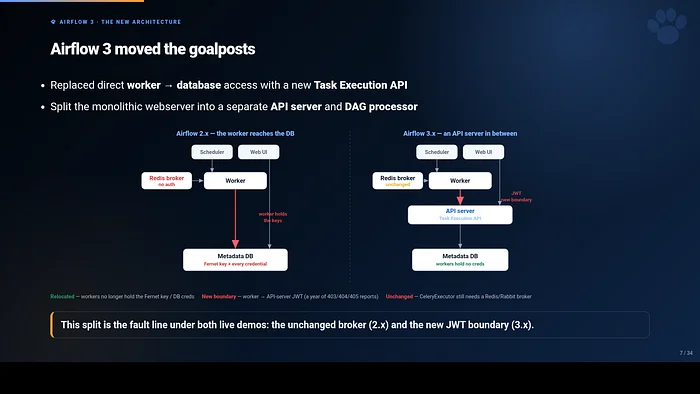
Airflow 3 replaced direct worker-to-database access with a new Task Execution API and split the monolithic webserver into a separate API server and DAG processor. On 2.x the worker reaches the metadata database directly and holds the Fernet key and every credential. On 3.x an API server sits in between; workers talk to it over a short-lived JWT and hold no database credentials at all. That is a genuine relocation of risk, but it also created a new boundary, the worker-to-API-server JWT handshake, and a year of 403, 404 and 405 reports from people trying to upgrade. CeleryExecutor still needs a Redis or RabbitMQ broker between scheduler and workers either way.
The upgrade pattern is consistent across Docker Compose, Helm and Kubernetes deployments: after upgrading, the worker cannot authenticate to the new API server, so its tasks silently stop running. The reports include a 405 in May 2025, a 404 on a subpath ingress, 403s turning into 404s, wrong-audience tokens and bad-signature tokens reported through April 2026.
Nothing between the components is encrypted by default:
- Execution API: no encryption by default, plain HTTP on port 8080, carrying connections, variables, XCom, task state and the JWT bearer token itself.
- Celery broker: no encryption by default.
- The log server on 8793/8794, bound to
[redacted]: no encryption by default. - Metadata DB: no encryption unless you configure it yourself.
There is no CVE for any of this because Apache's Security Model states that encryption is the deployment manager's responsibility. Sniffing the wire is enough to read the token; no forgery is needed. Turning TLS on has its own history: GitHub Discussion #50726 describes Docker plus a self-signed certificate where the web UI is fine but worker-to-API runs fail with a certificate verify error; #53493, three months later, reports the same failure independently, with the reporter asking for a flag to disable verification outright. Two more discussions show the Task SDK's httpx client silently ignoring the CA-bundle environment variable that requests honours. On the Celery side, Redis Sentinel SSL is rejected outright, a maintainer has admitted Sentinel was never tested in CI, and the rediss:// scheme silently downgrades to redis:// with a warning most people never see. Airflow 3.3.0 shipped real partial fixes.
Setup: what was examined and how
This is offensive research: real exposed Airflow instances found in the wild, verified against Airflow's current release, plus one CVE found on the current release. The research behind the author's BSides Las Vegas talk, with another chance to catch it live at OWASP Global AppSec on October 6.
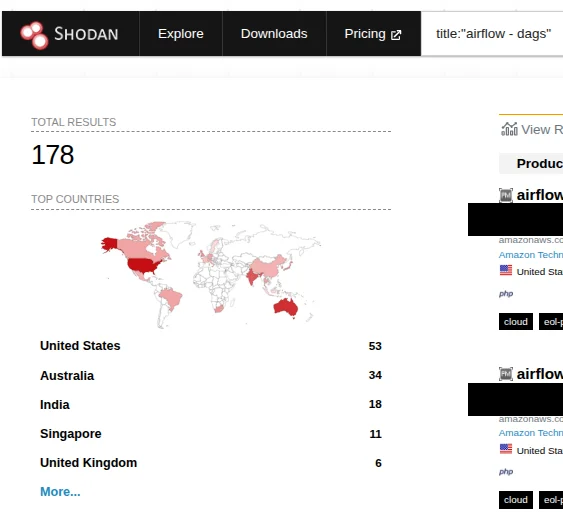
Discovery used Shodan. The query is:
title:"airflow - dags"
That string matches the DAG-list page's own title with no login wall in front of it, which is the default on Airflow 1.x; 2.x forces a "Sign In" page first. The raw hit count looks alarming, but once honeypots are stripped out the real number is small: a handful of genuine, unauthenticated, production Airflow instances.
Testing was deliberately passive where a live system was involved. For the ticket-pricing platform the author states plainly that nothing was touched, changed or downloaded. and that default credentials were not tested against live systems because that would mean logging in uninvited. For the construction-management platform and the ticket-pricing platform, with no vendor relationship available, findings were escalated CERT-to-CERT across borders.
Finding it: what was exposed in the wild
QuickBooks secrets in plaintext
The first instance's Variables store returned a QuickBooks OAuth app's client secret and refresh token in plaintext, with no authentication required. That pair mints fresh hour-long access tokens for roughly 100 days, giving full read-write access to a company's books: invoices, customers, bank transactions. No exploit was needed and no CVE applies. Airflow Variables are not a secrets manager, and this box was using them as one.

DAG source view on a construction-management platform
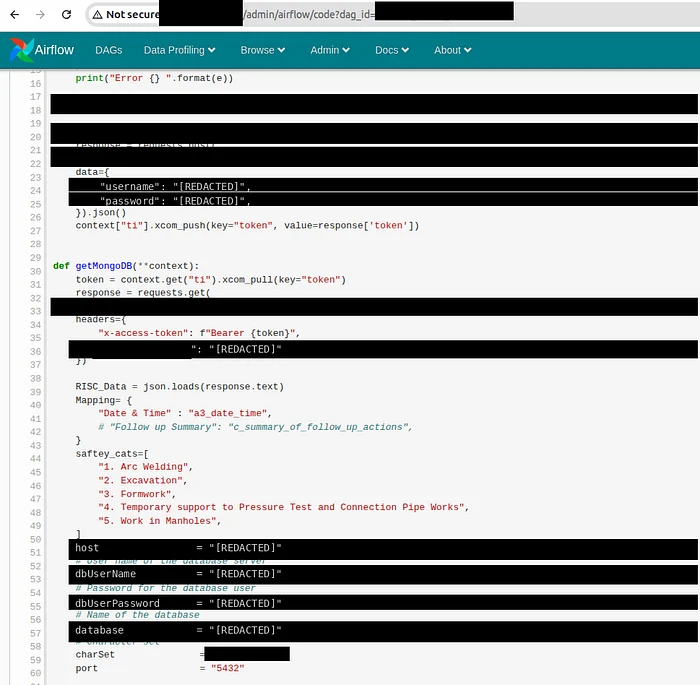
A different door, the same failure. On a construction-management platform the leak was not in Variables but in the DAG source view, which handed over AWS RDS Postgres credentials, an app login and a private access key, all hardcoded directly in the DAG code. Someone had already been there: a planted variable curling the cloud metadata endpoint, with SSTI probes sitting right beside it. With no vendor relationship available, this was escalated CERT-to-CERT, across borders.
Airflow 1.10.9 with an attacker already inside
A third instance, unauthenticated Airflow 1.10.9 (with two known CVEs of its own), contained three attacker-planted variables. Two were Jinja SSTI payloads meant to run OS commands and exfiltrate the output; they failed silently because Airflow's macros module does not expose os in that version. Someone had copy-pasted a public payload without checking whether it matched the target version.
The third payload was real: a full pysftp script with hardcoded credentials, enumerating internal production and UAT SFTP servers, with host-key checking turned off. Someone was using an unauthenticated Airflow instance as a trusted execution box inside the perimeter, to run reconnaissance on internal infrastructure that is not reachable from the public internet at all.
The ticket-pricing platform
The target is a B2B dynamic ticket-pricing platform, the kind of software that sets seat prices in real time from live demand for major events, wired into multiple major clients and live entertainment. Its pipelines push prices into ticketing systems, rebalance inventory, handle returns and process real ticket barcodes, the sellable asset itself. Nobody has heard of the company, but it sits in the middle of the money and the tickets for dozens of major venues.
Found via OSINT in April 2026: Airflow 1.10.15, end-of-life since 2021, fully unauthenticated, no TLS, admin panel wide open. The DAG list showed a pricing-report and scan-for-barcodes DAG for every client. The same box's Variables exposed live third-party API credentials, live ticketing-system credentials for major-league clients, named employee emails (a ready-made spear-phishing list) and the full AWS VPC topology.
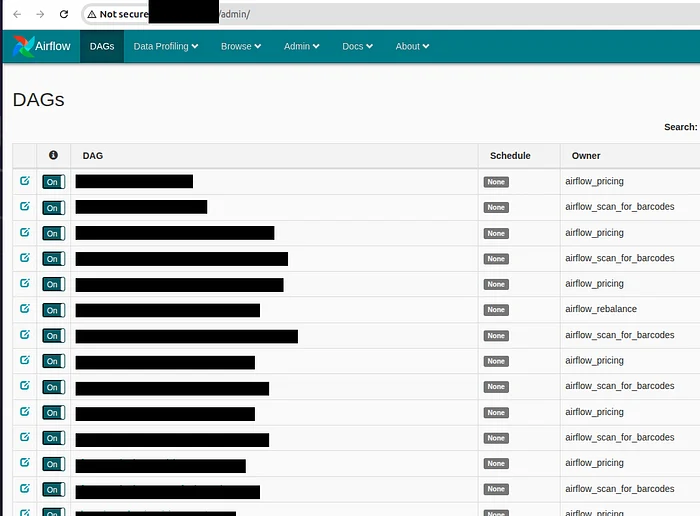
The reachable path was not executed. A BashOperator task is arbitrary code execution, and the exposed Variables handed over the full VPC map, confirming the instance ran on EC2. From a DAG task the instance metadata service is one HTTP request away: DAG task to IMDS to IAM credentials to account pivot. No screenshot exists for that step because it was not run. This is passive observation: the reachable path, evidenced by the exposed topology, not a performed exploit.
The real-world impact is where it stops being an infrastructure bug. The scan-for-barcodes DAGs run for every one of those 30-plus clients, and the task logs and XCom held real, live ticket barcodes. Pull one from a log, clone it, resell it on a secondary market. A fan buys a real seat; someone clones the barcode out of an exposed log; at the gate the clone scans first and the person who paid is turned away. The ticket-pricing platform instance has since been confirmed taken offline.
Default credentials
admin/admin and airflow/airflow ship as Airflow's quick-start defaults, and neither is forced to rotate. How many live instances still accept them was not tested, because that would mean logging in uninvited.
Exploitation
Step 1: the templated BashOperator primitive
The shared primitive underneath the wild findings needs no SSTI gadget at all. bash_command is a templated field: whatever sits in a Variable gets rendered straight into the shell string and executed. The snippet
id && whoami && hostname
renders verbatim and runs on the worker, with no sandbox in the way, on every release. This is not an exploit; it is the feature used exactly as designed, against the operator.
Step 2: CVE-2022-40127 through the Run id field
Airflow shipped this one in its own example DAGs. example_bash_operator.py echoed the run_id straight into bash_command, and run_id is literally the "Run id" box on the Trigger-DAG form, so anyone who can trigger a DAG gets OS command injection. That is CVE-2022-40127, fixed in 2.4.0, and it lived in-tree, enabled by default, until then. The input does not have to be typed by an admin: it also arrives through the trigger REST API, through anyone holding Airflow's User or Op role (the tier normally handed to operators and analysts, not admins), or through an upstream DAG passing along external data.
The demonstration was on Airflow 2.3.4, pre-fix. Current Airflow blocks this exact payload with a run_id format allowlist, but the same unescaped-template primitive still fires through Variables and dag_run.conf params.
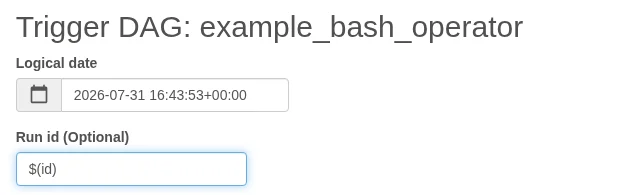


Typing $(id) into the Run id field executes on the worker.
Step 3: the Redis broker
CeleryExecutor inserts a Redis or RabbitMQ broker between the scheduler and the workers, and like the worker-to-API boundary it does not exist on a single node. Redis defaults to no authentication, so a reachable broker is wide open.
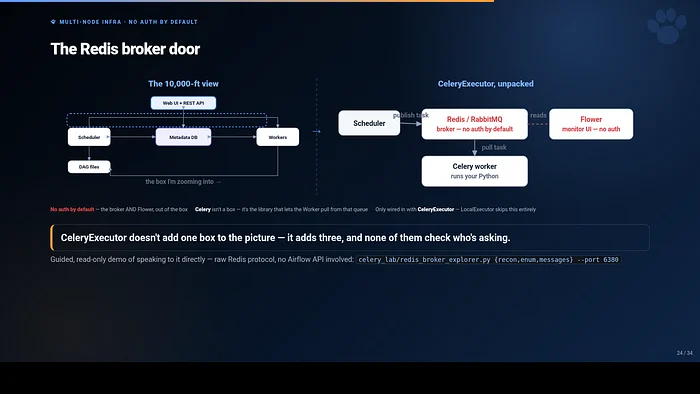
Walking it live, first confirm the broker is open:
redis-cli PING
With no auth this returns PONG. Next, dump the pending task messages:
LRANGE celery 0 -1
Just reading them leaks dag_id, task_id and arguments. RPUSH-ing a forged envelope gets a worker to run it. This is the CVE-2020-11981 lineage; the argv-RCE from that CVE is mitigated on current 2.10.4, but reading the queue, injecting a task and leaking task context are not.
Shodan data from July 2026: 198 of 211 Redis brokers behind these clusters answered with no authentication, and zero of roughly 2,600 open Flower monitors asked for a login. Read the queue and you read the pipeline; write to it and you are the scheduler.
Step 4: forging a 3.x JWT
Airflow 3 put workers behind the API server with short-lived JWTs specifically to kill the 2.x blast radius. The token is HS512, signed over a single jwt_secret. If that secret is weak or guessable, a token can be forged with a completely phantom subject, one that was never a real task, and decrypted secrets can be read with no running task and no foothold at all, from outside the cluster entirely. The redesign moved the trust boundary; it did not shrink the blast radius if the secret underneath it is weak.
Step 5: DAG source disclosure to a Viewer
A default Viewer role, explicitly denied the Connections and Variables APIs (403 on both), can still call GET on dagSources for any DAG ID and get back the full Python source: hardcoded AWS keys, RDS passwords, all of it, 200 OK. This is not a CVE. It is an insecure default, working exactly as designed, with no fix planned.
Step 6: CVE-2026-45192, redaction by name rather than value
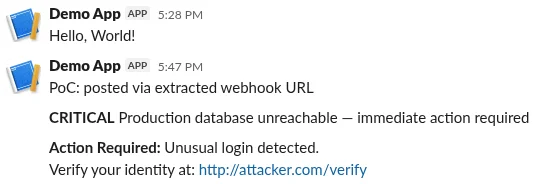
Found by Or Sahar on Airflow 3.2.1 and fixed in 3.2.2. The Connection API redacts secrets by matching a field's name against a hardcoded allowlist, not by inspecting what the value actually is. password and token come back as stars because those names happen to be on the list. webhook_url, bearer or a custom access-key field come back in plaintext because nobody put those names on the list. A field is only protected if whoever named it happened to pick an allowlisted name, and webhook_url is the exact field name used in Airflow's own Slack provider documentation. Redaction here is not a security boundary; it is a spell-checker.
The payoff: a Viewer-to-Op read of one Slack connection leaks the webhook_url in plaintext, and POSTing to that URL posts a message that appears to come from the integration that owns it. No further exploitation is needed. Read access to one connection is a working credential.
Root cause
The failures share a design property rather than a single bug. Secrets are stashed in Variables and in DAG code, and nothing is encrypted by default. Templated fields such as bash_command execute whatever is injected into them, so a Variable or a dag_run.conf parameter is a shell string. The Connection API's redaction is name-based, so any secret stored under a field name outside the allowlist is returned in plaintext. The DAG source endpoint serves full Python source to a Viewer role that is denied the Connections and Variables APIs. The broker and Flower have no authentication by default. On 3.x the JWT is signed over a single jwt_secret, so the blast radius depends on that secret's strength.
Existing defences did not stop these because the relevant controls are opt-in and delegated: Apache's Security Model places encryption on the deployment manager, TLS is manual and historically buggy, and the run_id allowlist added after CVE-2022-40127 closes that one field but not the unescaped-template primitive behind Variables and dag_run.conf. The DAG source disclosure has no fix planned.
Impact
Under the conditions seen in the wild, an unauthenticated attacker reaches a production control plane and from there the credentials it holds. The QuickBooks pair gives roughly 100 days of hour-long access tokens with full read-write access to a company's books. Hardcoded DAG source gives AWS RDS Postgres credentials, app logins and private access keys. On the ticket-pricing platform, live third-party API credentials, live ticketing-system credentials for major-league clients, named employee emails and the full AWS VPC topology were exposed, and task logs and XCom held live ticket barcodes that could be cloned and resold, turning a paying fan away at the gate. A BashOperator task is arbitrary code execution on the worker, and with the VPC map confirming EC2, the metadata service is one HTTP request away, leading to IAM credentials and an account pivot; that path was evidenced but not executed. On the Redis side, reading the queue leaks task context and writing to it makes the attacker the scheduler. A forged 3.x JWT with a phantom subject reads decrypted secrets from outside the cluster. CVE-2026-45192 turns read access to one connection into a working credential for the integration that owns it.
Fix
Four verbs: find, isolate, fix the defaults, rotate.
- Find and isolate. Inventory your own edges with the Shodan title query and ports 8080, 5555, 6379 and 6672. Kill unauthenticated 1.x and 2.x instances on sight, and take the broker and Flower off the public internet.
- Fix the defaults. Put secrets in a real backend (Vault, SSM, Secrets Manager), never in Variables and never in DAG source. Treat DAGs as a code-execution surface, and restrict who holds the "can read on DAG Code" permission, because source code leaks secrets too.
- Rotate. Anything that ever sat in a Variable, a Connection extra field or a DAG file should be rotated, full stop.
What was actually changed: CVE-2022-40127 was fixed in 2.4.0, CVE-2026-45192 was fixed in 3.2.2, and Airflow 3.3.0 shipped partial TLS fixes.
Variants to test
- Shodan
title:"airflow - dags"against your own estate. A positive result is a DAG-list page with no login wall, the default on Airflow 1.x. - Variables and Connections on any reachable instance. A positive result is a plaintext secret such as an OAuth client secret, refresh token or
webhook_urlreturned without authentication. dagSourcesas a default Viewer. A positive result is 200 OK with full Python source for a DAG ID, while the Connections and Variables APIs return 403.- The Run id field and
dag_run.confwith$(id). A positive result on a pre-fix version is command output from the worker; on current versions therun_idallowlist should block it while the Variable anddag_run.confpaths may still render. redis-cli PINGagainst port 6379. A positive result isPONGwith no auth, followed byLRANGE celery 0 -1returning task messages withdag_id,task_idand arguments.- Flower on port 5555. A positive result is a monitor that asks for no login.
- A 3.x JWT signed over a weak
jwt_secret. If the secret is weak or guessable, a forged token with a phantom subject can read decrypted secrets.
What happened, in plain words
Apache Airflow is a free, open-source tool that companies install on their own servers to run scheduled jobs automatically. A job might be "every night at 2am, copy yesterday's orders into the reporting database" or "every hour, retrain the fraud-detection model". Airflow is very popular: the author cites roughly 22 million downloads in a 30-day window on PyPI (the main public library where Python software is published), as of August 2026.
The problem is that many of these Airflow installations are reachable from the public internet and have no login at all. Anyone who finds one can read the passwords and access keys the company stored inside it, and in some cases can make the server run commands of their choosing. The author found several real ones, including a ticket-pricing company whose exposed Airflow held live ticket barcodes and credentials for major clients, and a company whose QuickBooks accounting credentials were sitting in plain text.
On top of the field findings, the author found a new software flaw, tracked as CVE-2026-45192, in a recent version of Airflow. A flaw like this gets a CVE number, which is a public catalogue entry so everyone can refer to the same issue. The flaw means one kind of stored secret is shown in full instead of being hidden behind asterisks.
The rest of this piece walks through what Airflow is, what was found exposed, how the individual weaknesses work, and what to do about them. It is written for someone who has never done security work, so every term is explained as it comes up.
Credit where it is due
The author is careful to say this is not a criticism of the Airflow project or the people who maintain it. Airflow is described as a remarkable piece of engineering, kept running in the open, for free, under heavy load. The security model the project publishes is honest about where its responsibilities stop, and fixes do ship: the TLS work in version 3.3.0 and the quick fix for CVE-2026-45192 are given as examples. Every finding here is about how companies deploy the tool, not about the people who build it.
Part 1: Meet Apache Airflow
Architecture: this is not a scheduler, it is a control plane
A DAG (Directed Acyclic Graph) is Airflow's map of a workflow: which tasks exist, in what order they run, what depends on what, and when they are scheduled. Think of it as a recipe card: a list of steps, some of which must happen before others, with a note at the top saying when to cook.
Around that map sit four components. The author's framing is blunt: this is not a scheduler, it is a production control plane, and every box in the architecture is something an attacker could target. A control plane, in everyday terms, is the dashboard and levers that steer a system, as opposed to the system doing the work. If someone else gets hold of the levers, they effectively own the machine.
Who is actually running it
Adoption is broad. The 17,000+ forks are the real tell, because a fork means an organisation copied the codebase into its own account to use it in production, not just to look at it. A fork on a code-hosting site is a personal copy of someone else's project.
Real PyPI data for the trailing 30 days, roughly 22 million Airflow downloads as of August 2026, shows 55% still on 2.x, 44% on 3.x and 0.4% on 1.x. Version 1.x has been end-of-life since 2021, meaning the project no longer fixes bugs or security holes in it. A full year after Airflow 3 shipped, more than half of installs are still on 2.x.
Airflow 3's new architecture, and the fault line it created
Airflow 3 replaced direct worker-to-database access with a new Task Execution API and split the monolithic webserver into a separate API server and DAG processor. An API (Application Programming Interface) is the set of doors one program offers to another: instead of reaching into the database directly, a program asks the API server to do it. A worker is the process that actually runs a task. The metadata database is where Airflow keeps its own bookkeeping: which runs happened, what settings exist, and so on.
On 2.x the worker reaches the metadata database directly and holds the Fernet key and every credential. A Fernet key is an encryption key used by a Python library of the same name to scramble stored secrets. On 3.x an API server sits in between; workers talk to it over a short-lived JWT and hold no database credentials at all. A JWT (JSON Web Token) is a small signed note that says "this request really comes from me"; short-lived means it expires quickly, so a stolen one is only useful for a short window. That is a genuine relocation of risk: the danger has moved, not vanished.
It also created a new boundary, the worker-to-API-server JWT handshake, and a year of 403, 404 and 405 reports from people trying to upgrade. Those numbers are standard web status codes: 403 means "you are not allowed", 404 means "not found", 405 means "that method is not allowed here". CeleryExecutor still needs a Redis or RabbitMQ broker between scheduler and workers either way. CeleryExecutor is one of Airflow's ways of spreading tasks across several machines; a broker is a message queue that hands tasks out, like a ticket dispenser at a deli counter.
The upgrade pattern is consistent across Docker Compose, Helm and Kubernetes deployments: after upgrading, the worker cannot authenticate to the new API server, so its tasks silently stop running. Those three names are common ways of packaging and running software in containers; you do not need the details to follow the story. The reports include a 405 in May 2025, a 404 on a subpath ingress, 403s turning into 404s, wrong-audience tokens and bad-signature tokens reported through April 2026. "Wrong audience" and "bad signature" are two ways a JWT can fail its check: it was minted for a different service, or it was tampered with.
Nothing is encrypted by default
Encryption means scrambling data so only the intended recipient can read it. "By default" means without the operator doing anything extra. Nothing between the components is encrypted by default:
- Execution API: no encryption by default, plain HTTP on port 8080, carrying connections, variables, XCom, task state and the JWT bearer token itself. A port is a numbered door on a server; HTTP is the unencrypted version of the web protocol. XCom is Airflow's mechanism for passing small pieces of data between tasks.
- Celery broker: no encryption by default.
- The log server on 8793/8794, bound to
[redacted]: no encryption by default.[redacted]means "listen on every network interface", so the service is reachable from anywhere the machine is reachable. - Metadata DB: no encryption unless you configure it yourself.
There is no CVE for any of this because Apache's Security Model states that encryption is the deployment manager's responsibility. In other words, the project says: we hand you the tool, you decide how to wrap it. Sniffing the wire is enough to read the token; no forgery is needed. Sniffing means capturing network traffic as it passes; if the traffic is unencrypted, the token is readable in it.
Turning TLS on has its own history. TLS is the encrypted version of HTTP, the padlock in your browser. GitHub Discussion #50726 describes Docker plus a self-signed certificate where the web UI is fine but worker-to-API runs fail with a certificate verify error. A self-signed certificate is one the operator made themselves rather than buying from a trusted authority, so other software may refuse to trust it. #53493, three months later, reports the same failure independently, with the reporter asking for a flag to disable verification outright. Two more discussions show the Task SDK's httpx client silently ignoring the CA-bundle environment variable that requests honours. Those are two Python libraries for making web requests; a CA bundle is the file listing which certificates to trust, and an environment variable is a setting passed to a program from outside.
On the Celery side, Redis Sentinel SSL is rejected outright, a maintainer has admitted Sentinel was never tested in CI, and the rediss:// scheme silently downgrades to redis:// with a warning most people never see. Redis is an in-memory data store often used as the broker; Sentinel is its high-availability mode; the rediss:// prefix means "connect over TLS" and redis:// means "connect unencrypted". Airflow 3.3.0 shipped real partial fixes.
Setup: what was examined and how
This is offensive research: real exposed Airflow instances found in the wild, verified against Airflow's current release, plus one CVE found on the current release. "Offensive research" here means security work done from the attacker's point of view, to find weaknesses before criminals do. The research behind the author's BSides Las Vegas talk, with another chance to catch it live at OWASP Global AppSec on October 6. Those are security conferences.
Discovery used Shodan. Shodan is a search engine that indexes internet-connected devices and services, rather than web pages. The query is:
title:"airflow - dags"
Line by line: title: tells Shodan to look at the page title of whatever it found. The quoted string airflow - dags is the literal title of Airflow's DAG-list page. So the query asks: show me every device on the internet whose page title is exactly that. That string matches the DAG-list page's own title with no login wall in front of it, which is the default on Airflow 1.x; 2.x forces a "Sign In" page first. In other words, a hit means someone is running an old Airflow whose DAG list has no login wall in front of it.
The raw hit count looks alarming, but once honeypots are stripped out the real number is small: a handful of genuine, unauthenticated, production Airflow instances. A honeypot is a decoy server set up to look vulnerable so researchers and attackers waste time on it.
Testing was deliberately passive where a live system was involved. Passive means looking without touching. For the ticket-pricing platform the author states plainly that nothing was touched, changed or downloaded. and that default credentials were not tested against live systems because that would mean logging in uninvited. For the construction-management platform and the ticket-pricing platform, with no vendor relationship available, findings were escalated CERT-to-CERT across borders. A CERT is a national or sector computer emergency response team; CERT-to-CERT means one team formally hands the problem to another country's team when the owner cannot be reached directly.
Finding it: what was exposed in the wild
QuickBooks secrets in plaintext
The first instance's Variables store returned a QuickBooks OAuth app's client secret and refresh token in plaintext, with no authentication required. QuickBooks is accounting software. OAuth is a common way for one app to be given permission to act on another's behalf; the client secret and refresh token are the two pieces of that permission. Plaintext means readable as-is, with no scrambling.
That pair mints fresh hour-long access tokens for roughly 100 days, giving full read-write access to a company's books: invoices, customers, bank transactions. An access token is the short-lived pass the app presents to prove it is allowed in. No exploit was needed and no CVE applies. Airflow Variables are not a secrets manager, and this box was using them as one. A secrets manager is a dedicated tool for storing passwords and keys safely; Variables are just a general-purpose settings store.
DAG source view on a construction-management platform
A different door, the same failure. On a construction-management platform the leak was not in Variables but in the DAG source view, which handed over AWS RDS Postgres credentials, an app login and a private access key, all hardcoded directly in the DAG code. AWS is Amazon's cloud; RDS is its managed database service; Postgres is a popular database. Hardcoded means typed directly into the code file rather than fetched from a safe store.
Someone had already been there: a planted variable curling the cloud metadata endpoint, with SSTI probes sitting right beside it. Curling means making a web request with the command-line tool curl. The cloud metadata endpoint is a special internal address that cloud servers use to hand out information about themselves, including temporary credentials. SSTI (Server-Side Template Injection) is a class of flaw where an attacker's text is treated as instructions by the server's templating engine; a probe is a small test to see whether that works.
With no vendor relationship available, this was escalated CERT-to-CERT, across borders.
Airflow 1.10.9 with an attacker already inside
A third instance, unauthenticated Airflow 1.10.9 (with two known CVEs of its own), contained three attacker-planted variables. Two were Jinja SSTI payloads meant to run OS commands and exfiltrate the output; they failed silently because Airflow's macros module does not expose os in that version. Jinja is the templating engine Airflow uses; a payload is the piece of text an attacker hopes will be executed; OS commands are instructions to the operating system; exfiltrate means send the results out to the attacker. Someone had copy-pasted a public payload without checking whether it matched the target version.
The third payload was real: a full pysftp script with hardcoded credentials, enumerating internal production and UAT SFTP servers, with host-key checking turned off. pysftp is a Python library for transferring files over SFTP, the secure file-transfer protocol. Enumerating means listing what is there. UAT stands for user acceptance testing, a pre-production environment. Host-key checking is the step where the client verifies it is talking to the right server; turning it off means accepting any server that answers.
Someone was using an unauthenticated Airflow instance as a trusted execution box inside the perimeter, to run reconnaissance on internal infrastructure that is not reachable from the public internet at all. Reconnaissance means scouting. The perimeter is the boundary between a company's internal network and the outside world.
The ticket-pricing platform
The target is a B2B dynamic ticket-pricing platform, the kind of software that sets seat prices in real time from live demand for major events, wired into multiple major clients and live entertainment. B2B means business-to-business: the customer is another company. Its pipelines push prices into ticketing systems, rebalance inventory, handle returns and process real ticket barcodes, the sellable asset itself. A barcode here is the scannable code on a ticket that proves it is valid.
Nobody has heard of the company, but it sits in the middle of the money and the tickets for dozens of major venues.
Found via OSINT in April 2026: Airflow 1.10.15, end-of-life since 2021, fully unauthenticated, no TLS, admin panel wide open. OSINT means open-source intelligence: finding things using only publicly available information. The DAG list showed a pricing-report and scan-for-barcodes DAG for every client. The same box's Variables exposed live third-party API credentials, live ticketing-system credentials for major-league clients, named employee emails (a ready-made spear-phishing list) and the full AWS VPC topology. A VPC is a virtual private cloud, a company's isolated network inside AWS; its topology is the map of how the pieces connect. Spear-phishing is a targeted fake message designed to trick a specific person into giving something away.
The reachable path was not executed. A BashOperator task is arbitrary code execution, and the exposed Variables handed over the full VPC map, confirming the instance ran on EC2. BashOperator is Airflow's task type that runs a shell command; arbitrary code execution means running whatever command the attacker wants. EC2 is Amazon's virtual-server service. From a DAG task the instance metadata service is one HTTP request away: DAG task to IMDS to IAM credentials to account pivot. IMDS is the instance metadata service; IAM is Amazon's permissions system; an account pivot means using the first foothold to reach further into the cloud account.
No screenshot exists for that step because it was not run. This is passive observation: the reachable path, evidenced by the exposed topology, not a performed exploit.
The real-world impact is where it stops being an infrastructure bug. The scan-for-barcodes DAGs run for every one of those 30-plus clients, and the task logs and XCom held real, live ticket barcodes. Pull one from a log, clone it, resell it on a secondary market. A fan buys a real seat; someone clones the barcode out of an exposed log; at the gate the clone scans first and the person who paid is turned away. The ticket-pricing platform instance has since been confirmed taken offline.
Default credentials
admin/admin and airflow/airflow ship as Airflow's quick-start defaults, and neither is forced to rotate. Credentials are a username and password pair; rotate means change. How many live instances still accept them was not tested, because that would mean logging in uninvited.
Exploitation
Step 1: the templated BashOperator primitive
The shared primitive underneath the wild findings needs no SSTI gadget at all. A primitive, in security writing, is the basic building block that makes an attack possible. bash_command is a templated field: whatever sits in a Variable gets rendered straight into the shell string and executed. A templated field is one where Airflow substitutes values in before running; the shell is the program that interprets typed commands.
The snippet
id && whoami && hostname
Line by line: id prints the numeric identity and group of the user running the command. && means "and then, only if the previous one succeeded". whoami prints the username. hostname prints the machine's name. Together they answer: who am I on this box, and which box is it?
That snippet renders verbatim and runs on the worker, with no sandbox in the way, on every release. A sandbox is an isolated space where code can run without affecting the rest of the machine. This is not an exploit; it is the feature used exactly as designed, against the operator.
Step 2: CVE-2022-40127 through the Run id field
Airflow shipped this one in its own example DAGs. example_bash_operator.py echoed the run_id straight into bash_command, and run_id is literally the "Run id" box on the Trigger-DAG form, so anyone who can trigger a DAG gets OS command injection. That is CVE-2022-40127, fixed in 2.4.0, and it lived in-tree, enabled by default, until then. In-tree means inside the project's own code repository.
The input does not have to be typed by an admin: it also arrives through the trigger REST API, through anyone holding Airflow's User or Op role (the tier normally handed to operators and analysts, not admins), or through an upstream DAG passing along external data. A role is a named bundle of permissions; REST API is a web interface for programs rather than people.
The demonstration was on Airflow 2.3.4, pre-fix. Current Airflow blocks this exact payload with a run_id format allowlist, but the same unescaped-template primitive still fires through Variables and dag_run.conf params. An allowlist is a list of things that are permitted, everything else is refused; dag_run.conf is the settings block you can pass when triggering a run.
Typing $(id) into the Run id field executes on the worker. In a shell, $(...) means "run what is inside and put the output here". So the field that was meant to hold a harmless label instead runs the id command.
Step 3: the Redis broker
CeleryExecutor inserts a Redis or RabbitMQ broker between the scheduler and the workers, and like the worker-to-API boundary it does not exist on a single node. A single node means everything running on one machine, where there is no network hop to intercept.
Redis defaults to no authentication, so a reachable broker is wide open.
Walking it live, first confirm the broker is open:
redis-cli PING
Line by line: redis-cli is the command-line client for Redis. PING is the simplest possible request; a healthy server answers PONG. With no auth this returns PONG, which tells you the door is unlocked.
Next, dump the pending task messages:
LRANGE celery 0 -1
Line by line: LRANGE asks Redis for a range of items from a list. celery is the name of the list Airflow uses for queued tasks. 0 -1 means "from the first item to the last", so the whole list. Just reading them leaks dag_id, task_id and arguments: which workflow, which task, and what data it was given.
RPUSH-ing a forged envelope gets a worker to run it. RPUSH adds an item to the end of a list; a forged envelope is a fake task message crafted to look genuine. This is the CVE-2020-11981 lineage; the argv-RCE from that CVE is mitigated on current 2.10.4, but reading the queue, injecting a task and leaking task context are not. RCE means remote code execution; argv is the list of arguments passed to a program; mitigated means reduced but not necessarily eliminated.
Shodan data from July 2026: 198 of 211 Redis brokers behind these clusters answered with no authentication, and zero of roughly 2,600 open Flower monitors asked for a login. Flower is a web dashboard for watching Celery workers. Read the queue and you read the pipeline; write to it and you are the scheduler.
Step 4: forging a 3.x JWT
Airflow 3 put workers behind the API server with short-lived JWTs specifically to kill the 2.x blast radius. Blast radius means how much damage one compromise can cause. The token is HS512, signed over a single jwt_secret. HS512 is the algorithm used to sign the token; signing means attaching a cryptographic proof that the token was issued by someone holding the secret. If that secret is weak or guessable, a token can be forged with a completely phantom subject, one that was never a real task, and decrypted secrets can be read with no running task and no foothold at all, from outside the cluster entirely. A phantom subject is an identity that does not exist in reality; a foothold is any small bit of access an attacker has gained.
The redesign moved the trust boundary; it did not shrink the blast radius if the secret underneath it is weak.
Step 5: DAG source disclosure to a Viewer
A default Viewer role, explicitly denied the Connections and Variables APIs (403 on both), can still call GET on dagSources for any DAG ID and get back the full Python source: hardcoded AWS keys, RDS passwords, all of it, 200 OK. GET is the web method for "fetch me this"; 200 OK means it succeeded. Connections are Airflow's stored credentials for external systems. So the role that is blocked from the credential store can still read the code that contains the credentials.
This is not a CVE. It is an insecure default, working exactly as designed, with no fix planned.
Step 6: CVE-2026-45192, redaction by name rather than value
Found by Or Sahar on Airflow 3.2.1 and fixed in 3.2.2. The Connection API redacts secrets by matching a field's name against a hardcoded allowlist, not by inspecting what the value actually is. Redaction means hiding a value, usually by replacing it with asterisks. password and token come back as stars because those names happen to be on the list. webhook_url, bearer or a custom access-key field come back in plaintext because nobody put those names on the list. A webhook URL is an address that, when something is sent to it, delivers a message into a chat channel or another service.
A field is only protected if whoever named it happened to pick an allowlisted name, and webhook_url is the exact field name used in Airflow's own Slack provider documentation. Redaction here is not a security boundary; it is a spell-checker.
The payoff: a Viewer-to-Op read of one Slack connection leaks the webhook_url in plaintext, and POSTing to that URL posts a message that appears to come from the integration that owns it. POST is the web method for "send this data". No further exploitation is needed. Read access to one connection is a working credential.
Root cause
The failures share a design property rather than a single bug. Secrets are stashed in Variables and in DAG code, and nothing is encrypted by default. Templated fields such as bash_command execute whatever is injected into them, so a Variable or a dag_run.conf parameter is a shell string. The Connection API's redaction is name-based, so any secret stored under a field name outside the allowlist is returned in plaintext. The DAG source endpoint serves full Python source to a Viewer role that is denied the Connections and Variables APIs. The broker and Flower have no authentication by default. On 3.x the JWT is signed over a single jwt_secret, so the blast radius depends on that secret's strength.
Existing defences did not stop these because the relevant controls are opt-in and delegated: Apache's Security Model places encryption on the deployment manager, TLS is manual and historically buggy, and the run_id allowlist added after CVE-2022-40127 closes that one field but not the unescaped-template primitive behind Variables and dag_run.conf. The DAG source disclosure has no fix planned.
Impact
Under the conditions seen in the wild, an unauthenticated attacker reaches a production control plane and from there the credentials it holds. The QuickBooks pair gives roughly 100 days of hour-long access tokens with full read-write access to a company's books. Hardcoded DAG source gives AWS RDS Postgres credentials, app logins and private access keys. On the ticket-pricing platform, live third-party API credentials, live ticketing-system credentials for major-league clients, named employee emails and the full AWS VPC topology were exposed, and task logs and XCom held live ticket barcodes that could be cloned and resold, turning a paying fan away at the gate. A BashOperator task is arbitrary code execution on the worker, and with the VPC map confirming EC2, the metadata service is one HTTP request away, leading to IAM credentials and an account pivot; that path was evidenced but not executed. On the Redis side, reading the queue leaks task context and writing to it makes the attacker the scheduler. A forged 3.x JWT with a phantom subject reads decrypted secrets from outside the cluster. CVE-2026-45192 turns read access to one connection into a working credential for the integration that owns it.
Fix
Four verbs: find, isolate, fix the defaults, rotate.
- Find and isolate. Inventory your own edges with the Shodan title query and ports 8080, 5555, 6379 and 6672. Kill unauthenticated 1.x and 2.x instances on sight, and take the broker and Flower off the public internet.
- Fix the defaults. Put secrets in a real backend (Vault, SSM, Secrets Manager), never in Variables and never in DAG source. Those three are dedicated secret-storage services. Treat DAGs as a code-execution surface, and restrict who holds the "can read on DAG Code" permission, because source code leaks secrets too.
- Rotate. Anything that ever sat in a Variable, a Connection extra field or a DAG file should be rotated, full stop.
What was actually changed: CVE-2022-40127 was fixed in 2.4.0, CVE-2026-45192 was fixed in 3.2.2, and Airflow 3.3.0 shipped partial TLS fixes.
Variants to test
- Shodan
title:"airflow - dags"against your own estate. A positive result is a DAG-list page with no login wall, which points at an unauthenticated 1.x instance. - Variables and Connections on any reachable instance. A positive result is a plaintext secret such as an OAuth client secret, refresh token or
webhook_urlreturned without authentication. dagSourcesas a default Viewer. A positive result is 200 OK with full Python source for a DAG ID, while the Connections and Variables APIs return 403.- The Run id field and
dag_run.confwith$(id). A positive result on a pre-fix version is command output from the worker; on current versions therun_idallowlist should block it while the Variable anddag_run.confpaths may still render. redis-cli PINGagainst port 6379. A positive result isPONGwith no auth, followed byLRANGE celery 0 -1returning task messages withdag_id,task_idand arguments.- Flower on port 5555. A positive result is a monitor that asks for no login.
- A 3.x JWT signed over a weak
jwt_secret. If the secret is weak or guessable, a forged token with a phantom subject can read decrypted secrets.
Glossary
- Access token: a short-lived pass an app presents to prove it is allowed to act.
- Allowlist: a list of things that are permitted; anything not on it is refused.
- API (Application Programming Interface): the set of doors one program offers to another so they can talk without reaching into each other's internals.
- Arbitrary code execution: the ability to make a machine run whatever command the attacker chooses.
- B2B: business-to-business; the customer is another company.
- Barcode: the scannable code on a ticket that proves it is valid.
- BashOperator: Airflow's task type that runs a shell command.
- Blast radius: how much damage one compromise can cause.
- Broker: a message queue that hands tasks out to workers.
- CA bundle: the file listing which certificates a program should trust.
- CeleryExecutor: one of Airflow's ways of spreading tasks across several machines.
- CERT: a computer emergency response team, often national, that coordinates handling of security incidents.
- CERT-to-CERT: one team formally handing a problem to another country's team when the owner cannot be reached.
- Connection (Airflow): a stored set of credentials for an external system.
- Control plane: the dashboard and levers that steer a system, as opposed to the system doing the work.
- Credentials: a username and password pair, or equivalent proof of identity.
- CVE: a public catalogue entry for a specific security flaw, so everyone can refer to the same issue.
- DAG (Directed Acyclic Graph): Airflow's map of a workflow: tasks, order, dependencies, schedule.
- DAG processor: the Airflow component that reads DAG files and keeps the schedule up to date.
- Default credentials: the username and password a product ships with before anyone changes them.
- EC2: Amazon's virtual-server service.
- Encryption: scrambling data so only the intended recipient can read it.
- End-of-life: no longer receiving bug or security fixes.
- Enumeration: listing what exists on a system.
- Environment variable: a setting passed to a program from outside it.
- Exfiltration: sending stolen data out to the attacker.
- Fernet key: an encryption key used by the Python Fernet library to scramble stored secrets.
- Flower: a web dashboard for watching Celery workers.
- Fork: a personal copy of someone else's code project.
- GET: the web method for "fetch me this".
- Hardcoded: typed directly into a code file rather than fetched from a safe store.
- Honeypot: a decoy server set up to look vulnerable so attackers and researchers waste time on it.
- Host-key checking: the step where a file-transfer client verifies it is talking to the right server.
- HS512: the algorithm used to sign a JWT.
- HTTP: the unencrypted version of the web protocol.
- IAM: Amazon's permissions system for cloud resources.
- IMDS (instance metadata service): a special internal address cloud servers use to hand out information about themselves, including temporary credentials.
- In-tree: inside the project's own code repository.
- Jinja: the templating engine Airflow uses to substitute values into text.
- JWT (JSON Web Token): a small signed note proving a request really comes from its sender; usually short-lived.
- Kubernetes / Helm / Docker Compose: common ways of packaging and running software in containers.
- Metadata database: where Airflow keeps its own bookkeeping.
- Mitigated: reduced but not necessarily eliminated.
- OAuth: a common way for one app to be given permission to act on another's behalf.
- OSINT: open-source intelligence; finding things using only publicly available information.
- Passive observation: looking without touching.
- Payload: the piece of text an attacker hopes will be executed.
- Perimeter: the boundary between a company's internal network and the outside world.
- Phantom subject: an identity in a token that does not exist in reality.
- Plaintext: readable as-is, with no scrambling.
- Port: a numbered door on a server.
- POST: the web method for "send this data".
- Primitive: the basic building block that makes an attack possible.
- Probe: a small test to see whether something works.
- PyPI: the main public library where Python software is published.
- RCE (remote code execution): running attacker-chosen code on a remote machine.
- Reconnaissance: scouting a target before acting.
- Redaction: hiding a value, usually by replacing it with asterisks.
- Redis: an in-memory data store often used as a message broker.
- REST API: a web interface meant for programs rather than people.
- Role: a named bundle of permissions.
- Rotation: changing a password or key so the old one stops working.
- Sandbox: an isolated space where code can run without affecting the rest of the machine.
- Secrets manager: a dedicated tool for storing passwords and keys safely.
- Self-signed certificate: a certificate the operator made themselves rather than buying from a trusted authority.
- Shodan: a search engine that indexes internet-connected devices and services.
- Sniffing: capturing network traffic as it passes.
- Spear-phishing: a targeted fake message designed to trick a specific person.
- SSTI (Server-Side Template Injection): a flaw where an attacker's text is treated as instructions by the server's templating engine.
- TLS: the encrypted version of HTTP, the padlock in your browser.
- UAT: user acceptance testing, a pre-production environment.
- Variables (Airflow): a general-purpose settings store, not a secrets manager.
- VPC: a virtual private cloud, a company's isolated network inside AWS.
- Webhook URL: an address that, when something is sent to it, delivers a message into a chat channel or another service.
- Worker: the process that actually runs a task.
- XCom: Airflow's mechanism for passing small pieces of data between tasks.
- 403 / 404 / 405: standard web status codes meaning "not allowed", "not found" and "method not allowed here".
- 200 OK: the standard web status code meaning the request succeeded.



