DOMXSS in Tweetdeck
 Originally disclosed on HackerOne
- Triaged in 8 hours
- Fixed in 10 hours
- Paid in 4 days
- Disclosed after 13 months
Hi, I would like to report a DOMXSS issue in TweetDeck.
#Details In Tweetdeck, a tweet contains info of what client (app) the user used to sent the tweet. The render process is vulnerable to DOMXSS.
In https://ton.twimg.com/tweetdeck-web/web/dist/bundle.6f91b4e832.js, the following line is responsible for retrieving the client website:
                case "followSourceLink":
                    TD.util.openURL($(n.getMainTweet().source).attr("href"));
                    break;
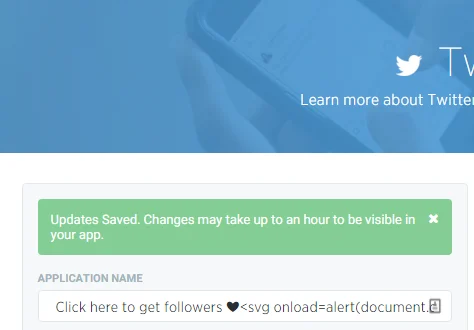
where n.getMainTweet().source is the client name. This name can be controlled through changing the application name (picture attached), and arbitrary characters can be inserted (including angle brackets). Moving on, $() is a jQuery DOMXSS sink. If we inject a payload like <svg onload=alert(document.domain)> then XSS will be executed showing the executing domain.
So to sum up,
- Attacker creates an application where the app name is a XSS payload.
- Attacker uses the app to post a tweet, then the tweet contains a malicious info of which app the tweet is sent from
- Victim clicks on the app info and XSS triggers.
#PoC
- Make sure you are using latest IE (otherwise CSP kicks in)
- Follow @attackerfoobar or search for the user on TweetDeck
- Expand the first tweet, click "Click here to get followers ❤️" (which is a bait app name)
- XSS executes
Video demonstration is also attached.
#Fix
Probably sanitize n.getMainTweet().source before putting it into $().
Attachments
Not written yet. The AI write-up for this report has not been written yet. The Original tab links to the source.
What is known
A XSS bug in X / xAI. HackerOne made it public on 2 April 2017.
About XSS
Script an attacker supplies runs in another user's browser, on the target's origin, with that user's session.
Not written yet. The AI write-up for this report has not been written yet. The Original tab links to the source.
What is XSS?
Script an attacker supplies runs in another user's browser, on the target's origin, with that user's session.




