NO username used in authenthication to www.mopub.com leading to direct password submission which has unlimited submission rate.

- Triaged in 4 days
- Fixed in 5 days
- Paid in 11 days
- Disclosed after 20 days
**Summary:**user name is not used in authentication leading to direct password submission
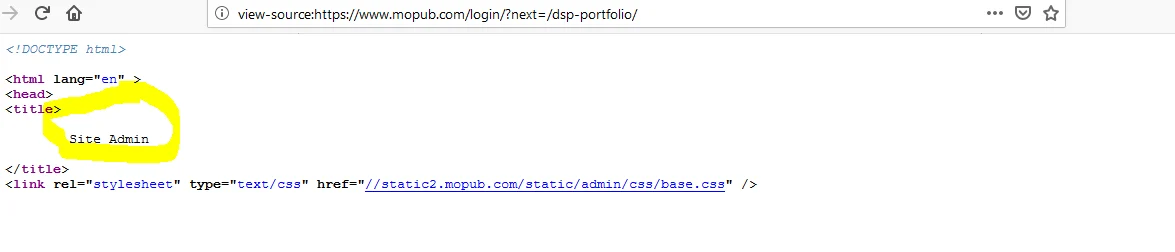
Description: user name not used in authentication in https://www.mopub.com/login/?next=/dsp-portfolio/ (this page is labelled as SITE ADMIN: refer POC) can lead to direct submitting of password and this password has unlimited submission rate
Steps To Reproduce:
(Add details for how we can reproduce the issue)
- go to https://www.mopub.com/login/?next=/dsp-portfolio/
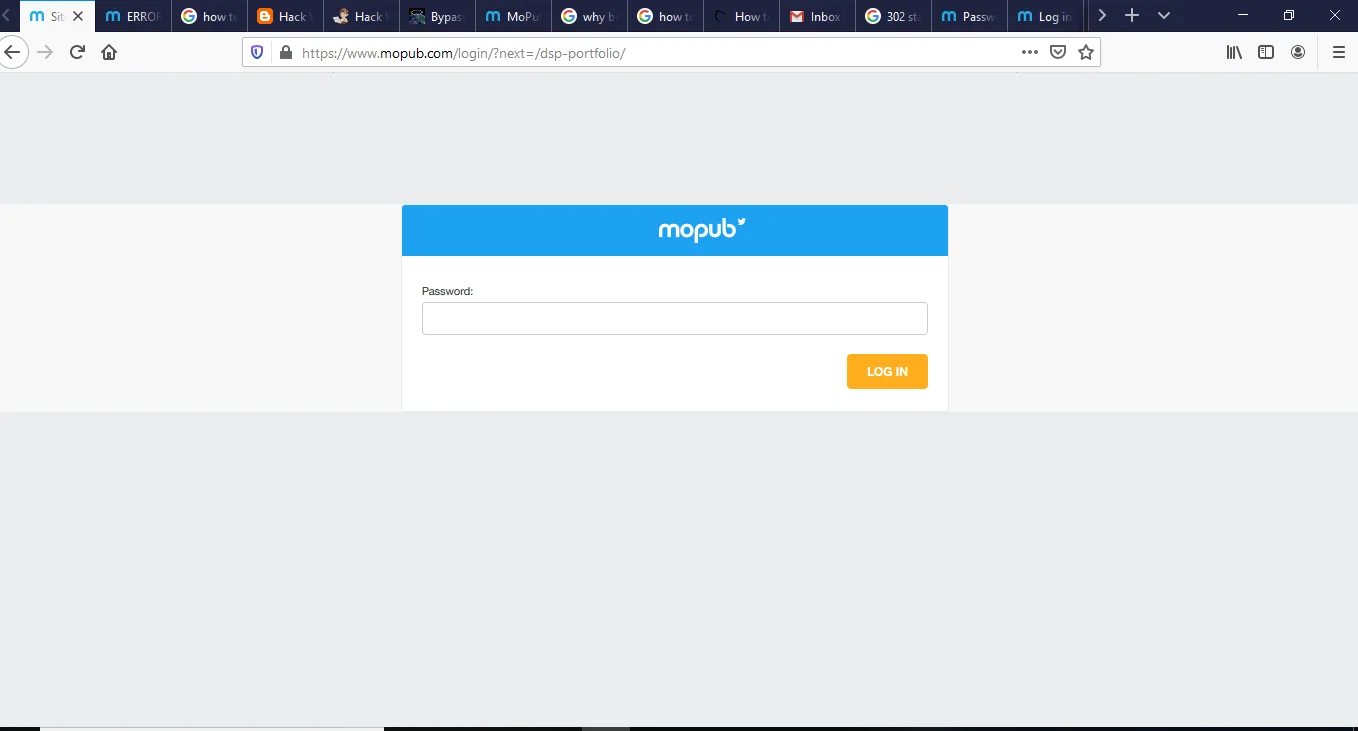
- we get a text box input only for password submission.
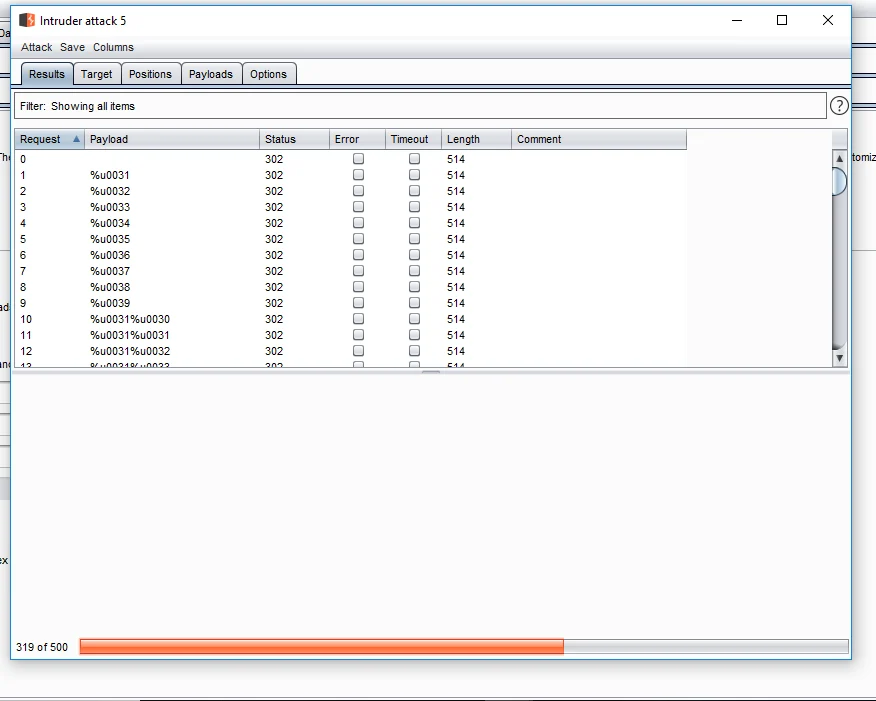
- this password submission has unlimited rate for submitting leading to bruteforce attacks.
POC screenshots attached.
Impact:This page is labelled as site admin (look in poc)and thus direct entry of password only which has no rate for submission can lead to attacker getting logged in.
Supporting Material/References:
- screenshots of POC attached.)
Impact
attaker can login to page which is listed as SITE ADMIN in mopub.com
Attachments
Context
MoPub was a mobile advertising monetisation platform, and www.mopub.com was its public web presence. The report concerns the login flow at https://www.mopub.com/login/?next=/dsp-portfolio/, which the researcher describes as being labelled as SITE ADMIN. The next parameter points at the DSP portfolio area, so the login page is the gate in front of an administrative surface rather than a generic user sign-in.
What makes the page interesting is that, according to the researcher, it asks for a password only. There is no username field in the authentication step. The identity of the account being authenticated is therefore not supplied by the person logging in, at least not through the visible form.
Setup
No accounts, roles, tools or versions are described in the report. The researcher worked against the public login URL and captured screenshots as proof of concept. The only precondition implied by the steps is that the login page is reachable without authentication, which it is, since it is the entry point itself.
Finding it
The researcher noticed two things about the login page:
- The form contains a text box for the password only. No username is submitted as part of the authentication step.
- The password submission has no limit on how many times it can be attempted.
Either of these alone would be worth a look. Together they suggest that the server decides which account is being authenticated by something other than a user-supplied identifier, and that it will accept an unbounded number of guesses against that account. The researcher labelled the page as SITE ADMIN in the proof of concept, which raises the stakes: the account behind the password-only form is an administrative one.
Exploitation
Step 1: Open the login page
The next parameter carries the path the user should be sent to after a successful login, here /dsp-portfolio/. The page is the entry point to the site admin area.
Step 2: Observe the password-only form
The page returns a text box that accepts a password and nothing else. There is no field for a username, so the request that the browser sends on submission carries only the password. The account being targeted is determined server-side rather than by the client.
Step 3: Submit passwords repeatedly
The researcher reports that the password submission endpoint imposes no rate limit. The same form can be submitted over and over, which is the condition needed for a brute-force attack against the password. The report does not include the raw submission request, the response codes, or any timing measurements; the claim rests on the observed behaviour of the form and the screenshots.
The first screenshot shows the login page as the researcher saw it, with the SITE ADMIN labelling that motivated the report.
The second screenshot documents the password-only input on the same page.
The third screenshot is the proof of concept for unlimited password submission.
Root cause
The design flaw is that authentication does not bind the submitted secret to a user-supplied identity. The server appears to decide which account is being authenticated on its own, so the only variable an attacker controls is the password. That collapses the attack surface to a single secret and removes any need to guess or enumerate a username first.
The second flaw is the absence of rate limiting on the password submission. Without a cap on attempts, a delay between attempts, or a lockout after repeated failures, an attacker can try candidate passwords as fast as the endpoint will accept them. The report does not describe any other defence, such as a CAPTCHA or a secondary factor, so it is likely that none was in place on this form.
Impact
Because the page is labelled as site admin, a successful guess gives the attacker access to an administrative surface on mopub.com. The researcher states that an attacker can log in to the page listed as SITE ADMIN. The practical impact depends on how strong the underlying password is and how quickly the endpoint accepts submissions; the report does not quantify either. The severity assigned to the report was medium.
Fix
The report does not describe a fix or a change made by the vendor. Based on the two flaws identified, the changes needed are:
- Require a username or other account identifier as part of the authentication request, so that the password is bound to a specific account and the server does not infer the identity on its own.
- Apply rate limiting to password submissions, with a delay or lockout after repeated failures, so that brute-force attempts become impractical.
Variants to test
- Password-only login forms elsewhere. Look for login pages that render a single password field. A positive result is a form whose submission carries no username and whose endpoint accepts repeated attempts.
- Hidden or pre-set identity fields. Some forms hide the username in a hidden input or a cookie. Check whether changing that value changes which account is authenticated; if it does, the identity is client-controlled.
- Rate limiting on the submission endpoint. Send the same failing password repeatedly and watch for 429 responses, increasing delays, lockouts or CAPTCHAs. A positive result is a long run of identical failure responses with no throttling.
nextparameter handling. Try changing thenextvalue to other administrative paths and see whether the post-login redirect follows it. A positive result is a redirect to a path the attacker chose.
Hunting notes
This kind of bug tends to hide on login pages for administrative or internal-facing areas, where the form may have been built for a single shared account or a legacy flow. During recon, a login page that asks for a password only, or that pre-fills or hides the account identifier, is the signal to look at. The researcher showed impact by tying the form to a page explicitly labelled SITE ADMIN and by reporting that submissions were not throttled. The report does not include request or response captures, so the evidence is the screenshots and the described behaviour of the form.
What happened, in plain words
MoPub was a service that helped mobile app makers make money from advertising. Its website, www.mopub.com, had a login page at https://www.mopub.com/login/?next=/dsp-portfolio/. The researcher found that this login page asked only for a password, with no username field. The page was labelled as "SITE ADMIN", meaning it was the entrance to an administrative area. Because there was no username, the server had to decide on its own which account was being logged into. And because the password form had no limit on how many times you could try, someone could keep guessing passwords until they got in. That is a brute-force attack. The researcher attached screenshots of the page and of the password submission.
Context
MoPub was a mobile advertising monetisation platform. In simple terms, it was a service that app developers used to show ads in their apps and earn money from them. www.mopub.com was its public website.
The report is about the login flow at https://www.mopub.com/login/?next=/dsp-portfolio/. The researcher describes this page as being labelled "SITE ADMIN". The next parameter in the URL points to the DSP portfolio area. A parameter is a piece of information added to the end of a URL after a question mark. Here, next=/dsp-portfolio/ tells the site where to send you after you log in. So the login page is the gate in front of an administrative area, not just a generic sign-in for ordinary users.
What makes the page interesting is that, according to the researcher, it asks for a password only. There is no username field in the authentication step. Authentication is the process of proving who you are, usually with a username and a password. The identity of the account being authenticated is therefore not supplied by the person logging in, at least not through the visible form.
Setup
The report does not describe any accounts, roles, tools or versions. The researcher worked against the public login URL and captured screenshots as proof of concept. The only precondition implied by the steps is that the login page is reachable without authentication, which it is, since it is the entry point itself.
Finding it
The researcher noticed two things about the login page:
- The form contains a text box for the password only. No username is submitted as part of the authentication step.
- The password submission has no limit on how many times it can be attempted.
Either of these alone would be worth a look. Together they suggest that the server decides which account is being authenticated by something other than a user-supplied identifier, and that it will accept an unbounded number of guesses against that account. The researcher labelled the page as SITE ADMIN in the proof of concept, which raises the stakes: the account behind the password-only form is an administrative one.
Exploitation
Step 1: Open the login page
This is an HTTP request. HTTP is the language browsers and web servers use to talk to each other. GET means "please give me this page". The line shows the address being requested. The next parameter carries the path the user should be sent to after a successful login, here /dsp-portfolio/. The page is the entry point to the site admin area.
Step 2: Observe the password-only form
The page returns a text box that accepts a password and nothing else. There is no field for a username, so the request that the browser sends on submission carries only the password. The account being targeted is determined server-side rather than by the client. In other words, the server, not the browser, decides which account the password belongs to.
Step 3: Submit passwords repeatedly
The researcher reports that the password submission endpoint imposes no rate limit. An endpoint is the specific address on a server that handles a particular action, here the action of checking a password. A rate limit is a cap on how many requests you can make in a given time. The same form can be submitted over and over, which is the condition needed for a brute-force attack against the password. A brute-force attack means trying many possible passwords until one works. The report does not include the raw submission request, the response codes, or any timing measurements; the claim rests on the observed behaviour of the form and the screenshots.
The first screenshot shows the login page as the researcher saw it, with the SITE ADMIN labelling that motivated the report.
The second screenshot documents the password-only input on the same page.
The third screenshot is the proof of concept for unlimited password submission.
Root cause
The design flaw is that authentication does not bind the submitted secret to a user-supplied identity. The server appears to decide which account is being authenticated on its own, so the only variable an attacker controls is the password. That collapses the attack surface to a single secret and removes any need to guess or enumerate a username first. Enumerating means systematically trying different values to discover which ones exist.
The second flaw is the absence of rate limiting on the password submission. Without a cap on attempts, a delay between attempts, or a lockout after repeated failures, an attacker can try candidate passwords as fast as the endpoint will accept them. The report does not describe any other defence, such as a CAPTCHA or a secondary factor, so it is likely that none was in place on this form. A CAPTCHA is a test that is easy for a human but hard for a computer, often a puzzle with distorted letters. A secondary factor is an extra proof of identity beyond a password, such as a code sent to your phone.
Impact
Because the page is labelled as site admin, a successful guess gives the attacker access to an administrative surface on mopub.com. The researcher states that an attacker can log in to the page listed as SITE ADMIN. The practical impact depends on how strong the underlying password is and how quickly the endpoint accepts submissions; the report does not quantify either. The severity assigned to the report was medium.
Fix
Based on the two flaws identified, the changes needed are:
- Require a username or other account identifier as part of the authentication request, so that the password is bound to a specific account and the server does not infer the identity on its own.
- Apply rate limiting to password submissions, with a delay or lockout after repeated failures, so that brute-force attempts become impractical.
Variants to test
- Password-only login forms elsewhere. Look for login pages that render a single password field. A positive result is a form whose submission carries no username and whose endpoint accepts repeated attempts.
- Hidden or pre-set identity fields. Some forms hide the username in a hidden input or a cookie. A cookie is a small piece of data a website stores in your browser to remember something about you. Check whether changing that value changes which account is authenticated; if it does, the identity is client-controlled.
- Rate limiting on the submission endpoint. Send the same failing password repeatedly and watch for 429 responses, increasing delays, lockouts or CAPTCHAs. A 429 response is an HTTP status code meaning "too many requests". A positive result is a long run of identical failure responses with no throttling.
nextparameter handling. Try changing thenextvalue to other administrative paths and see whether the post-login redirect follows it. A positive result is a redirect to a path the attacker chose.
Hunting notes
This kind of bug tends to hide on login pages for administrative or internal-facing areas, where the form may have been built for a single shared account or a legacy flow. During recon, a login page that asks for a password only, or that pre-fills or hides the account identifier, is the signal to look at. Recon means the early phase of exploring a target to find interesting parts. The researcher showed impact by tying the form to a page explicitly labelled SITE ADMIN and by reporting that submissions were not throttled. The report does not include request or response captures, so the evidence is the screenshots and the described behaviour of the form.
Glossary
- API: A set of rules that lets one piece of software talk to another.
- Authentication: The process of proving who you are, usually with a username and password.
- Brute-force attack: Trying many possible passwords or values until one works.
- CAPTCHA: A test that is easy for a human but hard for a computer, often a puzzle with distorted letters.
- Cookie: A small piece of data a website stores in your browser to remember something about you.
- Endpoint: A specific address on a server that handles a particular action.
- Enumerate: To systematically try different values to discover which ones exist.
- GET: An HTTP method meaning "please give me this page".
- HTTP: The language browsers and web servers use to talk to each other.
- Parameter: A piece of information added to the end of a URL after a question mark.
- Rate limit: A cap on how many requests you can make in a given time.
- Recon: The early phase of exploring a target to find interesting parts.
- Redirect: A response that tells the browser to go to a different address.
- Secondary factor: An extra proof of identity beyond a password, such as a code sent to your phone.
- Server-side: Happening on the server, not in the browser.
- 429 response: An HTTP status code meaning "too many requests".




