Singup Page HTML Injection Vulnerability
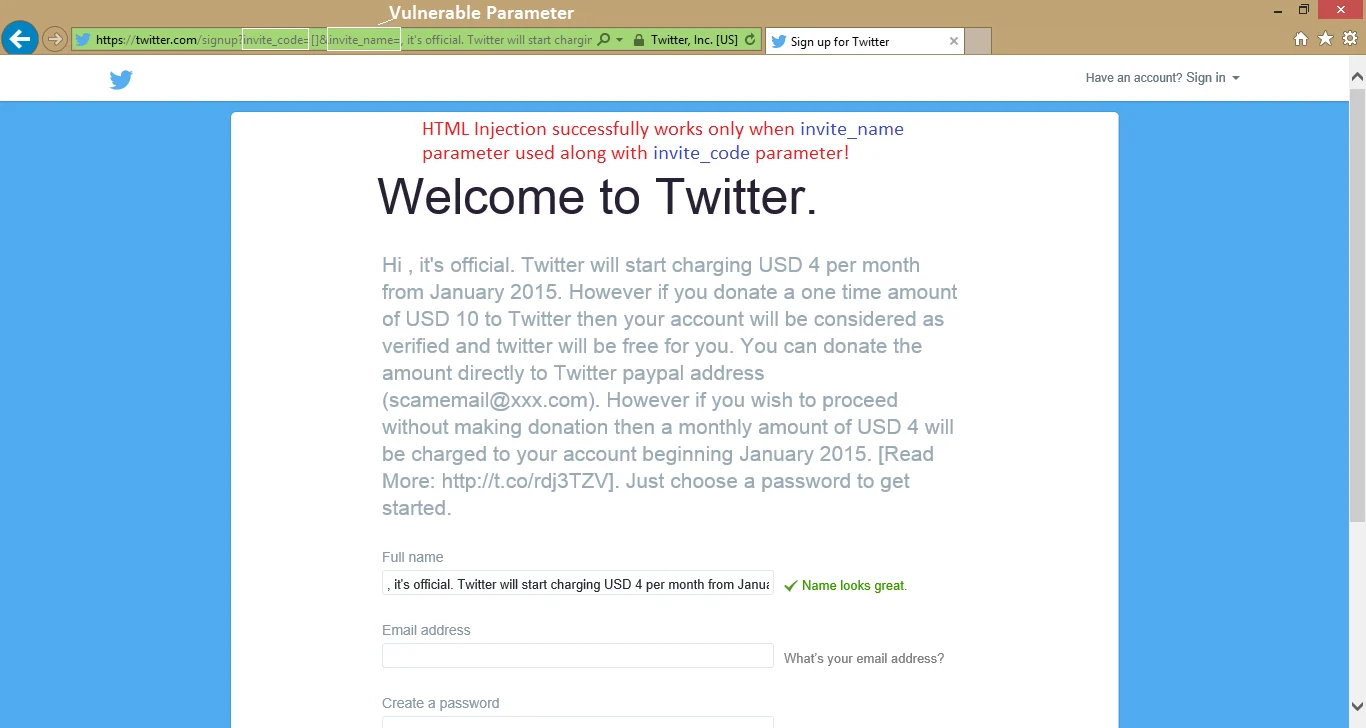
The Twitter signup page reflected the invite_name parameter without proper encoding when combined with an invite_code parameter, allowing an attacker to inject HTML content. An attacker could display crafted messages, including links to malicious sites, to users visiting the signup page.

- Triaged in 2 hours
- Fixed in 4 months
- Paid in 5 days
- Disclosed after 5 months
Information
There's an HTML Injection Vulnerability exists in Twitter main signup page which can be used by attackers to display personally crafted messages to twitter users for different malicious purposes. Affected parameters invite_code= & invite_name=.
Steps to reproduce:
- Refer to the main singup page.
- add
invite_code=parameter along with any random value. I have used[]in my below POC. - Now, put your personally crafted messages under
invite_name=parameter. A user may even be prompted to visit a malicious link. Refer the final POC link. (Please Note: The reported vulnerability successfully works only when both parameters are used in conjunction with each other.)
Screenshot Attached to this report
Final POC [Refer this link](https://twitter.com/signup?invite_name=, it's official. Twitter will start charging USD 4 per month from January 2015. However if you donate a one time amount of USD 10 to Twitter then your account will be considered as verified and twitter will be free for you. You can donate the amount directly to Twitter paypal address ([email protected]). However if you wish to proceed without making donation then a monthly amount of USD 4 will be charged to your account beginning January 2015. [Read More: http://t.co/rdj3TZV])
Let me know if i missed anything or any further information is required.
Attachments
Not written yet. The AI write-up for this report has not been written yet. The Original tab links to the source.
How it worked
Root cause
Likely the invite_name parameter was reflected into the page without HTML encoding when invite_code was also present.
Impact
An attacker could display crafted messages and links to users on the signup page, potentially tricking them into visiting malicious sites.
What the attacker needed
Victim visits a crafted signup URL
How it was found
- Go to the main signup page.
- Add the invite_code parameter with any random value.
- Put crafted messages in the invite_name parameter.
- Use both parameters together to trigger the injection.
Explained by bugbounty.wiki with AI from the original and checked against quotes from it; it can still be wrong. Read the original before relying on a detail.
Not written yet. The AI write-up for this report has not been written yet. The Original tab links to the source.
HTML injection is when a website takes text you type and puts it directly into the page without cleaning it first. Here, the signup page showed whatever was in the invite_name parameter as if it were part of the page, so an attacker could make the page display their own message and links. This could trick users into believing fake announcements or visiting harmful websites.
What is RCE?
Running the attacker's code on the target's servers: through command or code injection, unsafe deserialisation or template injection.