Potential XSS Vulnerability in Acronis Login Callback URL
The redirectUrl parameter in the login callback URL is not sanitised, allowing an attacker to inject JavaScript code that executes when a user logs in. This could let an attacker steal session cookies, perform phishing, or deface the site.

- Triaged in 3 days
- Fixed in 26 days
- Paid in 13 days
- Disclosed after 4 months
Summary
The login callback URL, https://learn.acronis.com/portal/, is vulnerable to Cross-Site Scripting (XSS) attacks. When a user logs in and is redirected to this URL, the redirectUrl parameter is not properly sanitized, allowing an attacker to inject arbitrary JavaScript code. This code could be used to steal the user's session cookie, perform phishing attacks, or deface the website.
Steps To Reproduce
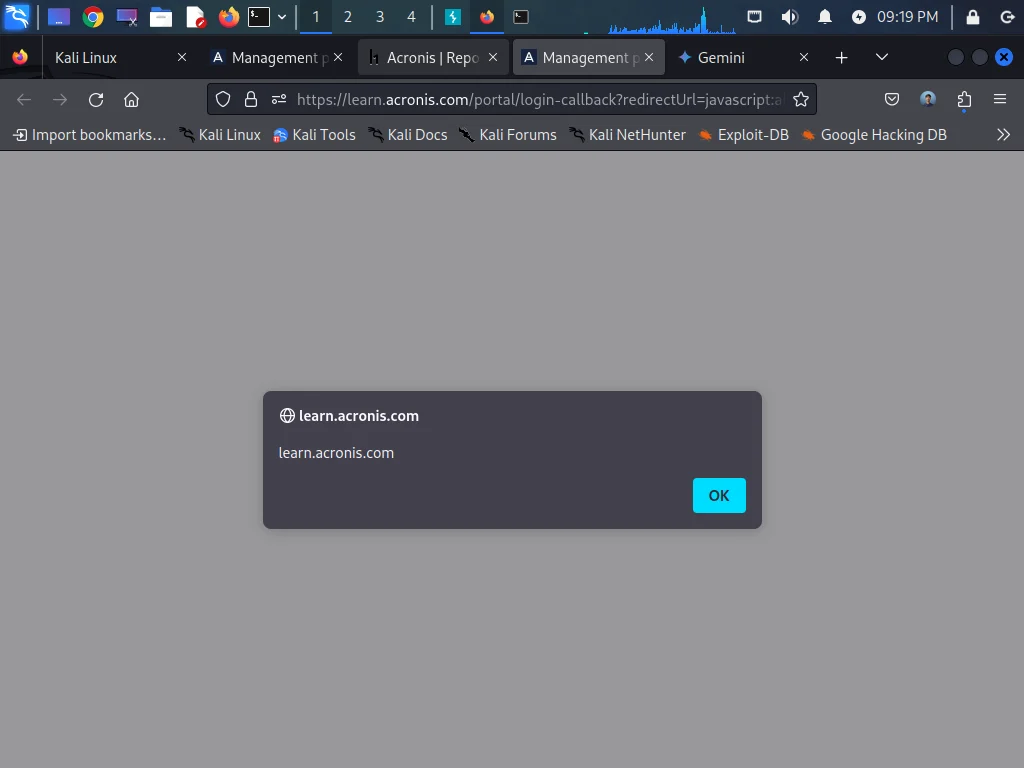
I was able to exploit this vulnerability by crafting a URL that included malicious JavaScript code in the redirectUrl parameter. When a user clicks on this URL and logs in, the injected code is executed in the user's browser.
For example, the following URL would display an alert containing the website domain: https://learn.acronis.com/portal/login-callback?redirectUrl=javascript:alert(document.domain)
An attacker could replace the alert with malicious code that steals the user's session cookie or redirects the user to a phishing website.
Impact
This vulnerability could allow an attacker to:
- Steal user session cookies
- Perform phishing attacks
- Deface the website
- Take control of user accounts
Not written yet. The AI write-up for this report has not been written yet. The Original tab links to the source.
How it worked
Root cause
Likely the application accepts a javascript: scheme in the redirectUrl parameter and executes it without validation.
Impact
An attacker could steal session cookies, perform phishing attacks, deface the website, or take control of user accounts.
What the attacker needed
Victim clicks a crafted link; victim logs in
How it was found
- Craft a URL with malicious JavaScript in the redirectUrl parameter.
- Send the URL to a victim.
- The victim clicks the URL and logs in.
- The injected code executes in the victim's browser.
Explained by bugbounty.wiki with AI from the original and checked against quotes from it; it can still be wrong. Read the original before relying on a detail.
Not written yet. The AI write-up for this report has not been written yet. The Original tab links to the source.
When you log in to a website, it often sends you to another page using a link parameter. Here, that parameter was not checked, so someone could put JavaScript code in it. That code would run in your browser after you logged in, letting the attacker do things like steal your login cookie.
What is XSS?
Script an attacker supplies runs in another user's browser, on the target's origin, with that user's session.





