Reflected Cross Site Scripting at ColdFusion Debugging Panel http://www.grouplogic.com/CFIDE/debug/cf_debugFr.cfm
The ColdFusion Debugging Panel's userPage parameter is not properly sanitised and is displayed without output encoding, leading to reflected cross-site scripting. An attacker could execute arbitrary JavaScript in a victim's browser, potentially stealing cookies or performing other malicious actions.

- Triaged in under an hour
- Fixed in 14 months
- Disclosed after 14 months
Summary
The ColdFusion Debugging Panel exposed at below URL.
http://www.grouplogic.com/CFIDE/debug/cf_debugFr.cfm?userPage=
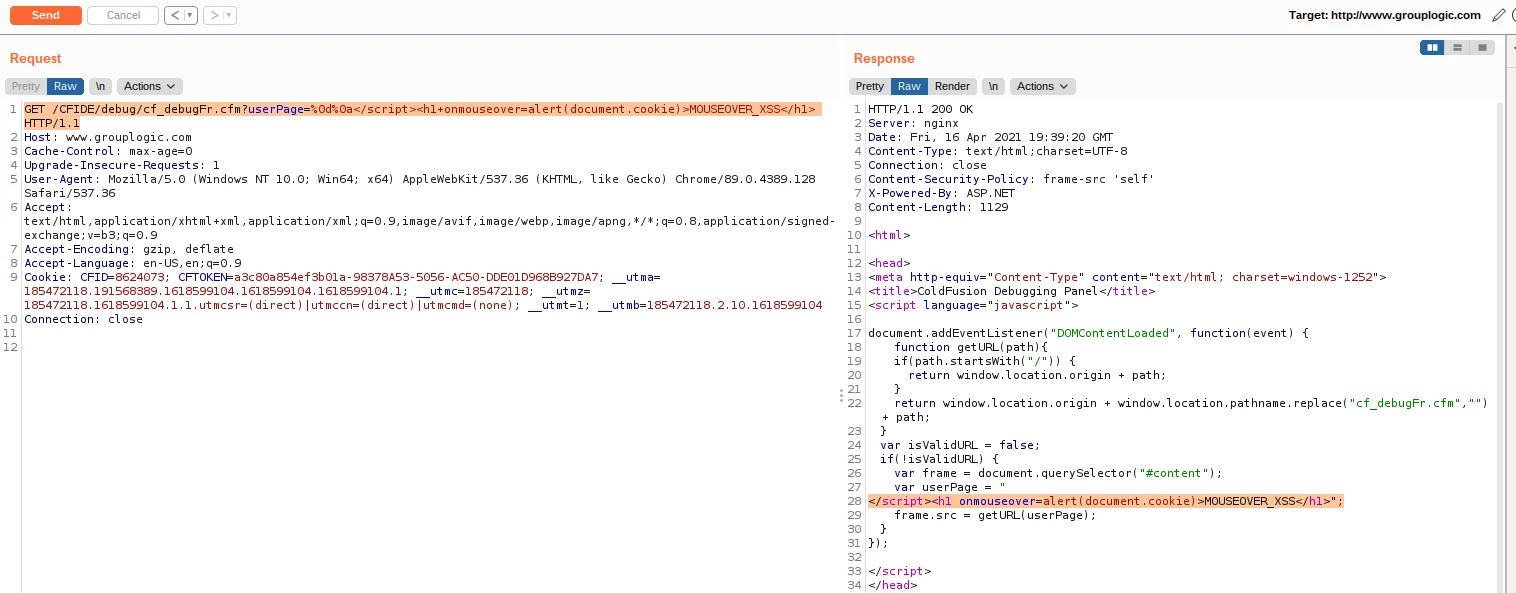
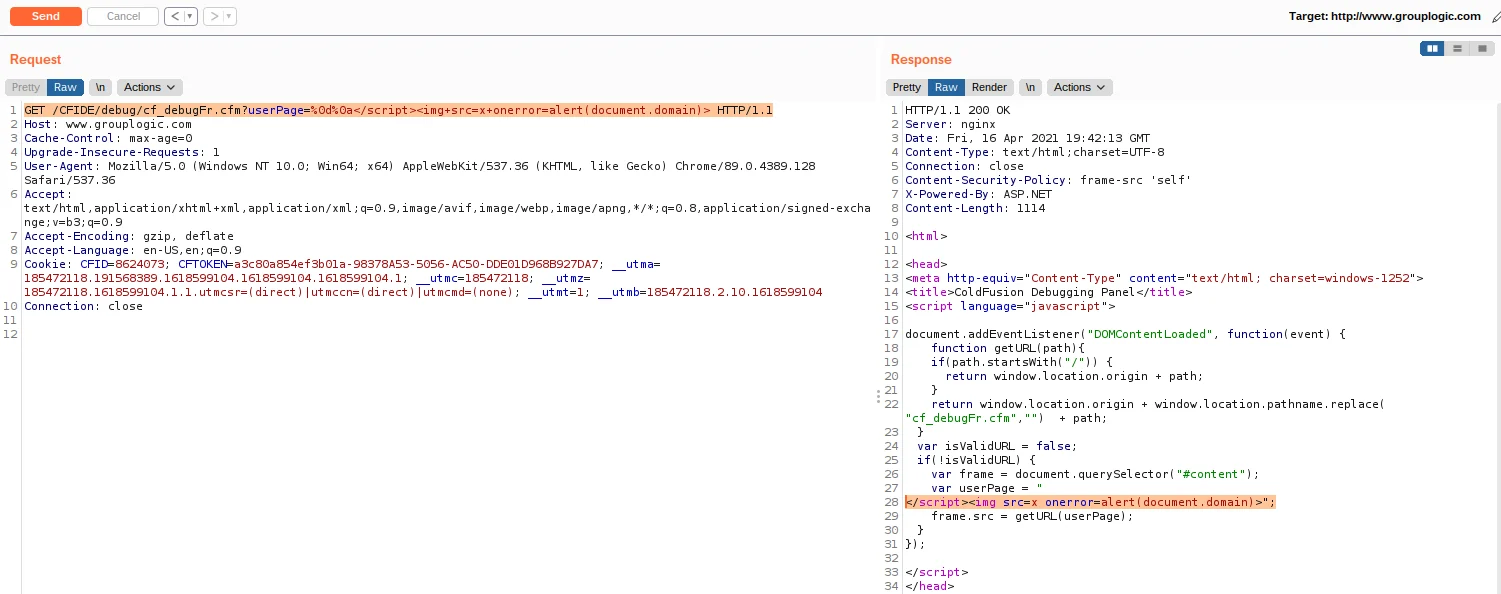
The userPage parameter is not properly sanitized and is displayed without proper output encoding. This results in reflected cross site scripting.
Steps To Reproduce
Enter any of below payload in the userPage parameter and access the URL:
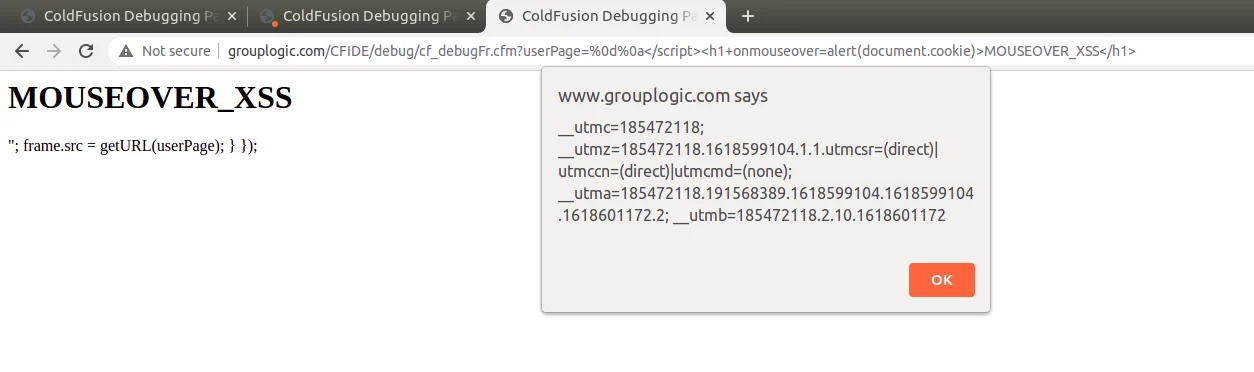
Payload 1: Mouse Over XSS
---------------------------
%0d%0a</script><h1+onmouseover=alert(document.cookie)>MOUSEOVER_XSS</h1>


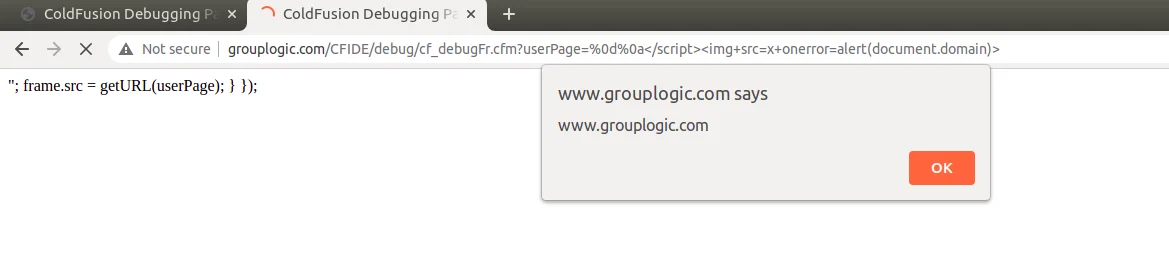
Payload 2:
---------
%0d%0a</script><img+src=x+onerror=alert(document.domain)>
Or Just access below URLs in browser:
http://www.grouplogic.com/CFIDE/debug/cf_debugFr.cfm?userPage=%0d%0a</script><h1+onmouseover=alert(document.cookie)>MOUSEOVER_XSS</h1>

http://www.grouplogic.com/CFIDE/debug/cf_debugFr.cfm?userPage=%0d%0a</script><img+src=x+onerror=alert(document.domain)>
Recommendations
It is highly recommended to implement output encoding.
Encode the following characters with HTML entity encoding to prevent switching into any execution context, such as script, style, or event handlers. Using hex entities is recommended in the spec. The 5 characters significant in XML (&, <, >, ", '):
& --> &
< --> <
> --> >
" --> "
' --> '
Reference: https://cheatsheetseries.owasp.org/cheatsheets/Cross_Site_Scripting_Prevention_Cheat_Sheet.html
Impact
XSS can be used to :
- Steal cookies, password
- Website Defacement
- Redirect Victim to Malicious site
- Log keystrokes etc.
Attachments
Not written yet. The AI write-up for this report has not been written yet. The Original tab links to the source.
How it worked
Root cause
Likely the userPage parameter is reflected into the HTML response without any output encoding or sanitisation.
Impact
An attacker could steal cookies or passwords, deface the website, redirect victims to malicious sites, or log keystrokes.
What the attacker needed
Victim clicks a crafted link
The fix
The userPage parameter should be HTML-entity encoded before being reflected into the page.
How it was found
- Enter a crafted payload in the userPage parameter and access the URL.
- Alternatively, directly access the provided URLs in a browser.
Explained by bugbounty.wiki with AI from the original and checked against quotes from it; it can still be wrong. Read the original before relying on a detail.
Not written yet. The AI write-up for this report has not been written yet. The Original tab links to the source.
The website takes a value from the URL and puts it directly into the page without cleaning it. This lets an attacker insert their own code, which runs in the victim's browser when they visit a crafted link. This is called cross-site scripting (XSS).
What is XSS?
Script an attacker supplies runs in another user's browser, on the target's origin, with that user's session.





