Reflected XSS on www.acronis.com/de-de/my/subscriptions/index.html
A parameter on the Acronis subscriptions page reflected user input into the page without proper encoding, allowing script execution. An attacker could run arbitrary JavaScript in the context of the site for a victim who opens a crafted link.

- Triaged in 3 days
- Fixed in 2 months
- Paid in 4 days
- Disclosed after 3.4 years
Hello Team,
I would like to report a Reflected XSS vulnerability on https://www.acronis.com/de-de/my/subscriptions/index.html
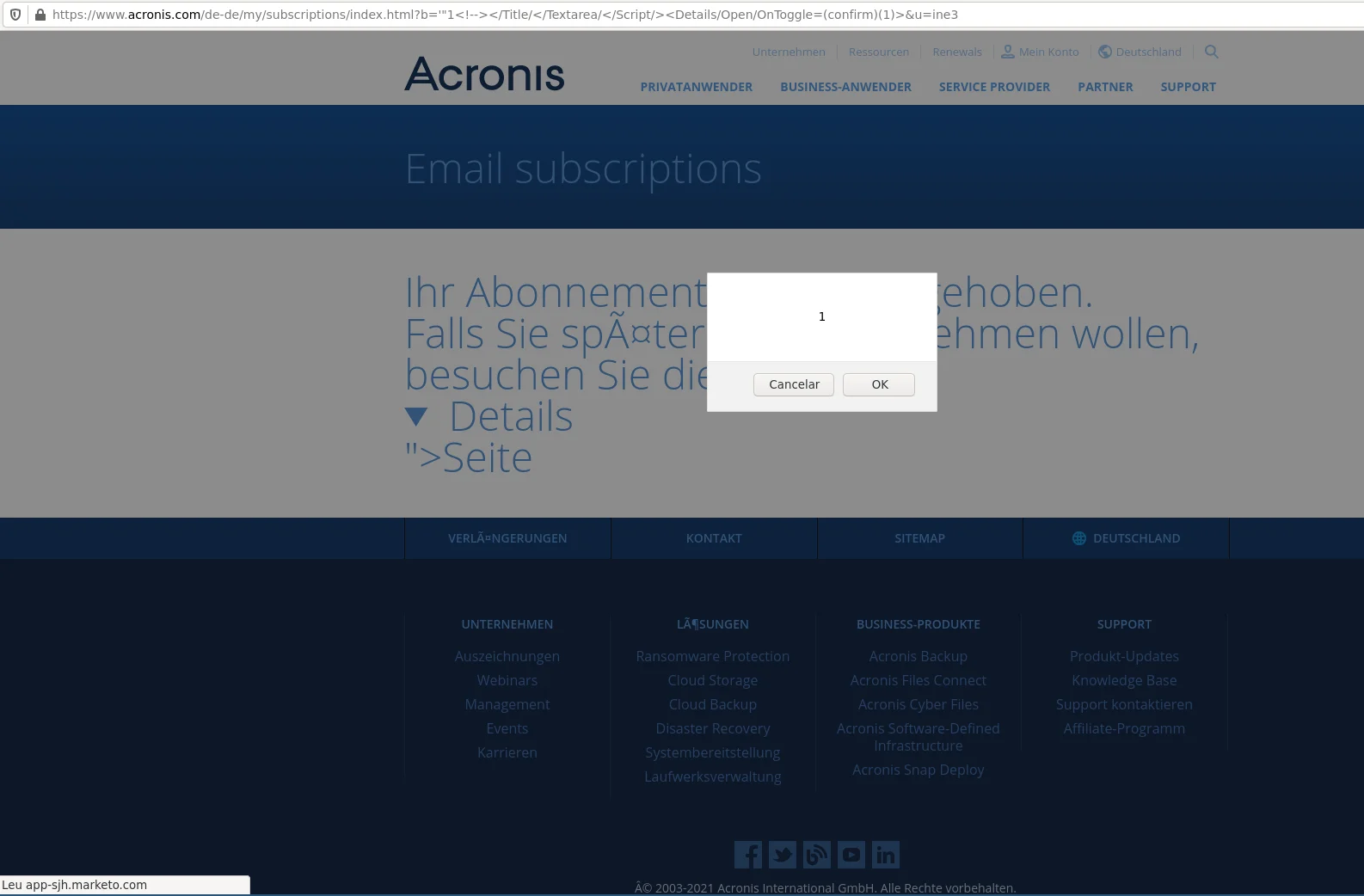
Vulnerable parameter: b Payload: '"1<!--></Title/</Textarea/</Script/><Details/Open/OnToggle=(confirm)(1)>
POC:
https://www.acronis.com/de-de/my/subscriptions/index.html?b='"1<!--></Title/</Textarea/</Script/><Details/Open/OnToggle=(confirm)(1)>&u=ine3
Impact
A XSS attack allows an attacker to execute arbitrary JavaScript in the context of the attacked website and the attacked user.
Not written yet. The AI write-up for this report has not been written yet. The Original tab links to the source.
How it worked
Root cause
Likely the 'b' parameter was written into the HTML response without output encoding, so markup in the value was interpreted by the browser.
Impact
An attacker could execute arbitrary JavaScript in the context of the attacked website and the attacked user, though the report only demonstrates a confirmation dialog.
What the attacker needed
Victim opens a crafted link
How it was found
- Open the subscriptions page with the crafted 'b' parameter value in the URL.
- The page reflects the value into the HTML and the browser executes the injected handler, showing a confirmation dialog.
Explained by bugbounty.wiki with AI from the original and checked against quotes from it; it can still be wrong. Read the original before relying on a detail.
Not written yet. The AI write-up for this report has not been written yet. The Original tab links to the source.
Reflected cross-site scripting (XSS) happens when a website takes something from the address bar and puts it straight into the page without cleaning it. If that something is code, the browser runs it as if the site itself had written it. Here a crafted link made the page run a script that showed a confirmation box, which proves code execution.
What is XSS?
Script an attacker supplies runs in another user's browser, on the target's origin, with that user's session.





