XSS on https://partners.acronis.com/
The login page took a query-string value, HTML-encoded it, then inserted it into the page as HTML, so the encoding did not stop markup from being created. An attacker could craft a link that runs JavaScript in a victim's browser on the login page and use it to steal credentials.

- Disclosed after 9 months
Hello,
I found DOM XSS on login page of https://partners.acronis.com/
Open this URL https://partners.acronis.com/en-us/profile/login.html?-back=test123"> and search for var back =. Here input is HTML encoded but from that reflected value, element is created and appended to the form.
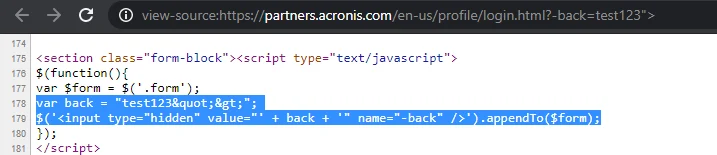
We can use JavaScript's unicode escaping to bypass this..
Steps To Reproduce
- For this payload
"><img src=x onerror=alert(1)><x y="we have to replace"with\u0022,>with\u003eand<with\u003c.
So the payload will be \u0022\u003e\u003cimg src=x onerror=alert(1)\u003e\u003cx y=\u0022
- Open this URL
https://partners.acronis.com/en-us/profile/login.html?-back=\u0022\u003e\u003cimg+src=x+onerror=alert(1)\u003e\u003cx+y=\u0022
 ```
1. And you'll see alert dialog.
{{media:1}}

## Impact

Attacker can execute JavaScript code on users who open the link. This XSS is in the login page so it can be used to get someone's credentials..
Not written yet. The AI write-up for this report has not been written yet. The Original tab links to the source.
How it worked
Impact
An attacker could run JavaScript in the browser of anyone who opens the crafted link, and since it is the login page it could be used to capture credentials.
What the attacker needed
Victim opens a crafted link
How it was found
- Open the login page with a crafted back parameter containing escaped angle brackets and quotes.
- Observe that the browser shows an alert dialog, proving script execution.
Explained by bugbounty.wiki with AI from the original and checked against quotes from it; it can still be wrong. Read the original before relying on a detail.
Not written yet. The AI write-up for this report has not been written yet. The Original tab links to the source.
A web page can build parts of itself from data in the address bar. Here the site tried to make that data safe by encoding special characters, but then still treated it as HTML, so the encoding was undone. Because the flaw sits on the login page, a crafted link could run code in the visitor's browser and potentially capture what they type.
What is XSS?
Script an attacker supplies runs in another user's browser, on the target's origin, with that user's session.




