How I Found A Vulnerability To Hack iCloud Accounts and How Apple Reacted To It
 Published on thezerohack.com
There wasn’t any response from them for months so I created a new ticket on 21st July 2021 stating that the HSMs would be still vulnerable to insider threats. After back and forth emails, Apple security team setup a call to discuss about this issue, they clarified the HSMs aren’t vulnerable due to quorum voting across…
The full write-up lives on its author's site
It belongs to its author, so we link to it rather than copy it. The other two tabs are our own rewrites, checked against it.
Context
This is a write-up by Laxman Muthiyah about a vulnerability in Apple's Apple ID forgot password flow. The feature is the forgot password option of Apple ID, which lets a user change their password using a 6 digit OTP sent to their trusted mobile number and email address. Once the correct OTP is entered, the password can be changed.
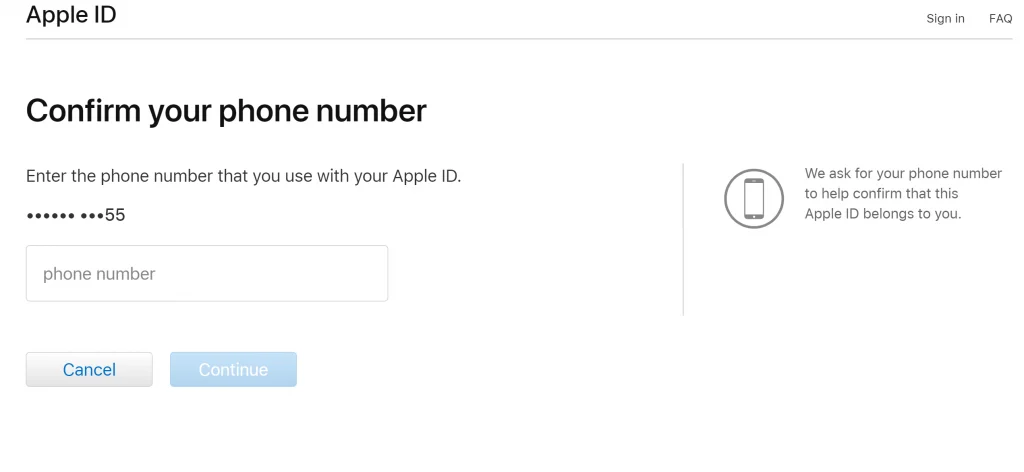
Apple forgot password page prompting to enter mobile number after entering email address
The researcher describes the bug as a race condition in the rate limits, not a typical brute force attack. Multiple concurrent requests are sent to the server to exploit the race condition present in the rate limits, making it possible to bypass them. He had previously reported the same class of issue against Instagram and Microsoft.
For security reasons Apple prompts for the trusted phone number along with the email address before an OTP is requested. To exploit the issue, an attacker therefore needs to know both the trusted phone number and the email address, and then try all possibilities of the 6 digit code, around 1 million attempts (10 ^ 6).
The report states that the vulnerability is completely patched by Apple and no longer works. Apple offered $18,000 USD under its bounty programme, and the researcher refused to receive it. The reasons are covered under Impact.
Setup
The report does not describe a lab or specific accounts. The preconditions it does state are:
- Knowledge of the target's trusted phone number and email address, needed to request the OTP.
- The ability to send POST requests to Apple servers from many source IP addresses, because of the per-IP limits described below.
- For the later passcode work, a jailbroken device with checkra1n and SSL Kill Switch to bypass certificate pinning, plus a MITM proxy such as Burp or Charles to read the traffic.
The researcher tried various cloud service providers and found that some of them were blocked (see Exploitation).
Finding it
The starting point was the observation that the forgot password endpoint had strong rate limits. Entering more than 5 attempts locked the account for the next few hours, and rotating the IP did not help.
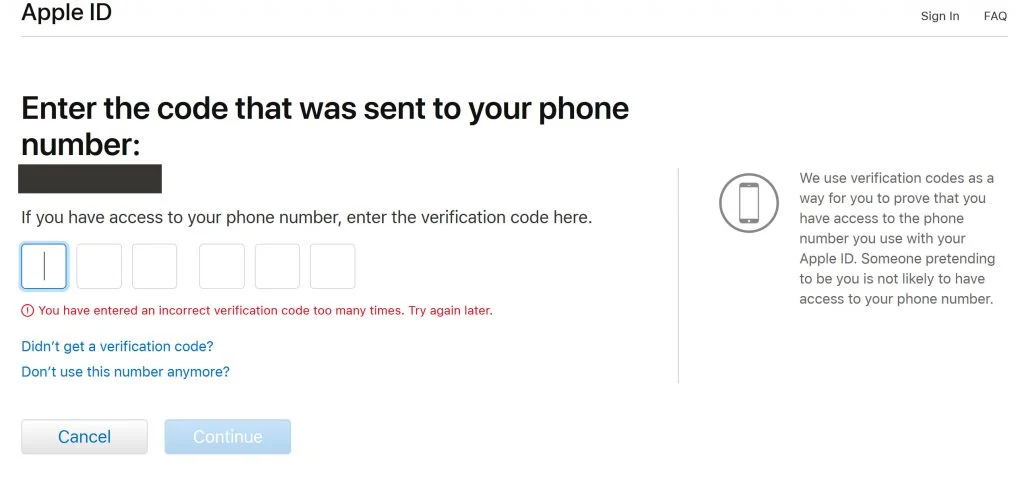
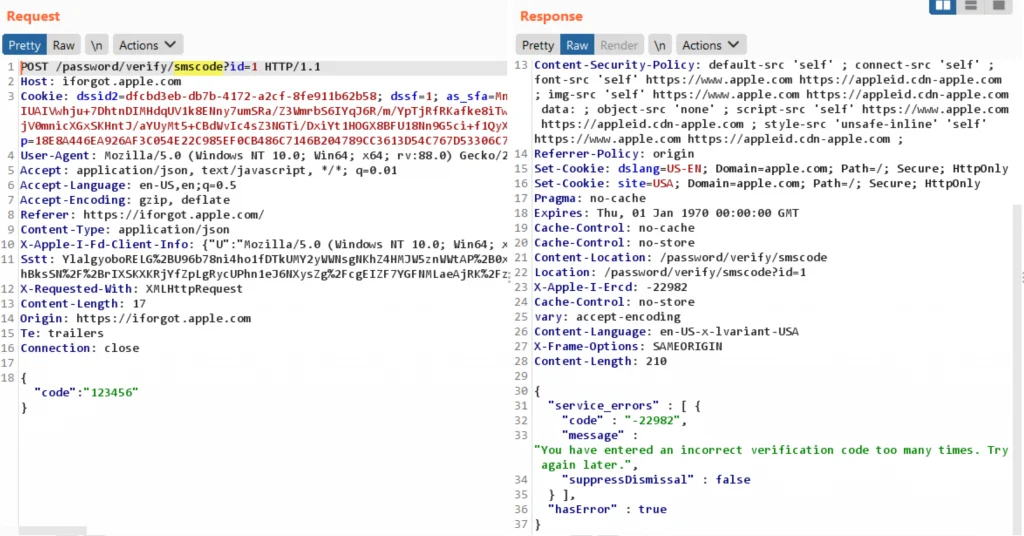
HTTP POST REQUEST SENT TO FORGOT PASSWORD ENDPOINT AND ITS RESPONSE
He then tried race hazard based brute forcing by sending simultaneous POST requests to the Apple server and found further limitations. Apple applies rate limits to concurrent POST requests from a single IP address, not just to the forgot password endpoint but to the entire Apple server. More than 6 concurrent POST requests are dropped, and the source IP address is blacklisted for future POST requests with a 503 error.
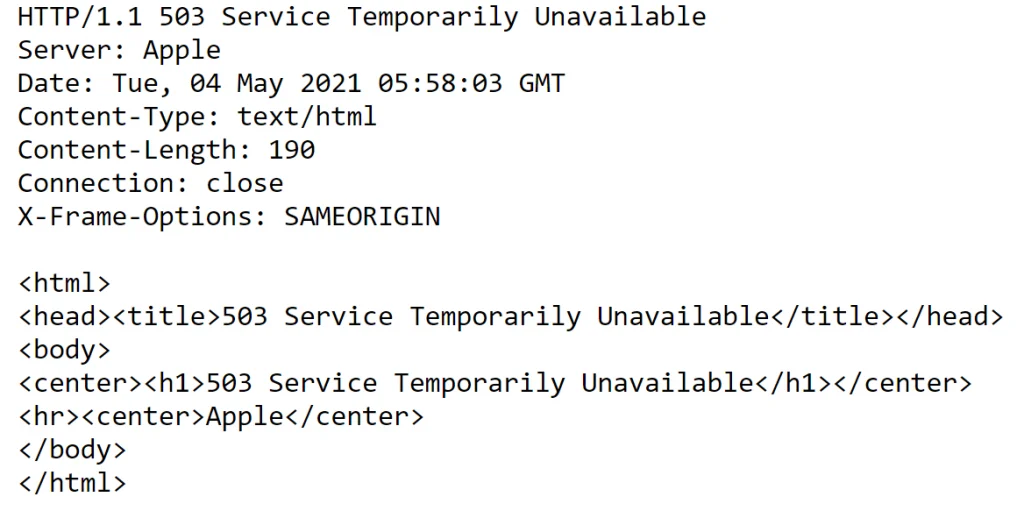

At first this looked like the end of the idea, but the researcher noted that these are generic limits across the server and not specific to the code validation endpoint. Further testing produced the following observations, quoted as the report lists them:
- iforgot.apple.com resolves to 6 IP addresses across the globe (the report lists them; they are omitted here).
- There are two rate limits: one triggered when more than 5 requests are sent to the forgot password endpoint (http://iforgot.apple.com/password/verify/smscode), and another across the Apple server when more than 6 concurrent POST requests are sent.
- Both rate limits are specific to the Apple server IP, which means requests (within the limits) can still be sent to another Apple server IP.
- Up to 6 concurrent requests can be sent to an Apple server IP (by binding iforgot.apple.com to the IP) from a single client IP address. With 6 Apple IP addresses, up to 36 requests can be sent across them (6 x 6 = 36) from a single IP address.
- Therefore an attacker would require 28K IP addresses to send up to 1 million requests to verify the 6 digit code.
28k IP addresses looks easy with cloud service providers, but the report describes a further obstacle: Apple rejects POST requests from cloud providers such as AWS and Google Cloud with a 502 Bad Gateway, without even checking the request URI or body.
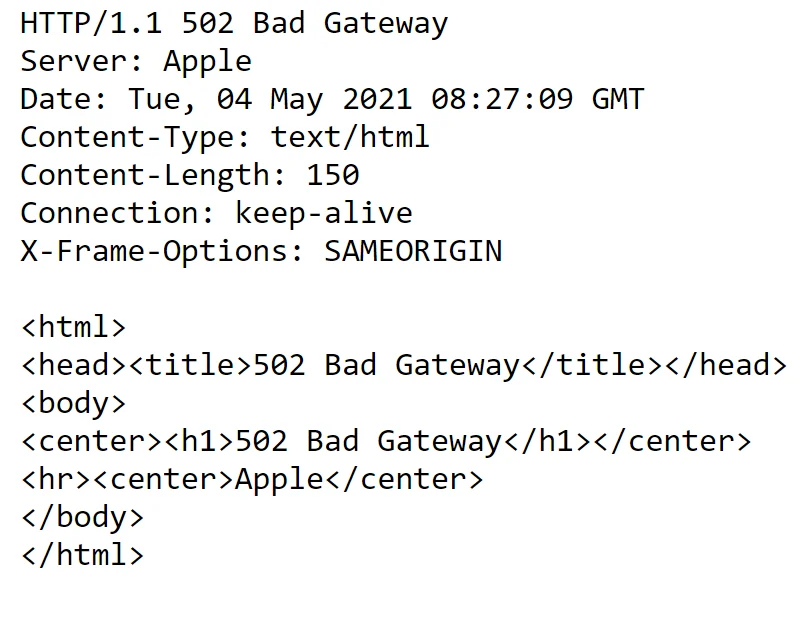
Response for any POST request sent from AWS & Google cloud
Changing IPs returned the same response code, which the researcher interprets as the entire ASN of some cloud service providers being blacklisted (he hedges this with "if am not wrong").

He kept trying various providers and finally found a few whose network IPs were not blacklisted.
Exploitation
Step 1: Understand the limits per source IP and per Apple server IP
The forgot password endpoint locks the account after more than 5 attempts, and the server drops more than 6 concurrent POST requests from one source IP and blacklists that IP with a 503. Because both limits are tied to the Apple server IP rather than being global, the attacker can spread requests across the 6 resolved Apple IP addresses, giving 36 requests per source IP.
Step 2: Obtain enough source IP addresses
Reaching roughly 1 million attempts at 36 requests per IP requires about 28K IP addresses. Cloud providers are the obvious source, but AWS and Google Cloud POST requests are answered with 502 Bad Gateway regardless of URI or body. The researcher found a few providers whose IP ranges were not blocked.
Step 3: Send concurrent requests from many IPs
With multiple concurrent POST requests sent from different IP addresses, the bypass worked. The researcher states that he could then change the password of any Apple ID with just the trusted phone number.
The report does not include the exact request or response bodies for this step; it only states that the concurrent multi-IP requests succeeded.
Step 4: Repeat for the email code, 2FA and password validation
The attack requires bypassing the SMS 6 digit code and then the 6 digit code received by email. Both bypasses use the same method and environment, so nothing needs to change for the second one. The report adds that even with two factor authentication enabled the account could still be accessed, because the 2FA endpoint shares the rate limit and was vulnerable. The same vulnerability was also present in the password validation endpoint.
Step 5: Report and timeline
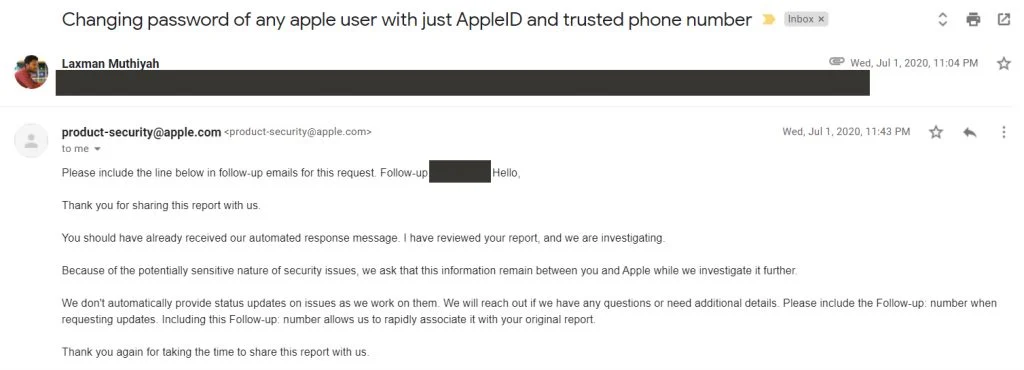
The issue was reported with detailed reproduction steps and a video demonstrating the bypass to Apple security on July 1st, 2020. Apple acknowledged and triaged it within a few minutes.
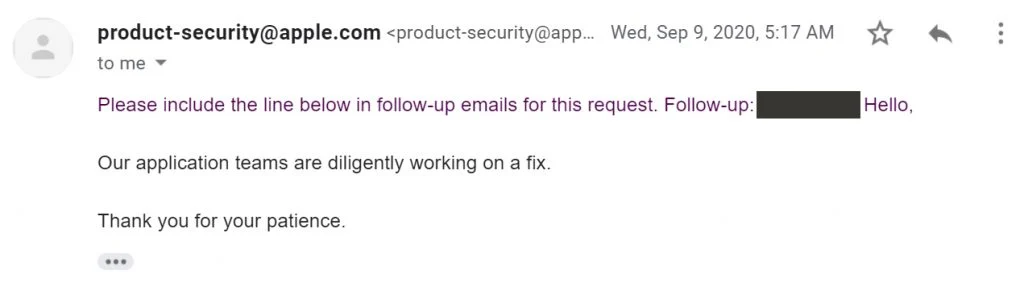
After triage there were no updates, and on Sep 9th, 2020 Apple said they were working on a fix.
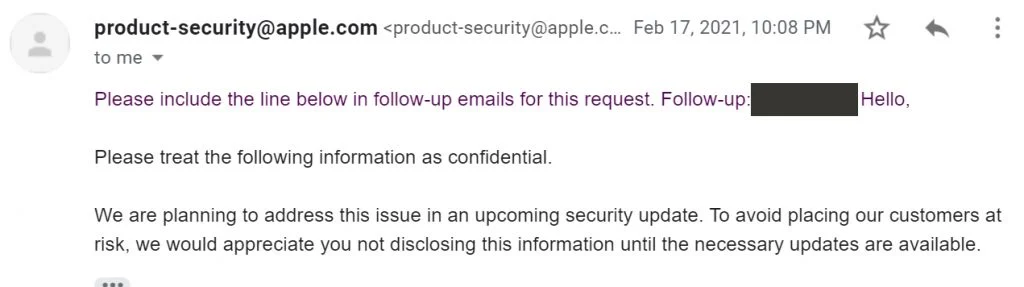
After another 5 months without updates, Apple said they were planning to address the issue in an upcoming security update.
The researcher kept retesting rather than relying on Apple. On April 1st, 2021 he found that a patch had been released to production, still without any update from Apple. When asked whether the issue was patched, Apple replied that they had no status updates to share.
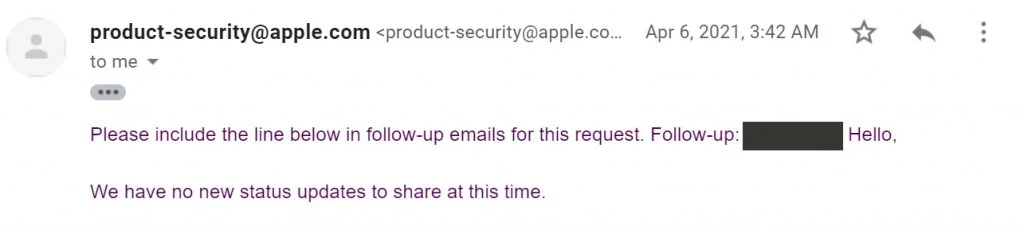
A month later he wrote that the issue had been patched on April 1st and that he wanted to publish the report on his blog. Apple asked to see a draft of the article before publication. After the draft was shared, Apple denied his claim, saying the vulnerability did not allow takeover of the majority of iCloud accounts.
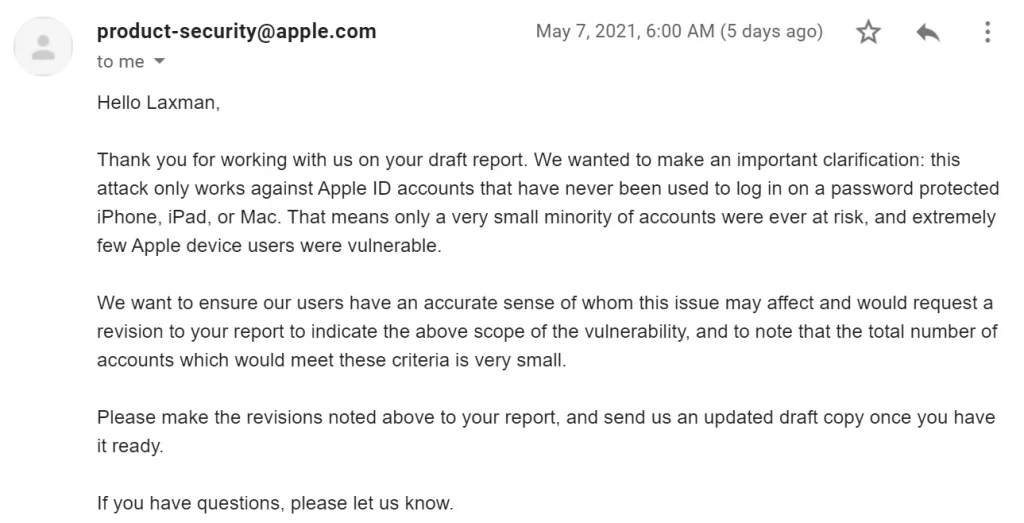
Their analysis, as shown in the email screenshot, was that it only works against iCloud accounts that have not been used in passcode or password protected Apple devices.
Step 6: The passcode argument and the SRP investigation
The researcher argued that even if the device passcode (4 or 6 digit) is asked instead of the 6 digit code sent to email, it would share the same rate limits and be vulnerable to race condition based brute forcing, and that the passcode of the associated device could also be discovered. He also noticed changes to Apple's support page on forgot password.
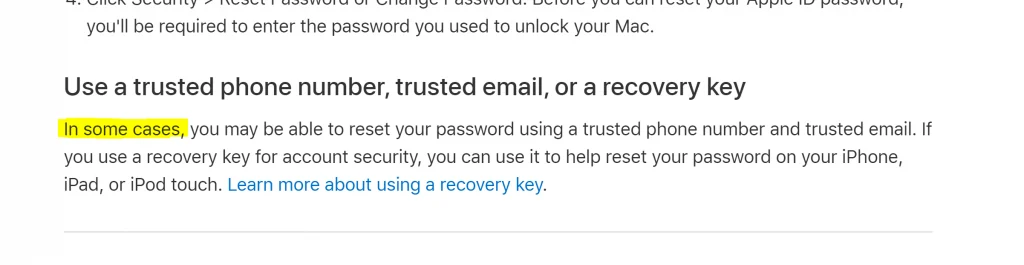
Link: https://support.apple.com/en-in/HT201487
He states the page looked different before his report. In October 2020 it looked like this:
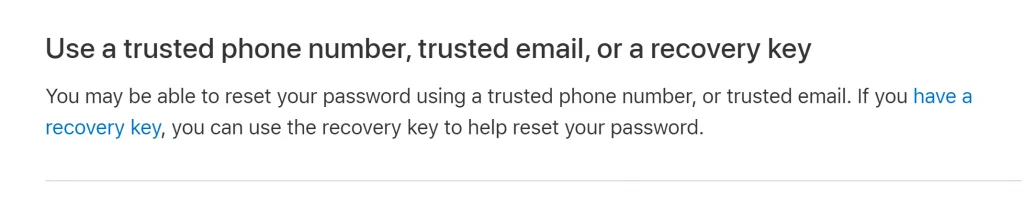
Link from web archive: http://web.archive.org/web/20201005172245/https://support.apple.com/en-in/HT201487
He notes that "In some cases" was prefixed to the paragraph in October 2020, exactly after he was told in September 2020 that a fix was being worked on. He argues the page had not been updated for years and that a minor update after his report does not look like a coincidence. Apple said the updates were due to changes in iOS 14. He asked what resetting a password with a trusted email or phone number has to do with iOS 14, and whether trusted phone number and email were used to reset the password before iOS 14, in which case his report would apply to all Apple accounts. He says he got no answer.
He told Apple he would publish without waiting for approval. Apple arranged a call with its engineers.
On the call, Apple said the passcode is not sent to any server endpoint and is verified in the device itself. The researcher argued that a random Apple device cannot know another device's passcode without contacting Apple's server. Apple said the data is sent to the server but verified using a cryptographic operation, and that they could not reveal more due to security concerns. When asked what happens if the encryption process is reverse engineered to replicate it and brute force the server with concurrent requests, he says he got no definite answer. Apple concluded that the only way to brute force the passcode is through brute forcing the device, which is not possible due to local system rate limits.
To verify this himself, he tested the passcode validation endpoint. He found SSL pinning specific to that endpoint, so traffic could not be read by a MITM proxy such as Burp or Charles. Using checkra1n and SSL Kill Switch he bypassed pinning and read the traffic.
He found that Apple uses SRP (Secure Remote Password), a PAKE protocol, to verify that the user knows the right passcode without sending it to the server. Both server and client perform mathematical calculations using previously known data to derive a key, similar to a Diffie-Hellman key exchange. The report summarises what matters here:
- Apple's server stores two values per user, a verifier and a salt, created when the passcode is set or updated.
- When a user initiates SRP authentication with a username and an ephemeral value A, the server responds with the salt for that user and an ephemeral value B.
- The client uses the salt to calculate the key prescribed by SRP-6a.
- The server uses the salt and verifier to calculate the key prescribed by SRP-6a.
- Both then prove to each other that the derived keys are the same.
SRP is known to prevent brute force attacks because of the user-specific salt and verifier: even with the database, an attacker needs a CPU intensive brute force per user. In this case, though, only a single user needs to be brute forced to get into their iCloud account and find their passcode. Brute forcing is possible only with both the salt and verifier for the target user. After bypassing the SMS passcode the attacker can impersonate the target and obtain the salt, but the verifier is the problem: it must be obtained from the server, or the rate limit on the key verifying endpoint must be bypassed. If the rate limit is bypassed, different combinations of the key obtained from precomputed passcode values can be tried until the matching key is found. Deriving a key for each 4 or 6 digit numeric passcode (from 0000/000000 to 9999/999999) requires a lot of computation.
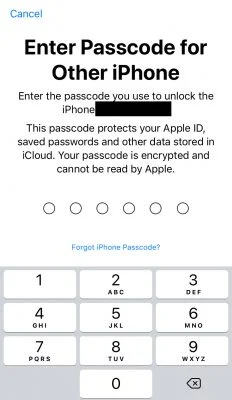
Step 7: The escrow proxy request
When the passcode is entered on an iPhone or iPad during password reset, the device initiates SRP authentication by sending the user session token obtained from the successful SMS verification. The server responds with the salt for that user. The passcode and salt are hashed to derive the final key, which is sent to https://p50-escrowproxy.icloud.com/escrowproxy/api/recover to check whether it matches the key computed on the server (using ephemeral, salt and verifier).
The POST request sent to verify the key looked like this:
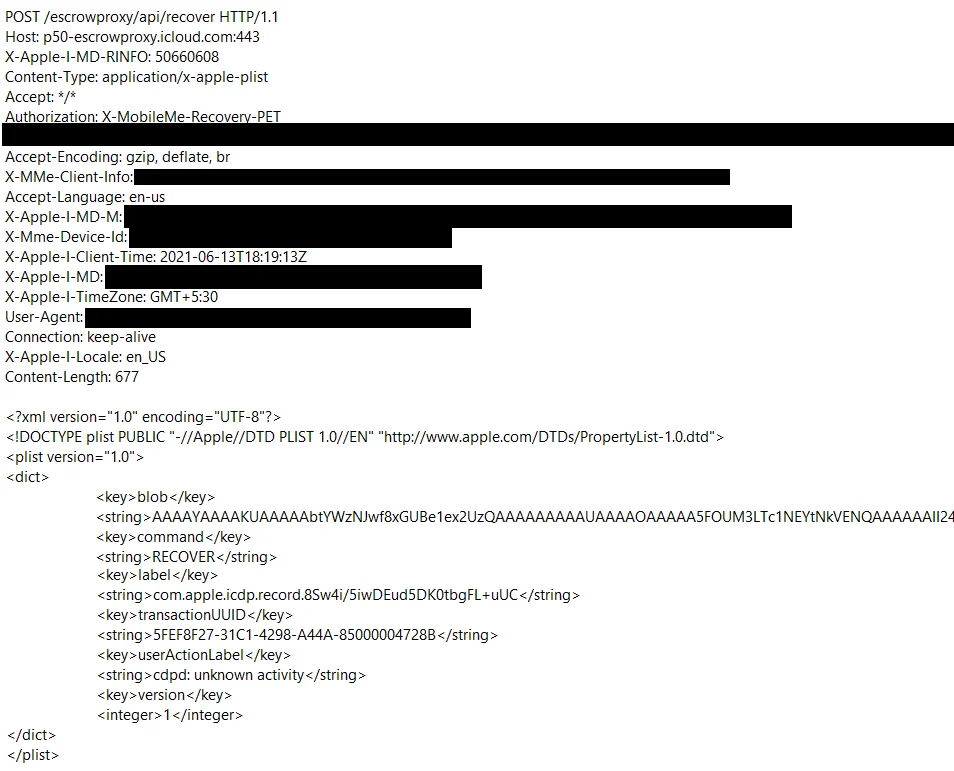
The report says the string tag has all the data mentioned above, sent in DATA BLOB format.
Step 8: Test the escrow proxy for the race condition
Before decoding the BLOB values, the researcher checked the rate limit. He sent the request 30 times concurrently.
To his shock it was not vulnerable: out of 30 requests, 29 were rejected with an internal server error.
He reasons that rate limiting would be performed in the Apple server itself or in the HSM (hardware security module), and that either way the rate limit logic should be programmed to prevent a race hazard. He considers it very unlikely that this endpoint was not vulnerable to a race hazard before his report, because every other endpoint he tested was vulnerable: SMS code validation, email code validation, two factor authentication and password validation. He concludes that if Apple patched it after his report, the vulnerability became much more severe than he initially thought: by brute forcing the passcode and differentiating the responses, an attacker could not only take over any iCloud account but also discover the passcode of the associated Apple device. He states that, although the attack is complex, this could hack any iPhone or iPad with a 4 or 6 digit numeric passcode if his assumption is right. Since the endpoint now validates concurrent requests properly, he says there is no way for him to verify his claim other than writing to Apple, and that they gave no response on this point.
Step 9: The bounty and the dispute
The bounty email from Apple arrived on June 4th, 2021.
Apple's published payout for iCloud account takeover is $100,000 USD, and for extracting sensitive data from a locked Apple device $250,000 USD. The researcher argues his report covered both scenarios (assuming the passcode endpoint was patched after his report), so even the maximum of the two, $250,000 USD, should apply.
https://developer.apple.com/security-bounty/payouts/
He says $18,000 USD is not close to the actual bounty, and lists the impact even if all his assumptions are wrong and the passcode endpoint was not vulnerable before his report:
- The two factor authentication was bypassed, so it is as if 2FA does not exist for affected users.
- The password validation rate limits were bypassed, so Apple ID accounts with common, weak or hacked passwords are vulnerable even with 2FA enabled. Once hacked, the attacker can track the device location and wipe it remotely. He cites the 2014 celebrities iCloud hack as largely due to weak passwords.
- The SMS verification was bypassed if the passcode or password of the associated device is known. For example, a friend or relative who knows the device passcode could take over the iCloud account and erase the device remotely without physical access.
- All Apple IDs not associated with a passcode protected Apple device could be taken over through the SMS and email code bypass, which means:
- any Apple device without a passcode or password, such as one where the passcode was turned off or never set;
- any Apple ID created without an Apple device, for example in a browser or an Android app, and not used on a password protected Apple device;
- for example, 50 million+ Android users have downloaded the Apple Music app, and the majority of them may not have used Apple devices. They are still Apple users, and information such as credit cards, billing address and subscription details could be exposed.
He says Apple need not reward the upper cap of $100k but it should at least be close to it given the impact. After almost a year of waiting he refused the bounty and told Apple it was unfair, asking them to reconsider or let him publish with all the information. There was no response, so he published.
Update 27 March 2022
With no response for months, he created a new ticket on 21st July 2021 stating that the HSMs would still be vulnerable to insider threats. After back and forth emails, Apple set up a call and clarified that the HSMs are not vulnerable due to quorum voting across multiple HSMs located globally.
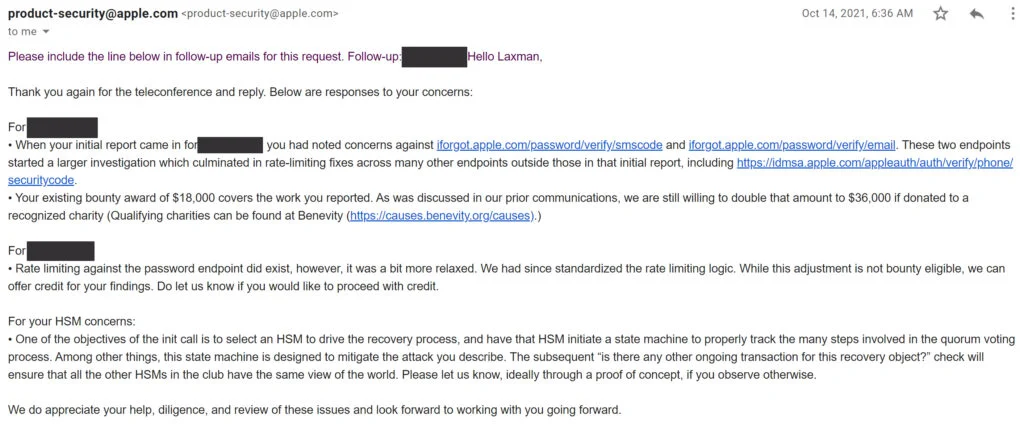
He argues that even with voting across multiple machines, race conditions are not prevented: the randomly picked HSM checks only the other members of the club for whether another transaction is in progress, not itself, so concurrent requests to the picked HSM would bypass the rate limit. Apple responded that HSMs do not handle concurrent requests.

He tested this in multiple aspects and could not confirm Apple's claim. When concurrent srp init and recover calls hit the escrow proxy, either all should be dropped or all processed serially, but only one was executed and the others dropped, which he says clearly indicates the host or proxy is filtering concurrent requests. He was not sure whether the HSM really does not support concurrent processing and did not want to invest more time, as he considers Apple not transparent from the beginning.
Apple said they did not consider the 2FA bypass and other rate limit bypass patches that resulted from his report, because those were not included in his initial report.
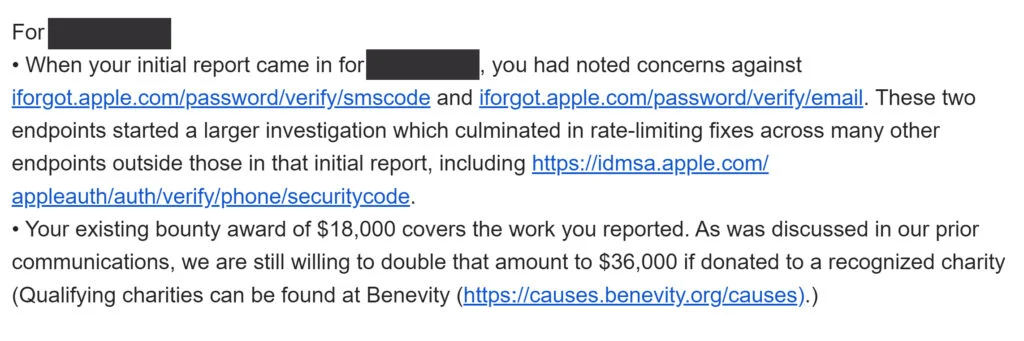
He calls this unfair: if nobody had reported it, none of it would have been patched, and the investigation was a result of the report. He says his report was about an account takeover vulnerability that included 3 endpoint bypasses, and he did not focus on 2FA because it is less critical than account takeover. He argues that the fairest bounty programmes reward the maximum impact caused by the underlying vulnerability, not just what the report showcases. As an example he cites a Facebook bug that was low severity (around $1000), where investigation found a sophisticated RCE and Facebook paid $80,000 instead of the normal low severity payout.
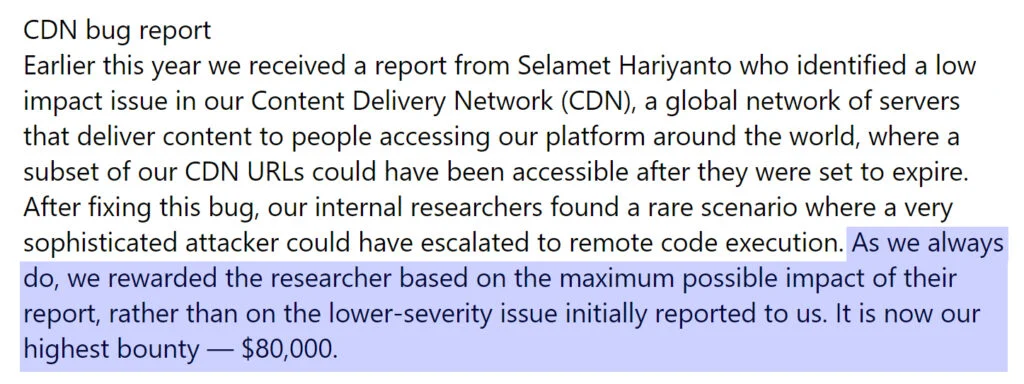
https://www.facebook.com/BugBounty/posts/4087540111260184
He says he raised the same example with Apple, but they skipped that part and responded only to the HSM queries. After months without responses he decided not to participate in Apple's bug bounty programme until the policies change and become transparent.
Root cause
The report attributes the issue to a race condition in the rate limits. The limits are enforced per Apple server IP and per source IP, and the researcher's description is that the rate limit logic should be programmed to prevent a race hazard. The report does not show the server-side code, so the exact implementation flaw is not stated; the researcher's description is that the rate limit logic should be programmed to prevent a race hazard, and that the escrow proxy's behaviour (only one of several concurrent srp init and recover calls executed, the rest dropped) suggests filtering at the host or proxy level rather than in the HSM.
Existing defences that did not stop it, as described:
- The 5 attempt limit on the forgot password endpoint was worked around by spreading requests across the 6 resolved Apple server IP addresses.
- The 6 concurrent POST limit per source IP was bypassed by using many source IPs, after finding providers whose ASNs were not blocked.
- The 502 Bad Gateway for AWS and Google Cloud was an obstacle, not a fix, because other providers were not blocked.
- 2FA and password validation shared the same rate limit and were therefore also bypassable.
- The escrow proxy endpoint, which the researcher expected to be vulnerable on the same basis, rejected 29 of 30 concurrent requests with an internal server error, so it was not bypassable at the time he tested it.
Impact
Under the conditions in the report, an attacker who knows the target's email address and trusted phone number could bypass the SMS and email OTP checks and change the password of the Apple ID, which the researcher describes as account takeover. Because the 2FA endpoint shared the rate limit, accounts with two factor authentication enabled were also affected. The password validation endpoint was vulnerable too, so accounts with weak or reused passwords were exposed even with 2FA. Once in, the attacker could track the device location and wipe the device remotely.
Apple's position, as quoted in the report, was that the vulnerability does not allow takeover of the majority of iCloud accounts and only works against iCloud accounts not used in passcode or password protected Apple devices. The researcher disputes this and argues that the passcode path shares the same rate limits, and that if the escrow proxy was patched after his report, the issue would also allow discovery of the device passcode and therefore compromise of any iPhone or iPad with a 4 or 6 digit numeric passcode. He hedges this with "if my assumption is right" and notes he could not verify it because the endpoint no longer accepts concurrent requests.
The report also notes that the attack is not easy: it needs a proper setup, many source IP addresses (about 28K by his calculation), and a lot of computation to derive keys for each candidate passcode.
Fix
According to the report, the researcher found on April 1st, 2021 that a patch for the vulnerability had been released to production. It does state that the escrow proxy endpoint rejected 29 of 30 concurrent requests with an internal server error when he tested it, and that Apple said the HSMs do not handle concurrent requests and are protected by quorum voting across multiple HSMs located globally. The researcher was not able to confirm the HSM claim.
What the report implies should be fixed, rather than what Apple says it changed: the rate limit check must be atomic with respect to concurrent requests, so that simultaneous requests cannot all pass the check before any of them is counted. The report also argues that the maximum impact of the underlying vulnerability should be rewarded, which is a programme policy point rather than a code fix.
Variants to test
- Multi-IP fan-out against per-IP limits. On any OTP or code validation endpoint, resolve the hostname and check whether the limit is tied to the server IP or the client IP. A positive result is that requests spread across resolved server IPs, each within the per-IP concurrency limit, are all processed rather than dropped.
- Concurrent request bursts just under the drop threshold. Send the maximum allowed number of simultaneous requests and check whether more than the documented number of attempts are counted. A positive result is more validation attempts accepted than the limit allows.
- Shared rate limit across related endpoints. Test whether the 2FA, password validation and OTP endpoints share the same counter. A positive result is that exhausting one endpoint's budget affects the others, or that bypassing one bypasses all.
- Cloud provider ASN blocking. Send POST requests from different cloud providers and compare response codes. A positive result is a provider whose requests are processed normally while others get 502 or 503.
- SRP or PAKE key verification endpoints. Send the key verification request concurrently and compare responses. A positive result is that more than one concurrent request is processed, or that responses differ in a way that reveals whether a candidate key matched.
- Certificate pinning on mobile validation endpoints. Check whether the endpoint pins certificates and whether the traffic can be read after bypassing pinning. A positive result is readable request bodies containing the values needed to replay the verification.
- Support page and documentation changes. Compare archived versions of vendor documentation around the disclosure timeline. A positive result is wording changes that narrow the affected population after a report, which is worth raising with the vendor.
What happened, in plain words
A security researcher called Laxman Muthiyah found a way to break into Apple iCloud accounts. He did not guess passwords one at a time like a person typing at a login screen. Instead he found that Apple's defences against guessing (called rate limits) could be tricked by sending many requests at the exact same moment, from many different computers. This trick is called a race condition.
The feature involved is the "forgot password" page for an Apple ID. When you forget your password, Apple lets you reset it by sending a 6 digit code (a one time password, or OTP) to your trusted phone number and to your email address. If you type the right code, you can set a new password. The researcher found that an attacker who knows both your email address and your trusted phone number could try all one million possible 6 digit codes, because the limit on how many tries you get could be bypassed.
He reported it to Apple on 1 July 2020. He found a patch had been released to production on 1 April 2021. Apple offered him $18,000 USD as a bug bounty reward, and he refused to take it, because he felt the amount did not match the impact and because Apple disputed parts of his report. He published the write-up anyway.
This article walks through his report step by step, explaining every technical idea from scratch. Nothing here is invented: where the original report does not say something, this article says so too.
The researcher and the feature
The report is by Laxman Muthiyah.

He had previously reported the same kind of problem against Instagram and Microsoft. That matters because it shows this was not a one-off: the same weakness (rate limits that can be bypassed with simultaneous requests) appears in many services.
What the forgot password feature does
The feature is the forgot password option of Apple ID. It lets a user change their password using a 6 digit OTP sent to their trusted mobile number and email address. Once the correct OTP is entered, the password can be changed.
Apple forgot password page prompting to enter mobile number after entering email address
In plain words: you go to the page, type your email address, then Apple asks for the phone number it already has on file for you (the "trusted" number). Apple then sends a short numeric code to that phone and to your email. You type the code, and you are allowed to set a new password.
Why the attacker needs two pieces of information
For security reasons, Apple prompts for the trusted phone number along with the email address before an OTP is requested. So to exploit the issue, an attacker needs to know both the trusted phone number and the email address. Then they have to try all possibilities of the 6 digit code, which is around 1 million attempts (10 ^ 6).
Why 1 million? A 6 digit code has ten possible digits in each position (0 to 9). Six positions means 10 x 10 x 10 x 10 x 10 x 10 = 1,000,000 possible codes. That is the whole search space.
What the report claims about the fix
The report states that the vulnerability is completely patched by Apple and no longer works. Apple offered $18,000 USD under its bounty programme, and the researcher refused to receive it. The reasons are covered later, under the bounty dispute.
What you need before you can try this (the setup)
The report does not describe a lab or specific accounts. What it does state as preconditions:
- Knowledge of the target's trusted phone number and email address, needed to request the OTP.
- The ability to send POST requests to Apple servers from many source IP addresses, because of the per-IP limits described below.
- For the later passcode work, a jailbroken device with checkra1n and SSL Kill Switch to bypass certificate pinning, plus a MITM proxy such as Burp or Charles to read the traffic.
Let us unpack those terms, because they are the foundation of everything else.
- POST request: when your browser talks to a website, it uses a method (a verb) to say what it wants. GET means "give me this page". POST means "here is some data, please act on it", for example submitting a login form. A POST request carries a body, which is the data being sent.
- IP address: the numeric address of a computer on the internet, a bit like a postal address. Every request you send comes from some IP address, and the server can see it.
- Source IP address: the IP address the request came from, that is, yours.
- Cloud service provider: a company that rents out computers and IP addresses over the internet (the report names AWS and Google Cloud). Renting many machines gives you many source IP addresses.
- Jailbroken device: an iPhone or iPad that has been modified so you can run software Apple does not normally allow, such as tools that inspect network traffic.
- Certificate pinning: normally your device trusts a list of certificate authorities to vouch for websites. Pinning means the app only trusts one specific certificate, so a proxy that tries to sit in the middle is rejected. Bypassing pinning means removing that restriction so you can read the traffic.
- MITM proxy: a "man in the middle" proxy is a tool that sits between your device and the server, so you can see and edit the requests. Burp and Charles are two well known ones.
The researcher tried various cloud service providers and found that some of them were blocked. That is covered in the exploitation section.
Finding it
The first wall: strong rate limits
The starting point was the observation that the forgot password endpoint had strong rate limits. Entering more than 5 attempts locked the account for the next few hours, and rotating the IP did not help.
HTTP POST REQUEST SENT TO FORGOT PASSWORD ENDPOINT AND ITS RESPONSE
What is a rate limit? It is a rule on the server that says "you may only do this N times in a period". It exists to stop exactly the kind of guessing attack described here. If you can only try 5 codes, then guessing a 6 digit code is hopeless: you would need a million tries.
"Rotating the IP" means switching to a different source IP address, hoping the limit is tracked per IP. It did not help, which tells us the limit was tracked in a way that did not care about the IP alone.
The second wall: limits on simultaneous requests
He then tried race hazard based brute forcing by sending simultaneous POST requests to the Apple server, and found further limitations. Apple applies rate limits to concurrent POST requests from a single IP address, not just to the forgot password endpoint but to the entire Apple server. More than 6 concurrent POST requests are dropped, and the source IP address is blacklisted for future POST requests with a 503 error.
Let us define the key idea here, because the whole report rests on it.
- Brute force: trying every possible answer until one works. Like trying every key on a big ring on a lock.
- Concurrent requests: requests sent at the same moment, rather than one after another. If you open ten tabs and hit submit in all of them within a fraction of a second, those are concurrent.
- Race condition: a bug where a system does two things in the wrong order because two actions happen at the same time. A simple everyday comparison: two people reach for the last seat on a train at the same instant, and both think it is free because neither has sat down yet. In software, a server checks "has this user tried too many times?" and then "count this attempt". If many requests arrive between the check and the count, they all pass the check before any of them is counted.
- 503 error: an HTTP status code meaning the server is refusing to serve you right now. Here it is used as a punishment: your IP is blacklisted.
So the researcher's idea was: instead of trying codes one after another (which the 5 attempt limit stops), send many at once, so that the server's counting cannot keep up. But Apple also limited how many simultaneous requests one IP could send: more than 6, and they are dropped and the IP is blacklisted.
At first this looked like the end of the idea. But the researcher noted that these are generic limits across the server and not specific to the code validation endpoint. In other words, the limit was a general traffic rule, not a rule about checking codes, which suggested there might be a way around it.
The observations that opened the door
Further testing produced the following observations, quoted as the report lists them:
- iforgot.apple.com resolves to 6 IP addresses across the globe (the report lists them; they are omitted here).
- There are two rate limits: one triggered when more than 5 requests are sent to the forgot password endpoint (http://iforgot.apple.com/password/verify/smscode), and another across the Apple server when more than 6 concurrent POST requests are sent.
- Both rate limits are specific to the Apple server IP, which means requests (within the limits) can still be sent to another Apple server IP.
- Up to 6 concurrent requests can be sent to an Apple server IP (by binding iforgot.apple.com to the IP) from a single client IP address. With 6 Apple IP addresses, up to 36 requests can be sent across them (6 x 6 = 36) from a single IP address.
- Therefore an attacker would require 28K IP addresses to send up to 1 million requests to verify the 6 digit code.
Let us explain each of these slowly.
Point 1: one name, many addresses. When you type a website name into your browser, a system called DNS translates that name into one or more IP addresses. Big services often have many servers in different places, so one name can map to several addresses. Here, iforgot.apple.com resolved to 6 addresses. The report lists the actual addresses; they are left out of this article.
Point 2: two separate limits. One limit is about how many attempts you make against the code check (more than 5 and the account locks). The other is about how many simultaneous POST requests you fire at the server from one IP (more than 6 and you are dropped and blacklisted).
Point 3: the limits are tied to the Apple server, not to you. This is the crucial detail. If the limit were global ("only 5 attempts per account, ever, from anywhere"), spreading requests would not help. But because the limit is counted per Apple server IP, sending requests to a different Apple server IP gives you a fresh allowance.
Point 4: the arithmetic. You can send up to 6 simultaneous requests to one Apple server IP. There are 6 Apple server IPs. So from a single source IP you can send 6 x 6 = 36 requests, spread across the six servers, each server seeing no more than 6 at once.
Point 5: how many source IPs you need. To reach about 1 million attempts at 36 attempts per source IP, you divide: roughly 28,000 source IP addresses. The report rounds this to 28K.
The third wall: cloud providers are blocked
28k IP addresses looks easy with cloud service providers, but the report describes a further obstacle: Apple rejects POST requests from cloud providers such as AWS and Google Cloud with a 502 Bad Gateway, without even checking the request URI or body.
Response for any POST request sent from AWS & Google cloud
- 502 Bad Gateway: an HTTP status code meaning a server in the middle could not get a valid answer from the server behind it. Here it is used as a blanket rejection.
- Request URI: the path part of the request, for example /password/verify/smscode. It says which page or action you are calling.
- Request body: the data you are sending, for example the code you are guessing.
The point is that Apple rejected these requests before even looking at what was in them. That is not a normal application error; it looks like a network level block.
Changing IPs returned the same response code, which the researcher interprets as the entire ASN of some cloud service providers being blacklisted (he hedges this with "if am not wrong").
- ASN (Autonomous System Number): a number that identifies a whole network belonging to one organisation. Blocking an ASN blocks every IP address in that network at once. It is like a postal service refusing all mail from one entire city rather than from individual houses.
He kept trying various providers and finally found a few whose network IPs were not blacklisted. That is the breakthrough: the block was not universal, just applied to some providers.
Exploitation
Step 1: Understand the limits per source IP and per Apple server IP
The forgot password endpoint locks the account after more than 5 attempts, and the server drops more than 6 concurrent POST requests from one source IP and blacklists that IP with a 503. Because both limits are tied to the Apple server IP rather than being global, the attacker can spread requests across the 6 resolved Apple IP addresses, giving 36 requests per source IP.
The researcher worked out that the counting is per Apple server, which is the flaw that makes the whole attack possible.
Step 2: Obtain enough source IP addresses
Reaching roughly 1 million attempts at 36 requests per IP requires about 28K IP addresses. Cloud providers are the obvious source, but AWS and Google Cloud POST requests are answered with 502 Bad Gateway regardless of URI or body. The researcher found a few providers whose IP ranges were not blocked.
Why this step matters: the attack needs volume. One computer cannot send a million requests within the lockout window. Many computers, each with its own IP address, can.
Step 3: Send concurrent requests from many IPs
With multiple concurrent POST requests sent from different IP addresses, the bypass worked. The researcher states that he could then change the password of any Apple ID with just the trusted phone number.
The report does not include the exact request or response bodies for this step; it only states that the concurrent multi-IP requests succeeded.
Why this step matters: this is the proof. The theory (limits counted per server, spread across servers and source IPs) was tested and the requests went through.
Step 4: Repeat for the email code, 2FA and password validation
The attack requires bypassing the SMS 6 digit code and then the 6 digit code received by email. Both bypasses use the same method and environment, so nothing needs to change for the second one. The report adds that even with two factor authentication enabled the account could still be accessed, because the 2FA endpoint shares the rate limit and was vulnerable. The same vulnerability was also present in the password validation endpoint.
Let us define the terms:
- SMS code: the 6 digit code sent as a text message to the trusted phone number.
- Email code: the 6 digit code sent to the trusted email address. The reset flow asks for both, one after the other.
- Two factor authentication (2FA): a second proof of identity beyond your password, usually a code from an app or a text message. The idea is that even if someone steals your password, they still cannot get in without the second factor.
- Password validation endpoint: the part of the server that checks whether a password you typed is correct.
Why this step matters: it shows the weakness was not in one place. The same counting flaw appeared in several checks, so bypassing one meant bypassing the others.
Step 5: Report and timeline
The issue was reported with detailed reproduction steps and a video demonstrating the bypass to Apple security on July 1st, 2020. Apple acknowledged and triaged it within a few minutes.
- Reproduction steps: a numbered list of exactly what to do so someone else can see the same result.
- Triaged: the vendor has looked at the report, confirmed it is real, and put it in their queue. It does not mean fixed.
After triage there were no updates, and on Sep 9th, 2020 Apple said they were working on a fix.
After another 5 months without updates, Apple said they were planning to address the issue in an upcoming security update.
The researcher kept retesting rather than relying on Apple. On April 1st, 2021 he found that a patch had been released to production, still without any update from Apple. When asked whether the issue was patched, Apple replied that they had no status updates to share.
- Production: the live systems that real users use, as opposed to a test environment.
- Patch: a change to software that fixes a problem.
A month later he wrote that the issue had been patched on April 1st and that he wanted to publish the report on his blog. Apple asked to see a draft of the article before publication. After the draft was shared, Apple denied his claim, saying the vulnerability did not allow takeover of the majority of iCloud accounts.
Their analysis, as shown in the email screenshot, was that it only works against iCloud accounts that have not been used in passcode or password protected Apple devices.
Why this matters: the dispute is not only about money. Apple is narrowing who was affected, and the researcher disagrees with that narrowing.
Step 6: The passcode argument and the SRP investigation
The researcher argued that even if the device passcode (4 or 6 digit) is asked instead of the 6 digit code sent to email, it would share the same rate limits and be vulnerable to race condition based brute forcing, and that the passcode of the associated device could also be discovered. He also noticed changes to Apple's support page on forgot password.
Link: https://support.apple.com/en-in/HT201487
He states the page looked different before his report. In October 2020 it looked like this:
Link from web archive: http://web.archive.org/web/20201005172245/https://support.apple.com/en-in/HT201487
He notes that "In some cases" was prefixed to the paragraph in October 2020, exactly after he was told in September 2020 that a fix was being worked on. He argues the page had not been updated for years and that a minor update after his report does not look like a coincidence. Apple said the updates were due to changes in iOS 14. He asked what resetting a password with a trusted email or phone number has to do with iOS 14, and whether trusted phone number and email were used to reset the password before iOS 14, in which case his report would apply to all Apple accounts. He says he got no answer.
- Device passcode: the short number you type to unlock an iPhone or iPad. It is different from your Apple ID password.
- Web archive: a service that keeps old copies of web pages, so you can see what a page looked like on a given date. It is useful for checking whether wording changed after a report.
He told Apple he would publish without waiting for approval. Apple arranged a call with its engineers.
On the call, Apple said the passcode is not sent to any server endpoint and is verified in the device itself. The researcher argued that a random Apple device cannot know another device's passcode without contacting Apple's server. Apple said the data is sent to the server but verified using a cryptographic operation, and that they could not reveal more due to security concerns. When asked what happens if the encryption process is reverse engineered to replicate it and brute force the server with concurrent requests, he says he got no definite answer. Apple concluded that the only way to brute force the passcode is through brute forcing the device, which is not possible due to local system rate limits.
- Server endpoint: a specific address on a server that performs one action, for example /password/verify/smscode. Think of it as one counter in a large office, each counter handling one kind of request.
- Cryptographic operation: a mathematical process that uses secret values to prove something without revealing the secret.
- Reverse engineering: taking apart a program or a network exchange to work out how it works internally.
- Local system rate limits: limits enforced on the device itself, so that even someone holding the phone cannot try passcodes endlessly.
To verify this himself, he tested the passcode validation endpoint. He found SSL pinning specific to that endpoint, so traffic could not be read by a MITM proxy such as Burp or Charles. Using checkra1n and SSL Kill Switch he bypassed pinning and read the traffic.
- SSL pinning: the same idea as certificate pinning, applied to the encrypted connection (SSL/TLS) between app and server. The app refuses to talk to anything except the exact server certificate it expects, which defeats a proxy.
He found that Apple uses SRP (Secure Remote Password), a PAKE protocol, to verify that the user knows the right passcode without sending it to the server. Both server and client perform mathematical calculations using previously known data to derive a key, similar to a Diffie-Hellman key exchange.
- SRP (Secure Remote Password): a way for a client and a server to agree on a shared secret key, proving the client knows the password, without ever sending the password over the network.
- PAKE (Password Authenticated Key Exchange): the general family of protocols that do this. The everyday comparison: two people want to confirm they both know the same secret word without saying it out loud, so they each do a calculation and compare results.
- Diffie-Hellman key exchange: the classic method for two parties to agree on a shared secret over a public channel.
The report summarises what matters here:
-
Apple's server stores two values per user, a verifier and a salt, created when the passcode is set or updated.
-
When a user initiates SRP authentication with a username and an ephemeral value A, the server responds with the salt for that user and an ephemeral value B.
-
The client uses the salt to calculate the key prescribed by SRP-6a.
-
The server uses the salt and verifier to calculate the key prescribed by SRP-6a.
-
Both then prove to each other that the derived keys are the same.
-
Salt: a random value added to a password before hashing, so that two users with the same password do not produce the same stored value. It also stops precomputed tables of hashes from being reused.
-
Verifier: the stored value derived from the password and salt, kept on the server. It is not the password itself.
-
Ephemeral value: a temporary number generated fresh for each session. "Ephemeral" just means short lived.
-
SRP-6a: a specific version of the SRP protocol, with defined formulas for the calculations.
-
Hash: a one way mathematical function that turns any input into a fixed size output. You cannot easily go backwards from the output to the input.
SRP is known to prevent brute force attacks because of the user-specific salt and verifier: even with the database, an attacker needs a CPU intensive brute force per user. In this case, though, only a single user needs to be brute forced to get into their iCloud account and find their passcode. Brute forcing is possible only with both the salt and verifier for the target user. After bypassing the SMS passcode the attacker can impersonate the target and obtain the salt, but the verifier is the problem: it must be obtained from the server, or the rate limit on the key verifying endpoint must be bypassed. If the rate limit is bypassed, different combinations of the key obtained from precomputed passcode values can be tried until the matching key is found. Deriving a key for each 4 or 6 digit numeric passcode (from 0000/000000 to 9999/999999) requires a lot of computation.
Why this step matters: the researcher is testing Apple's claim. If the passcode check is really done on the device, then the server should not be involved. He found the server is involved, but in a way that does not send the passcode. That raised a new question: can the server side be brute forced instead?
Step 7: The escrow proxy request
When the passcode is entered on an iPhone or iPad during password reset, the device initiates SRP authentication by sending the user session token obtained from the successful SMS verification. The server responds with the salt for that user. The passcode and salt are hashed to derive the final key, which is sent to https://p50-escrowproxy.icloud.com/escrowproxy/api/recover to check whether it matches the key computed on the server (using ephemeral, salt and verifier).
- Session token: a short string the server gives you after you prove who you are, so you do not have to prove it again on every request. It is like a wristband at an event: show it at the door and you get in.
- Escrow proxy: "escrow" here means data held in trust by Apple on the user's behalf. The proxy is the server that handles the check.
The POST request sent to verify the key looked like this:
The report says the string tag has all the data mentioned above, sent in DATA BLOB format.
- String tag: a labelled field in the request that carries a value.
- DATA BLOB: a chunk of binary data, that is, raw bytes rather than readable text. It is like a sealed envelope: you can see it is there, but you need to open it to read the contents.
Why this step matters: this is the exact request the device sends when checking a passcode. If the researcher can send the same request himself, many times at once, he can test whether this endpoint has the same race condition.
Step 8: Test the escrow proxy for the race condition
Before decoding the BLOB values, the researcher checked the rate limit. He sent the request 30 times concurrently.
To his shock it was not vulnerable: out of 30 requests, 29 were rejected with an internal server error.
- Internal server error: an HTTP 500 status code, meaning something went wrong on the server side.
He reasons that rate limiting would be performed in the Apple server itself or in the HSM (hardware security module), and that either way the rate limit logic should be programmed to prevent a race hazard. He considers it very unlikely that this endpoint was not vulnerable to a race hazard before his report, because every other endpoint he tested was vulnerable: SMS code validation, email code validation, two factor authentication and password validation. He concludes that if Apple patched it after his report, the vulnerability became much more severe than he initially thought: by brute forcing the passcode and differentiating the responses, an attacker could not only take over any iCloud account but also discover the passcode of the associated Apple device. He states that, although the attack is complex, this could hack any iPhone or iPad with a 4 or 6 digit numeric passcode if his assumption is right. Since the endpoint now validates concurrent requests properly, he says there is no way for him to verify his claim other than writing to Apple, and that they gave no response on this point.
- HSM (hardware security module): a dedicated physical computer whose job is to hold secret keys and perform cryptographic operations safely. It is like a safe with a computer inside.
- Quorum voting: requiring agreement from several machines before an action is allowed, so that no single machine can be tricked alone.
Why this step matters: this is the one place where the attack did not work. The researcher is honest that he could not confirm his theory, and he explains why: the endpoint now rejects simultaneous requests, so he cannot test what it did before the fix.
Step 9: The bounty and the dispute
The bounty email from Apple arrived on June 4th, 2021.
- Bug bounty: a programme where a company pays researchers who report security problems, so the problems get fixed instead of sold or used.
Apple's published payout for iCloud account takeover is $100,000 USD, and for extracting sensitive data from a locked Apple device $250,000 USD. The researcher argues his report covered both scenarios (assuming the passcode endpoint was patched after his report), so even the maximum of the two, $250,000 USD, should apply.
https://developer.apple.com/security-bounty/payouts/
He says $18,000 USD is not close to the actual bounty, and lists the impact even if all his assumptions are wrong and the passcode endpoint was not vulnerable before his report:
- The two factor authentication was bypassed, so it is as if 2FA does not exist for affected users.
- The password validation rate limits were bypassed, so Apple ID accounts with common, weak or hacked passwords are vulnerable even with 2FA enabled. Once hacked, the attacker can track the device location and wipe it remotely. He cites the 2014 celebrities iCloud hack as largely due to weak passwords.
- The SMS verification was bypassed if the passcode or password of the associated device is known. For example, a friend or relative who knows the device passcode could take over the iCloud account and erase the device remotely without physical access.
- All Apple IDs not associated with a passcode protected Apple device could be taken over through the SMS and email code bypass, which means:
- any Apple device without a passcode or password, such as one where the passcode was turned off or never set;
- any Apple ID created without an Apple device, for example in a browser or an Android app, and not used on a password protected Apple device;
- for example, 50 million+ Android users have downloaded the Apple Music app, and the majority of them may not have used Apple devices. They are still Apple users, and information such as credit cards, billing address and subscription details could be exposed.
He says Apple need not reward the upper cap of $100k but it should at least be close to it given the impact. After almost a year of waiting he refused the bounty and told Apple it was unfair, asking them to reconsider or let him publish with all the information. There was no response, so he published.
Why this step matters: the technical finding and the reward are separate questions. The researcher is arguing that the reward should reflect the worst impact the bug could cause, not only the narrow scenario he first described.
Update 27 March 2022
With no response for months, he created a new ticket on 21st July 2021 stating that the HSMs would still be vulnerable to insider threats. After back and forth emails, Apple set up a call and clarified that the HSMs are not vulnerable due to quorum voting across multiple HSMs located globally.
- Insider threat: the risk that someone inside the organisation misuses their access.
He argues that even with voting across multiple machines, race conditions are not prevented: the randomly picked HSM checks only the other members of the club for whether another transaction is in progress, not itself, so concurrent requests to the picked HSM would bypass the rate limit. Apple responded that HSMs do not handle concurrent requests.
He tested this in multiple aspects and could not confirm Apple's claim. When concurrent srp init and recover calls hit the escrow proxy, either all should be dropped or all processed serially, but only one was executed and the others dropped, which he says clearly indicates the host or proxy is filtering concurrent requests. He was not sure whether the HSM really does not support concurrent processing and did not want to invest more time, as he considers Apple not transparent from the beginning.
- srp init: the first step of an SRP exchange, where the client starts the conversation.
- Serially: one after another, in order, rather than at the same time.
Apple said they did not consider the 2FA bypass and other rate limit bypass patches that resulted from his report, because those were not included in his initial report.
He calls this unfair: if nobody had reported it, none of it would have been patched, and the investigation was a result of the report. He says his report was about an account takeover vulnerability that included 3 endpoint bypasses, and he did not focus on 2FA because it is less critical than account takeover. He argues that the fairest bounty programmes reward the maximum impact caused by the underlying vulnerability, not just what the report showcases. As an example he cites a Facebook bug that was low severity (around $1000), where investigation found a sophisticated RCE and Facebook paid $80,000 instead of the normal low severity payout.
https://www.facebook.com/BugBounty/posts/4087540111260184
- RCE (remote code execution): a vulnerability that lets an attacker run their own code on someone else's machine. It is usually considered very serious.
He says he raised the same example with Apple, but they skipped that part and responded only to the HSM queries. After months without responses he decided not to participate in Apple's bug bounty programme until the policies change and become transparent.
Root cause
The report attributes the issue to a race condition in the rate limits. The limits are enforced per Apple server IP and per source IP, and the researcher's description is that the rate limit logic should be programmed to prevent a race hazard. The report does not show the server-side code, so the exact implementation flaw is not stated; the researcher's description is that the rate limit logic should be programmed to prevent a race hazard, and that the escrow proxy's behaviour (only one of several concurrent srp init and recover calls executed, the rest dropped) suggests filtering at the host or proxy level rather than in the HSM.
- Atomic: done as a single indivisible step, so nothing can happen in between. A good everyday comparison: a turnstile that counts one person at a time. If two people squeeze through at once, the count is wrong.
Existing defences that did not stop it, as described:
- The 5 attempt limit on the forgot password endpoint was worked around by spreading requests across the 6 resolved Apple server IP addresses.
- The 6 concurrent POST limit per source IP was bypassed by using many source IPs, after finding providers whose ASNs were not blocked.
- The 502 Bad Gateway for AWS and Google Cloud was an obstacle, not a fix, because other providers were not blocked.
- 2FA and password validation shared the same rate limit and were therefore also bypassable.
- The escrow proxy endpoint, which the researcher expected to be vulnerable on the same basis, rejected 29 of 30 concurrent requests with an internal server error, so it was not bypassable at the time he tested it.
Impact
Under the conditions in the report, an attacker who knows the target's email address and trusted phone number could bypass the SMS and email OTP checks and change the password of the Apple ID, which the researcher describes as account takeover. Because the 2FA endpoint shared the rate limit, accounts with two factor authentication enabled were also affected. The password validation endpoint was vulnerable too, so accounts with weak or reused passwords were exposed even with 2FA. Once in, the attacker could track the device location and wipe the device remotely.
- Account takeover: getting control of someone else's account, usually by changing the password so the real owner is locked out.
Apple's position, as quoted in the report, was that the vulnerability does not allow takeover of the majority of iCloud accounts and only works against iCloud accounts not used in passcode or password protected Apple devices. The researcher disputes this and argues that the passcode path shares the same rate limits, and that if the escrow proxy was patched after his report, the issue would also allow discovery of the device passcode and therefore compromise of any iPhone or iPad with a 4 or 6 digit numeric passcode. He hedges this with "if my assumption is right" and notes he could not verify it because the endpoint no longer accepts concurrent requests.
The report also notes that the attack is not easy: it needs a proper setup, many source IP addresses (about 28K by his calculation), and a lot of computation to derive keys for each candidate passcode.
Fix
According to the report, the researcher found on April 1st, 2021 that a patch for the vulnerability had been released to production. It does state that the escrow proxy endpoint rejected 29 of 30 concurrent requests with an internal server error when he tested it, and that Apple said the HSMs do not handle concurrent requests and are protected by quorum voting across multiple HSMs located globally. The researcher was not able to confirm the HSM claim.
What the report implies should be fixed, rather than what Apple says it changed: the rate limit check must be atomic with respect to concurrent requests, so that simultaneous requests cannot all pass the check before any of them is counted. The report also argues that the maximum impact of the underlying vulnerability should be rewarded, which is a programme policy point rather than a code fix.
Variants to test
These are the general lessons the report suggests for testing other services. Each one is written as: what to try, and what a positive result looks like.
- Multi-IP fan-out against per-IP limits. On any OTP or code validation endpoint, resolve the hostname and check whether the limit is tied to the server IP or the client IP. A positive result is that requests spread across resolved server IPs, each within the per-IP concurrency limit, are all processed rather than dropped.
- Concurrent request bursts just under the drop threshold. Send the maximum allowed number of simultaneous requests and check whether more than the documented number of attempts are counted. A positive result is more validation attempts accepted than the limit allows.
- Shared rate limit across related endpoints. Test whether the 2FA, password validation and OTP endpoints share the same counter. A positive result is that exhausting one endpoint's budget affects the others, or that bypassing one bypasses all.
- Cloud provider ASN blocking. Send POST requests from different cloud providers and compare response codes. A positive result is a provider whose requests are processed normally while others get 502 or 503.
- SRP or PAKE key verification endpoints. Send the key verification request concurrently and compare responses. A positive result is that more than one concurrent request is processed, or that responses differ in a way that reveals whether a candidate key matched.
- Certificate pinning on mobile validation endpoints. Check whether the endpoint pins certificates and whether the traffic can be read after bypassing pinning. A positive result is readable request bodies containing the values needed to replay the verification.
- Support page and documentation changes. Compare archived versions of vendor documentation around the disclosure timeline. A positive result is wording changes that narrow the affected population after a report, which is worth raising with the vendor.
Glossary
- 503 error: an HTTP status code meaning the server is refusing to serve you right now, used here as a punishment for too many requests.
- ASN (Autonomous System Number): a number identifying a whole network belonging to one organisation, so blocking it blocks every IP address in that network.
- Bug bounty: a programme where a company pays researchers who report security problems.
- Certificate pinning: an app only trusting one specific certificate, so a proxy cannot sit in the middle.
- Cloud service provider: a company that rents out computers and IP addresses over the internet.
- Cryptographic operation: a mathematical process using secret values to prove something without revealing the secret.
- DATA BLOB: a chunk of binary data, raw bytes rather than readable text.
- Device passcode: the short number you type to unlock an iPhone or iPad, different from your Apple ID password.
- DNS: the system that translates a website name into one or more IP addresses.
- Email code: the 6 digit code sent to the trusted email address during a password reset.
- Endpoint: a specific address on a server that performs one action.
- Escrow proxy: the server that handles checks on data Apple holds in trust for the user.
- Hash: a one way mathematical function turning any input into a fixed size output.
- HSM (hardware security module): a dedicated physical computer that holds secret keys and performs cryptographic operations safely.
- IP address: the numeric address of a computer on the internet.
- Jailbroken device: an iPhone or iPad modified to run software Apple does not normally allow.
- Local system rate limits: limits enforced on the device itself, so passcodes cannot be tried endlessly even with the phone in hand.
- MITM proxy: a tool that sits between your device and the server so you can see and edit requests.
- OTP (one time password): a short code valid for one use, sent to you to prove you are you.
- PAKE (Password Authenticated Key Exchange): the family of protocols that let two parties prove they know the same password without sending it.
- POST request: an HTTP method meaning "here is some data, please act on it".
- Production: the live systems that real users use.
- Quorum voting: requiring agreement from several machines before an action is allowed.
- Rate limit: a rule on the server saying how many times you may do something in a period.
- Request body: the data you send in a request.
- Request URI: the path part of a request, saying which page or action you are calling.
- Reverse engineering: taking apart a program or network exchange to work out how it works internally.
- Salt: a random value added to a password before hashing, so identical passwords do not produce identical stored values.
- Serially: one after another, in order.
- Server endpoint: a specific address on a server that performs one action.
- Source IP address: the IP address a request came from, that is, yours.
- SRP (Secure Remote Password): a protocol where client and server agree on a shared key, proving the client knows the password, without sending the password.
- SRP-6a: a specific version of the SRP protocol with defined formulas.
- SSL pinning: the same idea as certificate pinning, applied to the encrypted connection between app and server.
- String tag: a labelled field in a request that carries a value.
- Verifier: the stored value derived from a password and salt, kept on the server, not the password itself.





