SQL Injection Union Based
The site ID parameter in the comment history URL was vulnerable to SQL injection, allowing an attacker to inject arbitrary SQL commands. An attacker could retrieve database version and current user information, and potentially access private user data.

- Triaged in 5 days
- Fixed in 6 days
- Paid in 6 days
- Disclosed after 34 days
Summary:
Hello,
I have found a SQL Injection Union Based on https://intensedebate.com/commenthistory/$YourSiteId
The $YourSiteId into the url is vulnerable to SQL Injection.
Steps to reproduce
-
Logging into
https://intensedebate.com -
After create your own site on
https://intensedebate.com/installand follow all steps -
Now you need to know your site id, to get then you need go to
https://intensedebate.com/user-dashboardand you can see on the right side of the page your site list, choice your site and click to the linkOverview.
You will be redirected to https://intensedebate.com/dash/$YourSiteId.
-
Now you have your site id, go to the vulnerable URL with your site id
https://intensedebate.com/commenthistory/$YourSiteId. -
Now Trigger the SQL Injection with this following link
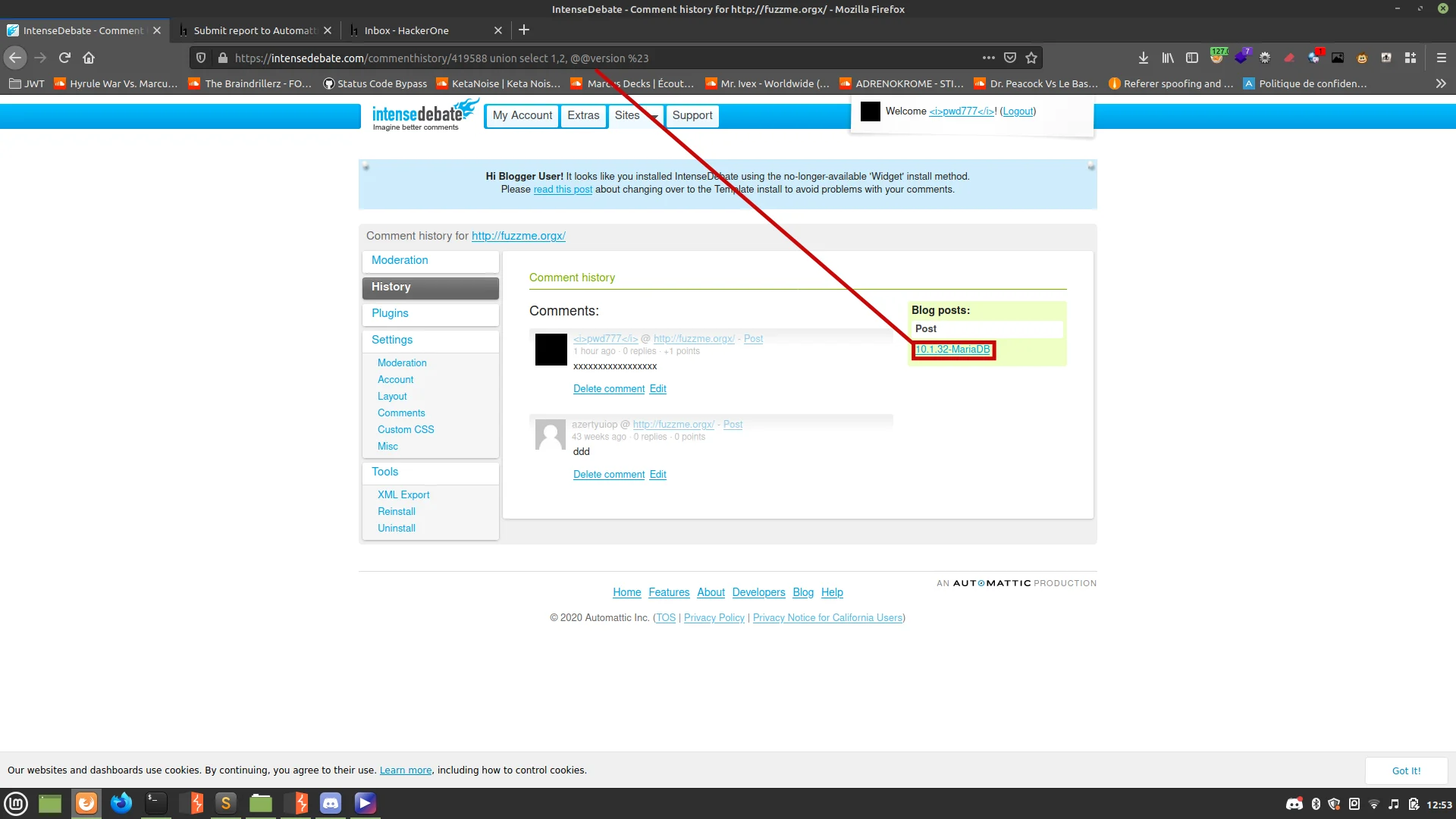
https://intensedebate.com/commenthistory/$YourSiteId%20union%20select%201,2,@@VERSION%23(!) You need to do this with your own site id (!) -
Now you can see
10.1.32-MariaDBon the page.
POC
@@VERSION
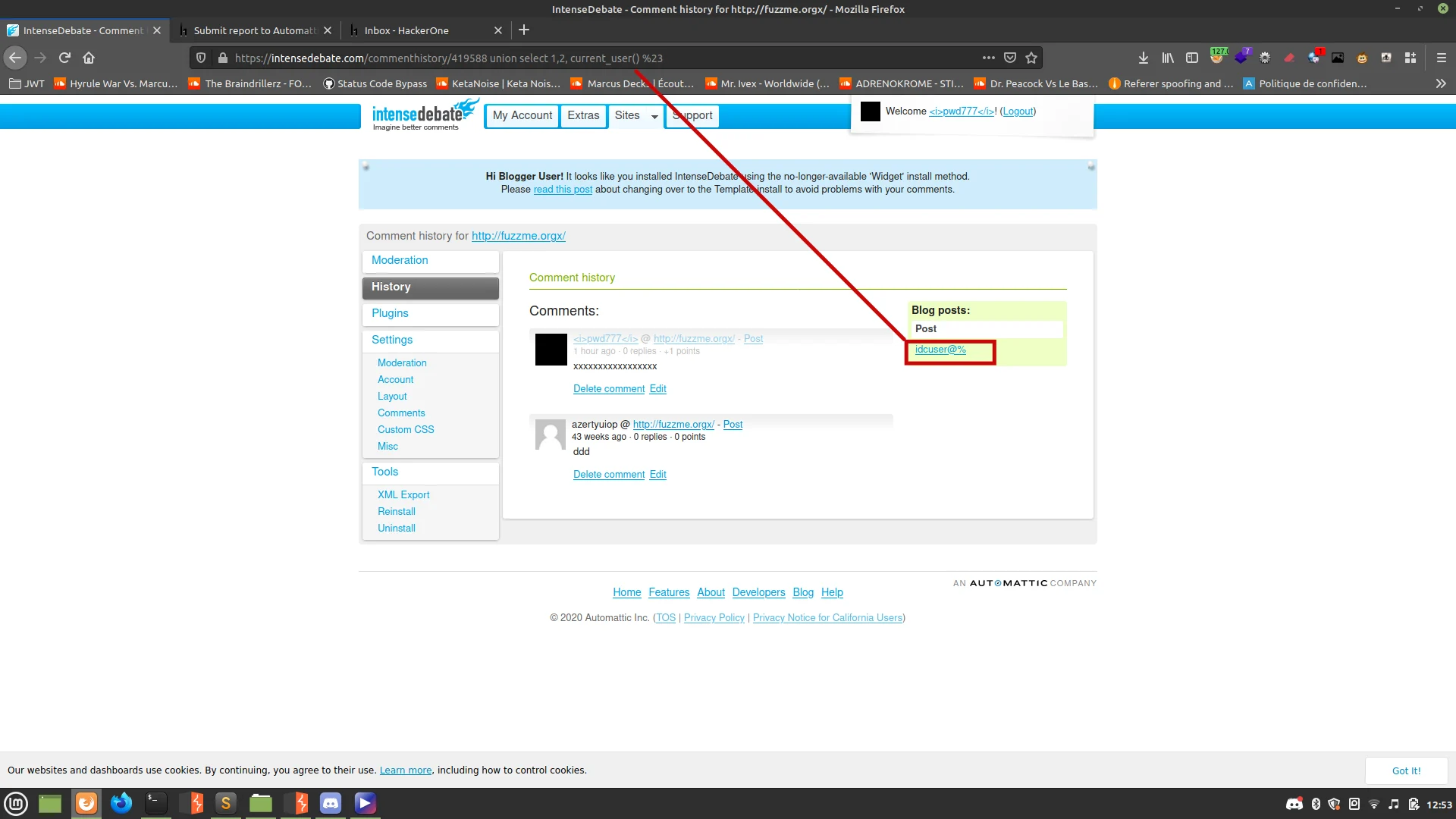
current_user()
Video POC
IMPORTANT
Can you see my comment into #1044698 ?? And I no longer want to put all SQL Injection issues on into my initial report #1042746, because i don't win any reputations
Thank you,
Fuzzme.
Impact
Full database access holding private user information and Reflected Cross-Site-Scripting
Attachments
Not written yet. The AI write-up for this report has not been written yet. The Original tab links to the source.
How it worked
Root cause
Likely the site ID from the URL was concatenated directly into a SQL query without proper sanitisation or parameterisation.
Impact
The report claims full database access with private user information and reflected cross-site scripting.
What the attacker needed
A free account; create a site to get a site ID
How it was found
- Log in to the site.
- Create a site and follow the setup steps.
- Find your site ID from the user dashboard.
- Visit the comment history URL with your site ID.
- Trigger the SQL injection by adding a union select statement to the site ID in the URL.
- Observe the database version displayed on the page.
Explained by bugbounty.wiki with AI from the original and checked against quotes from it; it can still be wrong. Read the original before relying on a detail.
Not written yet. The AI write-up for this report has not been written yet. The Original tab links to the source.
SQL injection is when a website puts user input directly into a database query without checking it. Here, the site ID in the URL was inserted into a database command, so an attacker could add extra database instructions to read information that should be hidden.
What is SQL injection?
Input reaches a database query as code, letting an attacker read or change data the application never meant to expose.





