[website] Script injection in newsletter signup https://brave.com/brave_youth_program_signup.html
A newsletter signup form on a website did not sanitise user input, allowing an attacker to inject HTML into the confirmation email sent to the user. An attacker could send phishing emails containing malicious links to users who sign up.

- Triaged in 4 hours
- Fixed in 20 days
- Paid in 20 days
- Disclosed after 22 days
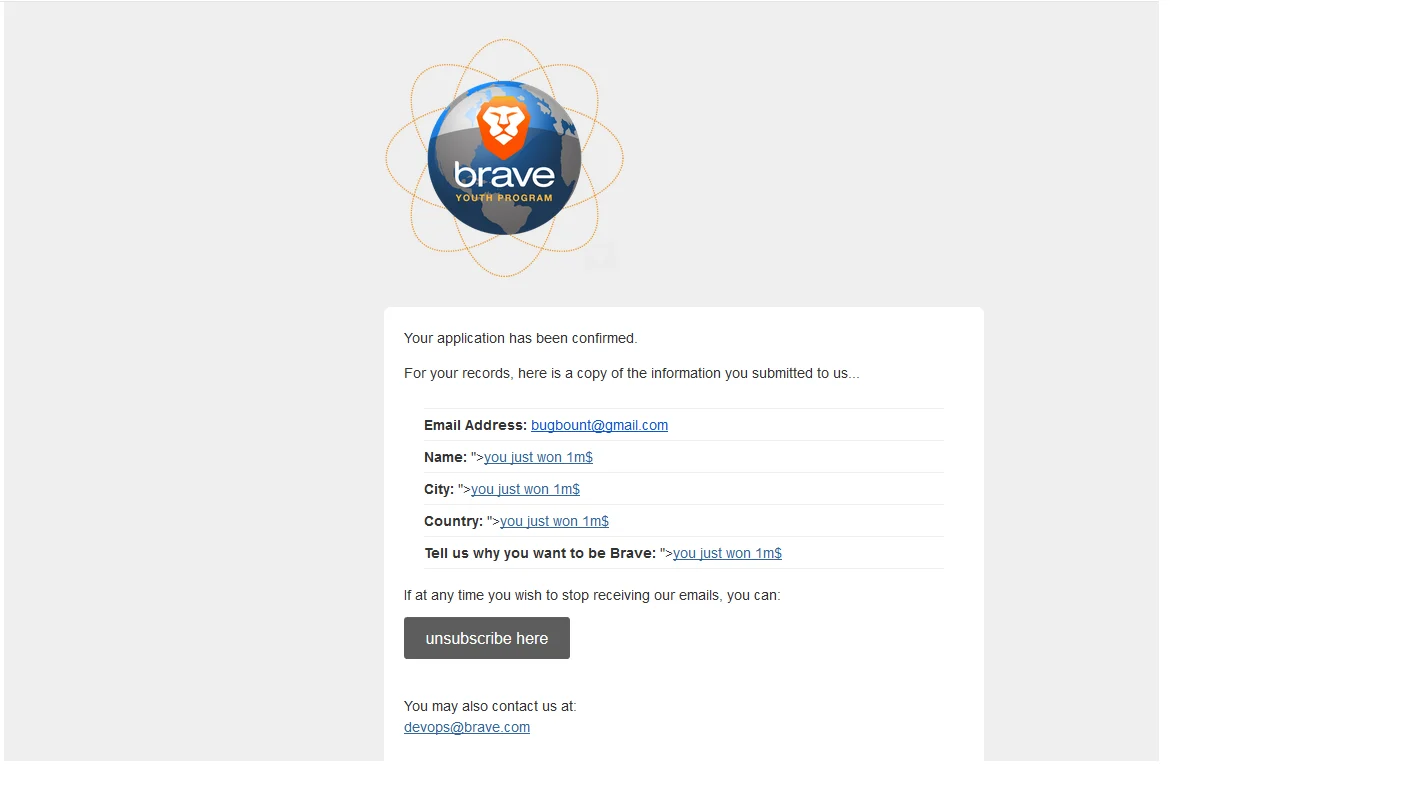
go to https://brave.com/brave_youth_program_signup.html click become an ambasador insert malicious payloads in the fields <a href='evil,com'>YOU JUST WON 1m$ </a> you will receive a mail like in the image attached.
You can send phising emails and do other bad stuff.
If you need more details i'm here.
Attachments
Not written yet. The AI write-up for this report has not been written yet. The Original tab links to the source.
How it worked
Root cause
Likely the application failed to sanitise or encode user-supplied input before including it in the email body.
Impact
An attacker could send phishing emails containing malicious links to users who sign up, potentially tricking them into visiting harmful sites.
What the attacker needed
Access to the signup form
How it was found
- Go to the signup page.
- Click 'become an ambassador'.
- Enter a malicious HTML link in the form fields.
- Submit the form and receive a confirmation email containing the injected link.
Explained by bugbounty.wiki with AI from the original and checked against quotes from it; it can still be wrong. Read the original before relying on a detail.
Not written yet. The AI write-up for this report has not been written yet. The Original tab links to the source.
When you type something into a form, the website should treat it as plain text, not as code. Here, the form put the text directly into an email without cleaning it, so an attacker could add a clickable link that looks like a prize but leads to a bad site. This is called HTML injection, a type of script injection.
What is XSS?
Script an attacker supplies runs in another user's browser, on the target's origin, with that user's session.




