Login form on non-HTTPS page on http://stream.highwebmedia.com/auth/login/
The login page was served over plain HTTP, so an attacker on the same network could intercept the username and password in clear text. The reporter notes that the actual login request appeared to use HTTPS, but the initial page load was insecure.
 Originally disclosed on HackerOne
- Triaged in 29 hours
- Fixed in 30 hours
- Paid in 29 hours
- Disclosed after 56 days
Dear Team,
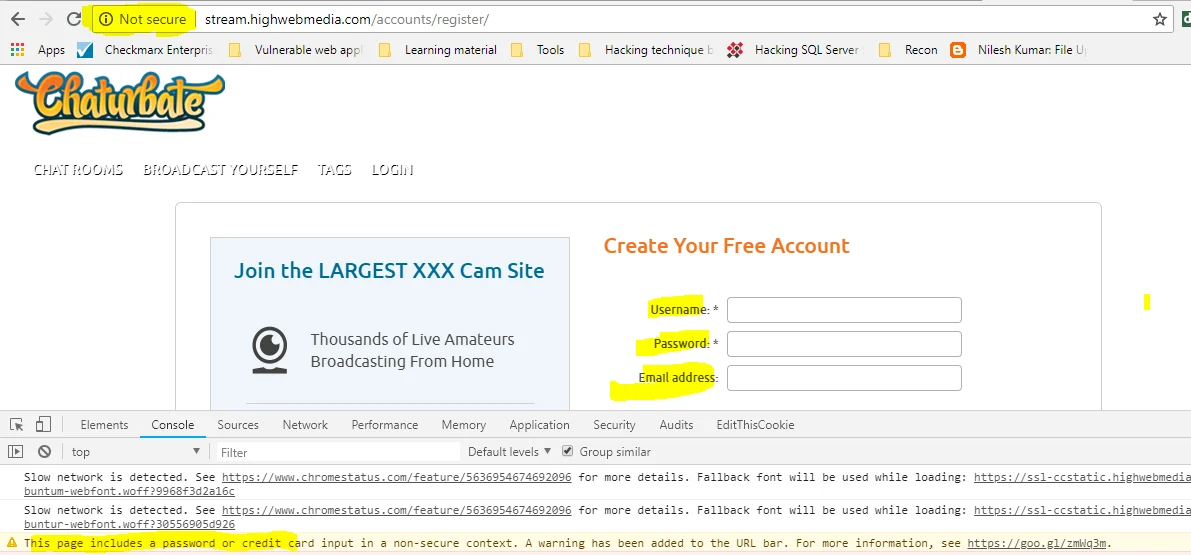
##Summary## A page on a http://stream.highwebmedia.com/auth/login/ is not fully protected by an SSL certificate. This could allow an attacker in a Man-in-the-Middle position to obtain usernames and passwords of users visiting the site.
Note the warning in screenshot 1, firefox has identified that this page is not protected with an SSL certificate, therefore the username and password will be sent over a plaintext connection. In itself, this may be enough to put some users off using your page. Once submit is pressed on the login, it appears as though the request is sent over a HTTPS connection (when seen through Burp Suite or Wireshark), which suggests that the page does protect the username and password with SSL/TLS,
Steps To Reproduce:
- go to http://stream.highwebmedia.com/auth/login and setup wireshark
- you can get username , password is in clear text
##Mitigation If any part of a site is required to be protected by SSL, the entire site should be protected by SSL. Ts this would stop the attack outlined above from working, as a certificate error would be displayed to the user. HTTP Strict Transport security could be used to mitigate this attack, which would tell all browsers not to allow a HTTP connection to this website.
Supporting Material/References:
Please find attachement
Impact
If a user were to visit this page from a public or shared network (eg, starbucks, airport, library, etc) and submit a comment, a malicious user on the same network would be able to obtain that users username and password by conducting a Man-in-the-Middle attack using sslstrip and wireshark.
This would allow the malicious user complete access to the user's account.
Attachments
Not written yet. The AI write-up for this report has not been written yet. The Original tab links to the source.
How it worked
Root cause
Likely the login page was served over HTTP instead of HTTPS, allowing credentials to be transmitted in clear text.
Impact
An attacker on the same network could obtain a user's username and password via a man-in-the-middle attack, gaining full account access.
What the attacker needed
Victim uses public/shared network; attacker on same network
The fix
The entire site should be protected by SSL, and HTTP Strict Transport Security could be used to prevent HTTP connections.
How it was found
- Go to the HTTP login page and set up Wireshark.
- Capture network traffic to see the username and password in clear text.
Explained by bugbounty.wiki with AI from the original and checked against quotes from it; it can still be wrong. Read the original before relying on a detail.
Not written yet. The AI write-up for this report has not been written yet. The Original tab links to the source.
When a website uses HTTP instead of HTTPS, information sent between your browser and the site is not encrypted. Anyone on the same network, like a public Wi-Fi, can read that information. Here, the login page was loaded over HTTP, so someone could steal your username and password.
What is Info disclosure?
Data the application should keep private (personal data, internal details, other users' records) reaches someone it should not.