Able to blocking users with 2fa from login into their accounts by just knowing the SteamID
The login confirmation endpoint for two-factor authentication used a client-controlled cookie to identify the account, so an attacker could target any user by changing the SteamID cookie. By sending repeated requests with wrong codes, the attacker could lock the victim out of login for five minutes.
 Originally disclosed on HackerOne
- Triaged in 20 days
- Fixed in 2.6 years
- Paid in 7 months
- Disclosed after 2.6 years
Hi, team!
Summary:
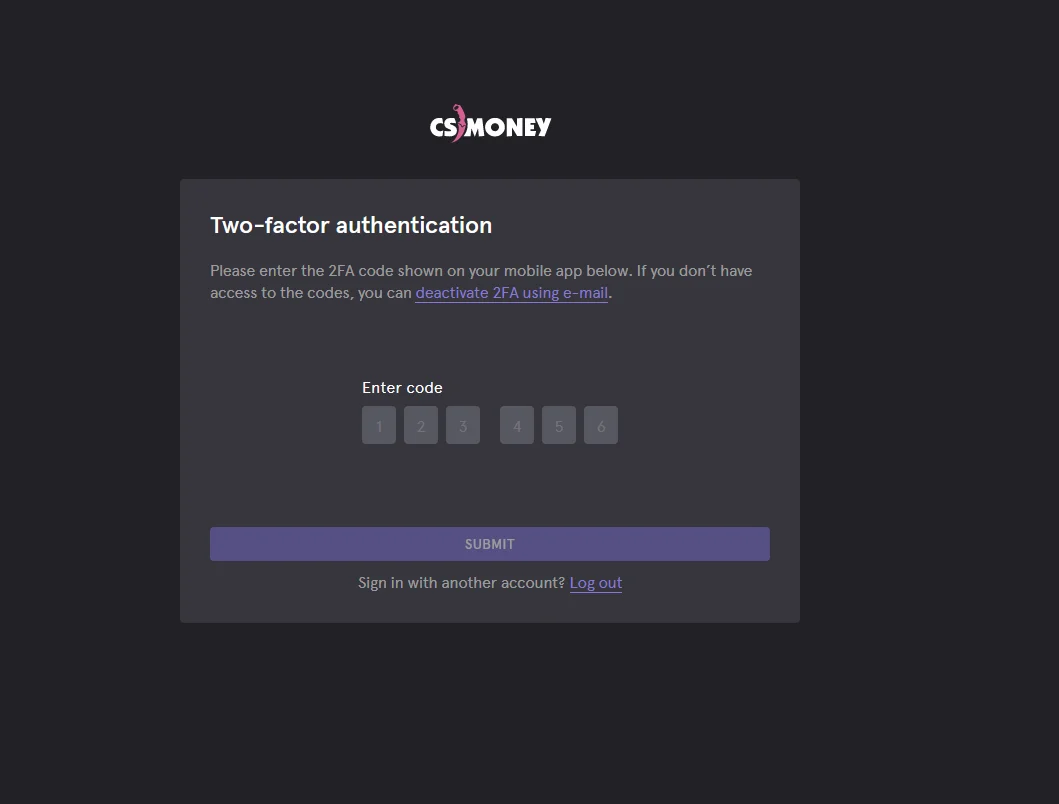
By changing the steamID cookie on confirm 2fa code request, I am able to block the login of an account with 2fa for 5 minutes (300 seconds). So I am able to block users with 2fa from login into their accounts by just knowing the SteamID.
Steps To Reproduce:
- Login into your account with 2fa.
- Get the request to confirm the 2fa code.
POST /login/confirm HTTP/1.1
Host: cs.money
Content-Length: 28
Connection: close
Cookie: steamid=<victim_steam_id>;

{"token":"foo","code":"foo"}
- Change the cookie steamid to the victim one.
- Repeat the request 4 times (4 wrong codes).
█████
Impact
I hacker could block everyone with 2fa from login into cs.money.
What the report shows
The target is the login flow of cs.money, specifically the endpoint that confirms a two-factor authentication code. The researcher, benjamin-mauss, found that the steamid cookie used in that request is trusted by the server when deciding which account the submitted code belongs to, and that this cookie can be changed freely by the client.
The reproduction starts from a normal login into an account protected by 2FA. The researcher captures the request that confirms the 2FA code:
POST /login/confirm HTTP/1.1
Host: cs.money
Content-Length: 28
Connection: close
Cookie: steamid=<victim_steam_id>;

{"token":"foo","code":"foo"}
The steps, as given in the report:
- Log in to your own account with 2FA enabled.
- Capture the request that confirms the 2FA code.
- Change the
steamidcookie to the victim's SteamID. - Repeat the request four times with wrong codes.
The outcome is that the victim's account is blocked from logging in for 5 minutes (300 seconds). Because the only value needed to target someone is their SteamID, the researcher states that an attacker could block everyone with 2FA from logging into cs.money. The report was rated medium severity, paid a 300 USD bounty and disclosed on 14 December 2023. The weakness is classified as reliance on cookies without validation and integrity checking in a security decision.
Root cause
The behaviour suggests the server derives the account being authenticated from the client-controlled steamid cookie. The server accepts the steamid cookie value as supplied by the client. As a result, four wrong codes sent with a victim's SteamID block that account from logging in.
Impact
An attacker who knows a victim's SteamID can lock that victim out of the site for the duration of the lockout window by submitting four wrong codes against the victim's identifier. The report frames this as a denial of service against any 2FA-protected account, since only the SteamID is needed to target someone. The lockout is temporary: 5 minutes (300 seconds) per the report.
How this kind of bug works
Many login flows keep a short-lived state between the password step and the second factor: a pending-authentication token, a user identifier, or a counter of failed attempts. If any part of that state is stored in a cookie or another client-side value and the server trusts it without verification, the client can rewrite it. When the same value also keys a security decision such as "which account is this code for" or "how many failures has this account had", the attacker can redirect the decision to another account.
The bug class is a failure of integrity checking on a security-relevant input. Cookies are controlled by the client; the browser sends whatever value is stored there. Defences are signing or encrypting the cookie so tampering is detectable, or better, keeping the state server-side and referencing it with an opaque, unguessable session identifier. Rate limiting and lockout counters should be keyed on server-side identity, not on a value the client supplies.
How to test for it
- Map the authentication flow: password submission, any intermediate token, the 2FA confirmation request, and any recovery or resend endpoints.
- Identify every cookie, header and body field that appears to identify the account or the pending login. Note which ones look like identifiers (numeric IDs, usernames, opaque tokens).
- Create two accounts you control, both with 2FA enabled. Capture a confirmation request from account A.
- Swap the identifier values one at a time for account B's values and observe the response. A positive result is any behaviour that changes for account B, such as a lockout.
- Test the lockout path specifically: send several wrong codes while pointing the identifier at account B, then try to log in as B. If B is now blocked, the counter is keyed on the client-supplied value.
- Check whether the cookie is signed: modify it slightly and see whether the server rejects it outright or processes it.
Confirm by testing the victim account's actual login state afterwards, not just the response body.
How it is fixed
- Derive the account being authenticated from server-side session state, not from a client-supplied cookie.
- If a cookie must carry state, sign it (HMAC) or encrypt it, and reject values that fail verification.
- Key lockout and rate-limit counters on the server-side identity, and consider combining account and IP signals.
- Use short, single-use pending-authentication tokens that are bound to the session.
- Return uniform responses so that probing does not reveal whether a given identifier exists or is locked.
Hunting notes
This bug class tends to hide in multi-step authentication flows: password then 2FA, email verification links, password reset, OAuth callbacks, and any place where a "pending user" is carried between requests. Look for cookies with names like userid, uid, account, steamid, pending, or opaque tokens that decode to an identifier. Recon signals include cookies that change meaning when edited, endpoints that accept an identifier in both cookie and body, and error messages that differ between accounts.
What happened, in plain words
cs.money is a website that offers two-factor authentication for its accounts. To keep accounts safe, it offers two-factor authentication, usually shortened to 2FA. That means that after you type your password, the site asks for a second proof that it is really you, such as a short code from an app on your phone. Only when both the password and the code are correct does the site let you in.
A request is the message your browser sends to a website when you click something or submit a form. It contains a method (here POST, meaning "I am sending data"), a path (here /login/confirm, the part of the site that checks the 2FA code), some headers (extra information such as the site name), and a body (the data itself). A cookie is a small piece of text that a website stores in your browser and that your browser sends back with every request to that site. Cookies are how a site remembers who you are between page loads.
The researcher, benjamin-mauss, found that the request which confirms a 2FA code carries a cookie called steamid, and that the server uses this cookie to decide which account the submitted code belongs to. The problem is that a cookie lives in the browser, so the person using the browser can change it to any value they like. The server trusts it without checking that it was the site itself that set it.
SteamID is the identifier of a Steam account. So if the server believes whatever steamid cookie it receives, anyone who knows a victim's SteamID can pretend, for the purpose of this one request, to be that victim.
What the report shows
The researcher started from a normal login into an account with 2FA enabled and captured the request that confirms the 2FA code:
POST /login/confirm HTTP/1.1
Host: cs.money
Content-Length: 28
Connection: close
Cookie: steamid=<victim_steam_id>;

{"token":"foo","code":"foo"}
Line by line:
POST /login/confirm HTTP/1.1is the first line of the request: the method, the path on the site, and the version of the HTTP protocol.Host: cs.moneytells the server which website the request is for.Content-Length: 28says how many bytes of data follow in the body.Connection: closeasks the server to close the network connection after answering.Cookie: steamid=<victim_steam_id>;is the cookie header. In the request shown, the value is the victim's SteamID.- The empty line separates the headers from the body.
{"token":"foo","code":"foo"}is the body, written in JSON (a common text format for data).codeis the 2FA code being submitted.foois just a placeholder.
The steps, as given in the report:
- Log in to your own account with 2FA enabled. This gets you to the point where the site is waiting for a code, and gives you a real request to work from.
- Capture the request that confirms the 2FA code. Capturing means recording the request so you can look at it and resend it, for example with your browser's developer tools or a proxy tool.
- Change the
steamidcookie to the victim's SteamID. This is the core of the attack: the request now names the victim's account instead of your own. - Repeat the request four times with wrong codes. Each wrong code counts as a failed attempt against the account named in the cookie.
The result is that the victim's account is blocked from logging in for 5 minutes (300 seconds). In other words, the site has a safety rule: after several wrong 2FA codes, stop accepting attempts for a while, to slow down anyone guessing codes. Because the account being counted is taken from a cookie the attacker controls, the attacker can make those failures land on someone else's account. Four wrong codes are enough to trigger the lockout.
The only thing an attacker needs to target someone is that person's SteamID. The researcher therefore states that an attacker could block everyone with 2FA from logging into cs.money. The report was rated medium severity, paid a 300 USD bounty and was disclosed on 14 December 2023. The weakness is classified as reliance on cookies without validation and integrity checking in a security decision.
In general, how this kind of bug works
Many login flows keep some short-lived state between the password step and the second factor: a note of which account is halfway through logging in, a pending-login token, or a count of failed attempts. If any part of that state is stored in a cookie and the server trusts it without verification, the client can rewrite it. When the same value also decides something security-relevant, such as which account a code belongs to or how many failures that account has had, the attacker can redirect the decision to another account.
This is a failure of integrity checking on a security-relevant input. Integrity means the data has not been altered. Cookies are controlled by the client: the browser sends whatever value is stored there. The usual defences are to sign or encrypt the cookie so that tampering is detectable, or, better, to keep the state on the server and refer to it with a random, unguessable session identifier. Lockout and rate-limit counters should be keyed on an identity the server knows, not on a value the client supplies.
The fix follows from the cause: derive the account being authenticated from server-side session state, sign or encrypt any cookie that must carry state and reject values that fail verification, key lockout counters on the server-side identity, use short single-use pending-authentication tokens bound to the session, and return uniform responses so probing does not reveal whether an identifier exists or is locked.
Glossary
- 2FA (two-factor authentication): a login step that asks for a second proof of identity, such as a code from an app, in addition to the password.
- Request: the message a browser sends to a website, made of a method, a path, headers and an optional body.
- POST: an HTTP method used to send data to the server, here the 2FA code.
- Endpoint: a specific path on a website that performs an action, such as
/login/confirm. - Header: a line of extra information in a request or response, such as
HostorCookie. - Cookie: a small piece of text stored by a website in the browser and sent back with later requests to that site.
- JSON: a text format for structured data, using curly braces and quoted names.
- Token: a value used to tie a request to a particular state, such as a pending login.
- SteamID: the public identifier of a Steam account.
- Integrity: the property that data has not been altered; integrity checking means verifying that.
- Session: the server-side record of a logged-in or in-progress user, usually referenced by a random identifier.
- Signing (HMAC): attaching a cryptographic check to a value so the server can detect if it was changed.
- Rate limiting / lockout: temporarily refusing attempts after too many failures, to slow down guessing.
- Denial of service: making a service unusable for someone, here by locking them out of their account.
- Severity: the rating of how serious a bug is, here medium.
- Bounty: a payment made to a researcher for a valid report, here 300 USD.





