Incorrect Type Conversion in interpreting IPv4-mapped IPv6 addresses and below `curl` results in indeterminate SSRF vulnerabilities.
curl incorrectly interprets IPv4-mapped IPv6 addresses with octal-formatted IPv4 parts, such as ::ffff:0127.0.0.1, by stripping leading zeros and connecting to 127.0.0.1. An attacker could bypass blocklists that restrict access to localhost, leading to SSRF and potentially RCE.

- Disclosed after 16 hours
Summary:
Octal Type Handling of Errors in IPv4 Mapped IPv6 Addresses in curl allows unauthenticated remote attackers to perform indeterminate SSRF, RFI, and LFI attacks on many programs that rely on curl.
RFC 4291 defines ways to embed an IPv4 address into IPv6 addresses. One of the methods defined in the RFC is to use IPv4-mapped IPv6 addresses, that have the following format:
   |                80 bits               | 16 |      32 bits        |
   +--------------------------------------+--------------------------+
   |0000..............................0000|FFFF|    IPv4 address     |
   +--------------------------------------+----+---------------------+
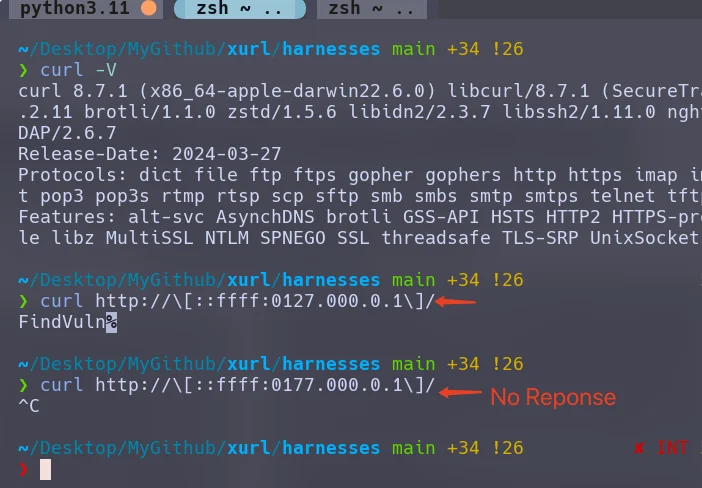
In IPv6 notation, the corresponding mapping for 127.0.0.1 is ::ffff:127.0.0.1 (RFC 4038). Although curl correctly converts octal numbers starting with 0 in IPv4 format, such as recognizing 0177.0.0.1 as 127.0.0.1, it fails to properly identify the data format of 0127.0.0.1 in IPv4-mapped IPv6 addresses. The curl command automatically removes the leading zeros from IP addresses in the format ::ffff:0127.0.0.1, and sends requests to 127.0.0.1 instead. This behavior can undermine defensive strategies that restrict access to 127.0.0.1, potentially leading to security threats such as Server-Side Request Forgery (SSRF) and Remote Code Execution (RCE) on the server.
Steps To Reproduce:
2.1 Affected components
The vulnerable component is:
- curl: https://github.com/curl/curl
- 8.7.1 and below
2.2 Attack scenario
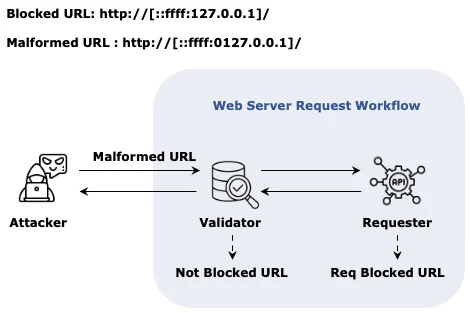
A typical attack scenario is illustrated in the diagram below. The Validator checks whether the attacker-supplied URL is on the blocklist. If not, the URL is passed to the Requester for processing. The Requester is responsible for sending requests to the hostname specified by the URL.
2.3 PoC
payloads:
http://[::ffff:0127.000.0.1]/
You can verify this issue using the sample program below. Simply replace the payload variable in the verify function with the above payload to conduct the test.
curl http://[::ffff:0127.000.0.1]/
I set up an HTTP server on my local machine using port 80 with the following Python code. Upon a successful request, the server will return the string "FindVuln".
from flask import Flask

app = Flask(__name__)
@app.route("/")
def index():
    return "FindVuln"

if __name__ == "__main__":
    app.run(host='0.0.0.0', port=80, threaded=True)
Figure 1 illustrates how curl handles IPv4 addresses, while Figure 2 demonstrates curl's processing of IPv4-mapped IPv6 representations.
Figure 1:
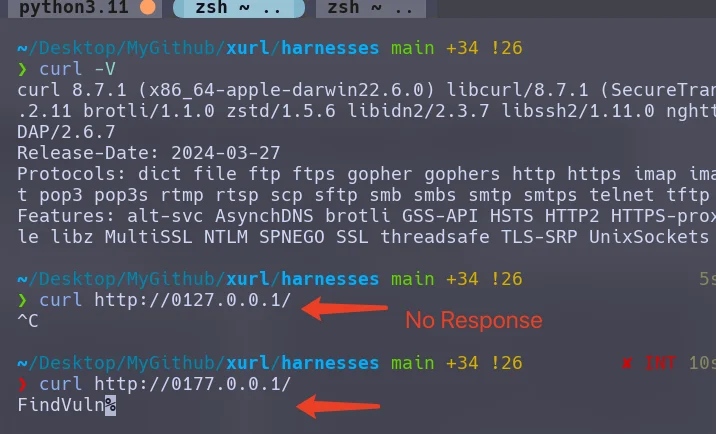
Figure 2:
Mitigation
Please refer to RFC 4291 and RFC 4038 to fix this function.
Supporting Material/References:
This security issue has also been identified in other libraries, and CVE IDs have been assigned. For more information, refer to [1], [2], [3] and [4].
[1] https://cve.mitre.org/cgi-bin/cvename.cgi?name=CVE-2023-24329
[2] https://cve.mitre.org/cgi-bin/cvename.cgi?name=CVE-2024-22243
[3] https://sick.codes/sick-2021-015/
[4] https://sick.codes/sick-2021-016/
Impact
The impact of this vulnerability is huge because the curl is widely used. In many cases, developers need a blocklist to block on some IPs. However, the vulnerability will help attackers bypass the protection developers have set up for schemes and hosts. The vulnerability will lead to SSRF[1] and RCE[2] vulnerabilities in several cases.
[1] https://cwe.mitre.org/data/definitions/918.html [2] https://cwe.mitre.org/data/definitions/94.html
Not written yet. The AI write-up for this report has not been written yet. The Original tab links to the source.
How it worked
Root cause
Likely, curl fails to properly parse octal numbers in the IPv4 part of IPv4-mapped IPv6 addresses, incorrectly normalising them to decimal and thus bypassing blocklist checks.
Impact
The vulnerability could allow attackers to bypass blocklists and perform SSRF, potentially leading to RCE in some cases.
What the attacker needed
Application uses curl to fetch user-supplied URLs; application relies on a blocklist to restrict access
How it was found
- Set up a local HTTP server on port 80 that returns a known string.
- Run curl with the crafted IPv4-mapped IPv6 URL containing octal-formatted IPv4 parts.
- Observe that curl connects to [redacted] and receives the response, bypassing any blocklist.
Explained by bugbounty.wiki with AI from the original and checked against quotes from it; it can still be wrong. Read the original before relying on a detail.
Not written yet. The AI write-up for this report has not been written yet. The Original tab links to the source.
When a program checks a web address against a blocklist, it might miss a disguised form of localhost. curl treats an address like ::ffff:0127.0.0.1 as [redacted], so a blocklist that only blocks [redacted] can be bypassed. This lets an attacker make the server connect to itself, which can be dangerous.
What is SSRF?
The server can be made to fetch an address the attacker chooses, reaching internal services, cloud metadata or other customers' data.




