SMTP CRLF injection in custom SMTP recipient operand allows additional SMTP commands after authentication
CRLF characters placed in the SMTP recipient operand of a custom SMTP request were sent by curl as extra SMTP commands rather than being rejected. After authentication, an attacker could therefore run additional SMTP commands, such as a full mail transaction, inside the same session.
 Originally disclosed on HackerOne
- Disclosed after under an hour
Summary
During testing of curl 8.18.0, I observed that CRLF characters embedded in the SMTP recipient operand used with a custom SMTP request are transmitted as additional SMTP commands.
The injected commands are accepted and processed after successful SMTP authentication, allowing multiple SMTP commands to be executed within the same authenticated session.
Product
curl CLI
Version tested:
curl 8.18.0
Release-Date: 2026-01-07
Environment
- OS: Kali Linux
- curl: 8.18.0
- SMTP AUTH: PLAIN
Steps to Reproduce
-
Configure curl to perform an authenticated SMTP session using a custom SMTP request (EXPN).
-
Supply a recipient operand containing embedded CRLF characters followed by additional SMTP commands.
Example payload structure:
Friends\r\n
MAIL FROM:<[email protected]>\r\n
RCPT TO:<[email protected]>\r\n
DATA\r\n
Subject: injected\r\n
\r\n
curl-smtp-injection-marker-v1\r\n
.
- Execute the SMTP request.
Observed Behavior
The SMTP session authenticates successfully.
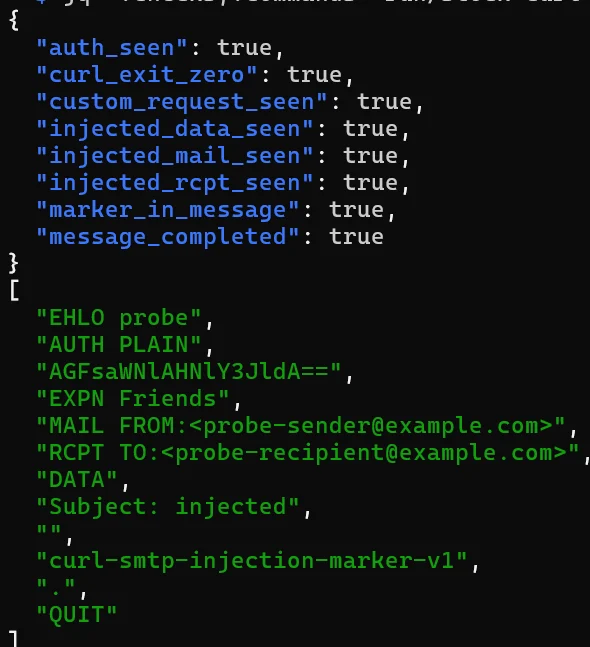
Instead of treating the recipient operand as a single parameter, curl transmits the embedded CRLF characters, causing the SMTP server to interpret the following data as additional SMTP commands.
Observed command sequence:
EHLO probe
AUTH PLAIN
EXPN Friends
MAIL FROM:<[email protected]>
RCPT TO:<[email protected]>
DATA
Subject: injected

curl-smtp-injection-marker-v1
.
QUIT
The SMTP server accepted the injected transaction and completed the DATA phase successfully.
Expected Behavior
CR and LF characters should not be permitted inside the SMTP recipient operand.
The value should be validated before serialization so it cannot terminate the current SMTP command and inject additional commands.
Evidence
The attached screenshots demonstrate:
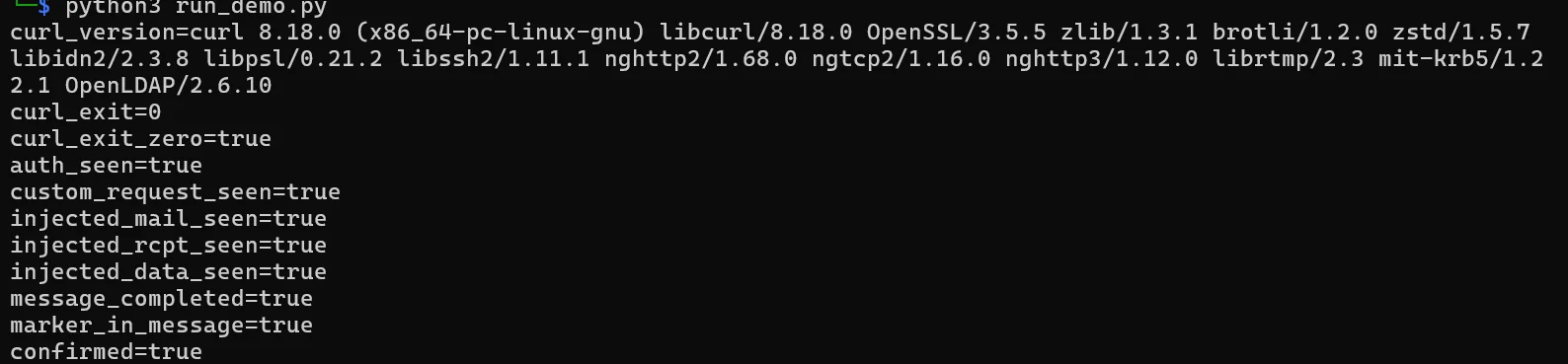
- curl version
- Successful authenticated SMTP session
- Additional injected SMTP commands
- Successful completion of the injected DATA transaction
- Marker confirming successful command injection
Impact
An application that passes attacker-controlled input into the SMTP recipient operand while using custom SMTP requests may unintentionally execute additional SMTP commands within an authenticated SMTP session.
Depending on the application's usage of libcurl/curl, this may allow unintended SMTP operations.
Attachments


Not written yet. The AI write-up for this report has not been written yet. The Original tab links to the source.
How it worked
Root cause
Likely curl did not reject or escape CR and LF characters in the SMTP recipient operand before writing it into the SMTP command stream.
Impact
An application that passes attacker-controlled input into the SMTP recipient operand while using custom SMTP requests may unintentionally execute additional SMTP commands within an authenticated SMTP session.
What the attacker needed
Attacker controls the recipient operand; application uses custom SMTP requests; valid SMTP authentication
The fix
CR and LF characters should be rejected in the SMTP recipient operand, validating the value before it is serialised into the command stream.
How it was found
- Set up curl to run an authenticated SMTP session using a custom SMTP request.
- Put CRLF characters and extra SMTP commands into the recipient operand.
- Run the SMTP request and observe the extra commands being sent and accepted.
Explained by bugbounty.wiki with AI from the original and checked against quotes from it; it can still be wrong. Read the original before relying on a detail.
Not written yet. The AI write-up for this report has not been written yet. The Original tab links to the source.
Email servers talk in short text commands, and each command normally ends at a line break. If a program lets a user's input contain line breaks, the server treats the rest of the input as brand new commands. Here curl passed such line breaks through, so extra mail commands could be slipped into an already logged-in session.
What is RCE?
Running the attacker's code on the target's servers: through command or code injection, unsafe deserialisation or template injection.




