`Curl_socketpair()` fallback vulnerable to man-in-the-middle attack
The fallback socketpair implementation in libcurl creates a listening socket on localhost and uses a 9-byte secret to verify the connection, but a local attacker can connect first and guess the secret, especially if the random number generator is weak. This could allow a man-in-the-middle attack on the socket pair.
 Originally disclosed on HackerOne
- Disclosed after 5 days
In Curl_socketpair() in curl/lib/socketpair.c if the operating system lacks a native socketpair() function, libcurl will create its own pair of sockets. To do this, libcurl first creates a listening socket, then it creates a client socket, which it then connects to the listening socket. During the time between when the listening socket is bound and set to listen, and when the client socket tries to connect, there is a gap where any process could connect to the listening socket first. As this is an obvious invitation to a man-in-the-middle attack, libcurl generates a 9 byte secret which it writes out of the listening socket, and then subsequently reads the secret back from the client socket for verification.
  listener = socket(AF_INET, SOCK_STREAM, IPPROTO_TCP);
  if(listener == CURL_SOCKET_BAD)
    return -1;

  memset(&a, 0, sizeof(a));
  a.inaddr.sin_family = AF_INET;
  a.inaddr.sin_addr.s_addr = htonl(INADDR_LOOPBACK);
  a.inaddr.sin_port = 0;

  socks[0] = socks[1] = CURL_SOCKET_BAD;

#if defined(_WIN32) || defined(__CYGWIN__)
  /* do not set SO_REUSEADDR on Windows */
  (void)reuse;
#ifdef SO_EXCLUSIVEADDRUSE
  {
    int exclusive = 1;
    if(setsockopt(listener, SOL_SOCKET, SO_EXCLUSIVEADDRUSE,
                  (char *)&exclusive, (curl_socklen_t)sizeof(exclusive)) == -1)
      goto error;
  }
#endif
#else
  if(setsockopt(listener, SOL_SOCKET, SO_REUSEADDR,
                (char *)&reuse, (curl_socklen_t)sizeof(reuse)) == -1)
    goto error;
#endif
  if(bind(listener, &a.addr, sizeof(a.inaddr)) == -1)
    goto error;
  if(getsockname(listener, &a.addr, &addrlen) == -1 ||
     addrlen < (int)sizeof(a.inaddr))
    goto error;
  if(listen(listener, 1) == -1)
    goto error;
  socks[0] = socket(AF_INET, SOCK_STREAM, 0);
  if(socks[0] == CURL_SOCKET_BAD)
    goto error;
  if(connect(socks[0], &a.addr, sizeof(a.inaddr)) == -1)
    goto error;

  /* use non-blocking accept to make sure we do not block forever */
  if(curlx_nonblock(listener, TRUE) < 0)
    goto error;
  pfd[0].fd = listener;
  pfd[0].events = POLLIN;
  pfd[0].revents = 0;
  (void)Curl_poll(pfd, 1, 1000); /* one second */
  socks[1] = accept(listener, NULL, NULL);
  if(socks[1] == CURL_SOCKET_BAD)
    goto error;
  else {
    struct curltime start = curlx_now();
    char rnd[9];
    char check[sizeof(rnd)];
    char *p = &check[0];
    size_t s = sizeof(check);

    if(Curl_rand(NULL, (unsigned char *)rnd, sizeof(rnd)))
      goto error;

    /* write data to the socket */
    swrite(socks[0], rnd, sizeof(rnd));
    /* verify that we read the correct data */
    do {
      ssize_t nread;

      pfd[0].fd = socks[1];
      pfd[0].events = POLLIN;
      pfd[0].revents = 0;
      (void)Curl_poll(pfd, 1, 1000); /* one second */

      nread = sread(socks[1], p, s);
      if(nread == -1) {
        int sockerr = SOCKERRNO;
        /* Do not block forever */
        if(curlx_timediff(curlx_now(), start) > (60 * 1000))
          goto error;
        if(
#ifdef USE_WINSOCK
          /* This is how Windows does it */
          (SOCKEWOULDBLOCK == sockerr)
#else
          /* errno may be EWOULDBLOCK or on some systems EAGAIN when it
             returned due to its inability to send off data without
             blocking. We therefore treat both error codes the same here */
          (SOCKEWOULDBLOCK == sockerr) || (EAGAIN == sockerr) ||
          (SOCKEINTR == sockerr) || (SOCKEINPROGRESS == sockerr)
#endif
          ) {
          continue;
        }
        goto error;
      }
      s -= nread;
      if(s) {
        p += nread;
        continue;
      }
      if(memcmp(rnd, check, sizeof(check)))
        goto error;
      break;
    } while(1);
  }
This approach is still vulnerable to both a man-in-the-middle attack. It is easy for a user to monitor for new TCP listening sockets on the localhost interface, and it is possible for another user to connect first to the listening socket. Once connected, the attacker could simply send 9 random bytes. While the probability of successfully guessing the generated secret is low, it is not zero. Furthermore, if curl is compiled without SSL, the curl random number generator will fall back to a low entropy mode based on the system clock, and secrets generated while in this mode would be much easier to guess. In curl/lib/rand.c
  infof(data, "WARNING: using weak random seed");
  {
    static unsigned int randseed;
    static bool seeded = FALSE;
    unsigned int rnd;
    if(!seeded) {
      struct curltime now = curlx_now();
      randseed += (unsigned int)now.tv_usec + (unsigned int)now.tv_sec;
      randseed = randseed * 1103515245 + 12345;
      randseed = randseed * 1103515245 + 12345;
      randseed = randseed * 1103515245 + 12345;
      seeded = TRUE;
    }

    /* Return an unsigned 32-bit pseudo-random number. */
    r = randseed = randseed * 1103515245 + 12345;
    rnd = (r << 16) | ((r >> 16) & 0xFFFF);
    memcpy(entropy, &rnd, length);
  }
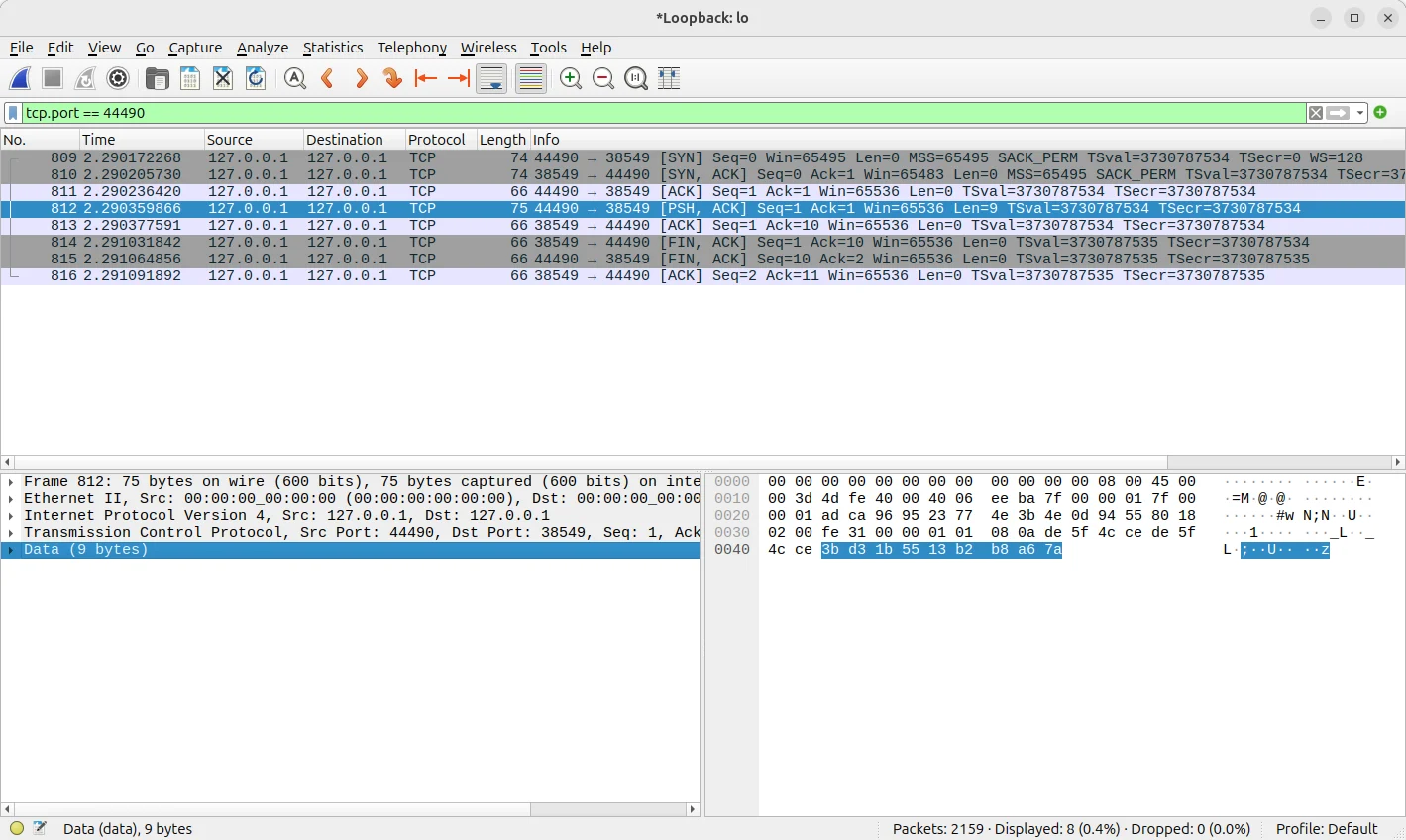
Also, any user on a system with the capability to capture network traffic on the localhost interface can read the generated 9 byte secret, and then inject the secret into their own connection to the server socket. While non-privileged users do not always have capture permissions, it is not unheard of, particularly in shared computer environments. Yes, this would imply that the attacker would have access to all data sent over the socket pair anyway, but that data could be encrypted at a higher level, whereas the 9 byte secret is essentially sent as plaintext. Here is a screenshot of an interception, with the 9 byte secret highlighted.
Similar Issue
CVE-2024-3219 https://nvd.nist.gov/vuln/detail/CVE-2024-3219 https://github.com/python/cpython/issues/122133
Suggested fix
Instead of generating, sending, and receiving a sequence of random bytes, I recommend following the example of Python by comparing the TCP ports of both sockets. As the sockets are both on the same localhost interface, matching the TCP ports will guarantee the socket equivalence. This also obviates any concern about the random number generator. In the code below, the port numbers are in network-byte order, but for the purposes of comparison that is irrelevant.
struct sockaddr_in addr;
socklen_t len;
in_port_t ports[4];
len = sizeof(struct sockaddr_in);
memset(&addr, 0, sizeof(struct sockaddr_in));
if(getsockname(socks[0], (struct sockaddr*)&addr, &len))
  goto error;
ports[0] = addr.sin_port;
memset(&addr, 0, sizeof(struct sockaddr_in));
if(getpeername(socks[0], (struct sockaddr*)&addr, &len))
  goto error;
ports[1] = addr.sin_port;
memset(&addr, 0, sizeof(struct sockaddr_in));
if(getsockname(socks[1], (struct sockaddr*)&addr, &len))
  goto error;
ports[2] = addr.sin_port;
memset(&addr, 0, sizeof(struct sockaddr_in));
if(getpeername(socks[1], (struct sockaddr*)&addr, &len))
  goto error;
ports[3] = addr.sin_port;
if(ports[0] != ports[3] || ports[1] != ports[2])
  goto error;
Impact
Any user on a system using a version of libcurl built without native socketpair() support can attempt to impersonate libcurl by hijacking the socket pair creation.
Not written yet. The AI write-up for this report has not been written yet. The Original tab links to the source.
How it worked
Root cause
Likely the fallback socketpair implementation relies on a short shared secret sent over a listening socket that is briefly open to any local user, and the secret can be guessed or read from the network.
Impact
A local attacker could impersonate libcurl and intercept or modify data on the socket pair, especially if the random number generator is weak or if they can capture localhost traffic.
What the attacker needed
Libcurl built without native socketpair(); attacker has local access to the same machine; attacker can monitor or connect to localhost sockets
The fix
The report suggests comparing the TCP ports of both sockets instead of using a random secret, as Python does.
Explained by bugbounty.wiki with AI from the original and checked against quotes from it; it can still be wrong. Read the original before relying on a detail.
Not written yet. The AI write-up for this report has not been written yet. The Original tab links to the source.
When a program needs two connected sockets but the operating system lacks a built-in way to create them, libcurl makes its own by setting up a temporary server socket on the local machine. Another user on the same machine could connect to that temporary socket before libcurl does, and if they guess a short secret code, they can pretend to be the other end. This lets them eavesdrop or tamper with the data that libcurl thinks is private.
What is Crypto?
Encryption, signatures, randomness or certificate checks that do not protect what they claim to.



