TLS session cache ignores CURLOPT_SSL_CTX_FUNCTION identity and resumes one client's session for another
curl's TLS session cache builds its peer key only from the normal certificate options, so two handles that load different client certificates solely through CURLOPT_SSL_CTX_FUNCTION share a cache key. The second handle then resumes the first handle's TLS session, and the server sees the first client's identity for the second request without any error.

- Disclosed after 17 hours
Researcher: Maturi Jaswanth Sai
Program: curl (HackerOne)
Asset: github.com/curl/curl, lib/vtls/vtls_scache.c
Affected: curl 8.21.0, 8.22.0 and 8.23.0 (tag curl-8_23_0,
2026-10-14), plus master eb2b201a (8.23.1-DEV, 2026-10-19)
Weakness: CWE-295, wrong client identity on a resumed TLS session. Same
class as CVE-2016-5419 and CVE-2017-7468
Before we went into report to be clear I have created separate file for reproduce steps to validate manually for the team so check that.
What happens
CURLOPT_SSL_CTX_FUNCTION lets an application configure the TLS context,
including loading a client certificate. Two easy handles that pick different
client certificates only through this callback, without setting
CURLOPT_SSLCERT or CURLOPT_SSLKEY, end up with the same TLS session-cache
peer key, because the key is built from struct ssl_filter_config fields and
never looks at the callback or its userdata.
The second handle opens its own TCP connection and its callback runs and loads its own certificate, but curl offers the first handle's cached TLS session. The server accepts the resumption, never asks for the second certificate, and continues as the first identity. Both requests return the first client's data and no error is reported.
Root cause
cf_ssl_peer_key_add_mtls() (8.23.0, lib/vtls/vtls_scache.c:126) adds the
client certificate material that comes from the normal options:
  if(ssl->clientcert && ssl->clientcert[0]) {
    result = cf_ssl_peer_key_add_path(buf, "CCERT", ssl->clientcert, is_local);
    ...
  if(ssl->key && ssl->key[0]) {
    result = cf_ssl_peer_key_add_path(buf, "KEY", ssl->key, is_local);
    ...
  if(ssl->key_blob) {
    result = cf_ssl_peer_key_add_hash(buf, "KEYBlob", ssl->key_blob);
ssl_peer_key_build() calls it at line 320. There is no entry for
data->set.ssl_fsslctx or data->set.ssl_fsslctxp, and no code that disables
the session cache when the callback is set.
The connection-reuse matcher (match_ssl_primary_config() in
lib/vtls/vtls_config.c) is fine and is not what causes this: the two requests
use different connections (ids 0 and 1). The confusion happens at the TLS
session layer.
Reproduce
One file, one command:
./poc_sslctx.py
It runs the bug case, the failed-workaround case and the control by itself.
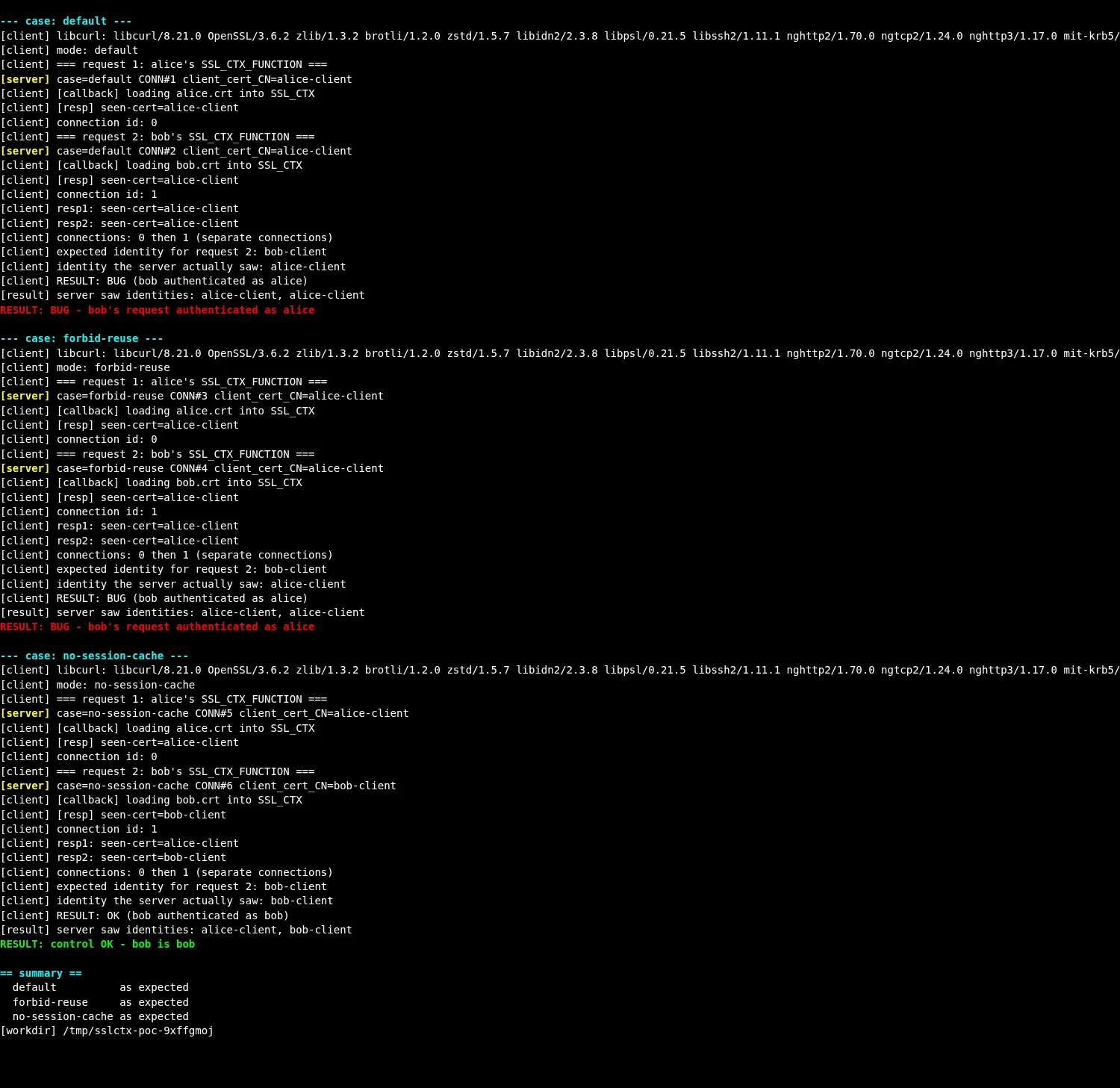
The script generates two client certificates (alice, bob) and a server certificate, builds its C client against the installed libcurl, starts an mTLS server, and runs three cases. Server connections, callbacks and responses are printed while they happen:
default— bug: both connections showalice-clientforbid-reuse— callback setsCURLOPT_FORBID_REUSE, stillalice-clientno-session-cache—CURLOPT_SSL_SESSIONID_CACHE=0, server showsbob-client
To use a libcurl built from the curl-8_23_0 tag instead of the system
library (full commands in REPRODUCE.md):
CURL_CFLAGS="-I$PWD/curl/include" \
CURL_LIBS="$PWD/curl/build/lib/libcurl.a -lssl -lcrypto -lpsl \
-lbrotlidec -lbrotlicommon -lz -lzstd -lpthread -ldl" \
./poc_sslctx.py
Full walkthrough, including building libcurl from source: [REPRODUCE.md].
Evidence
Server log, default case (8.23.0):
CONN#1 from ('127.0.0.1', 42158): client_cert_CN=alice-client  first_line=b'GET / HTTP/1.1'
CONN#2 from ('127.0.0.1', 42164): client_cert_CN=alice-client  first_line=b'GET / HTTP/1.1'
Client output from the same run:
[callback] loading alice.crt into SSL_CTX
connection id: 0

=== request 2: bob's SSL_CTX_FUNCTION ===
[callback] loading bob.crt into SSL_CTX
connection id: 1

resp1: seen-cert=alice-client
resp2: seen-cert=alice-client

connections: 0 then 1 (separate connections)
identity the server actually saw: alice-client
RESULT: BUG (bob authenticated as alice)
Control case with the session cache disabled:
CONN#2 from ('127.0.0.1', 54416): client_cert_CN=bob-client
resp2: seen-cert=bob-client
RESULT: OK (bob authenticated as bob)
The default case reproduced on every run with 8.23.0 and master, and also reproduced with 8.21.0 and 8.22.0. The control always flipped to bob.
Screenshot of the full run, all three cases in one capture:
- sslctx-full-run.png
The documented workaround does not work
docs/libcurl/opts/CURLOPT_SSL_CTX_FUNCTION.md says:
The CURLOPT_SSL_CTX_FUNCTION callback allows the application to reach in and modify SSL details in the connection without libcurl itself knowing anything about it, which then subsequently can lead to libcurl unknowingly reusing SSL connections with different properties. To remedy this you may set CURLOPT_FORBID_REUSE from the callback function.
Setting CURLOPT_FORBID_REUSE inside both callbacks gives two separate
connections but the same result: the second connection resumes the first
session and the server still sees alice-client. The workaround covers
connection reuse, not session resumption. Only
CURLOPT_SSL_SESSIONID_CACHE=0 changes the outcome.
What I checked
match_ssl_primary_config()inlib/vtls/vtls_config.cis complete forssl_primary_config; this is not a connection-reuse bug.fsslctxhas 20 references inlib/: setopt storage, the OpenSSL, wolfSSL and mbedTLS backends that invoke the callback, DoH propagation and the callback bookkeeping inapi.c.grep -rn fsslctx lib/vtls/vtls_scache.creturns nothing, so the session cache cannot see the callback at all.docs/libcurl/opts/CURLOPT_SSL_SESSIONID_CACHE.mdsays "nothing ever should get hurt by attempting to reuse SSL session-IDs". This is a counterexample.- Searched curl issues and PRs for
SSL_CTX_FUNCTION session,session resumption client certandfsslctx; no existing report matches.
Suggested fix
Only reuse a cached session when the callback identity matches. The pointer values are enough:
- add
ssl_fsslctxandssl_fsslctxpto the peer key inssl_peer_key_build(), or - do not cache or resume sessions for handles where
ssl_fsslctxis set.
A test can use two callbacks that load different client certs and assert the second connection is authenticated as the second identity.
Impact
An application that uses CURLOPT_SSL_CTX_FUNCTION to select a client
certificate per request against the same host, for example a gateway or proxy
that authenticates to one backend as different tenants, can have one tenant's
request authenticated as another tenant. The correct callback runs and returns
success, the server accepts a valid resumption, and nothing reports an error.
Preconditions are specific: the client certificate must be set only through the callback, and both handles must share a multi handle so they share the session cache. In exchange the impact is a server-side identity mix-up, which is why I rate this Medium. The project has fixed this class twice before (CVE-2016-5419, CVE-2017-7468) for the normal certificate options.
Attachments
Not written yet. The AI write-up for this report has not been written yet. The Original tab links to the source.
How it worked
Root cause
The session-cache peer key is built from struct ssl_filter_config fields and omits the SSL_CTX callback and its userdata, so handles with different callback-loaded certificates produce the same key.
Impact
An application that selects a client certificate per request through the callback, such as a gateway authenticating to one backend as different tenants, could have one tenant's request authenticated as another tenant, though this needs the certificate to be set only via the callback and both handles to share a multi handle.
What the attacker needed
Client cert set only via the callback; both handles share one multi handle; same host for both requests
The fix
The session cache should include the callback and its userdata in the peer key, or skip caching and resumption for handles where the callback is set; the text does not say it was fixed.
How it was found
- Run the provided script, which generates two client certificates and a server certificate, builds a small C client against libcurl and starts an mTLS server.
- In the default case, the first handle's callback loads the first client certificate and the request completes.
- The second handle opens its own connection and its callback loads the second client certificate.
- curl offers the first handle's cached session, the server accepts the resumption and does not request the second certificate.
- Both responses show the first client's identity, and the control case with the session cache disabled shows the second identity instead.
Explained by bugbounty.wiki with AI from the original and checked against quotes from it; it can still be wrong. Read the original before relying on a detail.
Not written yet. The AI write-up for this report has not been written yet. The Original tab links to the source.
When a client reconnects to a server it already talked to, TLS can skip the full handshake by resuming the earlier session. curl keeps a cache of these sessions and decides which cached session fits a new connection by comparing a key built from connection settings. Here the client certificate was loaded through a callback that the key never looks at, so curl handed one client's saved session to a different client, and the server treated the second request as the first person.
What is Crypto?
Encryption, signatures, randomness or certificate checks that do not protect what they claim to.




