[CRITICAL]-Taking over entire subdomain of romit.io
The subdomain blog.romit.io had a dangling CNAME pointing to wordpress.com, allowing anyone to claim it by mapping the domain to their own WordPress account. The attacker could then control the content served on that subdomain, potentially posting malicious material under the organisation's brand.

- Triaged in under an hour
- Fixed in under an hour
- Paid in under an hour
- Disclosed after 1 hour
Hi,
During recon, I found out that blog.romit.io was not mapped with wordpress.com and the domain was returning back error like this domain has not been mapped with wordpress.com, to map it please login into wordpres.com.
So, I quickly created an account on wordpress.com and mapped blog.romit.io by paying 13USD from my credit card.
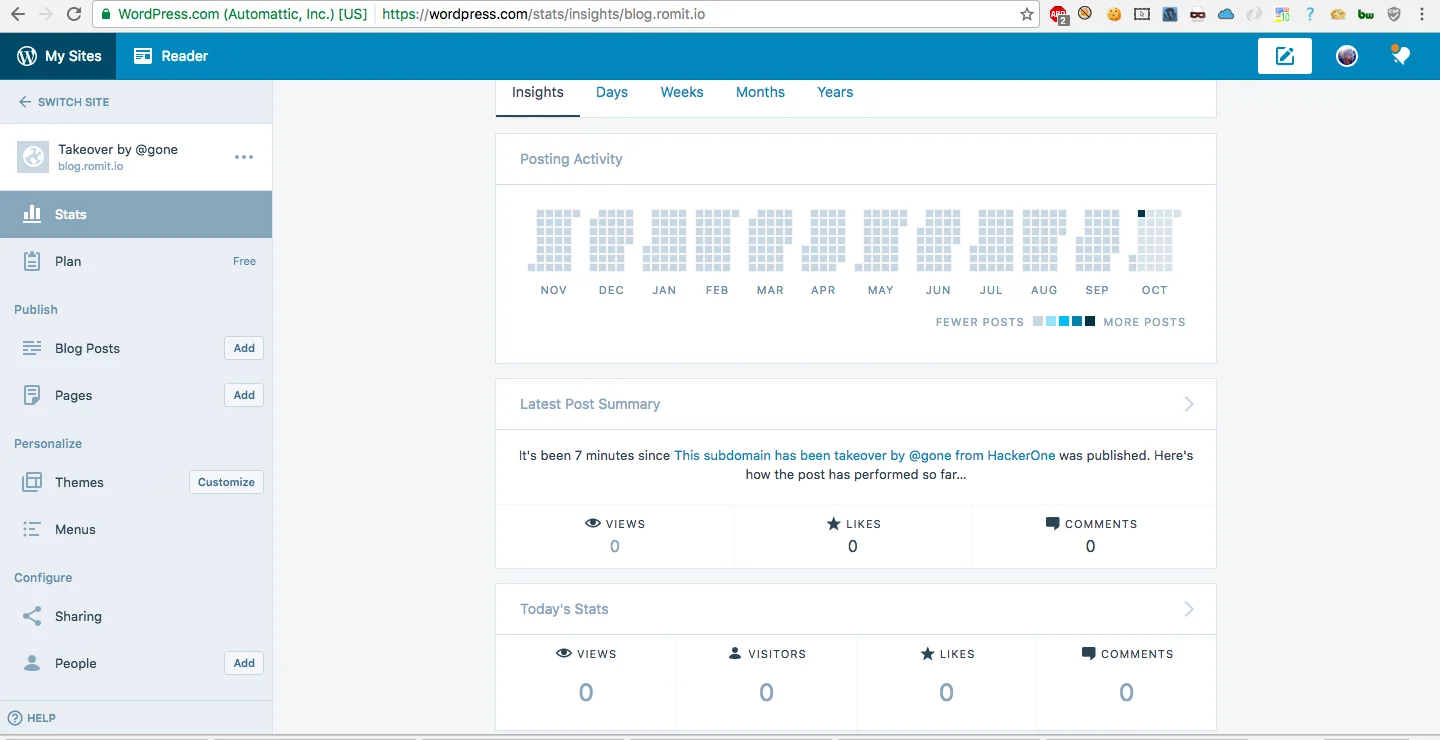
So, I become the admin of blog.romit.io for just 13USD.
Proof of concept:
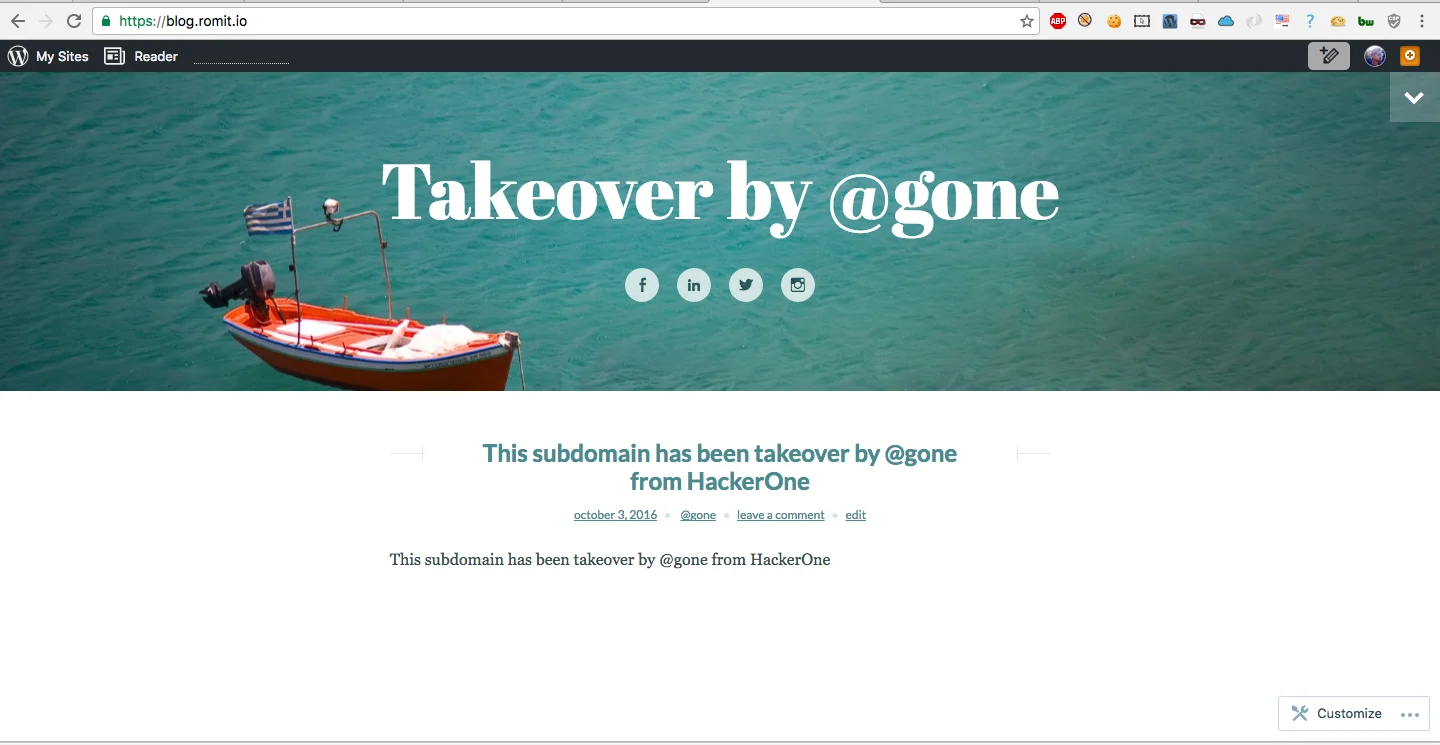
Just visit https://blog.romit.io.
Impact: This issue can have really huge impact on the companies reputation someone can post malicious content on the blog and then romit.io users will think its official but its NOT.
FIX?
- You can delete the CNAME entry for
blog.romit.io
or..
- You can have my wordpress.com credentials.
Please see attached screenshots.
Thanks -@gone
Attachments
What the report shows
The target is the host blog.romit.io, a subdomain of the romit.io domain. During reconnaissance the researcher found that the host was not mapped to wordpress.com, and that requesting it returned an error along the lines of:
this domain has not been mapped with wordpress.com, to map it please login into wordpres.com
The researcher then created an account on wordpress.com and mapped blog.romit.io to it, paying 13 USD by credit card. The result, in the researcher's words, was that they became the admin of blog.romit.io for 13 USD.
The proof of concept is a single instruction: visit the host.
The report does not include the response body or headers. It attaches two screenshots as evidence. It states the impact as reputational: someone could publish malicious content on the blog, and users of romit.io would take it for official content when it is not.
The suggested fixes are two:
- Delete the CNAME entry for
blog.romit.io. - Alternatively, take the researcher's
wordpress.comcredentials.
The report was disclosed on 3 October 2016 under the weakness "Improper Authentication - Generic" and paid a bounty of 513.00 USD. No CVSS score or severity rating is given in the text.
The two attached screenshots are referenced by the report as supporting evidence; the text does not describe what each one shows.
Root cause
The report suggests deleting the CNAME entry for blog.romit.io. A CNAME for blog.romit.io still pointed at a hosted blogging service, but no account on that service owned the name any more, so the service answered that the domain was not mapped. Because the mapping step on the service is self-service and open to anyone with an account, the first person to claim the name becomes its owner. The report does not explain why the name was unclaimed on the service.
Impact
As the report frames it, the impact is on reputation and trust: an attacker who controls the host can publish content that appears to come from the organisation, and readers who see the romit.io name will treat it as official. The report does not claim cookie theft, credential capture or access to other romit.io systems, and the subdomain takeover does not by itself grant any of those. The report limits the impact to publishing malicious content under the trusted name.
How this kind of bug works
A subdomain takeover happens when a DNS record for a name under the organisation's control points at a service that no longer has a matching claim on that name. The two common shapes are a CNAME to a third-party host (blogging platforms, marketing pages, help centres, status pages, file storage, function platforms) and a direct A record to a cloud IP that has since been released and can be reallocated.
The third-party service resolves incoming requests by the Host header. If no tenant has registered that hostname, the service either returns a generic error or serves a placeholder, and the first tenant to register the name receives the traffic. From the browser's point of view nothing has changed: the DNS name, the TLS certificate and the URL all belong to the organisation, so the content is trusted.
The mistake is lifecycle, not code: records outlive the service instances they point at. Defences are inventory and process. Keep DNS records tied to the systems that own them, remove records when a service is retired, and periodically re-resolve every name and check whether the far end still recognises it. Some providers offer domain-claim protection or reserved names, but the reliable control is deleting the record.
How to test for it
- Enumerate names: certificate transparency logs, passive DNS, search engine results for the apex domain, and wordlists for common service prefixes such as blog, shop, status, help, docs, support and dev.
- Resolve each name and record the CNAME target or A record. Names pointing at third-party platforms are the interesting ones.
- Request the name and read the response. A page saying the domain is unclaimed, a default provider error page, a 404 from the platform's edge, or a TLS error naming the provider are all signals.
- Confirm the claim is actually free by checking the provider's own documentation for the fingerprint of an unclaimed name, and, where the provider allows it, by attempting to register the name in a test account. Do not publish content; a minimal placeholder is enough to prove control.
- Record evidence: the DNS answer, the response before claiming, and the response after claiming, with timestamps.
Common false positives: the name resolves to a provider that still serves a valid tenant page; the error page comes from the organisation's own origin rather than the third party; the provider requires domain verification before a claim can be made; or the record is an A record to an address that is still allocated to the organisation. A generic 404 is not proof on its own.
How it is fixed
The standard fix is to remove the dangling record, as the report suggests. If the service is still wanted, re-register the name on the provider and keep the account active. Beyond the single record, the organisation should audit all names for the same pattern, add DNS changes to the decommissioning checklist, and monitor for names that stop resolving to a live tenant.
Hunting notes
This class hides in the long tail of an organisation's DNS: forgotten marketing microsites, regional blogs, event pages, documentation portals, status pages and anything created by a team that has since moved on. Recon signals worth watching are CNAMEs to hosted platforms, names that return provider-specific error strings, and names whose certificate or response headers name a third party rather than the target.
For acceptance, show control without causing harm: the DNS record, the pre-claim response, the post-claim response from a benign placeholder, and a clear statement of what an attacker could publish under the trusted name. Programs are more likely to accept a report that demonstrates the claim and stops there than one that hosts convincing phishing content on the taken-over host.
What happened, in plain words
A company owns a domain name, romit.io. Under it sits a smaller name, blog.romit.io, which is a subdomain: think of the main domain as a building and the subdomain as a labelled door on it. The company wanted a blog there, so instead of running blog software itself it used a hosted blogging service, wordpress.com. The way that works is a DNS record of type CNAME, which is a forwarding note in the internet's address book saying "for blog.romit.io, go and ask wordpress.com".
The forwarding note was still in place, and on the wordpress.com side nobody owned the name blog.romit.io any more. On the wordpress.com side, nobody owned the name blog.romit.io any more. During reconnaissance (the early stage of a security test, where you look around and collect information before attacking anything), the researcher requested the host and got an error back, roughly:
this domain has not been mapped with wordpress.com, to map it please login into wordpres.com
That message is the giveaway. It says the blogging service is still receiving traffic for blog.romit.io, but no customer has claimed that name. Claiming a name on wordpress.com is self-service: anyone who signs up can do it. So the researcher created an account, paid 13 USD by credit card to map blog.romit.io, and in the researcher's words became the admin of blog.romit.io for 13 USD.
The proof of concept is a single instruction: visit the host.
Line by line: GET is the method a browser uses when it simply asks for a page. https://blog.romit.io is the address being asked for, over the encrypted version of the web. HTTP/1.1 is the version of the language the request is written in. Nothing else is needed, because the takeover is not a trick against the site's code; it is a matter of who owns the name.
The two attached screenshots are offered as supporting evidence. The report does not describe what each one shows.
The impact, as the report frames it, is about reputation. Someone who controls the blog can publish malicious content there, and people who see the romit.io name will assume it is official when it is not.
The suggested fixes are two:
- Delete the CNAME entry for
blog.romit.io. - Alternatively, take the researcher's
wordpress.comcredentials.
The report was disclosed on 3 October 2016 under the weakness "Improper Authentication - Generic" and paid a bounty of 513.00 USD. No CVSS score or severity rating appears in the text.
In general, how this kind of bug works
This is called a subdomain takeover. It happens when a name under an organisation's control still points at a third-party service, but nobody at the organisation holds the matching account on that service any more. The forwarding note outlives the thing it forwarded to.
Two shapes are common. One is a CNAME to a hosted platform: blogging services, marketing page builders, help centres, status pages, file storage, function platforms. The other is a direct A record (a note giving a numeric server address) pointing at a cloud address that has since been released and can be handed to someone else.
When a request arrives, the third-party service decides which customer it belongs to by reading the Host header, a line in the request that names the site the browser wanted. If no customer has registered that name, the service returns a generic error or a placeholder. The first person to register the name then receives all the traffic. From the browser's side nothing looks wrong: the name, the TLS certificate (the padlock proof that the site is who it says) and the URL all belong to the organisation, so readers trust the content.
The mistake is about housekeeping, not code. Records outlive the services they point at. The defences are inventory and process: keep DNS records tied to the systems that own them, remove records when a service is retired, and periodically re-check every name to see whether the far end still recognises it. Some providers offer domain-claim protection or reserved names, but the reliable control is deleting the record.
How to test for it
- Collect names: certificate transparency logs (public records of certificates issued), passive DNS data, search engine results for the main domain, and wordlists of common prefixes such as blog, shop, status, help, docs, support and dev.
- Look up each name and note whether it is a CNAME and where it points, or an A record and which address it gives. Names pointing at third-party platforms are the interesting ones.
- Request the name and read the response. A page saying the domain is unclaimed, a default provider error page, a 404 from the platform's edge, or a TLS error naming the provider are all signals.
- Confirm the name is really free by checking the provider's documentation for the fingerprint of an unclaimed name and, where the provider allows it, by trying to register it in a test account. Do not publish content; a minimal placeholder is enough to prove control.
- Record evidence: the DNS answer, the response before claiming and the response after claiming, with timestamps.
Common false positives: the name resolves to a provider that still serves a valid customer page; the error page comes from the organisation's own server rather than the third party; the provider requires domain verification before a claim can be made; or the record is an A record to an address still allocated to the organisation. A generic 404 is not proof on its own.
How it is fixed
The standard fix is to remove the dangling record, as this report suggests. If the service is still wanted, re-register the name on the provider and keep the account active. Beyond the single record, the organisation should audit all its names for the same pattern, add DNS changes to the checklist used when retiring a service, and monitor for names that stop resolving to a live customer.
Where to look
This class hides in the long tail of an organisation's DNS: forgotten marketing microsites, regional blogs, event pages, documentation portals, status pages, and anything created by a team that has since moved on. Signals worth watching are CNAMEs to hosted platforms, names that return provider-specific error strings, and names whose certificate or response headers name a third party rather than the target.
For a report to be accepted, show control without causing harm: the DNS record, the response before claiming, the response after claiming from a harmless placeholder, and a clear statement of what an attacker could publish under the trusted name. Programs are more likely to accept a report that demonstrates the claim and stops there than one that hosts convincing phishing content on the taken-over host.
Glossary
- Domain: the main name a website is known by, such as
romit.io. - Subdomain: a name placed in front of a domain, such as
blog.romit.io, usually pointing at a separate service. - DNS: the internet's address book, which turns names into the location of the server that answers for them.
- DNS record: a single entry in that address book.
- CNAME: a record that says "for this name, go and ask this other name instead".
- A record: a record that gives the numeric address of a server directly.
- Host header: a line in a web request naming which site the browser wanted, used by shared servers to pick the right customer.
- Reconnaissance: the information-gathering phase of a security test, before any attack is attempted.
- Subdomain takeover: claiming a name that still points at a third-party service where nobody holds the matching account.
- Dangling record: a DNS record left pointing at a service that no longer has a matching claim.
- TLS certificate: the proof, shown as a padlock, that a site is who it claims to be.
- Request: the message a browser sends to a server asking for a page.
- Response: the message the server sends back.
- 404: the standard answer meaning "this page does not exist here".
- False positive: a finding that looks like a problem but is not one.
- CVSS: a standard scoring system for how severe a vulnerability is.
- Bounty: a payment made by a company to a researcher who reports a valid security problem.






