[auth2.zomato.com] Reflected XSS at `oauth2/fallbacks/error` | ORY Hydra an OAuth 2.0 and OpenID Connect Provider
The OAuth error fallback page at auth2.zomato.com reflected user-supplied query parameters into the page without proper encoding, allowing script execution. An attacker could send a crafted link to a logged-in user and run script in their session to read cookies.

- Triaged in 7 hours
- Fixed in 30 days
- Paid in 21 hours
- Disclosed after 46 days
Heyy there, I have found a xss in auth2.zomato.com
**Full url:**https://auth2.zomato.com/oauth2/fallbacks/error?error=xss&error_description=xss&error_hint=xss
Vulnerable Parameters: All available parameters are vulnerable
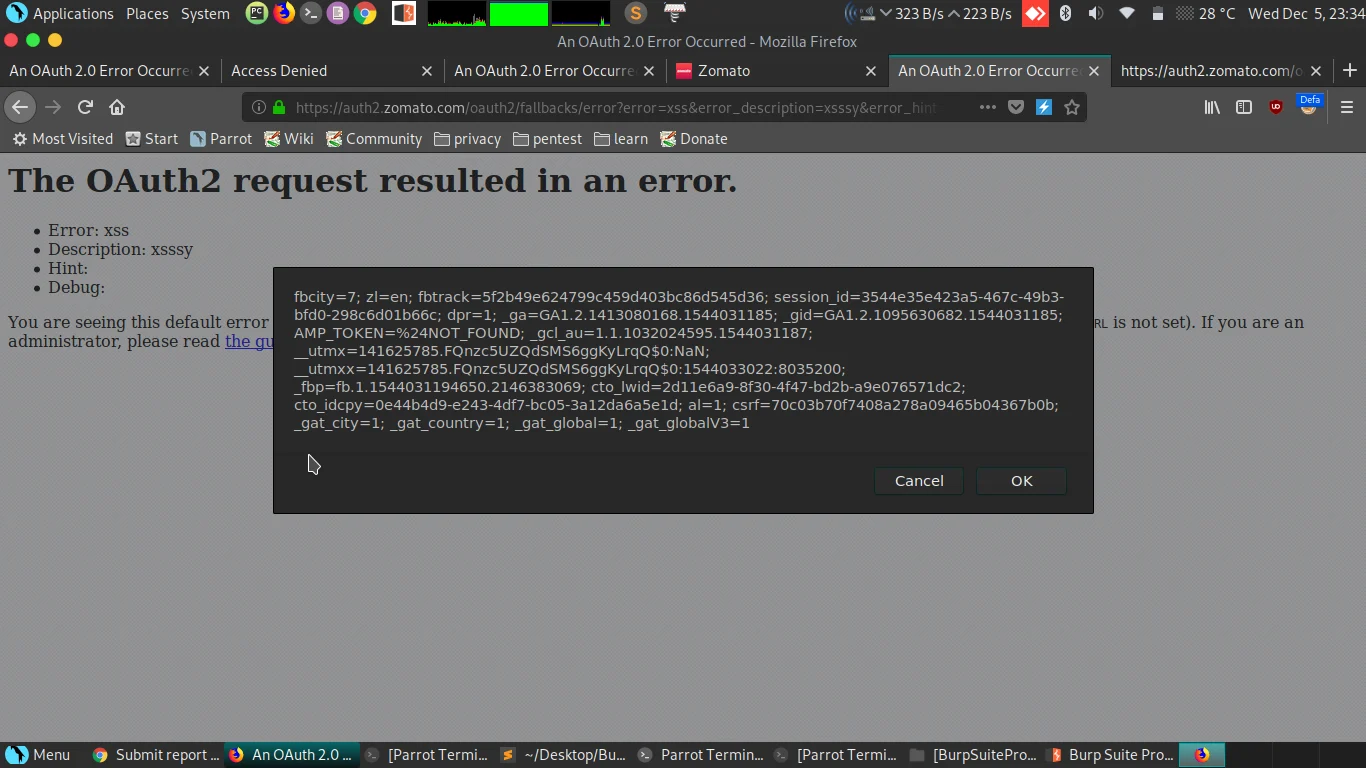
XSS Payload: <marquee loop%3d1 width%3d0 onfinish%3dco\u006efirm(document.cookie)>XSS<%2fmarquee>
Steps To Reproduce the xss
Just copy paste and load this url in your firefox browser and tadaa you will get the xss popup
https://auth2.zomato.com/oauth2/fallbacks/error?error=xss&error_description=xsssy&error_hint=%3Cmarquee%20loop%3d1%20width%3d0%20onfinish%3dco\u006efirm(document.cookie)%3EXSS%3C%2fmarquee%3E
POC:
Impact
An attacker can send this url with payload to an already login user and can steal the cookie.
Thankyou Kind Regards Sudhanshu
Not written yet. The AI write-up for this report has not been written yet. The Original tab links to the source.
How it worked
Root cause
Likely the OAuth error fallback page rendered the error, error_description and error_hint query parameters into HTML without encoding them.
Impact
An attacker could send the crafted link to an already logged-in user and steal their cookie, though the report only demonstrates this in Firefox.
What the attacker needed
Victim clicks a crafted link; victim is logged in; Firefox browser used in the demo
Explained by bugbounty.wiki with AI from the original and checked against quotes from it; it can still be wrong. Read the original before relying on a detail.
Not written yet. The AI write-up for this report has not been written yet. The Original tab links to the source.
A reflected cross-site scripting (XSS) bug means a website takes something from the link you clicked and puts it straight into the page as code. Here the error page echoed the error parameters back as HTML, so a link could carry a small script that runs in the victim's browser. That script can then read the user's cookies, which are often used to stay logged in.
What is XSS?
Script an attacker supplies runs in another user's browser, on the target's origin, with that user's session.