MailPoet Newsletters <= 2.7.2 - Authenticated Reflected Cross-Site Scripting (XSS)
The MailPoet Newsletters plugin reflected an attacker-controlled base64-encoded form value back into the page without sanitising it, so a crafted link could run JavaScript in a logged-in WordPress administrator's browser. An attacker who lured an admin to that link could steal the admin's session token or act on their behalf.

- Fixed in 4 months
- Disclosed after 5 months
Hello Team
Abstract:- A Cross-Site Scripting vulnerability was found in the MailPoet Newsletters plugin. This issue allows an attacker to perform a wide variety of actions, such as stealing Administrators' session tokens, or performing arbitrary actions on their behalf. In order to exploit this issue, the attacker has to lure/force a logged on WordPress Administrator into opening a URL provided by an attacker.
Introduction:- The MailPoet Newsletters plugin allows a WordPress administrator to create newsletters, automated emails, post notifications and autoresponders. A Cross-Site Scripting vulnerability was found in the MailPoet Newsletters plugin. This issue allows an attacker to perform a wide variety of actions, such as stealing Administrators' session tokens, or performing arbitrary actions on their behalf. In order to exploit this issue, the attacker has to lure/force a logged on WordPress Administrator into opening a URL provided by an attacker.
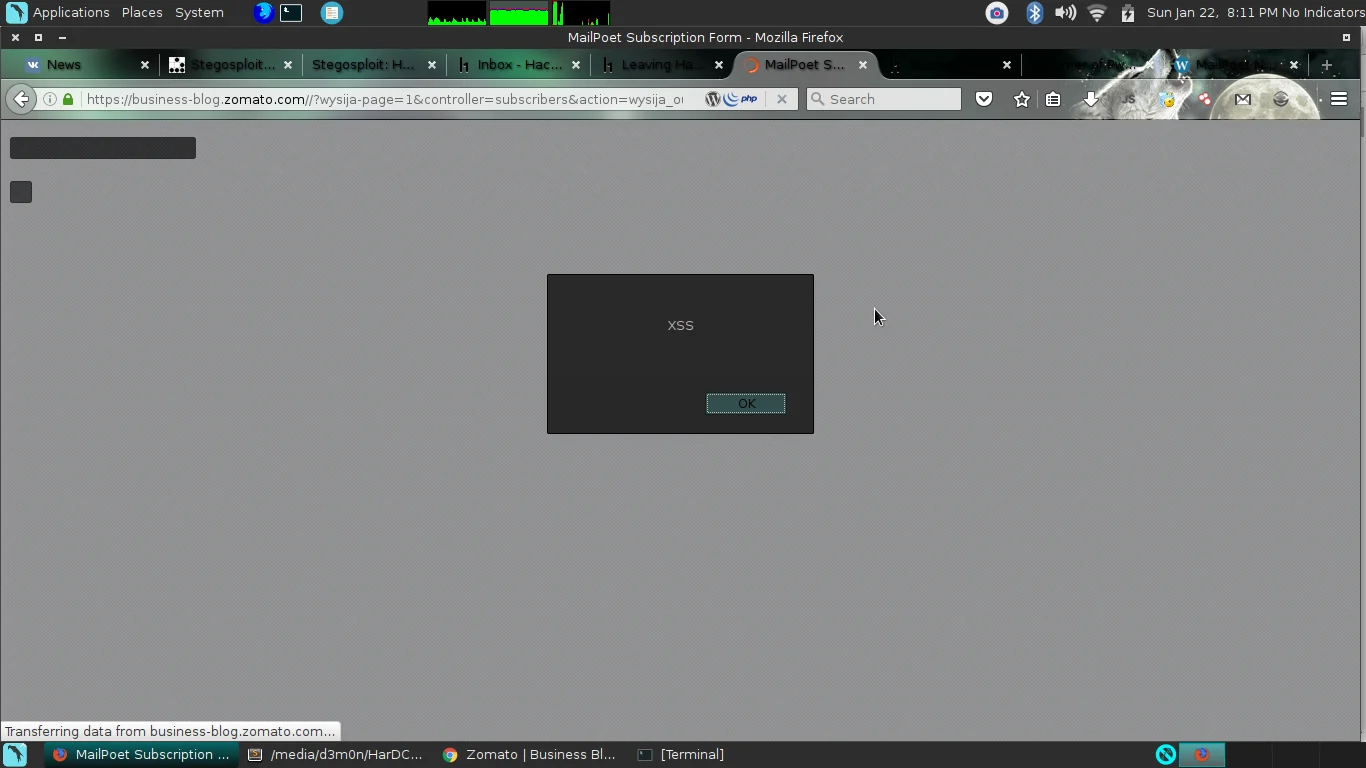
Proof of concept:- Have an authenticated admin visit the URL:-
https://business-blog.zomato.com//?wysija-page=1&controller=subscribers&action=wysija_outter&encodedForm=eyJmb3JtIjoiUHduIiwiYWZ0ZXJfd2lkZ2V0IjoiPHNjcmlwdD5hbGVydCgnWFNTJyk8L3NjcmlwdD4ifQ== The encodedForm parameter is the base64 encoded string: {"form":"Pwn","after_widget":"<script>alert('XSS)</script>"}
A pop-up box should appear, meaning the JavaScript contained in the request_id request parameter was executed by the browser.
Fix:- This issue is resolved in MailPoet Newsletters version 2.7.3.
Regards, Santhosh
Not written yet. The AI write-up for this report has not been written yet. The Original tab links to the source.
How it worked
Root cause
Likely the plugin decoded the encodedForm parameter and echoed its after_widget value into the page without output encoding or sanitisation.
Impact
An attacker could run arbitrary JavaScript in a logged-in administrator's browser, potentially stealing session tokens or performing actions as that administrator, though the victim must first be lured into opening the link.
What the attacker needed
Victim is a logged-in WordPress admin; victim opens an attacker-supplied link; MailPoet plugin 2.7.2 or earlier
The fix
The issue was fixed in MailPoet Newsletters version 2.7.3.
How it was found
- Log in to WordPress as an administrator.
- Open the crafted URL containing the encodedForm parameter.
- The browser executes the script and shows an alert box.
Explained by bugbounty.wiki with AI from the original and checked against quotes from it; it can still be wrong. Read the original before relying on a detail.
Not written yet. The AI write-up for this report has not been written yet. The Original tab links to the source.
A website sometimes takes a value from the address bar and puts it straight into the page. If that value is JavaScript instead of plain text, the browser runs it as if the site itself had written it. Here the plugin decoded a base64 value and inserted it into the page, so a link could make an administrator's browser run the attacker's code.
What is XSS?
Script an attacker supplies runs in another user's browser, on the target's origin, with that user's session.








