Reflected XSS on Zomato API
The Zomato restaurant search widget reflected user input without proper encoding, allowing an attacker to inject a script that executes in the victim's browser. An attacker could craft a URL that, when visited, runs arbitrary JavaScript in the context of the Zomato domain.

- Triaged in 4 days
- Fixed in 2 months
- Disclosed after 2 months
First of all [here] (https://hackerone.com/reports/115402) is another report looks like this report.
Zomato using APIs for developers to create their restaurant search etc.
You are using res_search_widget which is can be seen right [here] (https://www.zomato.com/widgets/res_search_widget.php).
In the report which is 115402 number that i mentioned start of the report, reporter say something like this:
I use a piece of javascript code that creates an alert box with the document.domain, which shows the SOP is bypassed: "}');alert(document.domain);console.log('. But you dont need to add something to your API or widget code. You should only use '"> characters to bypass security and have xss alert.
So, here is xss:
Just go to your widget from here.
And just write this payload:
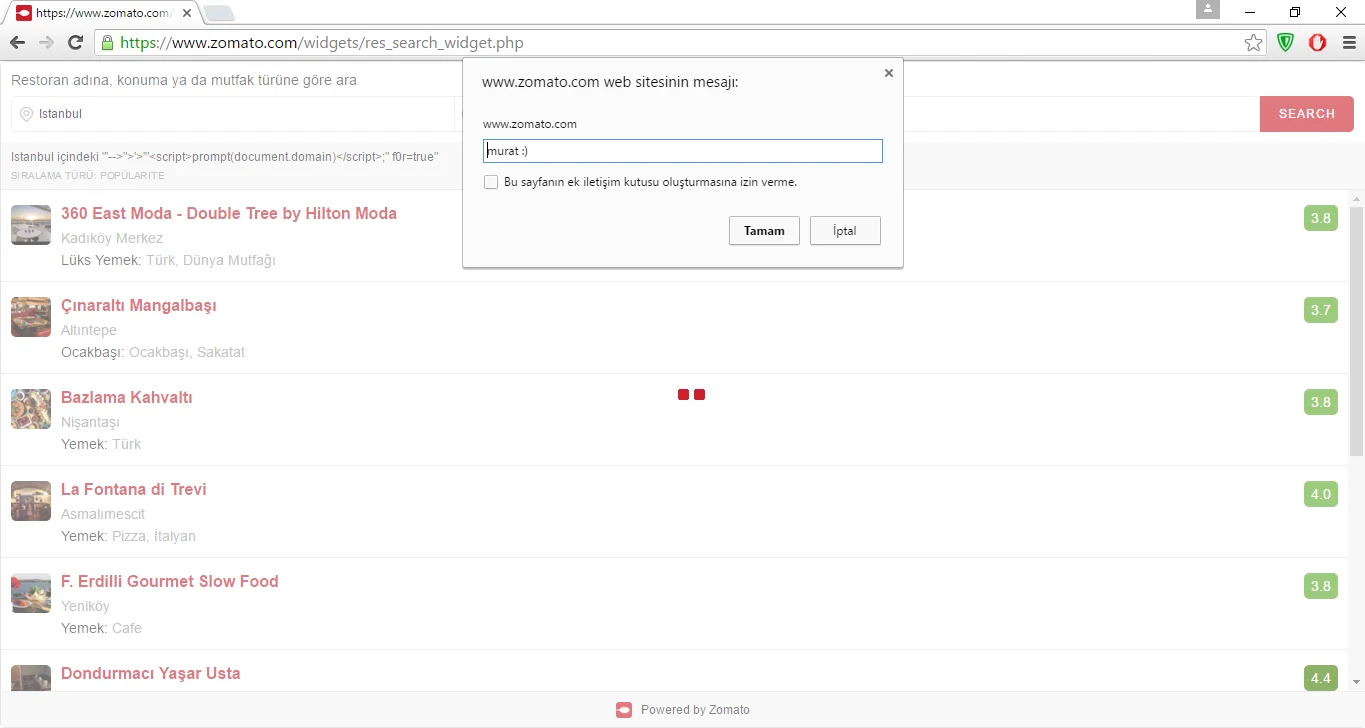
'-->">'>'"<script>prompt(document.domain)</script>;" f0r=TRUE
Here is your alert.
Attachments
Not written yet. The AI write-up for this report has not been written yet. The Original tab links to the source.
How it worked
Impact
An attacker could run JavaScript in a victim's browser when the victim visits a crafted link.
What the attacker needed
Victim clicks a crafted link
How it was found
- Go to the Zomato restaurant search widget page.
- Enter a crafted payload containing script tags into the widget input.
- Observe the script executing and showing an alert with the document domain.
Explained by bugbounty.wiki with AI from the original and checked against quotes from it; it can still be wrong. Read the original before relying on a detail.
Not written yet. The AI write-up for this report has not been written yet. The Original tab links to the source.
A reflected cross-site scripting (XSS) flaw lets an attacker put a small script into a link. When someone clicks the link, the script runs as if it came from the trusted website, so it can read or change things on that site. Here, the widget page echoed back whatever was typed into it without cleaning it up.
What is XSS?
Script an attacker supplies runs in another user's browser, on the target's origin, with that user's session.





