How I Hacked 100K+ Godaddy Users And Help To Secure For Free
An exposed .git directory on a GoDaddy-owned domain allowed the attacker to download internal source code containing API keys and other sensitive data. The attacker could also access non-public user data and modify email content such as registration and password reset messages.
 Published on medium.com
After a while, I made a plan to test one of my favorite programs. After scanning the subdomain, I discovered that it had expired and came across another domain on that page.
The full write-up lives on its author's site
It belongs to its author, so we link to it rather than copy it. The other two tabs are our own rewrites, checked against it.
Context
This write-up describes an accidental discovery made while testing a subdomain of a target the author had previously worked on. The subdomain had expired, and the page it served pointed to another domain. Judging by the thumbnail, the author visited that main domain to see whether it could be taken over. While browsing, the dotgit browser extension raised a pop-up saying that the root domain exposed its .git directory.
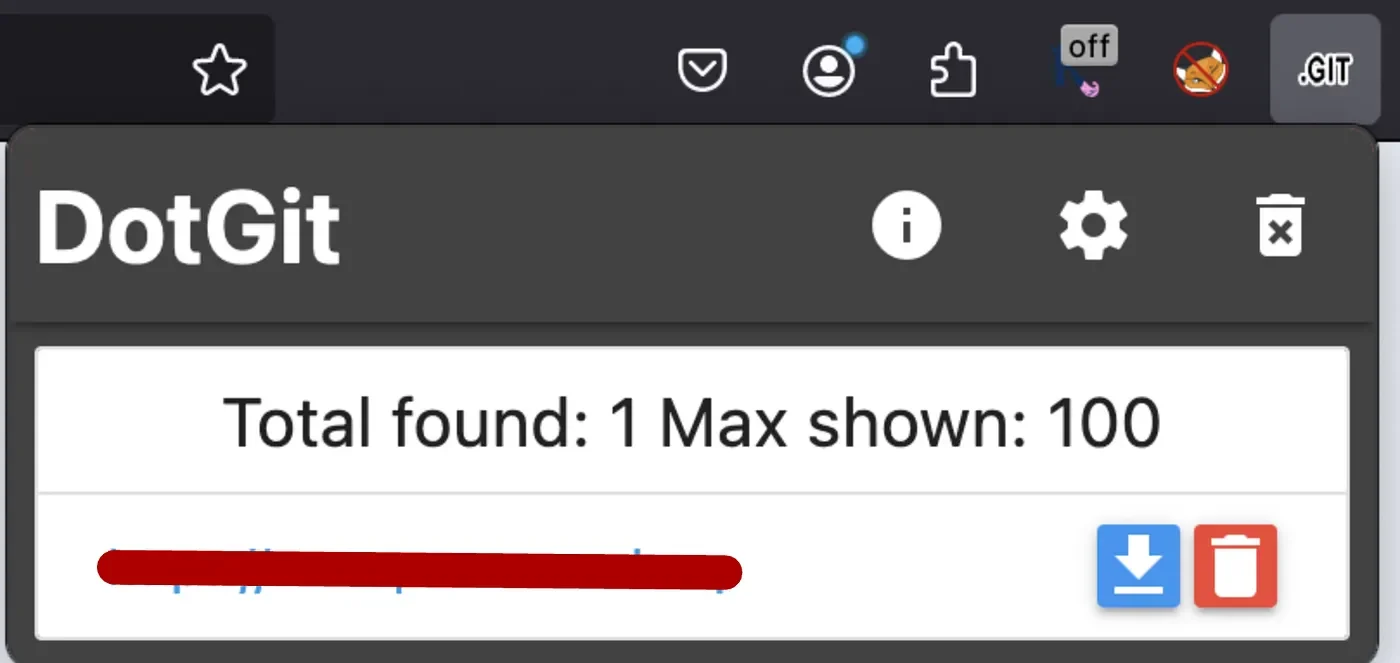
The screenshot shows the dotgit extension alert that started the investigation.
The exposed repository returned the internal source code, complete with various API keys and other sensitive data. The author did not initially know which organisation owned the domain. The report describes the weakness as disclosure of secrets for internal assets: sensitive data for internal assets sitting outside an authorisation barrier.
Setup
The report does not describe a dedicated lab, account provisioning or specific tool versions. The preconditions that matter are:
- A browser with the dotgit extension installed, which detects exposed
.gitdirectories on visited sites. - An HTTP interception proxy such as Burp Suite or OWASP ZAP, listed in the reproduction steps.
- An account on the affected application, used to exercise the download endpoint.
- A HackerOne account, used to submit the report and to correspond with triage.
The asset named in the platform metadata is medium.com, but the report itself refers to a domain the author found through an expired subdomain and later attributed to GoDaddy. The report does not name the domain.
Finding it
After the dotgit alert, the author tried to dump all the files through the .git directory. The dump returned the internal source code, complete with various API keys and other sensitive data.
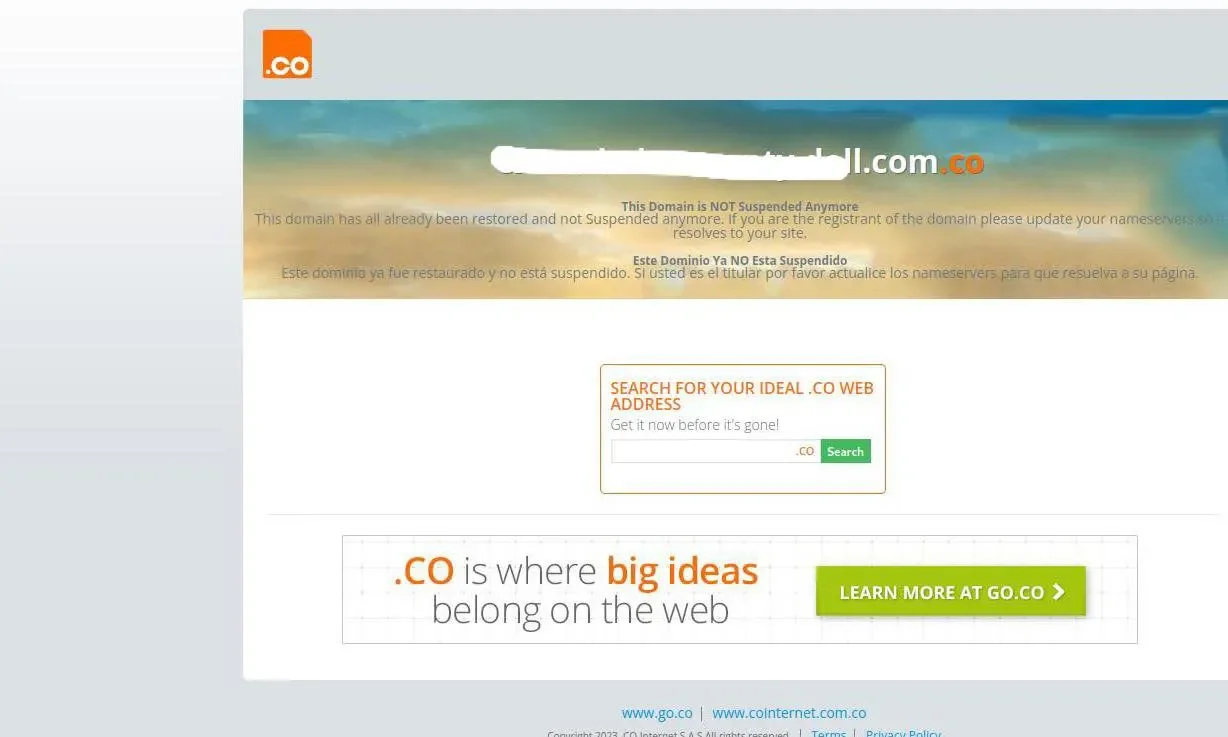
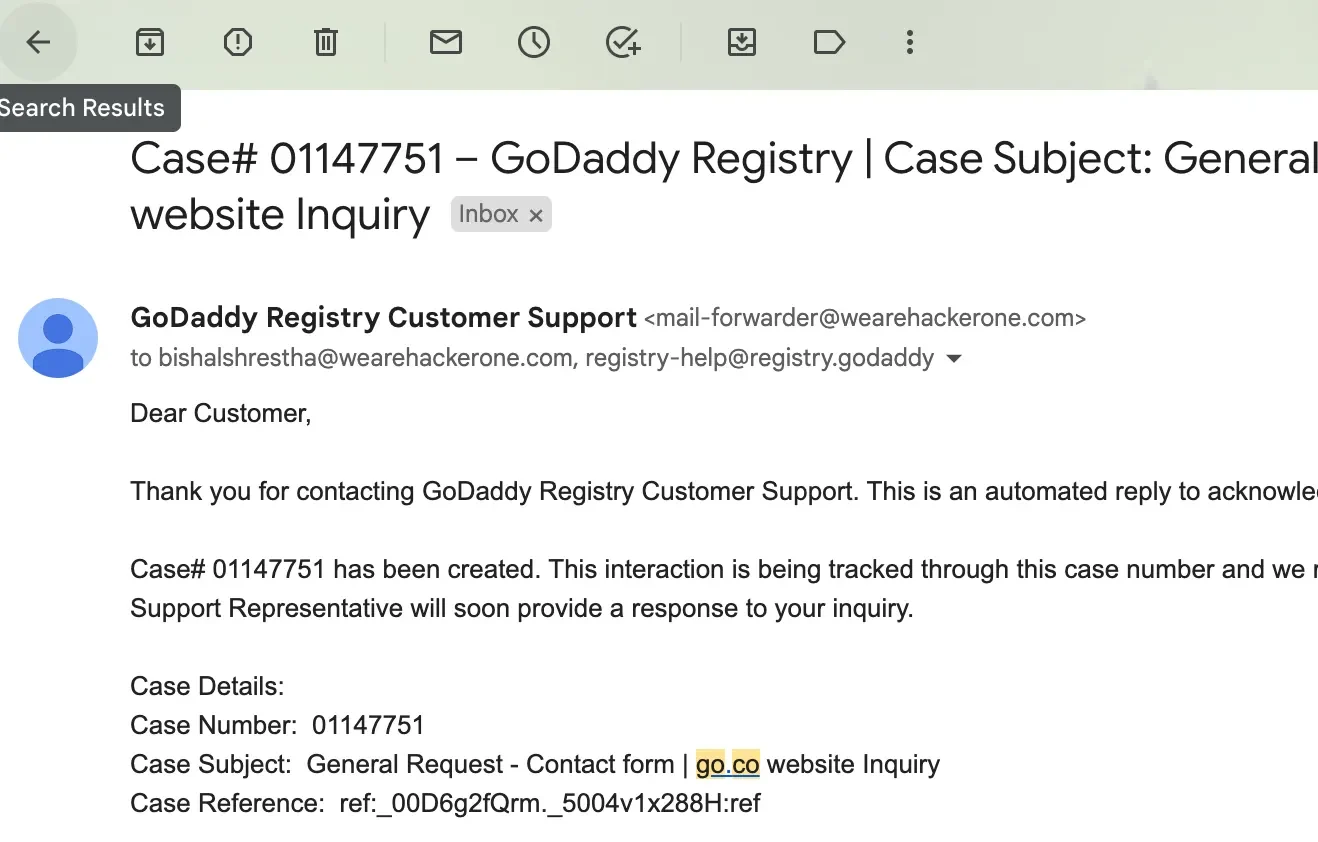
Still unsure which programme the asset belonged to, the author looked for a contact support email in order to offer assistance in securing the application. The address found was [redacted]. A message sent there produced an auto-generated reply from a GoDaddy email address, which suggested the domain was owned by GoDaddy.
To confirm, the author checked the GoDaddy programme scope on HackerOne. Finding no strict scope limitations, the author decided to report the issue to GoDaddy.
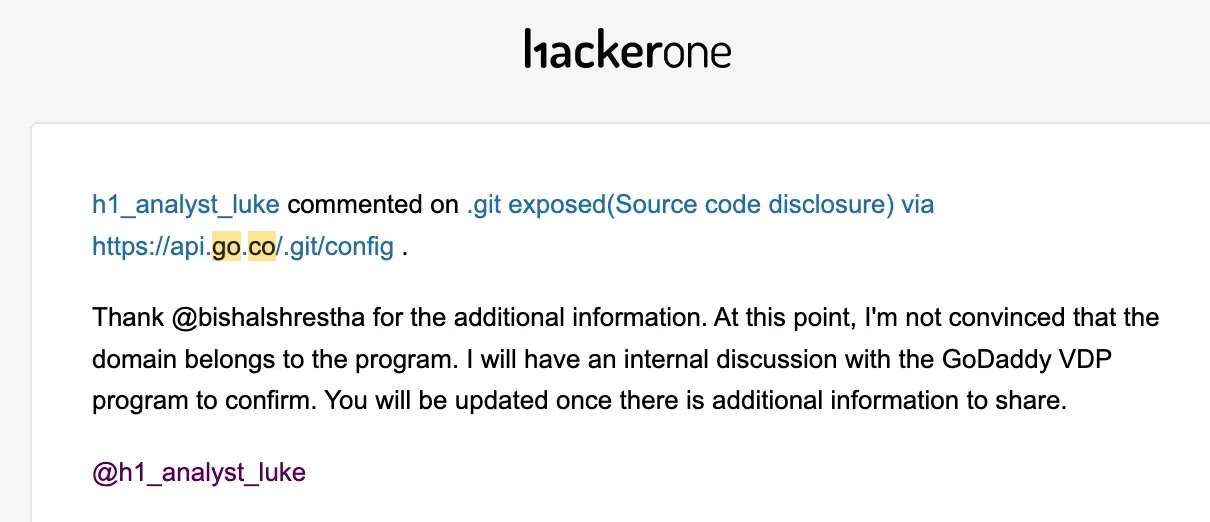
Hours later, HackerOne asked for more evidence that the domain was indeed owned by GoDaddy. The author reached out to [redacted] again and this time received a response. After some discussions, HackerOne's triage team agreed to escalate the issue and involve the GoDaddy team in the scope and resolution process.
After a few findings the author posted on Twitter: https://twitter.com/bishal0x01/status/1621752337760153600
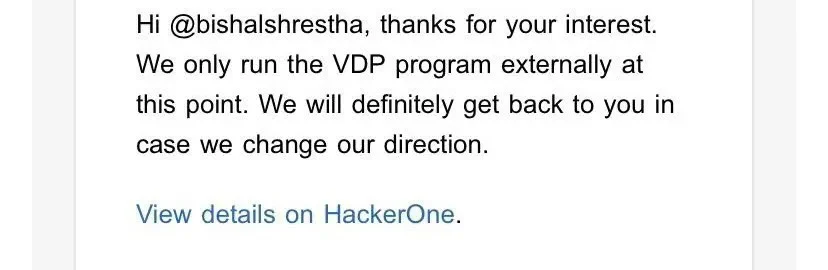
The screenshot shows the response received from the GoDaddy programme owner.
Exploitation
Step 1: Intercept traffic
Set up an HTTP interception proxy, such as Burp Suite or OWASP ZAP, so that requests to the application can be inspected and replayed.
Step 2: Try the download endpoint with an account
The author first attempted to download a file through the download.php?value=somevalue endpoint using their own account. The downloaded file turned out to be empty.
download.php?value=somevalue
Step 3: Read the leaked source and switch parameter
Looking at the source code obtained from the exposed .git directory, the author navigated to the following URL:
https://test.somedomain.com/download.php?q=
This is the proof of concept. The parameter in the working request is q, not the value parameter used in the first attempt. Looking at the leaked source code, the author navigated to the following URL.
With this request the author successfully demonstrated access to non-public user data.
Step 4: Modify email content
Beyond reading data, it was possible to modify the email content on the website, such as registration emails, reset password messages and more.
The screenshot accompanies the description of the successful access to non-public user data and the ability to modify email content.
The report does not include the full request or response for the data access or for the email modification, so the exact parameters and payloads used for those actions are not shown here.
Root cause
The root domain exposed its .git directory, and dumping it returned the internal source code with API keys and other sensitive data. The report frames the underlying weakness as disclosure of secrets for internal assets: sensitive data for internal assets was not behind an authorisation barrier.
Impact
Disclosure of secrets for an internal asset could be leveraged by an attacker to access the internal application or the environment where the application is hosted. The author also demonstrated access to non-public user data through the download endpoint and the ability to modify email content such as registration and password reset messages.
The report notes that disclosure of secrets for internal assets can lead to indirect financial loss if an attacker accesses, deletes or modifies data from within the application, whether through an insider threat, existing data breaches or a malicious internal attacker escalating privileges. Reputational damage can follow from the effect on customers' trust. The severity of the business impact depends on the sensitivity of the data stored in and transmitted by the application.
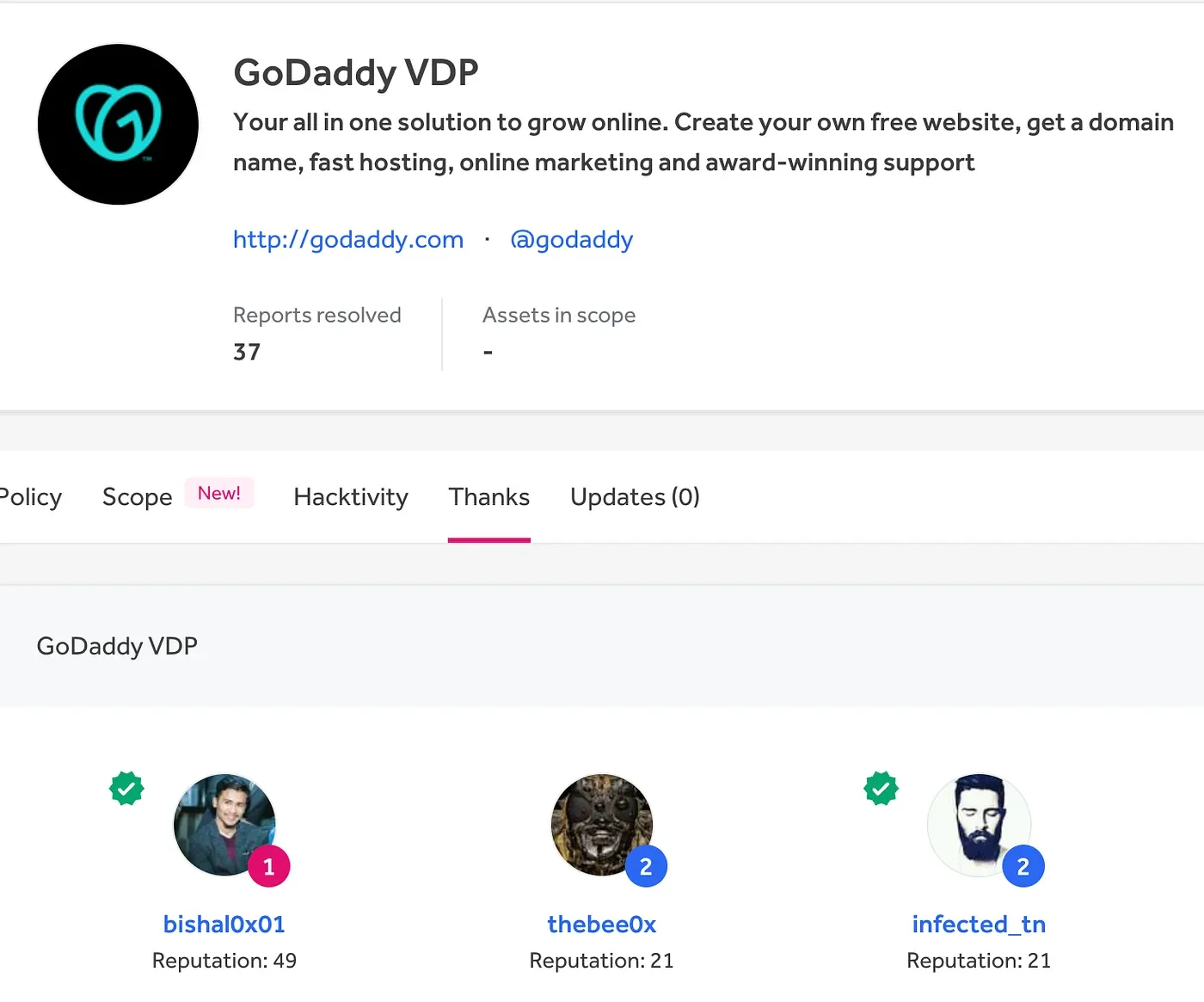
Despite achieving the top #1 ranking in GoDaddy's Vulnerability Disclosure Program (VDP) and reporting several critical and high-risk vulnerabilities, the author did not receive any reward for the findings.
Fix
It records that the issue was marked resolved on 7 February 2023, that the author retested on 8 February 2023 and reported it as still reproducible, that the GoDaddy team returned it to triage for that reason, and that the issue was fixed on 23 March 2023.
The conclusion recommends the following practices:
- Conduct thorough source code reviews to identify and address potential vulnerabilities at the root level.
- Use those reviews to gain insight into how the application works and to find weaknesses before they appear in real-world scenarios.
- Run internal and external vulnerability assessment and penetration testing (VAPT) and secure development workshops, implemented within the Software Development Life Cycle itself.
Variants to test
- Visit root domains and common paths with a
.gitdetector such as dotgit, or request/.git/HEADand/.git/configdirectly. A positive result is a response containing repository metadata rather than a 404 or a generic error page. - When a
.gitdirectory is exposed, attempt to reconstruct the repository and search the source for endpoint names, parameter names and hard-coded credentials. A positive result is source code that reveals internal endpoint names, parameter names and hard-coded credentials. - Compare a documented or guessed parameter with the parameter the source actually uses on download-style endpoints. A positive result is access to non-public user data.
- Test whether content used in outbound email, such as registration and password reset messages, can be modified through the application. A positive result is modified email content such as registration or password reset messages.
- Check expired subdomains for links or redirects to other domains, and follow them. A positive result is a live application whose ownership is not obvious from the subdomain alone, which is the situation that led to this finding.
Timeline
| Date | Event |
|---|---|
| Feb 4, 2023 | Report submitted via HackerOne |
| Feb 4, 2023 | H1 triage marked as pending programme review |
| Feb 6, 2023 | GoDaddy team marked report as Triaged |
| Feb 7, 2023 | Marked as resolved by GoDaddy |
| Feb 8, 2023 | Author retested and informed them it was still reproducible |
| Feb 8, 2023 | GoDaddy team marked the issue back to the triage state since it was still reproducible |
| Mar 23, 2023 | Issue fixed |
| Jun 8, 2023 | Write-up published |
Updated
After a request from the GoDaddy security team, a few pieces of information regarding data exposure, as well as some screenshots of the proof of concept and its impact, were modified in the write-up.
What happened, in plain words
A security researcher was testing a website he had worked on before. One of its subdomains had expired, and the page that subdomain now showed pointed to another domain. He followed that link to the main domain to see whether he could take it over. While he was browsing, a browser add-on called dotgit popped up a warning: the site was accidentally letting anyone download its .git folder.
That folder is where a developer's tool (Git) keeps the full history of a website's code. If a website serves it to the public, anyone can rebuild the source code of the site, including any passwords, keys or other secrets the developers left in it. That is what happened here: the researcher downloaded the internal source code, complete with API keys and other sensitive data.
He did not know at first whose website it was. He found a support email address, wrote to it, and got an automatic reply from a GoDaddy address. That told him the domain probably belonged to GoDaddy. He checked GoDaddy's bug bounty programme on HackerOne (a website where security researchers report bugs to companies), saw no strict limits on what was in scope, and reported the issue.
HackerOne asked for more proof that GoDaddy really owned the domain. He wrote to the support address again, this time got a human reply, and after some back and forth HackerOne's triage team agreed to escalate the report and bring the GoDaddy team into the process.
Looking at the leaked source code, he navigated to a download URL with a different parameter. With that request he demonstrated access to non-public user data, and he could also change the text of emails the site sends out, such as registration and password reset messages. He ended up ranked number one in GoDaddy's Vulnerability Disclosure Program, but he received no money for any of his findings.
This article walks through the same story step by step, explaining every technical idea from scratch as it appears.
The ideas you need before we start
Before following the steps, here are the few concepts the rest of the article relies on. Each one is explained as if you had never heard of it.
- Source code: the instructions a programmer writes to build a website. Think of it as the recipe behind a dish. Visitors see the dish (the web page); the recipe is normally kept in the kitchen.
- Git and the
.gitfolder: Git is a tool developers use to keep track of changes to their code, like a very detailed undo history. It stores that history in a hidden folder named.gitthat sits next to the code. If a web server is misconfigured and hands out that folder, a visitor can rebuild the whole recipe book, including notes the developers never meant to publish. - API key: a long secret string that lets a program prove to another service who it is, a bit like a password that software uses instead of a person. If it leaks, someone else can pretend to be that program.
- Subdomain: a smaller name in front of a main domain, for example
shop.example.comis a subdomain ofexample.com. Companies often have many of them, and old ones are sometimes forgotten. - Expired subdomain: a subdomain whose registration or configuration has lapsed. It may stop working, or it may start pointing somewhere else, which is why researchers watch them.
- Domain takeover: when someone else gains control of a name or page that a company still believes it owns, usually because a link or configuration was left dangling.
- Browser extension: a small add-on you install in your browser to add features. dotgit is one that watches the pages you visit and warns you when a site exposes its
.gitfolder. - HTTP interception proxy: a program that sits between your browser and a website and lets you see, pause and replay every request and response. Burp Suite and OWASP ZAP are two well-known ones. Think of it as a recording device on the phone line between you and the site.
- Endpoint: a specific address on a website that does one job, such as a page that downloads a file. It is like a particular counter in a large office: same building, different window.
- Parameter: the extra piece of information you attach to an address, usually after a
?, to tell the endpoint what you want. Indownload.php?value=somevalue, the parameter is namedvalueand its content issomevalue. - Bug bounty programme and VDP: a scheme where a company invites researchers to report security problems. A bug bounty pays money for valid reports; a Vulnerability Disclosure Program (VDP) accepts reports but does not promise payment.
- HackerOne: a platform where researchers submit reports to companies and where a triage team first checks whether a report is valid.
- Triage: the first review of a report, deciding whether it is real, in scope and worth passing to the company.
- Scope: the list of systems a programme says are fair game to test. Testing outside the scope is not allowed.
- Disclosure of secrets: a weakness where private information (keys, passwords, internal data) is left where it should not be reachable. The report describes this case as disclosure of secrets for internal assets, meaning sensitive data for internal systems was not behind an authorisation barrier, that is, nothing was checking who was allowed to see it.
- Authorisation barrier: any check that decides whether the person asking is allowed to see something, like a door with a lock rather than an open doorway.
- VAPT: vulnerability assessment and penetration testing, the practice of systematically looking for weaknesses in systems, both from inside and outside the company.
- SDLC (Software Development Life Cycle): the whole process of building software, from planning to release. Security checks placed inside that process catch problems earlier.
Setup
The report does not describe a special lab, a particular account setup or specific tool versions. What mattered was having:
- A browser with the dotgit extension installed, which detects exposed
.gitdirectories on the sites you visit. - An HTTP interception proxy such as Burp Suite or OWASP ZAP, which the reproduction steps list.
- An account on the affected application, used to try the download endpoint.
- A HackerOne account, used to submit the report and talk to triage.
The platform metadata names medium.com as the asset, but the report itself talks about a domain the author found through an expired subdomain and later attributed to GoDaddy. The report does not name that domain.
Finding it
After the dotgit alert, the author tried to dump all the files through the .git directory. Dumping here means downloading the folder's contents and using them to rebuild the repository. The dump returned the internal source code, complete with various API keys and other sensitive data.
The screenshot shows the dotgit extension alert that started the investigation.
Still unsure which programme the asset belonged to, the author looked for a contact support email so he could offer help in securing the application. The address he found was [redacted]. He sent a message there and received an auto-generated reply from a GoDaddy email address. An automatic reply like that is a strong hint about who runs the domain, because the mail system behind it belongs to that company.
To confirm, he checked the GoDaddy programme scope on HackerOne. Scope matters because reporting a bug on a system the programme does not cover can get a report closed without action. Finding no strict scope limitations, he decided to report the issue to GoDaddy.
Hours later, HackerOne asked for more evidence that the domain really was owned by GoDaddy. This is normal: a report is only useful if the company actually controls the affected system. The author reached out to [redacted] again and this time received a response. After some discussions, HackerOne's triage team agreed to escalate the issue and involve the GoDaddy team in the scope and resolution process.
After a few findings the author posted on Twitter: https://twitter.com/bishal0x01/status/1621752337760153600
The screenshot shows the response received from the GoDaddy programme owner.
Exploitation
Exploitation means actually using a weakness to prove it is real, rather than only suspecting it. The steps below are the ones in the report.
Step 1: Intercept traffic
Set up an HTTP interception proxy, such as Burp Suite or OWASP ZAP, so requests to the application can be inspected and replayed. Why this matters: a normal browser hides most of what it sends and receives. A proxy lets you see each request as text, change a value, and send it again, which is how you compare a request that fails with one that works.
Step 2: Try the download endpoint with an account
The author first tried to download a file through the download.php?value=somevalue endpoint using his own account. The downloaded file turned out to be empty.
download.php?value=somevalue
Line by line:
download.phpis the address of the endpoint, a script on the server whose job is to hand back a file.?marks the start of the parameters being passed to it.value=somevalueis one parameter namedvalue, with the contentsomevalue. The name is what the server looks for; the content is what you are asking for.
Step 3: Read the leaked source and switch parameter
Looking at the source code obtained from the exposed .git directory, the author navigated to the following URL:
https://test.somedomain.com/download.php?q=
Line by line:
https://is the secure web protocol, the same one your browser uses for most sites today.test.somedomain.comis the host, a placeholder name in the report for the real domain./download.phpis the same download endpoint as before.?q=is a parameter namedqwith an empty value. The name is different from the earliervalue.
This is the proof of concept, the smallest request that demonstrates the problem. The parameter in the working request is q, not the value used in the first attempt. In everyday terms: the first attempt knocked on the door with the wrong name, and the leaked recipe told him the right one.
With this request the author successfully demonstrated access to non-public user data, meaning information that ordinary users are not supposed to see.
Step 4: Modify email content
Beyond reading data, it was possible to modify the email content on the website, such as registration emails, reset password messages and more.
The screenshot accompanies the description of the successful access to non-public user data and the ability to modify email content.
The report does not include the full request or response for the data access or for the email modification, so the exact parameters and payloads used for those actions are not shown here.
Why it worked
The chain has two parts.
- The root domain served its
.gitdirectory, so the repository, including source code and committed secrets such as API keys, could be downloaded by anyone. Committed here means saved into the repository's history, where it stays even if the file is later changed. - The source code was obtained from the exposed
.gitdirectory, and the author then navigated to a download URL using the parameterq.
The report frames the underlying weakness as disclosure of secrets for internal assets: sensitive data for internal systems was not behind an authorisation barrier.
What could go wrong for the company
Disclosure of secrets for an internal asset could be leveraged by an attacker to access the internal application or the environment where the application is hosted. The author also demonstrated access to non-public user data through the download endpoint and the ability to modify email content such as registration and password reset messages.
The report notes that disclosure of secrets for internal assets can lead to indirect financial loss if an attacker accesses, deletes or modifies data from within the application, whether through an insider threat, existing data breaches or a malicious internal attacker escalating privileges. Reputational damage can follow from the effect on customers' trust. How serious the business impact is depends on how sensitive the data stored in and sent by the application is.
Despite achieving the top #1 ranking in GoDaddy's Vulnerability Disclosure Program (VDP) and reporting several critical and high-risk vulnerabilities, the author did not receive any reward for the findings.
How it was fixed
It records that the issue was marked resolved on 7 February 2023, that the author retested on 8 February 2023 and reported it as still reproducible, that the GoDaddy team returned it to triage for that reason, and that the issue was fixed on 23 March 2023.
The conclusion recommends the following practices:
- Conduct thorough source code reviews to identify and address potential vulnerabilities at the root level.
- Use those reviews to gain insight into how the application works and to find weaknesses before they appear in real-world scenarios.
- Run internal and external vulnerability assessment and penetration testing (VAPT) and secure development workshops, implemented within the Software Development Life Cycle itself.
Things worth trying yourself
These are the same ideas, phrased for someone starting out. Only test systems you are allowed to test, such as a programme's in-scope assets or your own practice sites.
- Visit root domains and common paths with a
.gitdetector such as dotgit, or request/.git/HEADand/.git/configdirectly. A positive result is a response containing repository metadata rather than a 404 or a generic error page. A 404 is the standard "not found" answer, so seeing real content instead is the signal. - When a
.gitdirectory is exposed, attempt to reconstruct the repository and search the source for endpoint names, parameter names and hard-coded credentials. A positive result is source code that reveals internal endpoint names, parameter names and hard-coded credentials. - Compare a documented or guessed parameter with the parameter the source actually uses on download-style endpoints. A positive result is access to non-public user data.
- Test whether content used in outbound email, such as registration and password reset messages, can be modified through the application. A positive result is modified email content such as registration or password reset messages.
- Check expired subdomains for links or redirects to other domains, and follow them. A positive result is a live application whose ownership is not obvious from the subdomain alone, which is the situation that led to this finding.
Timeline
| Date | Event |
|---|---|
| Feb 4, 2023 | Report submitted via HackerOne |
| Feb 4, 2023 | H1 triage marked as pending programme review |
| Feb 6, 2023 | GoDaddy team marked report as Triaged |
| Feb 7, 2023 | Marked as resolved by GoDaddy |
| Feb 8, 2023 | Author retested and informed them it was still reproducible |
| Feb 8, 2023 | GoDaddy team marked the issue back to the triage state since it was still reproducible |
| Mar 23, 2023 | Issue fixed |
| Jun 8, 2023 | Write-up published |
A note on the published version
After a request from the GoDaddy security team, a few pieces of information regarding data exposure, as well as some screenshots of the proof of concept and its impact, were modified in the write-up.
Glossary
- API key: a secret string that lets one program prove its identity to another service, like a password for software.
- Authorisation barrier: any check that decides whether the person asking is allowed to see or do something.
- Bug bounty programme: a scheme where a company invites researchers to report security problems, usually paying for valid ones.
- Burp Suite: a popular HTTP interception proxy used to inspect and replay web traffic.
- Committed: saved into a Git repository's history, where it remains even if the file is later changed.
- Disclosure of secrets: a weakness where private information such as keys or internal data is left reachable by people who should not see it.
- Domain: the main name of a website, such as
example.com. - Domain takeover: gaining control of a name or page that a company still believes it owns, often through a forgotten configuration.
- dotgit: a browser extension that warns you when a site exposes its
.gitfolder. - Endpoint: a specific address on a website that performs one job, such as downloading a file.
- Expired subdomain: a subdomain whose registration or configuration has lapsed, so it may stop working or point elsewhere.
- Git: a tool developers use to track changes to code, storing its history in a
.gitfolder. - HackerOne: a platform where researchers submit vulnerability reports to companies and where a triage team first reviews them.
- HTTP interception proxy: a program that sits between your browser and a website so you can see, pause and replay requests and responses.
- OWASP ZAP: a free HTTP interception proxy, an alternative to Burp Suite.
- Parameter: the extra piece of information attached to an address, usually after a
?, telling an endpoint what you want. - Proof of concept (PoC): the smallest request or action that demonstrates a weakness is real.
- Source code: the instructions a programmer writes to build a website or program.
- Subdomain: a smaller name in front of a main domain, such as
shop.example.comunderexample.com. - VAPT: vulnerability assessment and penetration testing, the practice of systematically looking for weaknesses from inside and outside a company.
- VDP (Vulnerability Disclosure Program): a scheme that accepts security reports but does not promise payment.



