Private Grab Messages on Android App can be accessed and cached by Search Engines
A Grab Android app endpoint accepted an authentication token in the URL query string and allowed search engines to index the page, exposing private messages and tokens. An attacker could use a search engine to find cached pages containing other users' tokens and messages.

- Triaged in 15 hours
- Fixed in 38 days
- Paid in 7 days
- Disclosed after 5 months
Summary by the researcher
This issue can be classified as best-practice. The exploitation against other users was very unlikely (possible under rare circumstances), but the team still decided to award me with a bounty - i very appreciate it! The team was very responsible and fixed the issue fast.
I requested to disclose this report to show the impact from search indexing of privileged/sensitive info. The reported issue itself is not very interesting, and not impactful much, but the idea behind it can help the other researchers to find more interesting bugs:) The applications can leak to the Search Engines emails (check it using allinurl:@<mailbox_domain> site:<target_domain>), sensitive tokens (same dork, but with 3-4 entropy characters depending on discovered info upon testing), private info of other users, etc.
Many interesting things and issues can be found just by using Google/Shodan/Censys etc.
The report
##Description
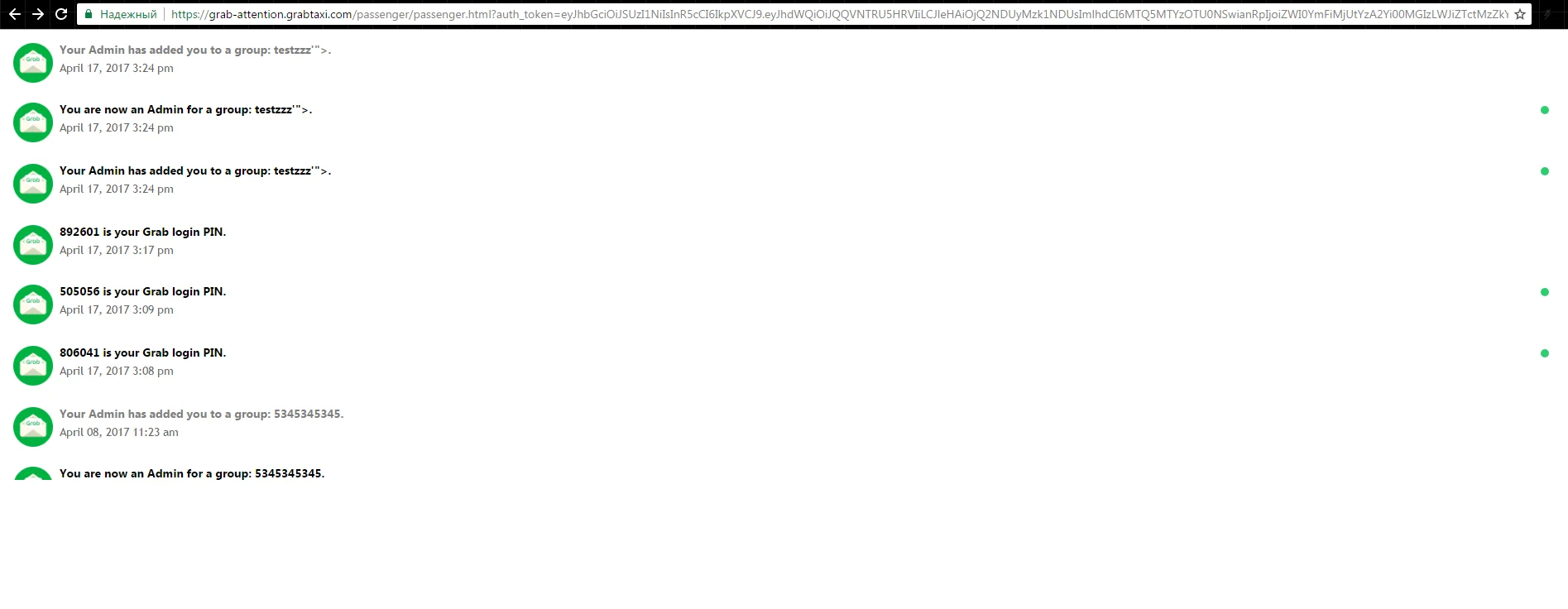
Hello. Today i discovered, that Search Engines can access the private users messages (OTP pins, Group invites information etc.)
It happens because the https://grab-attention.grabtaxi.com host allows search indexing, and can leak the auth_token to the Search Engines which also can lead to privilege escalation.
When vieving "Notifications" section on the app, i noticed the unsecure GET request to the https://grab-attention.grabtaxi.com/passenger/passenger.html?auth_token=[my_token]&view=268435456. I was surprised, when tried to repeat it in the browser - it gave me access to my messages.
##POC
Steps To Reproduce:
- Cheking the private messages of other user (me):
https://grab-attention.grabtaxi.com/passenger/passenger.html?auth_token=eyJhbGciOiJSUzI1NiIsInR5cCI6IkpXVCJ9.eyJhdWQiOiJQQVNTRU5HRVIiLCJleHAiOjQ2NDUyMzk1NDUsImlhdCI6MTQ5MTYzOTU0NSwianRpIjoiZWI0YmFiMjUtYzA2Yi00MGIzLWJiZTctMzZkYzFmMWRkZTMyIiwibG1lIjoiU1lTVEVNIiwibmFtZSI6IiIsInN1YiI6IjM2NWE0NjY0LTY1MGEtNDBjZC05YWU2LTQ4YWQwN2Q2NGY2OSJ9.eTX2dWnooTxm50Dv1VYoIZanOqCe073_AmVk97VE4p7m4e26mcWtnZzQz5IR1EwuWbs52qJLzzAIZ5KcpWoKCvadu6zuRQzy2xRk8BcFDUXGl8w8doPJbuSIHMY0K-x8Q-█████████ZTdgxLI&view=268435456#/ 2. Checking that search engines can crawl it:
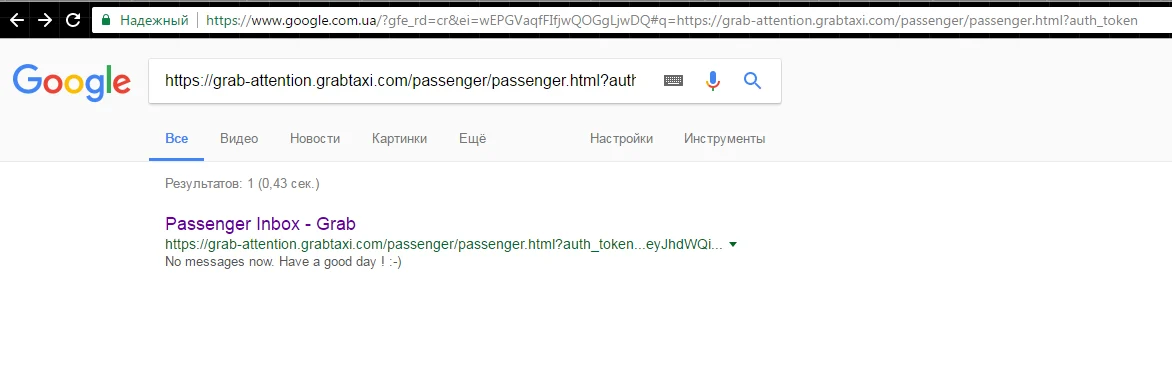
Use this Google DORK (search text):
passenger site:grab-attention.grabtaxi.com
and press Search.
You will see this cached page with auth_token (actually it was cutted due to big query length) - but it is still a huge information disclosure.
Suggested fix
- Disable Search indexing on
https://grab-attention.grabtaxi.com - For the better security you can change the request method to the
https://grab-attention.grabtaxi.com/passenger/passenger.htmlendpoint from GET to POST (or encrypt it) due to that fact that auth_token are leaked in the query parameters.
Not written yet. The AI write-up for this report has not been written yet. The Original tab links to the source.
How it worked
Root cause
Likely the endpoint placed the authentication token in the URL query string and did not prevent search engine indexing, allowing tokens to be cached and discovered.
Impact
Private messages and authentication tokens could be exposed to search engines, potentially leading to privilege escalation, though exploitation against other users was very unlikely.
What the attacker needed
Victim uses the Grab Android app; search engine indexes the endpoint; attacker finds cached page via search
The fix
The issue was fixed by the team; suggested fixes included disabling search indexing and changing the request method from GET to POST.
How it was found
- View the Notifications section in the app and observe the GET request containing the auth_token.
- Repeat the request in a browser to access private messages.
- Use a Google dork to check if search engines have indexed the page with the token.
Explained by bugbounty.wiki with AI from the original and checked against quotes from it; it can still be wrong. Read the original before relying on a detail.
Not written yet. The AI write-up for this report has not been written yet. The Original tab links to the source.
When you use an app, it sometimes sends a secret key in the web address (URL) to prove who you are. If that web address is public and search engines can save it, anyone can find the key and read your private messages. This report shows that happened with a Grab app.
What is Info disclosure?
Data the application should keep private (personal data, internal details, other users' records) reaches someone it should not.






