Content Spoofing on link.greenhouse.io
The link.greenhouse.io service reflected user-supplied content from the URL path back into the response, allowing an attacker to inject arbitrary text and headers. An attacker could craft a link that displays spoofed content under the trusted domain, potentially aiding social engineering.

- Fixed in 4 months
- Disclosed after 5 months
Summary by the program
This issue is affects one of our upstream vendors and we forwarded the report over to them.
The report
Hi,
#Description:
Content spoofing, also referred to as content injection or virtual defacement, is an attack targeting a user made possible by an injection vulnerability in a web application. When an application does not properly handle user supplied data, an attacker can supply content to a web application, typically via a parameter value, that is reflected back to the user. This presents the user with a modified page under the context of the trusted domain.
#Steps To Reproduce:
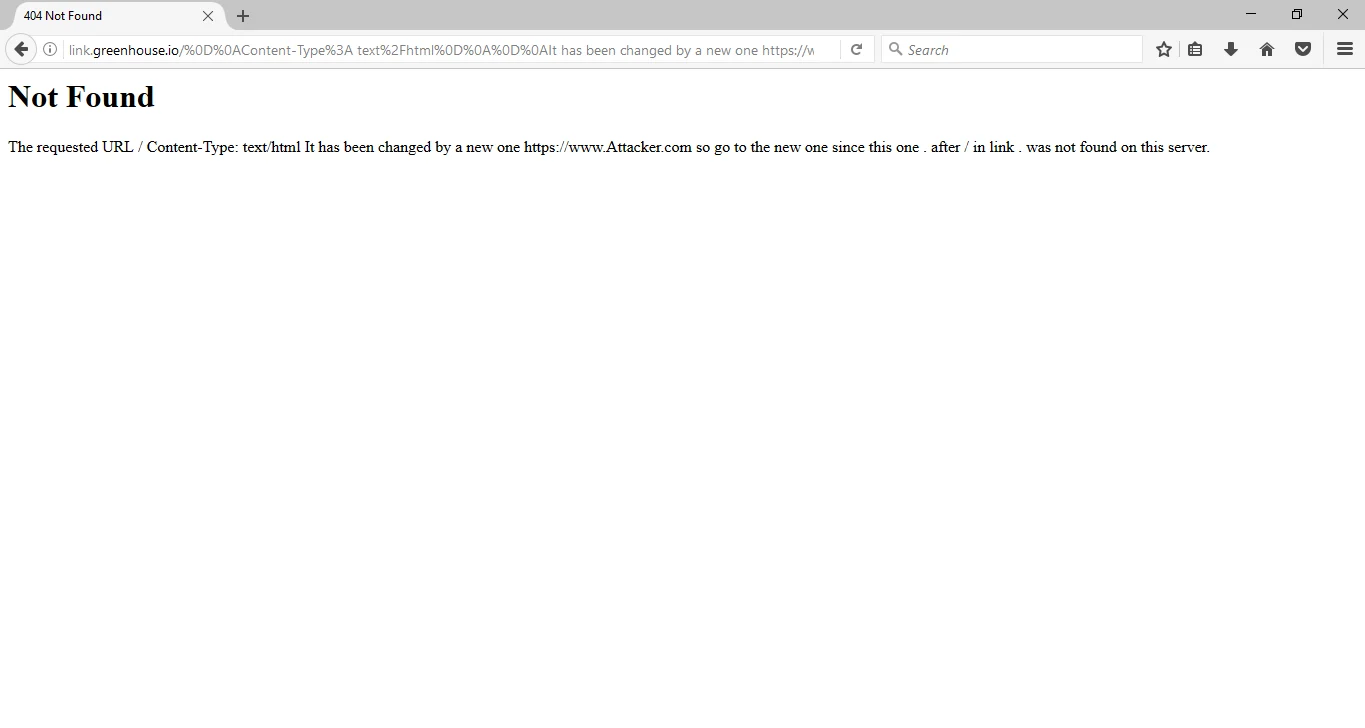
1- Go to http://link.greenhouse.io 2- Add %0D%0AContent-Type%3A text%2Fhtml%0D%0A%0D%0AIt has been changed by a new one https://www.Attacker.com so go to the new one since this one . after / in link .
#Impact:
This attack is typically used as, or in conjunction with, social engineering because the attack is exploiting a code-based vulnerability and a user's trust. spoofing a lot of users .
#Suggested fix:
just use a 404 page that don't include attacker text .
I hope you will fix this issue as soon as possible . Thank you so much .
Attachments
Not written yet. The AI write-up for this report has not been written yet. The Original tab links to the source.
How it worked
Impact
This attack could be used for social engineering by spoofing content on a trusted domain, potentially deceiving many users.
What the attacker needed
Victim clicks a crafted link
The fix
The application should return a generic 404 page that does not include any user-supplied text.
How it was found
- Visit the link.greenhouse.io website.
- Append a crafted string containing encoded carriage returns, line feeds, and HTML content after the slash in the URL.
- Observe that the injected content is reflected on the page.
Explained by bugbounty.wiki with AI from the original and checked against quotes from it; it can still be wrong. Read the original before relying on a detail.
Not written yet. The AI write-up for this report has not been written yet. The Original tab links to the source.
A website took part of the web address and showed it back on the page without cleaning it. An attacker could make a link that looks like it belongs to the real site but shows their own message, which could trick people.
What is XSS?
Script an attacker supplies runs in another user's browser, on the target's origin, with that user's session.





