DoS through cache poisoning using invalid HTTP parameters
The Greenhouse.io embed endpoint accepted an array of 'for' parameters and generated JavaScript with corrupted iframe URLs, which was then cached. An attacker could poison the cache so that the correct URL returned the corrupted JavaScript, causing a denial of service for embedded job boards and application iframes for about 20-30 minutes.

- Triaged in 10 days
- Fixed in 20 days
- Paid in 20 days
- Disclosed after 47 days
Summary by the researcher
Greenhouse.io allows its customers to embed iframes using its provided JS SDK on https://boards.greenhouse.io/embed/job_board/js?for=twitter, for Twitter for example. (Twitter does not seem to use Greenhouse.io anymore, but their account still exists.)
I found that using parameter arrays (e.g. for[]=twitter) still loads the correct JS file, but with different URLs for the job board and application iframes. This file turns out to be cached, which I had effectively poisoned even when accessing the original URL (i.e. https://boards.greenhouse.io/embed/job_board/js?for=twitter). This results in a denial of service of the Greenhouse.io iframes that would be embedded in the customer's site, for around 20-30 minutes until the cache was cleared again.
The report
I was taking a look into a related report (https://hackerone.com/reports/298265) and I discovered that the https://boards.greenhouse.io/embed/job_board/js?for= endpoint doesn't throw errors when I try to pass in an array of for parameters like this:
https://boards.greenhouse.io/embed/job_board/js?for[]=twitter&for[]=&for[]=&for[]=&for[]=&for[]=&for[]=&for[]=&for[]=&for[]=&for[]=&for[]=&for[]=&for[]=&for[]=&for[]=&for[]=&for[]=&for[]=
Instead, in the resultant JS, we can see that the HTTP parameters are escaped and injected into the Grnhse.Settings object:
Grnhse.Settings = {
  targetDomain:   'https://boards.greenhouse.io',
  scrollOnLoad:   true,
  autoLoad:       true,
  boardURI:       'https://boards.greenhouse.io/embed/job_board?for%5B%5D=twitter&for%5B%5D=&for%5B%5D=&for%5B%5D=&for%5B%5D=&for%5B%5D=&for%5B%5D=&for%5B%5D=&for%5B%5D=&for%5B%5D=&for%5B%5D=&for%5B%5D=&for%5B%5D=&for%5B%5D=&for%5B%5D=&for%5B%5D=&for%5B%5D=&for%5B%5D=&for%5B%5D=',
  applicationURI: 'https://boards.greenhouse.io/embed/job_app?for%5B%5D=twitter&for%5B%5D=&for%5B%5D=&for%5B%5D=&for%5B%5D=&for%5B%5D=&for%5B%5D=&for%5B%5D=&for%5B%5D=&for%5B%5D=&for%5B%5D=&for%5B%5D=&for%5B%5D=&for%5B%5D=&for%5B%5D=&for%5B%5D=&for%5B%5D=&for%5B%5D=&for%5B%5D=',
  baseURI:        '',
  iFrameWidth:    650
};
When fetching the actual correct endpoint (https://boards.greenhouse.io/embed/job_board/js?for=twitter), we see that the result for twitter is cached, returning the same corrupted URIs in the JS file. From my tests, it seems that these endpoints are cached for an unknown amount of time, with some staying in the cache for only a few minutes while others may be an hour or longer.
I also found out that the particular endpoint is on CloudFront by observing one of the IP addresses which served the file (35.164.91.227) and corroborating it with the IP range list published by AWS (https://ip-ranges.amazonaws.com/ip-ranges.json). However, fetching from different edge servers seems to result in the same mutated file being fetched at the correct endpoint (https://boards.greenhouse.io/embed/job_board/js?for=twitter). I conclude that there is a second layer of caching somewhere on the application layer.
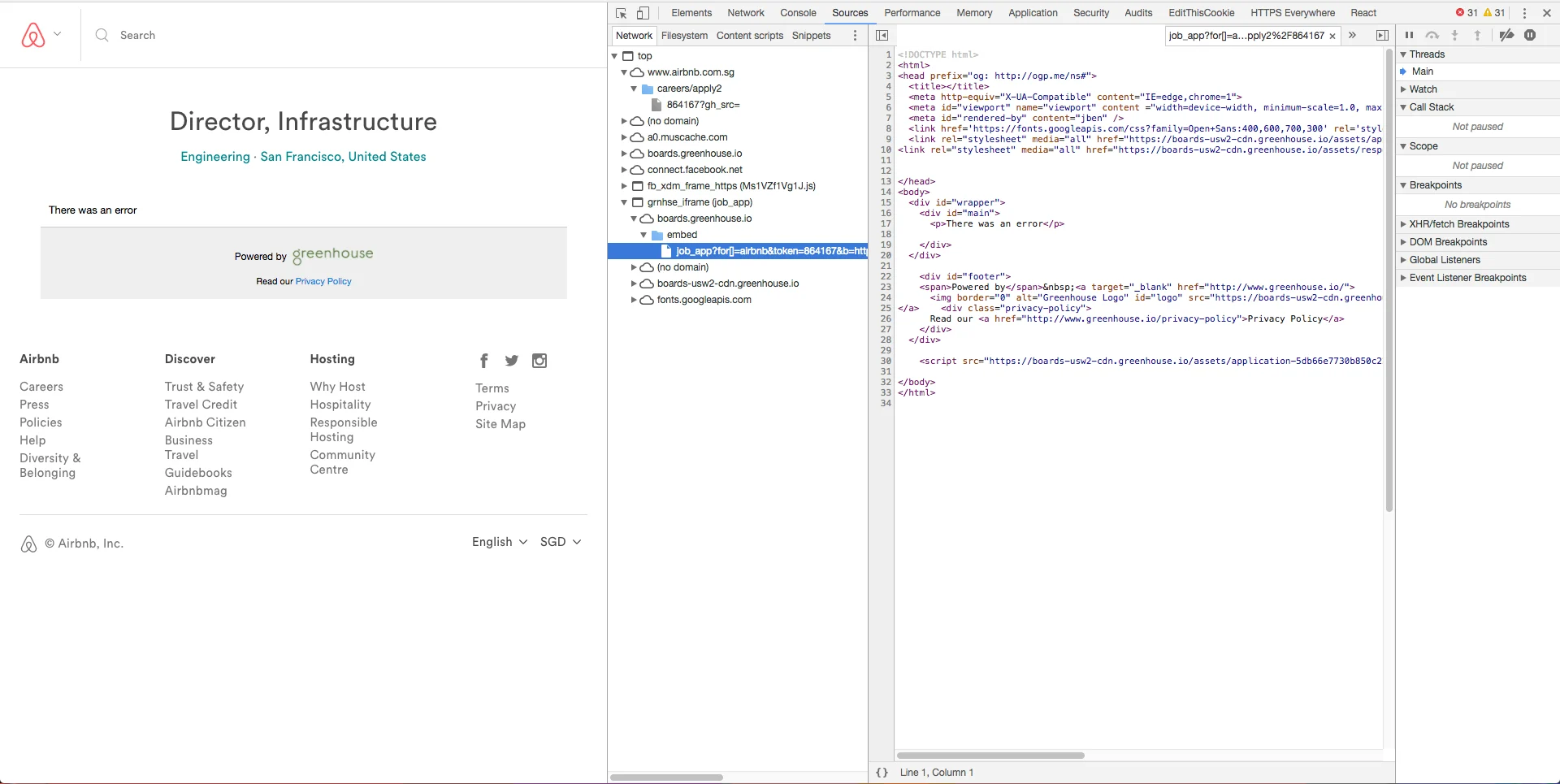
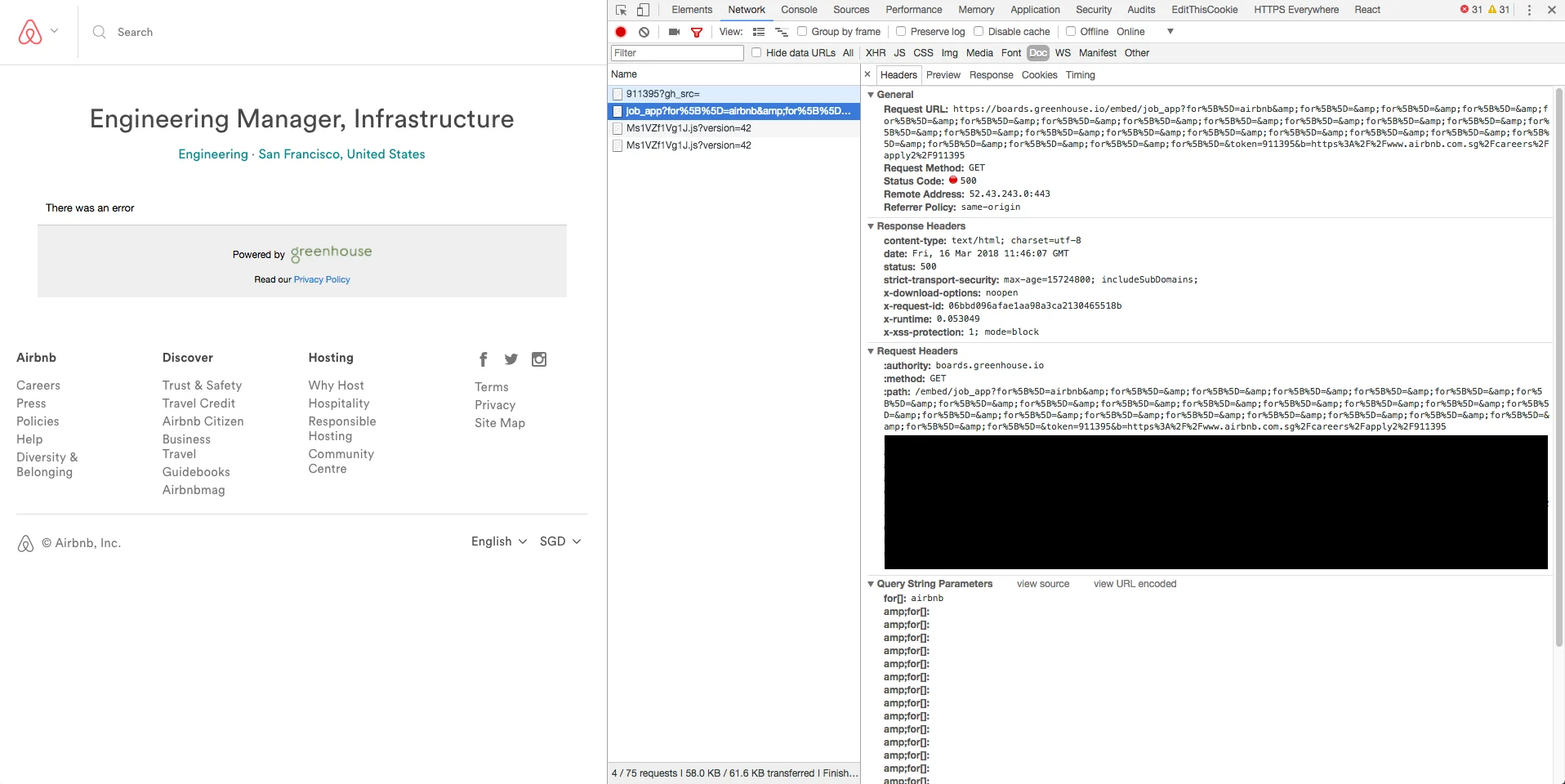
The impact of corrupting the boardURI and applicationURI values is that the job_app or job_board iframes would fail to load in the client's website since the URI is incorrect, resulting in a denial of service for the client. One example is that Airbnb's job application page shows a Greenhouse.io error page (see attached images), which I managed to replicate it twice and lasted for about 20 minutes and less than 5 minutes respectively.
I tried to investigate if I could reliably replicate this PoC by waiting for cache to expire, as well as across several domains, but failed to find anything conclusive without knowledge of the underlying network architecture. Additionally, I am not sure if what is going on at play is due to a cache, and seeing that some IDs take quite a while to recover back to its normal state, I will stop trying to replicate the attack for now.
P.S. This is my first report, so do let me know if I could be of more help!
Impact
If the attacker has more patience and knowledge about the underlying architecture, the attacker could attempt to poison the cache reliably, resulting in an extended denial of service of Greenhouse job boards/application iframes in client sites.
Attachments
Not written yet. The AI write-up for this report has not been written yet. The Original tab links to the source.
How it worked
Root cause
Likely the application did not properly validate or normalise array parameters, and the generated JavaScript was cached without considering the full query string, allowing cache poisoning.
Impact
The corrupted JavaScript causes the job board or application iframes to fail to load on customer sites, resulting in a denial of service that lasted around 20-30 minutes in tests.
What the attacker needed
Knowledge of the endpoint; ability to send crafted requests
How it was found
- Send a request to the embed endpoint with an array of 'for' parameters (e.g., for[]=twitter&for[]=&...).
- Observe that the returned JavaScript contains corrupted boardURI and applicationURI values.
- Request the original URL with a single 'for' parameter and see that the cached corrupted JavaScript is returned.
- Visit a customer site (e.g., Airbnb) and observe that the embedded iframe fails to load, showing an error page.
Explained by bugbounty.wiki with AI from the original and checked against quotes from it; it can still be wrong. Read the original before relying on a detail.
Not written yet. The AI write-up for this report has not been written yet. The Original tab links to the source.
A website can store a copy of a page to serve it faster later; this is called caching. The attacker found that by adding extra parameters to a URL, the server generated a broken version of a JavaScript file and saved it in the cache. After that, anyone requesting the normal URL got the broken file, so the job board iframes on customer sites failed to load.
What is Cache bugs?
A cache and the origin disagree about a request, so a poisoned response is served to everyone or a private page is stored as public.