Denial of service via cache poisoning on https://www.data.gov/
A crafted request with an unexpected host header caused the site to return a 502 error, and the response was stored in the cache. An attacker could then make that cached error page appear for other visitors, persistently blocking access to the affected page.

- Disclosed after 11 months
An attacker can persistently block access to any on https://www.data.gov/ by using cache poisoning with the h0st headers to cause 502 response code。
To replicate: load https://www.data.gov/ in your browser. look the burp , add ?xyzxyz=1 as cache buster , and add h0st headers h0st: wrtqvavjigwdvoqk in your burp. load https://www.data.gov/?xyzxyz=1 in your browser. again. and you win see 502 ERROR
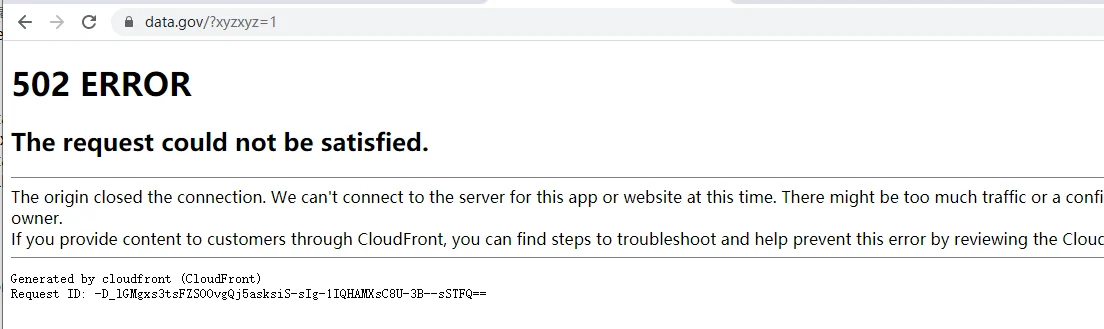
To be more clearer, see my video
my http request:
GET /?xyzxyz=1 HTTP/1.1
Host: www.data.gov
Connection: close
Cache-Control: max-age=0
Upgrade-Insecure-Requests: 1
User-Agent: Mozilla/5.0 (Windows NT 10.0; Win64; x64) AppleWebKit/537.36 (KHTML, like Gecko) Chrome/84.0.4147.89 Safari/537.36
Accept: text/html,application/xhtml+xml,application/xml;q=0.9,image/webp,image/apng,*/*;q=0.8,application/signed-exchange;v=b3;q=0.9
Sec-Fetch-Site: none
Sec-Fetch-Mode: navigate
Sec-Fetch-User: ?1
h0st: wrtqvavjigwdvoqk
Sec-Fetch-Dest: document
Accept-Encoding: gzip, deflate
Accept-Language: zh-CN,zh;q=0.9
For more information on the theory behind this attack, check out https://portswigger.net/research/responsible-denial-of-service-with-web-cache-poisoning
Similar report: https://hackerone.com/reports/622122 https://hackerone.com/reports/409370
Impact
An attacker can persistently block access to any on https://www.data.gov/
Not written yet. The AI write-up for this report has not been written yet. The Original tab links to the source.
How it worked
Root cause
Likely the cache key did not include the unexpected host header, so a response generated for a malformed request was stored and reused for normal visitors.
Impact
An attacker could persistently block access to pages on the site for other visitors by poisoning the cache with an error response.
What the attacker needed
No account needed; ability to send custom headers
How it was found
- Load the site in a browser.
- In Burp, add a cache-buster query parameter and an unexpected host header.
- Request the same URL with the cache-buster again.
- Observe the 502 error.
Explained by bugbounty.wiki with AI from the original and checked against quotes from it; it can still be wrong. Read the original before relying on a detail.
Not written yet. The AI write-up for this report has not been written yet. The Original tab links to the source.
A cache is a store that keeps a copy of a page so it loads faster for the next visitor. Here, a request with a strange extra header made the server produce an error page, and that error page was saved in the cache. Because the saved copy is served to everyone, other people would see the error instead of the real page.
What is Cache bugs?
A cache and the origin disagree about a request, so a poisoned response is served to everyone or a private page is stored as public.


