blockstack.org - is vulnerable to (CVE-2016-2183, CVE-2016-6329)
The server supports 3DES with a 64-bit block size, vulnerable to Sweet32. An attacker on the same network could potentially decrypt victim data.

- Disclosed after 5.3 years
Descriptions Cryptographic protocols like TLS, SSH, IPsec, and OpenVPN commonly use block cipher algorithms, such as AES, Triple-DES, and Blowfish, to encrypt data between clients and servers. To use such algorithms, the data is broken into fixed-length chunks, called blocks, and each block is encrypted separately according to a mode of operation. Older block ciphers, such as Triple-DES and Blowfish use a block size of 64 bits, whereas AES uses a block size of 128 bits. A attacker can can decrypt victim data using Sweet32 birthday attck vulnerability over wifi or (local network) Hackerone Refferals #232463 #375097 #216271 #210331
###Steps To Reproduce:
- open nmap and type:
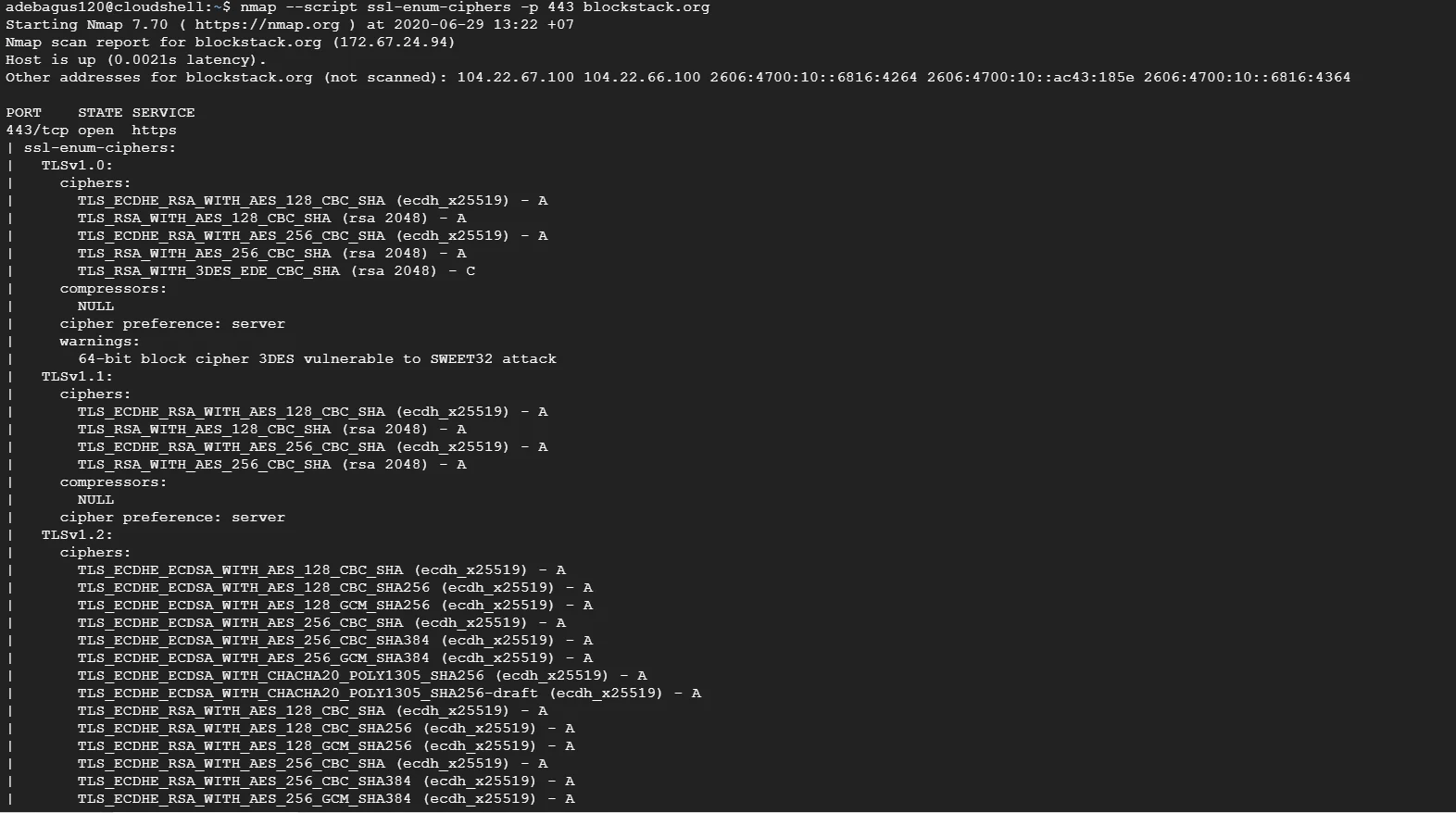
nmap --script ssl-enum-ciphers blockstack.org - and wait until it finishes the scan
- here are the results 64-bit block cipher 3DES vulnerable to SWEET32 attack Key exchange (secp192r1) of lower strength than certificate key
note: this vulnerability and exploitation has been demo'ed at defcon ref site: https://sweet32.info/
Response
443/tcp open  https
| ssl-enum-ciphers:
|   TLSv1.0:
|     ciphers:
|       TLS_ECDHE_RSA_WITH_AES_128_CBC_SHA (ecdh_x25519) - A
|       TLS_RSA_WITH_AES_128_CBC_SHA (rsa 2048) - A
|       TLS_ECDHE_RSA_WITH_AES_256_CBC_SHA (ecdh_x25519) - A
|       TLS_RSA_WITH_AES_256_CBC_SHA (rsa 2048) - A
|       TLS_RSA_WITH_3DES_EDE_CBC_SHA (rsa 2048) - C
|     compressors:
|       NULL
|     cipher preference: server
|     warnings:
|       64-bit block cipher 3DES vulnerable to SWEET32 attack
|   TLSv1.1:
|     ciphers:
|       TLS_ECDHE_RSA_WITH_AES_128_CBC_SHA (ecdh_x25519) - A
|       TLS_RSA_WITH_AES_128_CBC_SHA (rsa 2048) - A
|       TLS_ECDHE_RSA_WITH_AES_256_CBC_SHA (ecdh_x25519) - A
|       TLS_RSA_WITH_AES_256_CBC_SHA (rsa 2048) - A
How to fix this vulnerability It's recommended to disable SSLv3 and replace it with TLSv1.0 as soon as compatibility with legacy clients is no longer required. (The only browser that does not support TLSv1.0 is Internet Explorer 6).
To disable SSLv2 and SSLv3: For Nginx: ssl_protocols TLSv1 TLSv1.1 TLSv1.2;
Proof On Concept
- F886917
Impact
(CVE-2016-2183, CVE-2016-6329)
Attachments
Not written yet. The AI write-up for this report has not been written yet. The Original tab links to the source.
How it worked
Root cause
Likely the server's TLS configuration includes the 3DES cipher suite, which uses a 64-bit block size and is susceptible to the Sweet32 attack.
Impact
An attacker on the same network could potentially decrypt victim data using the Sweet32 attack.
What the attacker needed
Attacker on same network
The fix
The server should be configured to disable SSLv3 and use TLSv1.0 or later.
How it was found
- Run an nmap scan with the ssl-enum-ciphers script against the target host.
- Wait for the scan to complete.
- Review the output for warnings about 64-bit block ciphers.
Explained by bugbounty.wiki with AI from the original and checked against quotes from it; it can still be wrong. Read the original before relying on a detail.
Not written yet. The AI write-up for this report has not been written yet. The Original tab links to the source.
Some old encryption methods use small blocks of data. If a lot of data is sent, an attacker on the same Wi-Fi can sometimes recover small parts of it. This report found that the website still allows such an old method.
What is Crypto?
Encryption, signatures, randomness or certificate checks that do not protect what they claim to.



