How I hijacked the top-level domain of a sovereign state
A name server domain used in the NS delegations for the .cd country-code top-level domain had lapsed and was heading for deletion, so anyone could buy it and gain authoritative DNS control over part of the TLD. The author purchased it to prevent abuse, and could have redirected, intercepted or spoofed DNS answers for .cd domains.
 Published on labs.detectify.com
‘Twas the week before Christmas 2020 and I decided to run an analysis of all NS records used by all the TLDs globally. However one thing caught my attention.
The full write-up lives on its author's site
It belongs to its author, so we link to it rather than copy it. The other two tabs are our own rewrites, checked against it.
Context
The target here is not a web application but the DNS delegation of a country-code top-level domain: .cd, the ccTLD of the Democratic Republic of Congo. A TLD is kept alive by a set of name servers listed in the root zone. For .cd, some of those name servers lived under a domain name that a private party had registered and could let expire: scpt-network.com.
When a registry publishes NS records for a TLD, resolvers around the world cache and query those name servers. Whoever controls the name servers controls the answers for every domain under the TLD, including apex domains, subdomains, TXT records and everything else. The report describes what happens when one of those name server hostnames falls out of the registry's hands and into anyone else's.

Setup
The work used standard DNS tooling, including dig and a small bash script. The researcher, Fredrik N. Almroth, used dig to enumerate NS records and a small bash script to watch the EPP status of a domain name. No accounts on the target, no credentials and no special access were needed: the whole precondition was that scpt-network.com was a normal, publicly registrable domain name whose registration was about to lapse.
The timeline in the report:
- The week before Christmas 2020: analysis of NS records used by all TLDs globally.
- About a week later: the domain moved to
pendingDelete. - 30 December 2020, evening: the domain was purchased.
- 7 January 2021: the
.cdcontacts listed at IANA were approached. - 8 January 2021: a report was submitted to the Internet Bug Bounty on HackerOne; NS delegations from
.cdappear to have stopped around this date.
Finding it
While going through the NS records of every TLD, one detail stood out. The domain scpt-network.com carried the EPP status code redemptionPeriod, which means the registrant had failed to renew it in time. That domain was not incidental: it supplied several of the name servers for .cd.
almroot@x:~$ dig NS +trace cd | grep "cd."
cd.			172800	IN	NS	ns-root-5.scpt-network.com.
cd.			172800	IN	NS	igubu.saix.net.
cd.			172800	IN	NS	sangoma.saix.net.
cd.			172800	IN	NS	ns-root-2.scpt-network.com.
cd.			172800	IN	NS	sabela.saix.net.
cd.			172800	IN	NS	ns-root-1.scpt-network.com.
The output shows six NS records for cd.: three under scpt-network.com (ns-root-1, ns-root-2, ns-root-5) and three under saix.net (igubu, sangoma, sabela). The three scpt-network.com entries are the ones that depend on a domain anyone could register once it expired.
To follow the status, the researcher wrote a bash script that pinged him on any EPP status change of the domain. About a week later it fired: the domain had reached pendingDelete. At that point the severity was clear. The name would soon be purchasable by anyone on the Internet, and the buyer would inherit the NS capability for .cd.
The script was modified to probe the registrar on a minute basis for further status changes. On the evening of 30 December it fired again, and the domain was bought to keep it out of other hands.
Exploitation
Step 1: keep the TLD answering while the domain is held
Because the three SAIX delegations were still working, .cd remained operable throughout the period, with a slight performance impact on lookups. The TLD did not go dark; it simply had fewer working name servers than usual.
Step 2: point a name server hostname at a host you control
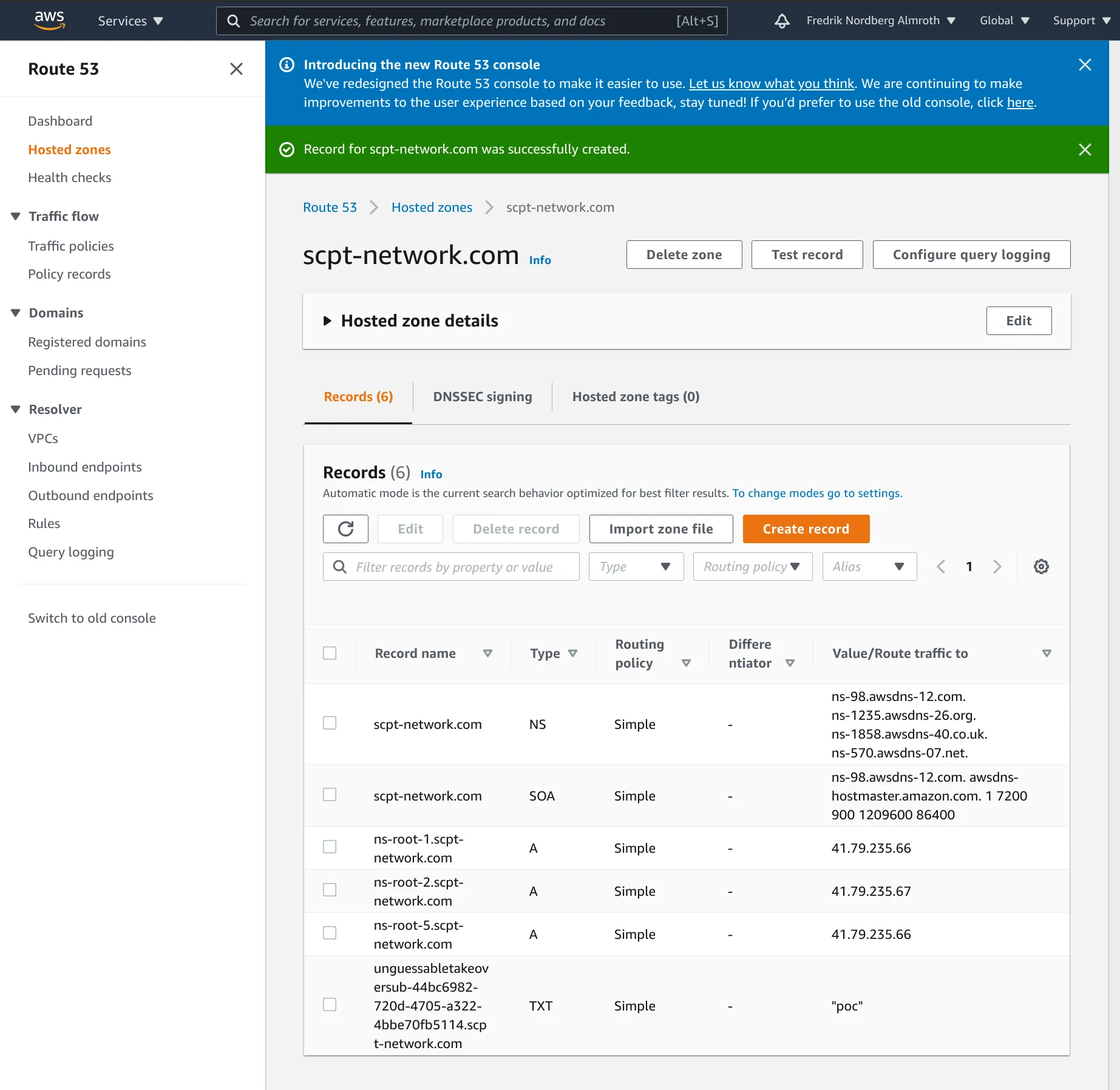
Owning scpt-network.com meant every subdomain under that zone could be configured at will. Creating a subdomain such as ns-root-1 with an A record pointing to an IP address of the researcher's choosing meant that address would receive legitimate incoming DNS queries meant for .cd. Any DNS response to those queries would be accepted by the caller.

Step 3: understand what happens when you stay silent
Not replying causes the caller to time out and assume SERVFAIL. That is the benign outcome: a SERVFAIL forces the caller to try another NS record for the zone, so it eventually reaches one of the legitimate SAIX servers and is routed correctly. The three SAIX delegations kept the TLD operable throughout this period.
Step 4: answer instead of staying silent
The interesting case is the opposite one. If the controlled name server answers, the caller accepts the answer. The report walks through what that enables, using google.cd as an illustration: reply to any NS request for google.cd with ns-root-1.scpt-network.com instead of the legitimate set ([ns1,ns2,n3,ns4].google.com), and the caller will then send all subsequent DNS requests for that domain to the name server the researcher controls.
Step 5: redirect everything
A broader version: reply to all NS queries with a reference back to the controlled server, and answer every A question with the chosen IP. Every lookup for any apex or subdomain eventually lands on the manipulated A pointer, and all subsequent network traffic is redirected there, which turns the controlled host into the focus of a DDoS.
Step 6: break availability at TLD scale
Because the controlled name servers were part of the delegation set, this also affects availability of the entire TLD: 50% of the DNS traffic would become faulty. The impact of both DoS directions can be amplified by setting a high TTL in the DNS replies, so resolvers keep the bad answers for longer.
Step 7: obtain valid certificates
Targeting TXT records served for google.cd would allow abuse of Let's Encrypt's DNS-01 challenge to issue a valid certificate for google.cd, undermining SSL/TLS. With control of the NS delegations of any .cd apex domain and the ability to get valid certificates, a MITM attack becomes possible even when SSL/TLS is enforced by the target. The report notes that Google has countermeasures for this kind of abuse, but that this is not the case for all apex domain names under .cd, and points to CA/Browser Forum BR 1.7.3 for how CAs verify domain ownership.
Step 8: reach into local networks through WPAD
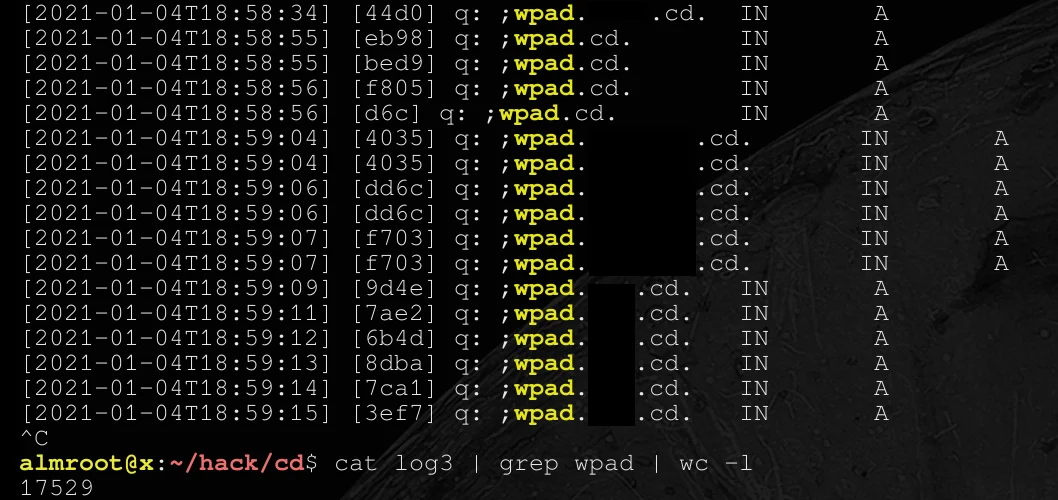
With privileged access on an upstream host that has DNS control, local networks of companies that send DNS lookups for WPAD can be infiltrated: monitor their queries, spoof a reply, and redirect the local caller to download and execute a malicious JS-based proxy configuration over the Internet. The report notes that WPAD has had its share of issues, including RCE vulnerabilities discussed by Google's Project Zero.
Root cause
The design mistake is that a ccTLD delegated part of its authority to name server hostnames inside a domain name that was not kept under the registry's control. The NS records for cd. pointed at ns-root-1, ns-root-2 and ns-root-5 under scpt-network.com, so the security of those delegations depended on the renewal of an ordinary registration. Once that registration lapsed through redemptionPeriod to pendingDelete, the delegation could be inherited by anyone willing to pay for the domain.
Existing defences did not stop it. The remaining SAIX name servers kept the TLD resolvable, which limited the damage but did not prevent an attacker from answering queries sent to the compromised hostnames. Nothing in the DNS protocol ties an NS hostname to a particular operator; a resolver that receives a valid answer from a delegated name server accepts it.
Impact
Hijacking the ccTLD of a sovereign state has serious implications, especially in the hands of cybercriminals or a foreign adversary. The DRC has roughly 90 million people, and many international companies and organisations operate .cd websites. TLD-level DNS hijacking is rare but not unheard of: the report cites the former Soviet Union's .su being hijacked by cybercriminals in the past, and Lenovo and Google websites for Vietnam (.vn) falling prey to DNS hijacking in 2015.
The concrete abuse paths the researcher lists, had he operated with malicious intent:
- Passively intercept DNS traffic, usable for surveillance or data exfiltration.
- Create new domain names out of thin air, with the capabilities that implies when leveraged for Fast Fluxing.
- Launch RCE attacks on local networks, targeting companies that use WPAD to query public DNS servers.
- Reply to legitimate DNS queries with bogus responses, taking over targeted apex domains for companies or institutions with a
.cdwebsite, or launching a DDoS attack.
Redirecting traffic from legitimate .cd websites to a phishing site is one clear path; MITM even under enforced SSL/TLS is another, via DNS-01 issuance; and availability of the whole TLD is at stake, with 50% of DNS traffic becoming faulty and high TTLs amplifying the effect. The report hedges where it should: Google has mitigations for certificate abuse, but not every apex under .cd does, and the WPAD path depends on a company sending WPAD lookups to public DNS servers.
Fix
On 7 January the researcher contacted the Administrative and Technical contacts listed for .cd on IANA's webpage, initially intending to transfer ownership of the domain back to the entity operating .cd. One contact replied and delegated to a colleague, but as of writing there was no follow-up confirmation that the issue was fixed. The issue nevertheless appears to have been patched shortly afterwards: the DNS traffic previously controlled for .cd was redirected to scpt-network.net, and NS delegations from .cd seem to have stopped around 8 January 2021. A report was also submitted to the Internet Bug Bounty on HackerOne on 8 January.
As of writing, the researcher still owns scpt-network.com, deliberately, to prevent malicious actors from taking the ccTLD within the narrow window in which the domain could have been taken over by anyone. No damage appears to have been done.
The report does not describe the registry's fix beyond the traffic being redirected to scpt-network.net. A registry that does depend on external hostnames should watch their EPP status and treat a lapse as an incident.
Variants to test
- Enumerate NS records for every TLD and resolve each hostname to its registrable domain. A positive result is a TLD whose delegation depends on a domain that is not owned by the registry or a stable third party.
- Check the EPP status of every such domain for
redemptionPeriod,pendingDeleteor expiry dates close to the present. A positive result is a delegated name server hostname that is about to become registrable. - Apply the same enumeration to second-level delegations: NS records of large organisations that point at hostnames under domains with weak renewal hygiene. A positive result is an apex domain whose NS set can be inherited by registering an expiring domain.
- For any domain you can register, create a subdomain matching the delegated hostname with an A record to a host you control, and observe whether queries for the parent zone arrive. A positive result is legitimate DNS queries for the parent arriving at your host.
- Test the certificate path: if you receive queries for TXT records of a target apex, check whether a DNS-01 challenge for that apex can be completed. A positive result is a valid certificate issued for a domain you do not own.
- Test the WPAD path from a network that sends WPAD lookups to public resolvers. A positive result is a client fetching a proxy configuration file from a host you control.
What happened, in plain words
Every website address you type, like example.cd, has to be translated into a numeric address before your browser can connect. That translation is done by a system called DNS, and the computers that do the translating are called name servers. A country's top-level domain, the last part of the address such as .cd for the Democratic Republic of Congo, is looked after by a small set of name servers. If someone else gains control of those name servers, they can decide what every .cd address in the world resolves to.
This is the story of how one researcher, Fredrik N. Almroth, noticed that some of the name servers for .cd lived under an ordinary domain name, scpt-network.com, that nobody had renewed. When that domain expired, anyone on the Internet could buy it, and with it inherit the ability to answer DNS queries for the whole country. He bought it himself to keep it out of other hands, and for a short while he controlled about half of the DNS traffic for the TLD. The report explains what that control could have been used for, and how the problem was eventually fixed.
Background: what DNS and name servers are
When you open a website, your computer does not know where that website lives. It asks a DNS resolver, a kind of Internet phone book, for the numeric address (the IP address) behind the name. The resolver may not know the answer itself, so it asks other computers, called name servers, which are responsible for parts of the phone book.
The phone book is organised in layers. At the very top are the root servers. Below them are the top-level domains: .com, .org, and country codes such as .cd. Each top-level domain publishes a list of name servers that know about it. That list is called the NS records, short for name server records. Anyone who controls those name servers controls the answers for every domain underneath.
A top-level domain like .cd is called a ccTLD, short for country-code top-level domain. It is the two-letter ending that belongs to a country. The .cd ccTLD belongs to the Democratic Republic of Congo.
A domain name such as scpt-network.com is registered with a registrar, a company that sells domain names. Registrations have to be renewed, usually once a year. If the owner does not pay, the domain goes through a series of statuses. One is redemptionPeriod, a grace period during which the old owner can still reclaim it. The next is pendingDelete, meaning it is about to be released and can then be bought by anyone.
EPP stands for Extensible Provisioning Protocol. It is the technical language registrars use to talk to the registry that keeps the official record of who owns which domain. The EPP status code is simply the current state of a domain in that record, for example whether it is active, in redemption, or pending deletion.
Finding it
The researcher started by looking at the name server records of every top-level domain in the world. This is public information: anyone can ask for it. One detail stood out. The domain scpt-network.com had the EPP status redemptionPeriod, which meant its owner had failed to renew it in time.
That domain was not incidental. It supplied several of the name servers for .cd. To see this, he ran a command called dig, a standard tool for asking DNS questions from a terminal. The command below asks for the NS records of cd and follows the chain of servers that answer, then filters the output to lines containing cd..
almroot@x:~$ dig NS +trace cd | grep "cd."
cd.			172800	IN	NS	ns-root-5.scpt-network.com.
cd.			172800	IN	NS	igubu.saix.net.
cd.			172800	IN	NS	sangoma.saix.net.
cd.			172800	IN	NS	ns-root-2.scpt-network.com.
cd.			172800	IN	NS	sabela.saix.net.
cd.			172800	IN	NS	ns-root-1.scpt-network.com.
Line by line, in plain words:
almroot@x:~$is the command prompt: the useralmrooton a machine calledx, sitting in their home directory. Everything after it is the command that was typed.digis the DNS lookup tool.NStellsdigto ask for name server records.+tracetellsdigto start at the root servers and follow the delegation down to the answer, showing each step.cdis the domain being asked about, here the top-level domain itself.| grep "cd."pipes the output throughgrep, a text filter, keeping only lines that containcd..- Each result line has the same shape: the name
cd., a number172800(the TTL, or time to live, in seconds, meaning how long a resolver may cache the answer), the classIN(Internet), the record typeNS, and then the name server hostname.
The output shows six name servers for cd.. Three of them, ns-root-1, ns-root-2 and ns-root-5, live under scpt-network.com. The other three, igubu, sangoma and sabela, live under saix.net, which is the South African Internet eXchange. The three scpt-network.com entries are the ones that depend on a domain anyone could register once it expired.
To keep an eye on the situation, the researcher wrote a small bash script, a short program for the command line, that would send him a notification whenever the EPP status of the domain changed. About a week later it fired: the domain had reached pendingDelete. At that point the severity was clear. The name would soon be purchasable by anyone on the Internet, and the buyer would inherit the ability to act as a name server for .cd.
He modified the script to check the registrar every minute for further status changes. On the evening of 30 December it fired again, and he bought the domain to keep it out of other hands.
Exploitation: what control of the domain allowed
Step 1: keep the TLD answering while the domain is held
Because the three SAIX name servers were still working, .cd remained usable throughout the period, with a slight slowdown on lookups. The TLD did not go dark; it simply had fewer working name servers than usual.
Step 2: point a name server hostname at a host you control
Owning scpt-network.com meant every subdomain under that zone could be configured at will. A subdomain is a name that sits in front of the main domain, such as ns-root-1.scpt-network.com. An A record is the DNS record that maps a name to an IP address, the numeric address of a machine on the Internet.
By creating a subdomain such as ns-root-1 with an A record pointing to an IP address of his choosing, the researcher made that address receive legitimate incoming DNS queries meant for .cd. Any DNS response to those queries would be accepted by the caller. In other words, the Internet's resolvers had been told by the .cd delegation that this hostname was a valid name server, so they trusted whatever it said.
Step 3: understand what happens when you stay silent
Not replying causes the caller to time out and assume SERVFAIL. SERVFAIL is a DNS status meaning the lookup failed on the server side. That is the benign outcome: a SERVFAIL forces the caller to try another name server record for the zone, so it eventually reaches one of the legitimate SAIX servers and is routed correctly. The three SAIX delegations kept the TLD operable throughout this period.
Step 4: answer instead of staying silent
The interesting case is the opposite one. If the controlled name server answers, the caller accepts the answer. The report walks through what that enables, using google.cd as an illustration: reply to any NS request for google.cd with ns-root-1.scpt-network.com instead of the legitimate set ([ns1,ns2,n3,ns4].google.com), and the caller will then send all subsequent DNS requests for that domain to the name server the researcher controls.
In plain terms, the first answer redirects the resolver to a different name server, and from then on every question about that domain is answered by the attacker. The caller accepts the answer from the name server it was pointed to.
Step 5: redirect everything
A broader version: reply to all NS queries with a reference back to the controlled server, and answer every A question with the chosen IP. Every lookup for any apex or subdomain eventually lands on the manipulated A pointer, and all subsequent network traffic is redirected there. An apex domain is the main domain itself, such as example.cd, as opposed to a subdomain like shop.example.cd.
This turns the controlled host into the focus of a DDoS, a distributed denial of service attack, where many machines are pointed at one target at once.
Step 6: break availability at TLD scale
Because the controlled name servers were part of the delegation set, this also affects availability of the entire TLD: 50% of the DNS traffic would become faulty. The impact of both DoS directions can be amplified by setting a high TTL in the DNS replies, so resolvers keep the bad answers for longer. TTL, time to live, is how many seconds a resolver is allowed to remember an answer before asking again. A high TTL means a wrong answer sticks around for a long time.
Step 7: obtain valid certificates
Targeting TXT records served for google.cd would allow abuse of Let's Encrypt's DNS-01 challenge to issue a valid certificate for google.cd, undermining SSL/TLS. A TXT record is a DNS record that holds free-form text. Let's Encrypt is a certificate authority, an organisation that issues the digital certificates websites use to prove their identity and enable encrypted HTTPS connections. The DNS-01 challenge is one way Let's Encrypt checks that you control a domain: it asks you to publish a specific value in a TXT record. If you control the DNS answers, you can publish that value and pass the check.
With control of the NS delegations of any .cd apex domain and the ability to get valid certificates, a MITM attack becomes possible even when SSL/TLS is enforced by the target. MITM stands for man in the middle: an attacker who sits between you and the website, reading or altering traffic while both sides believe they are talking directly to each other.
The report notes that Google has countermeasures for this kind of abuse, but that this is not the case for all apex domain names under .cd, and points to CA/Browser Forum BR 1.7.3 for how certificate authorities verify domain ownership. The CA/Browser Forum is the industry body that writes the rules certificate authorities must follow.
Step 8: reach into local networks through WPAD
With privileged access on an upstream host that has DNS control, local networks of companies that send DNS lookups for WPAD can be infiltrated: monitor their queries, spoof a reply, and redirect the local caller to download and execute a malicious JS-based proxy configuration over the Internet.
WPAD stands for Web Proxy Auto-Discovery. It is a way for a computer to find out automatically which proxy server to use for web traffic, by looking up a special name such as wpad in DNS. A proxy is an intermediary that forwards web requests. If an attacker can answer that lookup, they can point the computer at a proxy configuration file of their choosing. A JS-based proxy configuration is a file written in JavaScript that tells the browser how to route requests. The report notes that WPAD has had its share of issues, including RCE vulnerabilities discussed by Google's Project Zero. RCE means remote code execution: an attacker can run their own code on the victim's machine.
Root cause
The design mistake is that a ccTLD delegated part of its authority to name server hostnames inside a domain name that was not kept under the registry's control. The NS records for cd. pointed at ns-root-1, ns-root-2 and ns-root-5 under scpt-network.com, so the security of those delegations depended on the renewal of an ordinary registration. Once that registration lapsed through redemptionPeriod to pendingDelete, the delegation could be inherited by anyone willing to pay for the domain.
Existing defences did not stop it. The remaining SAIX name servers kept the TLD resolvable, which limited the damage but did not prevent an attacker from answering queries sent to the compromised hostnames. Nothing in the DNS protocol ties a name server hostname to a particular operator; a resolver that receives a valid answer from a delegated name server accepts it.
Impact
Hijacking the ccTLD of a sovereign state has serious implications, especially in the hands of cybercriminals or a foreign adversary. The DRC has roughly 90 million people, and many international companies and organisations operate .cd websites. TLD-level DNS hijacking is rare but not unheard of: the report cites the former Soviet Union's .su being hijacked by cybercriminals in the past, and Lenovo and Google websites for Vietnam (.vn) falling prey to DNS hijacking in 2015.
The concrete abuse paths the researcher lists, had he operated with malicious intent:
- Passively intercept DNS traffic, usable for surveillance or data exfiltration. Data exfiltration means secretly moving data out of a network.
- Create new domain names out of thin air, with the capabilities that implies when leveraged for Fast Fluxing. Fast Fluxing is a technique where a criminal domain keeps changing the addresses it resolves to, to stay ahead of takedowns.
- Launch RCE attacks on local networks, targeting companies that use WPAD to query public DNS servers.
- Reply to legitimate DNS queries with bogus responses, taking over targeted apex domains for companies or institutions with a
.cdwebsite, or launching a DDoS attack.
Redirecting traffic from legitimate .cd websites to a phishing site is one clear path. Phishing is a fake website that looks real and collects passwords or payment details. MITM even under enforced SSL/TLS is another, via DNS-01 issuance. And availability of the whole TLD is at stake, with 50% of DNS traffic becoming faulty and high TTLs amplifying the effect. The report hedges where it should: Google has mitigations for certificate abuse, but not every apex under .cd does, and the WPAD path depends on a company sending WPAD lookups to public DNS servers.
Fix
On 7 January the researcher contacted the Administrative and Technical contacts listed for .cd on IANA's webpage, initially intending to transfer ownership of the domain back to the entity operating .cd. IANA is the organisation that keeps the global list of top-level domains and the contacts for each one. One contact replied and delegated to a colleague, but as of writing there was no follow-up confirmation that the issue was fixed.
The issue nevertheless appears to have been patched shortly afterwards: the DNS traffic previously controlled for .cd was redirected to scpt-network.net, and NS delegations from .cd seem to have stopped around 8 January 2021. A report was also submitted to the Internet Bug Bounty on HackerOne on 8 January. HackerOne is a platform where security researchers report bugs to organisations, and the Internet Bug Bounty is a programme that pays for bugs affecting core Internet infrastructure.
As of writing, the researcher still owns scpt-network.com, deliberately, to prevent malicious actors from taking the ccTLD within the narrow window in which the domain could have been taken over by anyone. No damage appears to have been done.
The report does not describe the registry's fix beyond the traffic being redirected to scpt-network.net. A registry that does depend on external hostnames should watch their EPP status and treat a lapse as an incident.
Variants to test
These are the same checks, written so that someone new to security can follow the reasoning. Each one describes what to look at and what a positive result would mean.
- Enumerate NS records for every TLD and resolve each hostname to its registrable domain. A positive result is a TLD whose delegation depends on a domain that is not owned by the registry or a stable third party.
- Check the EPP status of every such domain for
redemptionPeriod,pendingDeleteor expiry dates close to the present. A positive result is a delegated name server hostname that is about to become registrable. - Apply the same enumeration to second-level delegations: NS records of large organisations that point at hostnames under domains with weak renewal hygiene. A positive result is an apex domain whose NS set can be inherited by registering an expiring domain.
- For any domain you can register, create a subdomain matching the delegated hostname with an A record to a host you control, and observe whether queries for the parent zone arrive. A positive result is legitimate DNS queries for the parent arriving at your host.
- Test the certificate path: if you receive queries for TXT records of a target apex, check whether a DNS-01 challenge for that apex can be completed. A positive result is a valid certificate issued for a domain you do not own.
- Test the WPAD path from a network that sends WPAD lookups to public resolvers. A positive result is a client fetching a proxy configuration file from a host you control.
Glossary
- A record: a DNS record that maps a domain name to an IP address.
- Apex domain: the main domain itself, such as
example.cd, as opposed to a subdomain likeshop.example.cd. - Bash script: a short program written for the command line on Unix-like systems.
- ccTLD: country-code top-level domain, the two-letter ending that belongs to a country, such as
.cd. - Certificate authority: an organisation that issues digital certificates used to prove a website's identity and enable encrypted connections.
- DDoS: distributed denial of service, an attack that floods a target with traffic from many machines at once.
- dig: a standard command-line tool for asking DNS questions.
- DNS: the system that translates domain names into IP addresses.
- DNS-01 challenge: a way a certificate authority checks domain ownership by asking you to publish a specific value in a DNS TXT record.
- Domain name: a human-readable name such as
example.com, registered through a registrar. - EPP: Extensible Provisioning Protocol, the language registrars use to talk to the registry that keeps the official record of domain ownership.
- EPP status code: the current state of a domain in that record, for example active, in redemption, or pending deletion.
- Fast Fluxing: a technique where a criminal domain keeps changing the addresses it resolves to, to stay ahead of takedowns.
- IANA: the organisation that keeps the global list of top-level domains and the contacts for each one.
- IP address: the numeric address of a machine on the Internet.
- MITM: man in the middle, an attacker who sits between you and a website, reading or altering traffic while both sides believe they are talking directly to each other.
- Name server: a computer that answers DNS questions for a part of the phone book.
- NS record: a DNS record that lists a name server responsible for a domain.
pendingDelete: an EPP status meaning a domain is about to be released and can then be bought by anyone.- Phishing: a fake website that looks real and collects passwords or payment details.
- Proxy: an intermediary that forwards web requests.
- RCE: remote code execution, an attacker running their own code on the victim's machine.
redemptionPeriod: an EPP status, a grace period during which the old owner of an expired domain can still reclaim it.- Registrar: a company that sells domain name registrations.
- Registry: the organisation that keeps the official record of which domains exist and who owns them.
- Resolver: the part of the DNS system that looks up answers on your behalf, often run by your Internet provider or a public service.
SERVFAIL: a DNS status meaning the lookup failed on the server side.- SSL/TLS: the encryption that protects HTTPS connections.
- Subdomain: a name that sits in front of the main domain, such as
ns-root-1.scpt-network.com. - TLD: top-level domain, the last part of a domain name, such as
.comor.cd. - TTL: time to live, how many seconds a resolver may remember a DNS answer before asking again.
- TXT record: a DNS record that holds free-form text.
- WPAD: Web Proxy Auto-Discovery, a way for a computer to find out automatically which proxy server to use, by looking up a special name in DNS.




