There is any issue No valid SPF Records
The domain's SPF record uses a soft fail (~all) instead of a hard fail (-all), which allows email spoofing. An attacker could send forged emails that appear to come from the domain, potentially leading to phishing.
 Originally disclosed on HackerOne
- Disclosed after 3 months
Summary by the program
We have been aware of issues related to domain SPF and DMARC records since before the bug bounty program was launched (see this email thread). While we may address the issue in the future, nobody in the community has judged it of sufficient importance to take the time to add/update the records.
The report
There is a email spoofing vulnerability.Email spoofing is the forgery of an email header so that the message appears to have originated from someone or somewhere other than the actual source. Email spoofing is a tactic used in phishing and spam campaigns because people are more likely to open an email when they think it has been sent by a legitimate source. The goal of email spoofing is to get recipients to open, and possibly even respond to, a solicitation.
I found :
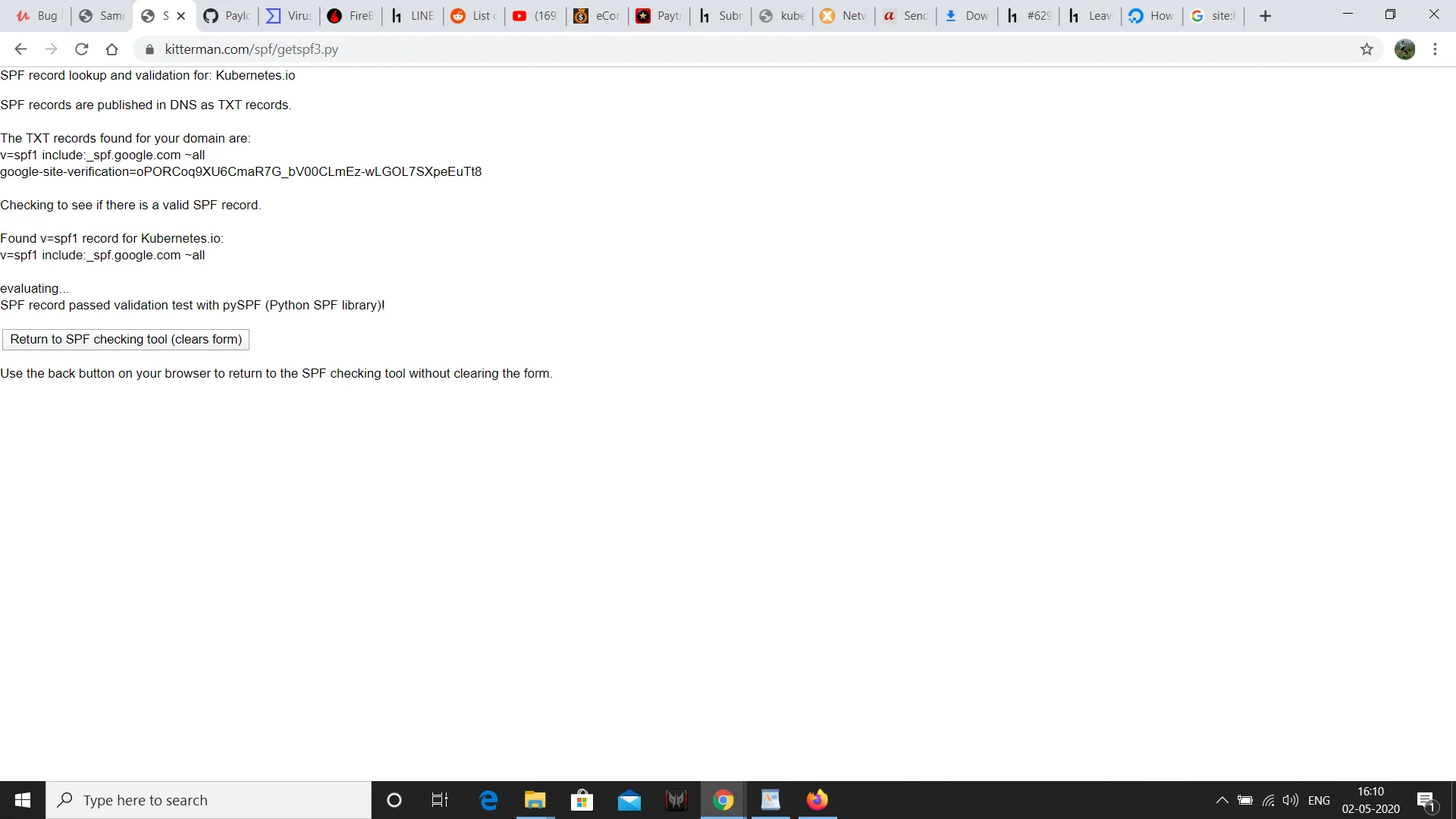
SPF record lookup and validation for: Kubernetes.io
SPF records are published in DNS as TXT records.
The TXT records found for your domain are: v=spf1 include:_spf.google.com ~all google-site-verification=oPORCoq9XU6CmaR7G_bV00CLmEz-wLGOL7SXpeEuTt8
Checking to see if there is a valid SPF record.
Found v=spf1 record for Kubernetes.io: v=spf1 include:_spf.google.com ~all
evaluating... SPF record passed validation test with pySPF (Python SPF library)!
Use the back button on your browser to return to the SPF checking tool without clearing the form.
Remediation :
Replace ~all with -all to prevent fake email.
Refferences :
Impact
An attacker would send a Fake email. The results can be more dangerous.
Attachments
Not written yet. The AI write-up for this report has not been written yet. The Original tab links to the source.
How it worked
Root cause
The SPF record uses a soft fail (~all) instead of a hard fail (-all), which permits spoofed emails to be delivered with only a warning.
Impact
An attacker could send fake emails that appear to originate from the domain, which could be used in phishing campaigns.
What the attacker needed
None
Explained by bugbounty.wiki with AI from the original and checked against quotes from it; it can still be wrong. Read the original before relying on a detail.
Not written yet. The AI write-up for this report has not been written yet. The Original tab links to the source.
SPF is a DNS record that tells email servers which servers are allowed to send email for a domain. The record here ends with ~all, which means 'soft fail' — receivers should mark suspicious mail but not reject it. Changing it to -all would tell receivers to reject mail from unauthorised servers, making spoofing harder.
What is Account takeover?
Getting into someone else's account through a flaw in sign-in, password reset, second factor, single sign-on or session handling.



