Reflected XSS on https://apps.topcoder.com/wiki/page/
A reflected cross-site scripting vulnerability exists on the wiki attachment editing page because the filename parameter is not properly sanitised. An attacker can craft a URL that executes JavaScript in a victim's browser when opened.

- Triaged in 18 hours
- Fixed in 6 days
- Disclosed after 7 days
Summary:
Hi :) A reflected XSS occurs on https://apps.topcoder.com/wiki/pages/doeditattachment.action when editing wiki pages attachments.
Steps To Reproduce:
A user can add attachments on https://apps.topcoder.com/wiki/pages/viewpageattachments.action?pageId=165871793 a wiki page and can edit on https://apps.topcoder.com/wiki/pages/editattachment.action?pageId=165871793&fileName=sss.svg. If there is an error, user redirected to doeditattachment path with an error message. An attacker can change the filename parameter and add JS codes. When a victim opens this url, XSS will execute.
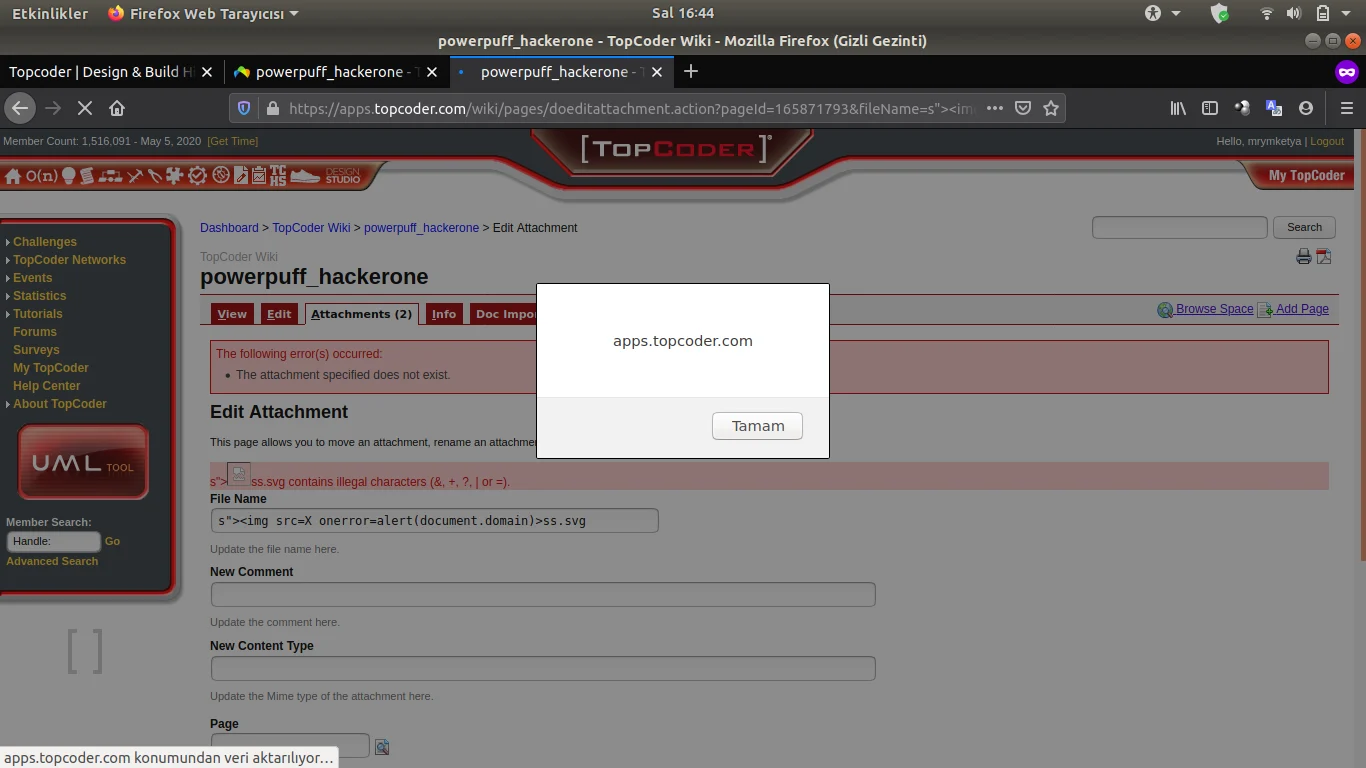
Impact
XSS can use to steal cookies or to run arbitrary code on victim's browser.
Not written yet. The AI write-up for this report has not been written yet. The Original tab links to the source.
How it worked
Root cause
Likely the application reflects the fileName parameter into the error page without proper output encoding.
Impact
An attacker could steal cookies or run arbitrary code in the victim's browser.
What the attacker needed
Victim clicks a crafted link; attacker can create or edit a wiki attachment
How it was found
- Add an attachment to a wiki page.
- Edit the attachment, causing an error that redirects to the doeditattachment path.
- Modify the fileName parameter to include JavaScript code.
- Send the crafted URL to a victim; when opened, the script executes.
Explained by bugbounty.wiki with AI from the original and checked against quotes from it; it can still be wrong. Read the original before relying on a detail.
Not written yet. The AI write-up for this report has not been written yet. The Original tab links to the source.
Cross-site scripting (XSS) is a flaw where a website inserts user input into a page without cleaning it, so an attacker can make the page run their own JavaScript. Here, the filename shown in an error message is not escaped, so a malicious filename can contain code that runs when someone visits a crafted link.
What is XSS?
Script an attacker supplies runs in another user's browser, on the target's origin, with that user's session.





