SWEET32 TLS attack
The 3DES-CBC cipher in TLS is vulnerable to a birthday attack (SWEET32) that allows decryption of customer data. An attacker could recover plaintext from long-lived TLS sessions using this cipher.
 Originally disclosed on HackerOne
- Disclosed after 14 days
Researchers have found new attack against 3DES-CBC cipher in TLS,that they can decrypt customer data using a method called SWEET32 Birthday Attack.
This Vulnerability has got CVE-2016-2183 and has cvss score 5.0
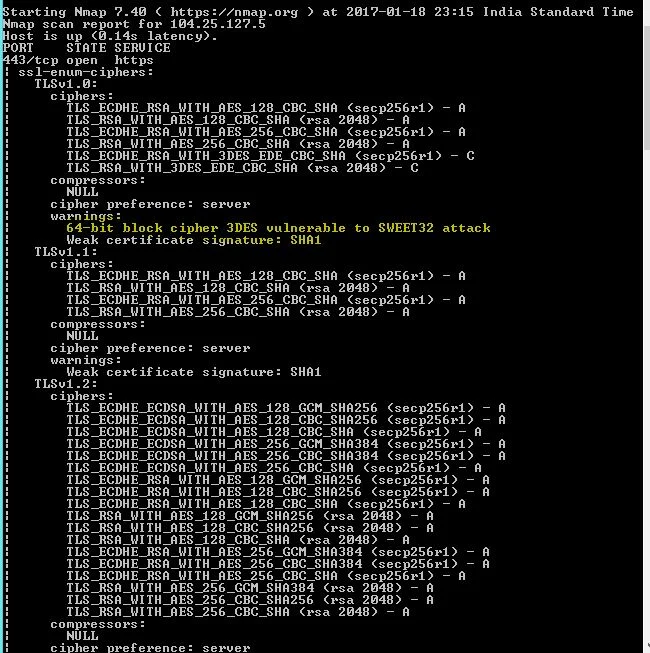
This vulnerability can be found manually by simply using nmap script
nmap -Pn -p --script ssl-enum-ciphers ip
Mitigation for SWEET32 attack
->Prefer minimum 128-bit cipher suites
->Limit the length of TLS sessions with a 64-bit cipher, which could be done with TLS renegotiation or closing and starting a new connection
-> Disable cipher suites using 3DES
Attachments
Not written yet. The AI write-up for this report has not been written yet. The Original tab links to the source.
How it worked
Impact
An attacker could decrypt customer data from TLS sessions using 3DES-CBC.
What the attacker needed
Server supports 3DES-CBC cipher; long-lived TLS session
The fix
Disable cipher suites using 3DES and prefer 128-bit or stronger ciphers, and limit TLS session length.
How it was found
- Run an nmap script to enumerate supported TLS ciphers on the target IP.
- Check if 3DES-CBC cipher suites are offered.
Explained by bugbounty.wiki with AI from the original and checked against quotes from it; it can still be wrong. Read the original before relying on a detail.
Not written yet. The AI write-up for this report has not been written yet. The Original tab links to the source.
TLS protects web traffic. The 3DES-CBC cipher in TLS is vulnerable to the SWEET32 birthday attack, which can decrypt customer data.
What is Crypto?
Encryption, signatures, randomness or certificate checks that do not protect what they claim to.





