The websocket traffic is not secure enough
The WebSocket endpoint did not validate the Origin header, allowing cross-site WebSocket hijacking. An attacker could send messages to the WebSocket from an external origin, potentially performing actions such as login.
 Originally disclosed on HackerOne
- Disclosed after 10 months
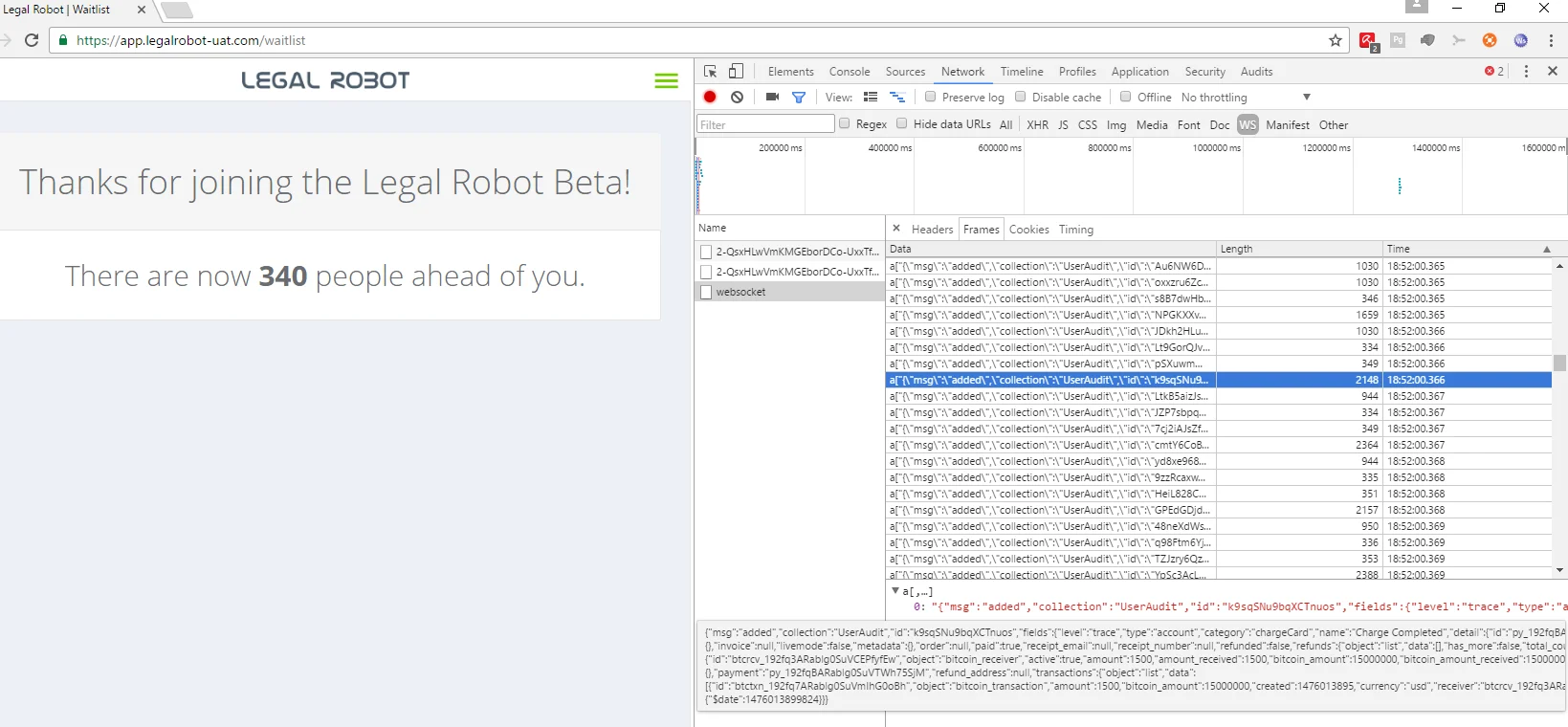
'Cross-Site WebSocket Hijacking' is possible, because the websocket connection is not secure (enough). The traffic from and to the websocket can be sniffed with Chrome (see attachment), and replayed elsewhere (cross-domain). Explanation: https://www.christian-schneider.net/CrossSiteWebSocketHijacking.html
Steps: After opening the homepage (https://app.legalrobot-uat.com) a websocket is created after a HTTP request like: https://app.legalrobot-uat.com/sockjs/689/k287_2tz/websocket, with a HTTP101 (switching protocols) response, resulting in a connection wss://app.legalrobot-uat.com/sockjs/689/k287_2tz/websocket.
This (upgrade) request can be called from an external origin.
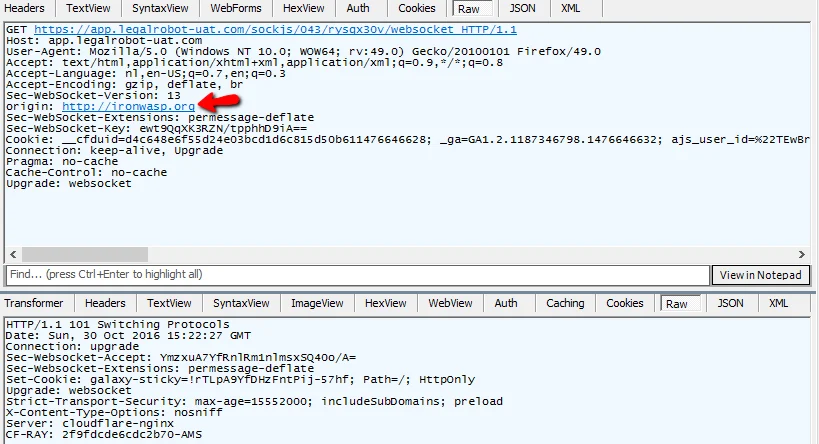
After knowing the websocket URL, messages (captured in chrome) can be successfully sent.
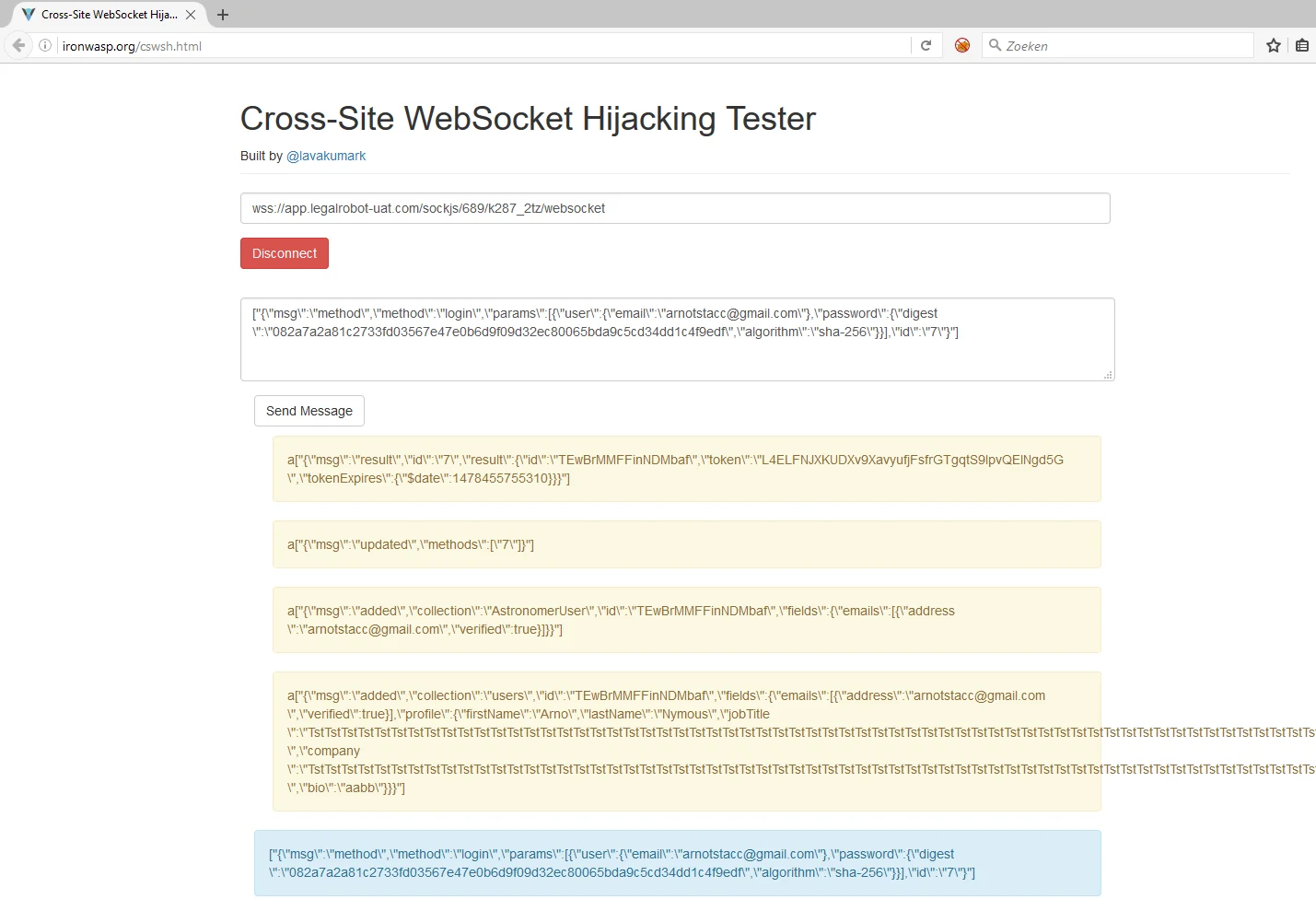
For example: Open a session: ["{"msg":"connect","version":"1","support":["1","pre2","pre1"]}"] Ping: ["{"msg":"ping"}"] Login: ["{"msg":"method","method":"login","params":[{"user":{"email":"[email protected]"},"password":{"digest":"082a7a2a81c2733fd03567e47e0b6d9f09d32ec80065bda9c5cd34dd1c4f9edf","algorithm":"sha-256"}}],"id":"7"}"] It is also unnecessary, to include the password algorithm in the login message (which can be encrypted with: http://md5decrypt.net/en/Sha256/)
A successful test with above messages using: http://ironwasp.org/cswsh.html (an online test tool).
Suggestions to fix:
- Check the origin from the requester server-side and adjust the Origin header for the 'upgrade' request.
- Add additional 'CSRF tokens'.
- Encrypt messages, so they cannot be intercepted in Chrome
Additional references: https://www.notsosecure.com/how-cross-site-websocket-hijacking-could-lead-to-full-session-compromise/ https://www.owasp.org/index.php/Testing_WebSockets_(OTG-CLIENT-010) https://humblesoftwaredev.wordpress.com/2016/08/01/securing-websocket-sockjs-connection/
Attachments
Not written yet. The AI write-up for this report has not been written yet. The Original tab links to the source.
How it worked
Impact
An attacker could send messages to the WebSocket from an external origin, potentially performing actions such as login, but the report does not demonstrate full session compromise.
What the attacker needed
Attacker knows the WebSocket URL
The fix
The server should check the Origin header on WebSocket upgrade requests and add CSRF tokens.
How it was found
- Open the homepage and observe a WebSocket connection being created.
- Capture the WebSocket upgrade request and note the WebSocket URL.
- Send messages to the WebSocket from an external origin using a tool.
Explained by bugbounty.wiki with AI from the original and checked against quotes from it; it can still be wrong. Read the original before relying on a detail.
Not written yet. The AI write-up for this report has not been written yet. The Original tab links to the source.
A WebSocket is a two-way connection between a browser and a server. Normally, a website should only accept connections from its own pages. Here, the server accepted connections from any website, so a malicious site could talk to the WebSocket on behalf of a logged-in user.
What is CSRF?
Another site makes a signed-in user's browser perform an action they did not intend.